

Introduction
Choosing the right technology stack is one of the most important decisions for anyone planning a career in software development. With businesses investing heavily in web applications, the demand for skilled full stack developers continues to increase across startups, IT companies, and multinational organizations. Among the most popular choices are MERN Stack vs Java Full Stack , both of which offer excellent career opportunities and long-term growth. However, beginners often struggle to decide which technology is better for learning, job opportunities, salary, and future scope.
While both stacks enable developers to build complete web applications, they differ significantly in programming languages, frameworks, databases, and development approaches. Understanding these differences will help you choose the right learning path based on your interests and career goals. Learning full stack development allows developers to work on both frontend and backend technologies, making them versatile professionals capable of building complete software solutions from scratch.
What is MERN Stack?
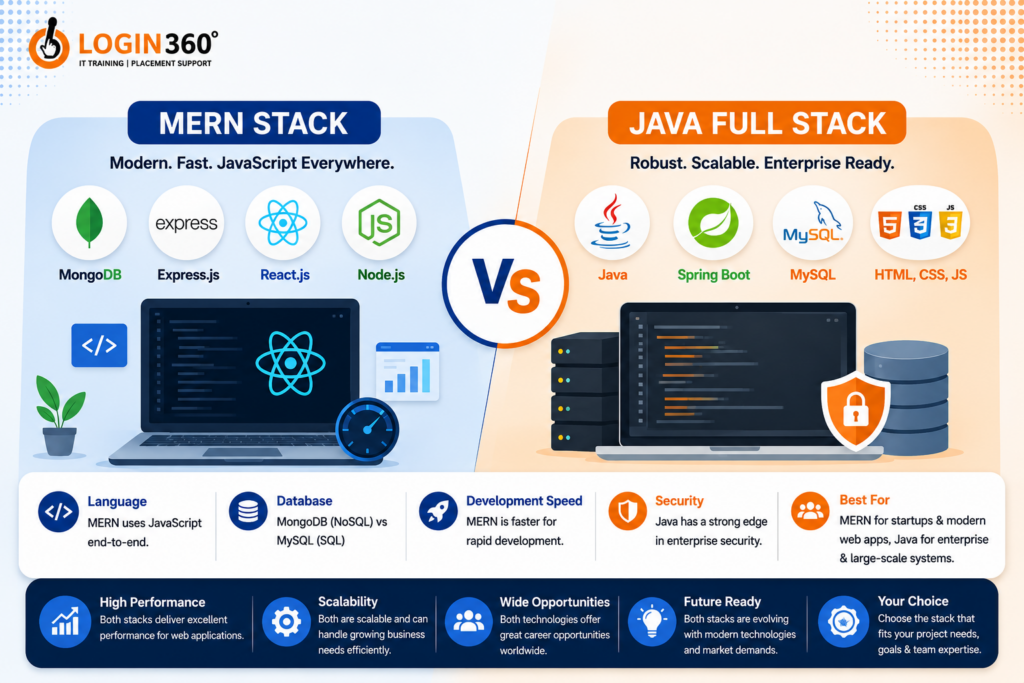
MERN Stack is a JavaScript-based technology stack that enables developers to build dynamic, responsive, and scalable web applications. The name MERN is derived from four technologies that work together to create complete web solutions. MongoDB is used for storing application data, Express.js handles backend development, React.js creates interactive user interfaces, and Node.js runs server-side applications. Since JavaScript is used throughout the entire development process, developers only need to master one programming language to build both frontend and backend components. This makes MERN Stack one of the most beginner-friendly technologies in web development. It is widely used by startups, software product companies, and SaaS businesses because it supports rapid development and faster deployment of modern applications.
What is Java Full Stack?
Java Full Stack refers to the combination of frontend technologies and Java-based backend development used to create enterprise-grade web applications. Developers typically use HTML, CSS, JavaScript, React, or Angular for the frontend, while Java and Spring Boot manage server-side functionality. Relational databases such as MySQL and PostgreSQL are commonly used to store structured application data. Java has been a trusted programming language for decades because of its reliability, security, and scalability. Organizations that develop business-critical applications continue to rely on Java Full Stack because it delivers stable performance even under heavy workloads. Many banking institutions, healthcare companies, insurance providers, and government organizations depend on Java-based applications to support their daily operations.
Core Technologies Used in MERN Stack
- MongoDB: A NoSQL database that stores data in a flexible, document-based format.
- Express.js: A backend framework that simplifies server-side development and API creation.
- React.js: A frontend library used to build fast, interactive, and reusable user interfaces.
- Node.js: A JavaScript runtime that enables scalable and high-performance backend development.
- JavaScript: A single programming language used for both frontend and backend development, making the development process easier.
- REST APIs: Used to enable smooth communication between the frontend, backend, and database.
Core Technologies Used in Java Full Stack
REST APIs: Used to connect the frontend, backend, and database while ensuring efficient data communication.
Java: The primary backend programming language known for security, stability, and performance.
Spring Boot: A powerful framework for building secure, scalable, and enterprise-grade web applications.
HTML, CSS, and JavaScript: Core frontend technologies used to create responsive web pages.
React or Angular: Modern frontend frameworks used for developing dynamic user interfaces.
MySQL or PostgreSQL: Relational databases used for structured, reliable, and secure data management.
MERN Stack vs Java Full Stack: Key Differences
MERN Stack and Java Full Stack differ in programming language, database, development speed, and enterprise capabilities. MERN Stack uses JavaScript and MongoDB, making it ideal for fast, modern web application development. Java Full Stack uses Java with relational databases such as MySQL or PostgreSQL, making it suitable for secure, large-scale enterprise applications. While MERN offers faster development and flexibility, Java Full Stack provides greater stability, scalability, and security for complex business solutions.
Learning Curve: Which Is Easier?
Many beginners choose their technology based on how quickly they can learn and start building projects. MERN Stack is widely considered easier to learn because JavaScript is used throughout the development process. Once developers understand JavaScript fundamentals, they can gradually learn React, Node.js, Express.js, and MongoDB without switching programming languages. This allows beginners to build practical applications within a relatively short period and gain confidence through hands-on experience.
Java Full Stack requires a deeper understanding of Java programming concepts, including object-oriented programming, inheritance, polymorphism, exception handling, multithreading, collections, and backend frameworks like Spring Boot. While the learning process is more challenging, it also develops strong programming fundamentals that benefit developers throughout their careers. Regardless of which technology you choose, mastering full stack development provides valuable experience in building complete applications, understanding databases, managing servers, and creating responsive user interfaces.
Performance and Scalability
MERN Stack
- MERN Stack delivers excellent performance for dynamic web applications that require fast user interactions and real-time data updates.
- Node.js efficiently handles multiple concurrent requests, making the stack highly scalable for applications with heavy user traffic.
- It is an ideal choice for developing chat applications, social media platforms, collaboration tools, and modern e-commerce websites.
- The use of JavaScript across the entire stack improves development speed and enhances overall application performance.
- MERN enables businesses to build flexible, scalable, and responsive applications that can easily grow with increasing user demands.
Java Full Stack
- Java Full Stack provides exceptional performance and scalability for large-scale enterprise applications with complex business requirements.
- Its advanced memory management and multithreading capabilities ensure efficient processing of high volumes of users and transactions.
- Java applications maintain high stability and reliability even under heavy workloads and continuous system operations.
- It is widely used for mission-critical applications such as banking systems, healthcare software, ERP solutions, and airline reservation platforms.
- Java Full Stack is the preferred choice for organizations that require secure, scalable, and high-performance enterprise-grade applications.
Career Opportunities in 2026
The demand for both MERN Stack and Java Full Stack developers continues to grow as companies accelerate their digital transformation initiatives. MERN Stack developers are commonly hired by startups, software product companies, SaaS businesses, digital agencies, and technology firms developing modern cloud-based applications. These organizations seek developers capable of building responsive, scalable, and user-friendly web applications using modern JavaScript technologies.
Java Full Stack developers remain highly valuable in enterprise organizations, multinational corporations, financial institutions, healthcare companies, insurance providers, and government agencies. Since many existing enterprise applications are built using Java, organizations continue to invest in skilled Java professionals for application development, modernization, and maintenance. Both career paths offer excellent growth opportunities, attractive salaries, and the chance to work on innovative software projects.
Salary Comparison Between MERN Stack and Java Full Stack
One of the most important factors for aspiring developers is salary potential. Fortunately, both MERN Stack and Java Full Stack offer competitive salaries because companies actively seek professionals who can build complete web applications. However, salary packages often depend on factors such as technical expertise, project experience, location, company size, and problem-solving skills.
Freshers with MERN Stack knowledge often find opportunities in startups, software product companies, and SaaS organizations where rapid development is a priority. These companies value developers who can work across both frontend and backend using JavaScript, making MERN developers an attractive hiring choice.
Java Full Stack developers are frequently recruited by multinational corporations, banking institutions, healthcare organizations, and IT service companies. Since Java powers many enterprise applications, experienced Java developers often receive attractive salary packages, especially when they possess expertise in Spring Boot, cloud technologies, and microservices. Regardless of the technology you choose, continuous learning and practical experience significantly influence your earning potential.
Advantages of MERN Stack
- Single Programming Language: MERN Stack uses JavaScript across the entire application, allowing developers to build both the frontend and backend without switching between multiple programming languages.
- Strong Community Support: The MERN ecosystem has a large developer community, providing access to thousands of open-source libraries, frameworks, tutorials, and regular updates.
- Faster Development: MERN Stack supports rapid application development, enabling startups and businesses to launch web applications within shorter project timelines.
- Flexible Database: MongoDB offers a flexible NoSQL database structure that efficiently manages dynamic and unstructured data while supporting easy scalability.
- Interactive User Interface: React helps developers create fast, responsive, and reusable user interface components that improve the overall user experience across web applications.
Advantages of Java Full Stack
Java Full Stack continues to dominate enterprise software development because of its stability, security, and scalability. Java applications are capable of handling complex business logic and large volumes of user requests while maintaining consistent performance. This makes Java an excellent choice for industries where reliability is critical.
Spring Boot simplifies backend development by providing powerful tools for creating secure APIs and enterprise applications. Java also benefits from decades of continuous improvement, making it one of the most mature programming ecosystems available today.
Another significant advantage is long-term career stability. Since countless enterprise systems continue to rely on Java, skilled Java Full Stack developers remain in high demand across various industries. The technology’s compatibility with cloud platforms, microservices architecture, and modern development practices ensures that Java continues to remain relevant in the evolving software industry.
Future Scope of MERN Stack and Java Full Stack
- MERN Stack will continue to grow in popularity among startups due to its flexibility and faster development cycle.
- The increasing adoption of React, Node.js, and cloud-native technologies will drive demand for MERN developers.
- Java Full Stack will remain a leading choice for enterprise applications requiring high security and scalability.
- Technologies like Spring Boot, microservices, cloud computing, and AI will further strengthen Java’s future.
- Both MERN Stack and Java Full Stack offer excellent career opportunities as businesses continue investing in digital transformation.
MERN Stack vs Java Full Stack: Which One Should You Choose?
Selecting the right technology depends entirely on your personal interests and professional aspirations. If you enjoy JavaScript, prefer working in startup environments, and want to build modern web applications quickly, MERN Stack offers an excellent learning path. It enables developers to create responsive, scalable applications while mastering a single programming language across the development process.
If your goal is to work on enterprise applications, banking software, healthcare systems, or other large-scale business platforms, Java Full Stack provides outstanding career opportunities. Developers interested in structured programming, secure application development, and long-term enterprise careers often find Java to be the better choice.
Learning full stack development is valuable regardless of the technology stack you choose. Strong programming fundamentals, practical project experience, and continuous skill development will have a greater impact on your career success than selecting one framework over another.
MERN Stack vs Java Full Stack Comparison Table
| Feature | MERN Stack | Java Full Stack |
|---|---|---|
| Programming Language | JavaScript | Java + JavaScript |
| Backend Framework | Node.js & Express.js | Spring Boot |
| Frontend Library | React.js | React.js or Angular |
| Database | MongoDB | MySQL / PostgreSQL |
| Learning Curve | Easier for Beginners | Moderate to Advanced |
| Development Speed | Faster | Moderate |
| Enterprise Usage | Medium | Very High |
| Startup Demand | Very High | Moderate |
| Security | Good | Excellent |
| Scalability | Excellent | Excellent |
| Best For | Modern Web Applications | Enterprise Applications |
Conclusion
Choosing between MERN Stack and Java Full Stack is not about finding a single winner but identifying the technology that best aligns with your career aspirations. MERN Stack provides a modern JavaScript ecosystem that supports rapid development, flexibility, and interactive web applications. Java Full Stack continues to lead enterprise software development with its exceptional security, stability, and scalability.
As businesses continue embracing digital transformation, the demand for skilled developers will remain strong across both technologies. Building expertise in full stack development through practical projects, industry-focused training, and continuous learning will significantly improve your career prospects. Whether you choose MERN Stack or Java Full Stack, developing real-world experience and staying updated with emerging technologies will help you become a successful software developer. If you’re looking to start your journey, enrolling in a professional Full Stack Development Course can provide the practical knowledge, mentorship, and placement support needed to launch a rewarding career in the IT industry.