

Table of Contents
Introduction
If you have been exploring software careers, you have probably heard the term “full stack developer” thrown around a lot. Among all the full stack paths, the Java Full Stack Framework holds a special place because it powers a huge chunk of enterprise software running banks, e-commerce platforms, insurance systems, and large-scale applications across the world. For a beginner, the idea of learning both frontend and backend together can feel overwhelming, but working with a Java Full Stack Framework actually follows a fairly structured path once you understand the pieces involved. This guide walks you through what this framework really means, the skills you need to build, the tools professionals use daily, and where this career path can take you. Whether you are a student deciding your specialization or someone switching careers into tech, this should give you a clear starting point.
What Is Java Full Stack Development?
Java full stack development simply means being able to work on both the client-facing part of an application (frontend) and the server-side logic (backend), with Java as the primary language powering the backend. A full stack developer does not just write code for one layer; they understand how a user’s click on a webpage travels through the browser, hits a server, talks to a database, and returns a response, all while ensuring the application is secure and performs well. In the Java ecosystem, this usually means combining HTML, CSS, and JavaScript-based frontend frameworks with Java backend frameworks like Spring Boot, along with a relational database such as MySQL or PostgreSQL. Companies prefer full stack developers because they reduce dependency on multiple specialists and can independently take a feature from design to deployment, which is exactly why this skill set is in such high demand right now.
Core Java Concepts You Need to Know
- Object-Oriented Programming (OOP): Concepts like classes, objects, inheritance, polymorphism, encapsulation, and abstraction form the foundation of how Java applications are structured. Almost every framework you touch later assumes you already understand these.
- Collections Framework: Lists, Sets, Maps, and their implementations like ArrayList, HashMap, and LinkedHashSet are used constantly for storing and manipulating data in memory. You will use these in nearly every project you build.
- Exception Handling: Real applications fail in unexpected ways, so knowing how to use try-catch blocks, custom exceptions, and finally blocks helps you write code that does not crash the entire application over a single error.
- Multithreading and Concurrency: As applications scale, handling multiple tasks at once becomes important. Understanding threads, the Executor framework, and basic concurrency concepts prepares you for real-world performance challenges.
- JDBC (Java Database Connectivity): This is how core Java communicates with databases before you move on to ORM tools like Hibernate. Learning JDBC first helps you understand what Hibernate is actually doing behind the scenes.
Frontend Technologies in Java Full Stack
The frontend is what users actually see and interact with, and even though Java handles the backend, the frontend of a Java full stack application usually leans on standard web technologies rather than Java itself. HTML and CSS form the structure and styling, while JavaScript adds interactivity. Beyond the basics, most Java full stack developers today learn a modern frontend framework such as React or Angular, since these make it easier to build dynamic, component-based interfaces that talk to backend APIs efficiently. React tends to be more popular among beginners because of its simpler learning curve and huge community support, while Angular is often preferred in larger enterprise teams because of its built-in structure and tooling. Regardless of which one you pick, the core idea stays the same: the frontend sends requests to your Java backend, receives data, usually in JSON format, and renders it for the user without needing a full page reload.
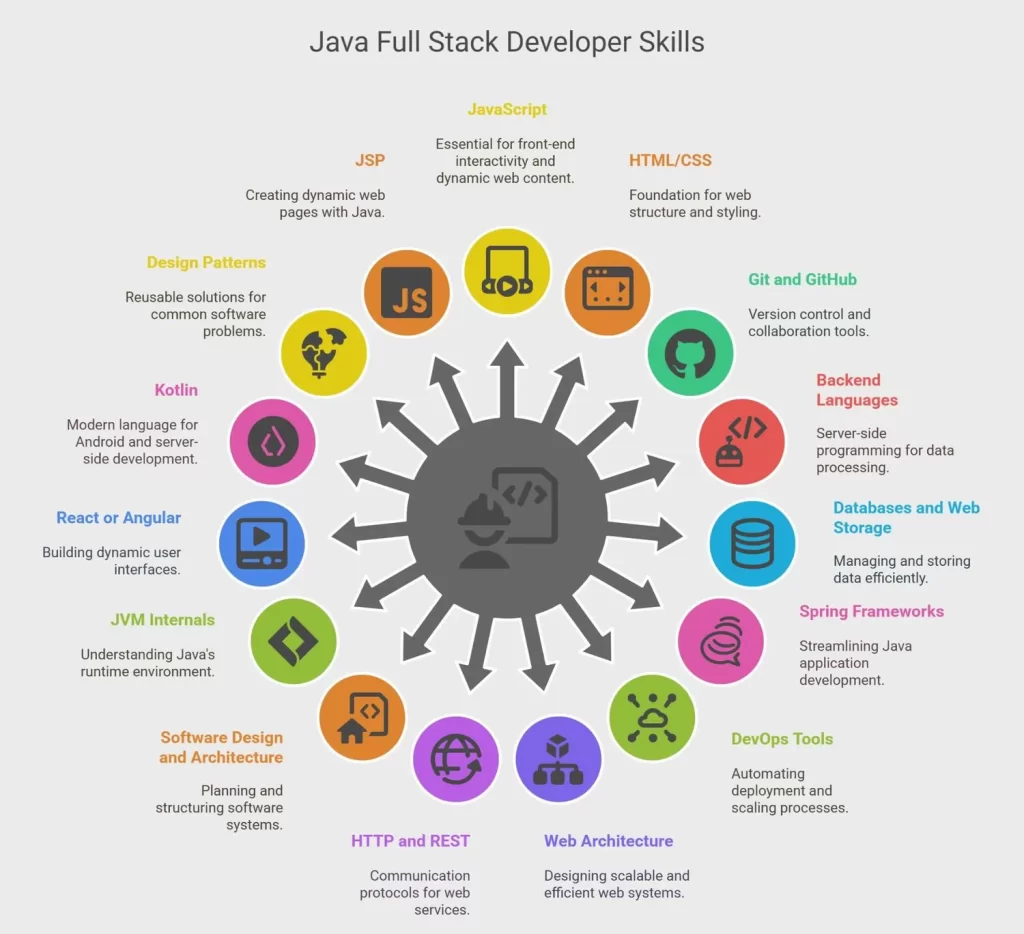
Backend Frameworks: Spring and Spring Boot
- Spring Framework: This is the foundational framework that handles dependency injection, meaning it manages how different parts of your application connect to each other without you writing repetitive setup code. It also simplifies things like transaction management and security configuration.
- Spring Boot: Built on top of Spring, this is what most beginners actually start with today because it removes a lot of the manual configuration Spring traditionally required. With Spring Boot, you can get a working backend server running in minutes using auto-configuration and embedded servers.
- Spring MVC: This handles the Model-View-Controller pattern, letting you organize your backend logic cleanly by separating how data is handled, how business logic runs, and how responses are structured.
- RESTful APIs: Almost every modern Java backend exposes REST APIs so the frontend can communicate with it. Learning how to design endpoints, handle HTTP methods like GET, POST, PUT, and DELETE, and return proper status codes is a core full stack skill.
- Spring Security: Once your application handles real users, you need authentication and authorization. Spring Security lets you manage login systems, role-based access, and token-based authentication like JWT.
Database Management with Java
No application is complete without a way to store and retrieve data reliably, and this is where database skills come in. Most Java full stack developers work with relational databases like MySQL or PostgreSQL, writing SQL queries to create, read, update, and delete records. Rather than writing raw SQL everywhere, Java developers typically use Hibernate, an Object-Relational Mapping (ORM) tool that lets you interact with the database using Java objects instead of writing SQL directly for every operation. Spring Data JPA builds on top of Hibernate and makes database operations even simpler by letting you define repository interfaces that handle common queries automatically. Understanding database design basics, such as normalization, primary and foreign keys, and indexing, will also help you build applications that stay fast and reliable even as data grows.
Essential Tools for Java Full Stack Developers
- IDEs like IntelliJ IDEA or Eclipse: These provide code completion, debugging support, and project management features that speed up development significantly compared to writing code in a plain text editor.
- Build Tools like Maven or Gradle: These manage your project dependencies and automate tasks like compiling code and packaging your application, saving you from manually downloading and configuring libraries.
- Git and GitHub: Version control is non-negotiable in any development team. Git lets you track changes to your code, while GitHub gives you a place to host repositories and collaborate with others.
- Postman: This tool lets you test your backend APIs independently of the frontend, which is extremely useful when you want to confirm your endpoints work correctly before connecting them to the user interface.
- Docker: As you grow more comfortable, learning basic Docker concepts helps you package your application along with its environment, making it easier to deploy consistently across different machines.
Building Your First Full Stack Project
Once you have covered the basics, the fastest way to actually learn is by building something small end to end rather than jumping between tutorials. A good starter project is a simple task management or student record system, where users can add, view, update, and delete entries. On the backend, you would set up a Spring Boot application with REST endpoints connected to a MySQL database through Spring Data JPA. On the frontend, a basic React application would call these endpoints to display data in a list, along with forms to add or edit records. This kind of project forces you to deal with real challenges like handling errors from the API, managing state on the frontend, and structuring your backend code properly, which is far more valuable than passively watching videos. Once this basic version works, you can gradually add features like user login, search functionality, or pagination to make it closer to a real-world application.
Career Opportunities for Java Full Stack Developers
- Job Roles: Common titles include Java Full Stack Developer, Backend Developer with full stack exposure, and Software Engineer, with responsibilities ranging from API development to frontend integration.
- Industries Hiring: Banking, e-commerce, healthcare IT, and enterprise software companies rely heavily on Java, making these sectors consistent sources of job openings.
- Salary Expectations: Entry-level Java full stack roles in India typically start in a reasonable range and grow significantly with two to three years of hands-on project experience, especially if you can demonstrate real deployed applications.
- Freelance and Remote Work: Since Java full stack skills are versatile, many developers also take up freelance projects or remote roles for international clients once they have a solid portfolio.
- Growth Path: With experience, Java full stack developers often move into roles like Senior Developer, Technical Lead, or Solutions Architect, since the combination of frontend and backend knowledge gives a broader understanding of how systems are built.
Version Control Workflow in Team Projects
Once you start working on real projects, especially in a team, Git becomes more than just a tool for saving code; it becomes the backbone of how everyone collaborates without stepping on each other’s work. Instead of everyone editing the same files directly, teams work on separate branches, usually one for each feature or bug fix, and merge them back into the main branch once the work is reviewed. A typical workflow involves creating a feature branch, committing changes with clear messages, pushing it to GitHub, and opening a pull request so a teammate or senior developer can review the code before it gets merged. Merge conflicts happen often when two people edit the same lines of code, and learning to read and resolve these calmly, rather than panicking, is a skill that comes only with practice. For a beginner, getting comfortable with basic Git commands and the pull request process early will make your transition into an actual development team much smoother.
Testing in Java Full Stack
- Unit Testing with JUnit: On the backend, JUnit is the standard framework for testing individual methods and classes in isolation, helping you catch bugs before they reach the rest of the application.
- Mockito for Mocking Dependencies: Since backend code often depends on databases or external services, Mockito lets you simulate those dependencies during tests so you can test your logic without needing a real database connection every time.
- Frontend Testing with Jest: If you are using React, Jest is commonly used to test components and functions, making sure your UI behaves correctly as you keep adding features.
- React Testing Library: This works alongside Jest and focuses on testing components the way a user would actually interact with them, rather than testing internal implementation details.
- Integration Testing: Beyond individual pieces, integration tests check whether your backend, database, and API layer work correctly together, which catches issues unit tests alone might miss.
Deployment Basics
Building an application is only half the job; getting it in front of real users means learning the basics of deployment. For a Spring Boot backend, this usually involves packaging your application into a JAR file and deploying it to a cloud platform such as AWS, Render, or Railway, where it can run continuously and handle real traffic. The React frontend is typically built into static files and hosted separately, often through services like Netlify or Vercel, or served alongside the backend depending on how the project is structured. Environment variables become important at this stage too, since things like database credentials and API keys should never be hardcoded directly into your code. Many teams also set up basic CI/CD pipelines using tools like GitHub Actions, so that whenever code is pushed, it gets automatically tested and deployed without someone manually repeating the same steps every time. As a beginner, even deploying one small project end to end will teach you far more about real-world development than any amount of local testing.
Microservices vs Monolith
- Monolithic Architecture: This is where the entire application, frontend logic, backend logic, and database interactions, runs as a single unified codebase and deployment unit. It is simpler to build and is usually where most beginner projects and smaller companies start.
- Microservices Architecture: Here, the application is broken into smaller, independent services, each responsible for a specific business function, such as a separate service for user authentication, another for payments, and another for orders. These services communicate with each other over the network, often through REST APIs or messaging queues.
- Why Companies Choose Microservices: Larger organizations prefer this approach because different teams can work on different services independently, and services can be scaled individually based on demand, rather than scaling the entire application at once.
- Trade-offs to Understand: Microservices bring added complexity around communication between services, data consistency, and deployment, so they are not always the right choice for smaller applications or early-stage projects.
- What This Means for Beginners: You do not need to build microservices from day one, but understanding the concept and how Spring Boot supports it through tools like Spring Cloud will help you speak confidently about it in interviews.
Common Beginner Mistakes
Looking at how most beginners struggle early on, a few patterns show up again and again, and knowing them in advance can save you a lot of frustration. A common one is skipping proper exception handling entirely, which means the application crashes with a confusing error the moment something unexpected happens, instead of failing gracefully with a clear message. Another frequent mistake is hardcoding sensitive information like database passwords or API keys directly into the code, which becomes a serious security risk the moment that code is pushed to a public repository. Many beginners also skip input validation on their API endpoints, assuming the frontend will always send correct data, which breaks the moment someone tests the API directly through a tool like Postman. On the frontend side, a common issue is not handling loading and error states properly, so the interface either shows nothing or breaks silently when an API call fails. Recognizing these patterns early and building the habit of handling errors, securing credentials, and validating input from the start will set your code apart from typical beginner projects.
Conclusion
Learning Java full stack development is less about memorizing every framework at once and more about building a strong foundation and layering skills on top of it gradually. Start with core Java, move into Spring Boot for the backend, pick up a frontend framework like React, and get comfortable with a database like MySQL alongside Hibernate. Once you have the basics in place, building small real projects will teach you far more than any single course ever could, since it forces you to connect all these pieces together practically. The demand for skilled Java full stack developers is not slowing down anytime soon, so the effort you put in now toward mastering these fundamentals will keep paying off well into your career.


[…] a personal portfolio website is one of the best beginner-friendly full-stack Python project ideas. Although this project seems simple, it covers many essential web development concepts that every […]
[…] and scalability. Organizations that develop business-critical applications continue to rely on Java Full Stack because it delivers stable performance even under heavy workloads. Many banking institutions, […]