

MERN Stack Development is a popular choice for anyone looking to build a career in modern web development. MERN stands for MongoDB, Express.js, React, and Node.js, four technologies that work together to build complete web applications.
One major advantage of MERN is that it uses JavaScript across both frontend and backend development. This makes it easier for developers to learn, build projects, and grow into full-stack roles.
In this guide, we’ll look at the skills you need, the learning roadmap, career opportunities, and how you can start your journey as a MERN Stack Developer.
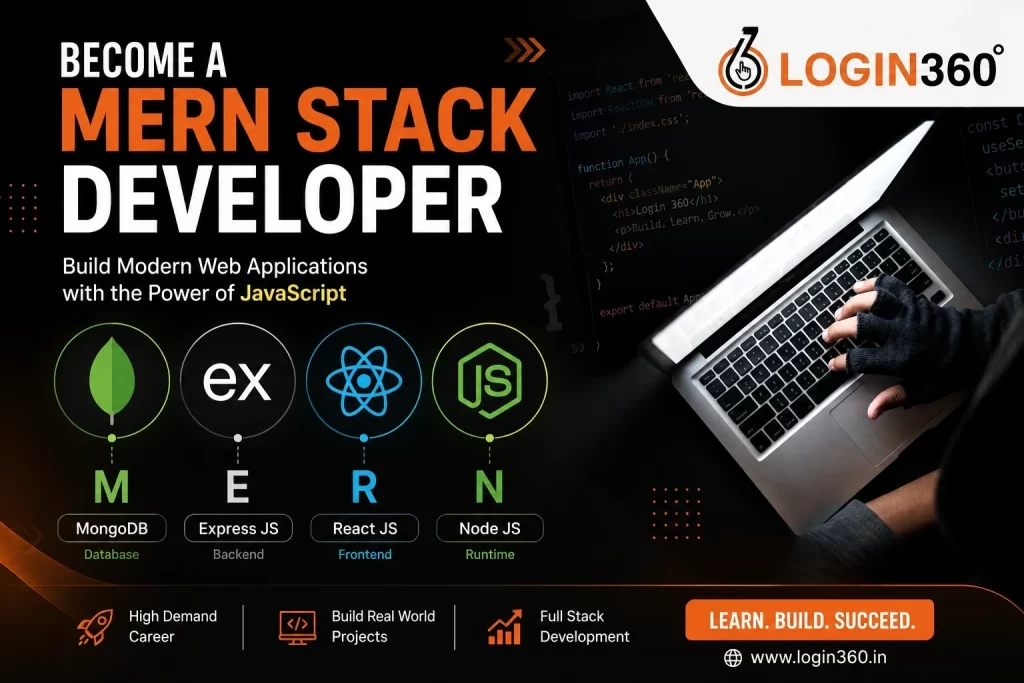
What Is a MERN Stack Developer?
A MERN Stack Developer works with four main technologies:
- MongoDB – Database
- Express.js – Backend framework
- React.js – Frontend library
- Node.js – JavaScript runtime
Together, these technologies can be used to create complete web applications.
For example, think about an e-commerce website. React can handle the product pages, shopping cart, and checkout interface. Node.js and Express.js can manage the backend requests, while MongoDB stores information about users, products, and orders.
A MERN developer can work on different parts of an application instead of focusing on only the frontend or backend.
Understanding the MERN Stack
MongoDB
MongoDB is a NoSQL database used to store application data. Instead of traditional rows and tables, it stores information in documents and collections.
MERN developers should understand:
- Databases and collections
- Documents and fields
- CRUD operations
- Queries
- Indexing
- Data relationships
- Database design
For example, a learning platform could use MongoDB to store student accounts, courses, lessons, assignments, and learning progress.
Express.js
Express.js is a backend framework for Node.js. It makes it easier to create servers, APIs, routes, and backend services.
Developers commonly use Express for handling requests, processing application logic, connecting databases, and returning responses.
Important concepts include:
- Routing
- Middleware
- Requests and responses
- REST APIs
- Error handling
- Authentication
React.js
React is used to build the frontend of web applications. It allows developers to create reusable components and interactive user interfaces.
For example, a website can have separate React components for a navigation bar, product card, login form, shopping cart, and footer.
Important React topics include:
- Components
- JSX
- Props
- State
- Hooks
- Forms
- Events
- Routing
- API integration
Node.js
Node.js allows JavaScript to run outside the browser. This makes it possible to use JavaScript for backend development.
Node.js can be used to create servers, APIs, backend services, and real-time applications.
Developers should learn concepts such as:
- npm
- Modules
- Promises
- Async/await
- Asynchronous programming
- HTTP
- Environment variables
- Server development
Why Learn MERN Stack Development?
There are several reasons why MERN is a popular choice for web development.
JavaScript Across the Stack
One of the biggest advantages is that JavaScript can be used for both frontend and backend development. You don’t have to switch between completely different programming languages when moving between the client and server.
Large Developer Community
JavaScript has a large developer community and a huge ecosystem of libraries, frameworks, tools, and learning resources. If you get stuck while working on a project, you can usually find documentation or community discussions that can help.
Build Different Types of Applications
MERN can be used to build many different applications, including:
- E-commerce websites
- Job portals
- Social media platforms
- Learning platforms
- Booking applications
- Business dashboards
- SaaS products
- Inventory systems
Good Foundation for Full-Stack Development
MERN gives beginners a practical path from frontend development to backend development and databases. You can learn each technology step by step and eventually connect everything into one complete application.
Skills Required to Become a MERN Stack Developer
Learning the MERN technologies is important, but you also need some supporting skills.
HTML and CSS
Before starting React, make sure you understand HTML and CSS.
You should be comfortable with:
- HTML structure
- Forms
- Semantic HTML
- Flexbox
- CSS Grid
- Responsive design
- Media queries
- Basic animations and styling
These skills help you create clean and responsive interfaces.
JavaScript
JavaScript is the foundation of MERN development. Don’t rush through it just because you want to start React quickly.
Important topics include:
- Variables
- Data types
- Functions
- Arrays
- Objects
- Loops
- Conditions
- DOM
- ES6 features
- Promises
- Async/await
- Modules
- Error handling
A strong JavaScript foundation will make learning React and Node.js much easier.
Git and GitHub
Git is used to track changes in your code and is an important part of modern software development.
You should understand repositories, commits, branches, merging, pushing, pulling, and pull requests.
GitHub is also useful for building a portfolio and showing potential employers what you can build.
REST APIs
Frontend and backend applications need to communicate with each other. APIs make this communication possible.
You should understand common HTTP methods:
- GET – Retrieve data
- POST – Create data
- PUT/PATCH – Update data
- DELETE – Remove data
API knowledge is essential for full-stack development.
Authentication and Security
Most real-world applications need user accounts. Developers should understand basic authentication concepts such as registration, login, password hashing, authorization, protected routes, JWT, sessions, and user roles.
Security should be considered throughout the development process.
MERN Stack Developer Roadmap
If you’re starting from zero, don’t try to learn everything at once. Follow a simple roadmap.
Step 1: Learn HTML and CSS
Start with the basics of web design and build small projects such as:
- Portfolio website
- Business landing page
- Login page
- Product page
- Responsive website
Step 2: Learn JavaScript
Once you are comfortable with HTML and CSS, focus on JavaScript.
Build simple projects like:
- Calculator
- To-do list
- Quiz application
- Weather application
- Expense tracker
Building projects will help you understand concepts much better than watching tutorials alone.
Step 3: Learn React
After building a good JavaScript foundation, move to React.
Start with components and JSX, then learn props, state, hooks, forms, routing, and API integration.
Try to build small applications while learning each concept.
Step 4: Learn Node.js and Express
Now move into backend development.
Learn how servers work and understand routes, APIs, middleware, requests, responses, and error handling.
Step 5: Learn MongoDB
Learn how to create databases and collections, perform CRUD operations, write queries, and connect MongoDB with your backend application.
Step 5: Learn MongoDB
Learn how to create databases and collections, perform CRUD operations, write queries, and connect MongoDB with your backend application.
Step 6: Build Full-Stack Projects
This is where everything comes together:
React → Node.js/Express → MongoDB
Try building real-world projects such as:
- E-commerce website
- Job portal
- Student management system
- Food ordering application
- Inventory management system
- Appointment booking application
Don’t just copy projects from tutorials. After following a tutorial, try rebuilding the project yourself and add your own features.
Step 7: Learn Deployment
A project becomes more valuable when people can actually use it.
Learn the basics of deployment, environment variables, database hosting, production builds, domains, and cloud platforms.
Having live projects in your portfolio can make a strong impression during job applications.
MERN Stack Developer Career Opportunities
MERN skills can open the door to several career paths.
Frontend Developer
Frontend developers focus on the user interface and browser-side functionality. React is an important skill for this role.
Backend Developer
Backend developers work with servers, APIs, databases, authentication, and application logic. Node.js and Express provide a strong foundation for this path.
Full-Stack Developer
Full-stack developers work across both frontend and backend development. MERN is a popular combination for people interested in this career.
Software Developer
With experience, you can move into broader software development roles by learning areas such as testing, system design, cloud technologies, and software architecture.
Freelance Developer
MERN developers can also work as freelancers. Businesses often need websites, dashboards, e-commerce platforms, booking systems, and custom web applications.
A strong portfolio can help you demonstrate your skills to potential clients.
MERN Stack Developer Salary
Salary depends on factors such as experience, location, company, technical skills, and job role.
Entry-level developers generally start with lower salaries, while developers with strong experience and problem-solving skills can earn considerably more.
Instead of focusing only on salary, beginners should focus on developing skills that create long-term career opportunities.
A developer who can build complete applications, work with APIs and databases, solve problems, use Git, and deploy projects will generally have more opportunities than someone who only knows the basics.
How Long Does It Take to Learn MERN?
There is no fixed timeline for learning MERN. Everyone learns at a different speed.
A beginner could follow a roadmap like:
Months 1–2: HTML, CSS, and JavaScript
Months 3–4: Advanced JavaScript and React
Months 5–6: Node.js, Express.js, and MongoDB
Months 7–8: Full-stack projects, authentication, APIs, Git, and deployment
This is only a general guide. Some people may progress faster, while others may need more time.
The important thing is not how quickly you finish. What matters is whether you can understand concepts and build applications independently.
Common Mistakes Beginners Make
Trying to Learn Everything
There are thousands of technologies in the development world. You don’t need to learn all of them.
Focus on the core technologies first and build a strong foundation.
Watching Too Many Tutorials
Tutorials are useful, but watching them without building anything yourself can slow your progress.
After learning a concept, close the tutorial and try to build something using what you learned.
Ignoring JavaScript
Starting React without understanding JavaScript can make development confusing.
Spend enough time learning JavaScript before moving too deeply into React.
Building Only Basic Projects
Simple projects are useful when you’re starting, but your portfolio should eventually include projects with real features such as authentication, APIs, databases, search, filtering, and deployment.
Not Using GitHub
Start using Git and GitHub early. Upload your projects and gradually build a portfolio that demonstrates your skills and progress.
What Should You Learn After MERN?
Once you are comfortable with MERN, you can expand your skills based on your career goals.
Some useful areas include:
- TypeScript
- Testing
- Cloud computing
- DevOps
- CI/CD
- System design
- Cybersecurity
- Performance optimization
- Advanced databases
- AI-assisted development
You don’t need to learn everything immediately. First become comfortable with MERN, then choose technologies that support your career direction.
The Future of MERN Stack Development
Web development is constantly changing. New frameworks, cloud platforms, AI tools, and development technologies continue to appear.
However, strong fundamentals remain valuable.
Understanding programming, databases, APIs, security, software architecture, and problem-solving will help you adapt to new technologies.
MERN can provide a strong starting point, but developers should continue learning throughout their careers.
The goal isn’t to know every new tool. The goal is to understand problems and know how to build practical solutions.
Is MERN Still Worth Learning?
If you’re interested in JavaScript-based web development, MERN can still be a useful technology stack to learn.
It provides a practical path from frontend development to backend development and database integration.
However, learning MERN alone doesn’t guarantee a job.
Companies look for developers who can understand requirements, solve problems, write maintainable code, work with teams, and build useful applications.
That’s why practical experience matters.
Build projects. Make mistakes. Debug your code. Improve your applications. Deploy them. Learn from other developers and keep practicing.
Every project gives you another opportunity to become better.
Conclusion
Becoming a MERN Stack Developer takes time, practice, and consistency. You don’t need to learn everything in one day.
Start with HTML and CSS, build a strong foundation in JavaScript, learn React for frontend development, move into Node.js and Express for backend development, and then learn MongoDB.
Once you understand the basics, focus on building real-world projects.
Don’t measure your progress only by the number of courses or certificates you complete. Ask yourself what you can actually build without following a tutorial.
Your first application may not have perfect code. Your first API may have errors, and your first deployment may fail. That’s completely normal. Every problem you solve helps you improve.
With consistent learning, practical experience, strong fundamentals, and a willingness to keep improving, you can build a solid foundation for a career in web development.
MERN is not just four technologies to memorize. It is a starting point for understanding how modern web applications are designed, developed, connected, and delivered.
Visit Our Website
Ready to start your MERN Stack development journey?
Visit Login 360 to explore our courses, training programs, and career-focused learning opportunities.
👉 Visit our website today and take the next step toward your technology career.
Learn. Build. Practice. Grow.
However, strong fundamentals remain valuable.
Understanding programming, databases, APIs, security, software architecture, and problem-solving will help you adapt to new technologies.
MERN can provide a strong starting point, but developers should continue learning throughout their careers.
The goal isn’t to know every new tool. The goal is to understand problems and know how to build practical solutions.
However, learning MERN alone doesn’t guarantee a job.
Companies look for developers who can understand requirements, solve problems, write maintainable code, work with teams, and build useful applications.
