
Table of Contents
Introduction
Data science is no longer something used only by large technology companies. It shows up when your bank blocks a suspicious payment, when Netflix recommends a series, when a delivery app estimates your arrival time, or when an online store suggests products you may want.
At its simplest, data science combines programming, statistics, machine learning, and business knowledge to turn raw data into decisions. Companies collect information from apps, websites, machines, transactions, sensors, and customer interactions. The real value comes from finding useful patterns in that data.
Quick Takeaways
- Data science helps businesses predict what may happen next
- It reduces guesswork in marketing, finance, healthcare, and operations
- Machine learning can identify patterns that are difficult to spot manually
- Personalised recommendations are one of the most familiar uses of data science
- Python, SQL, statistics, and machine learning are core skills for data science careers
Here are the top 10 applications of data science and the practical impact they have across industries.
1. Healthcare and Medical Research
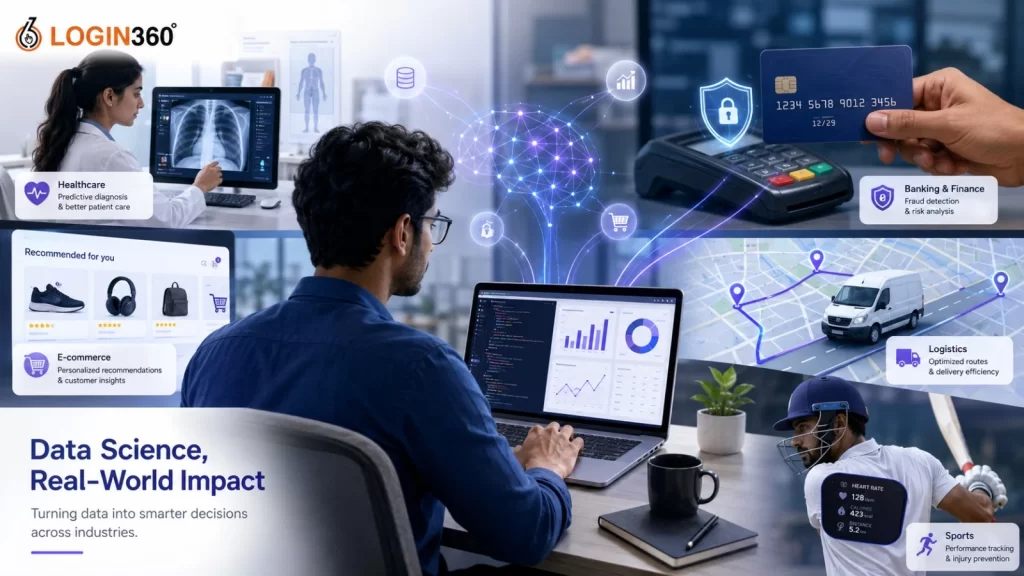
Data science helps hospitals predict disease risks, study medical images, and make treatment decisions based on a patient’s specific history. It gives doctors faster access to patterns hidden in reports, scans, laboratory results, and health records.
Machine learning models can analyse X-rays, MRI scans, retinal images, and other medical data to flag issues that may need closer review. DeepMind’s work with Moorfields Eye Hospital is a known example, where an AI system was trained to identify signs of eye disease from retinal scans.
Healthcare teams also use data science for:
- Disease-risk prediction
- Personalised treatment support
- Drug discovery and clinical research
- Hospital bed and staff planning
- Remote patient monitoring through wearable devices
The goal is not to replace doctors. It is to help them make earlier and better-informed decisions.
2. Finance and Banking
Banks use data science to detect fraud, assess credit risk, predict customer behaviour, and improve online banking security. Every payment, transfer, withdrawal, and login produces data that can reveal suspicious activity.
For example, a fraud detection system may check whether a card transaction matches a customer’s usual behaviour. It can compare the purchase amount, location, time, device, merchant type, and recent transaction history. If something looks unusual, the payment may be blocked or verified.
Credit scoring also depends heavily on data analysis. Lenders use income, repayment history, existing debt, and other financial patterns to estimate whether a borrower is likely to repay a loan.
3. E-commerce and Retail
E-commerce businesses use data science to recommend products, forecast demand, and understand what customers are likely to buy. Every product search, page visit, cart addition, review, and purchase gives retailers information about customer behaviour.
Amazon made product recommendations a normal part of online shopping. If you buy a laptop, you may see suggestions for a mouse, backpack, keyboard, or warranty. These recommendations are based on buying patterns from similar customers and products frequently purchased together.
Retailers also use data science to answer practical questions:
- Which products may sell more next month?
- How much stock should be ordered?
- Which items may run out soon?
- Which products are moving too slowly?
- When should a discount be introduced?
This helps businesses avoid stock shortages, reduce excess inventory, and improve the customer experience.
4. Marketing and Advertising
Data science helps marketers understand audiences, improve targeting, and spend advertising budgets more carefully. Instead of showing the same campaign to everyone, brands can focus on users who are more likely to click, enquire, subscribe, or purchase.
Google Ads and Meta Ads use predictive systems to estimate which users are most likely to take action after seeing an advertisement. These platforms consider details such as search intent, location, browsing activity, device, previous engagement, and conversion data.
For digital marketing teams, data science supports:
- Audience segmentation
- Lead scoring
- Customer churn prediction
- Email personalisation
- Remarketing campaigns
- Budget allocation across ad campaigns
A business does not need more traffic if that traffic never converts. Data-driven marketing helps focus on the people who are most likely to become customers.
5. Transportation and Logistics
Data science helps transportation companies plan faster routes, estimate delivery times, reduce fuel use, and manage vehicle fleets. Logistics businesses use GPS data, traffic information, weather reports, delivery schedules, and vehicle data to make daily decisions.
Ride-hailing and food-delivery apps use these systems to assign drivers, estimate wait times, and respond when demand suddenly rises in one area. Customers see the result as a delivery-time estimate. Behind the scenes, there is a lot of data involved.
UPS developed its ORION route-optimisation system to reduce unnecessary miles across its delivery network. Small route improvements can create major savings when repeated across thousands of deliveries.
6. Manufacturing and Predictive Maintenance
Manufacturers use data science to predict equipment failure before it interrupts production. This process is called predictive maintenance, and it helps factories avoid costly breakdowns.
Sensors fitted to machinery can measure vibration, temperature, pressure, energy use, and operating speed. If the data changes in an unusual way, the system can alert maintenance teams before the machine fails completely.
Data science is also useful for quality control. Camera systems and machine learning models can flag damaged or defective products during production. That means fewer faulty items reach customers.
| Application | Common technique | Main benefit |
| Equipment monitoring | Sensor analytics | Less downtime |
| Quality control | Computer vision | Fewer defects |
| Production planning | Forecasting | Better output planning |
| Energy analysis | Data modelling | Lower operating costs |
7. Entertainment and Media
Streaming platforms use data science to recommend movies, shows, music, podcasts, and videos based on what users enjoy. Netflix and Spotify are familiar examples of companies that use recommendation systems to keep content relevant.
These platforms can study what people watch, replay, pause, skip, save, or stop halfway through. The information helps them suggest content that matches a user’s likely interests.
Media companies also use audience data to understand whether people are enjoying a show or campaign while it is still active. They do not have to wait until the end to see what is working.
8. Cybersecurity
Data science helps cybersecurity teams identify suspicious behaviour before it becomes a serious security incident. Older security systems mainly looked for known threats. Data-driven systems can also spot unusual patterns that may point to a new type of attack.
For instance, a system may flag an employee account that logs in from an unfamiliar country, accesses sensitive files at an unusual time, or downloads a large amount of data unexpectedly.
Cybersecurity teams use data science for:
- Unusual login detection
- Network-traffic analysis
- Phishing and malware detection
- Account takeover prevention
- Security-alert prioritisation
Tools such as Microsoft Defender apply behavioural analysis to help organisations find possible threats faster. The NIST Artificial Intelligence Resource Center also provides guidance on trustworthy and responsible AI use.
9. Education and Online Learning
Data science helps schools and online learning platforms understand how students learn, where they struggle, and when they may need support. This is especially useful in online courses, where teachers cannot always see a student’s progress directly.
Platforms can track lesson completion, quiz scores, time spent on a topic, and repeated mistakes. Based on that information, they may recommend revision material, practice exercises, or the next suitable lesson.
Instead of finding out that a student is struggling only at the final exam, educators can act earlier. That can make a real difference.
10. Sports and Fitness
Sports teams use data science to analyse player performance, reduce injury risk, plan tactics, and recruit players. The data may come from match footage, fitness tests, GPS trackers, wearable devices, and past performance statistics.
The Moneyball approach in baseball showed how teams could find undervalued players through statistical analysis rather than relying only on traditional scouting. Today, IPL teams and other professional sports organisations use similar methods for player selection, match-ups, bowling plans, and field placements.
Data does not replace a coach’s experience. It gives that experience more evidence to work with.
Frequently Asked Questions

What are the top applications of data science?
Data science is used to identify useful patterns in large datasets and turn those patterns into decisions. It can predict fraud, customer churn, product demand, disease risk, machine failures, and many other outcomes.
Is data science useful for digital marketing?
Yes. Data science supports audience segmentation, ad targeting, lead scoring, customer retention, and campaign optimisation. It helps marketers spend more of their budget on people who are likely to respond.
What skills are needed for data science?
The main skills include Python or R, SQL, statistics, data visualisation, and machine learning. You also need to explain your findings clearly because businesses need useful answers, not just charts or code.
Can beginners learn data science?
Yes. Beginners can start with Python, Excel, SQL, and basic statistics before moving into machine learning. Working with small real-world datasets is one of the best ways to learn.
Learn Data Science in Kochi
Knowing the applications of data science is useful, but hands-on practice is what builds job-ready skill. You need to work with real datasets, write Python code, query databases with SQL, create reports, and solve practical problems.
Students in Kochi who want structured training can explore industry-oriented programs from LOGIN360. Look for a course that includes projects, portfolio work, and practical exposure to the tools employers expect.
Final Thoughts
Data science now affects decisions in hospitals, banks, online stores, factories, classrooms, and sports teams. It helps organisations predict what may happen next and act before a problem becomes larger.
For anyone in Kochi planning a career in data science, the best starting point is learning the basics, practising with real projects, and building proof of your skills.