

Introduction:
With the advancement of Artificial Intelligence (AI) technology, our world is evolving quickly. Data is becoming one of the most valuable assets for businesses. Through websites, apps, online shopping, customer interactions, financial services and social media, companies are generating huge volumes of data every single day. However, it is important to make sense of this data. Data Science and Artificial Intelligence can play a vital role here Data Science is a field that uses statistics, math, coding and analytical skills to make sense of data. Data Scientists will use various methods to make sense of trends and understand customer behaviors .Artificial Intelligence focuses on making computer systems that can carry out tasks that would usually require some human intelligence. This includes learning from information, recognizing patterns, understanding text and making predictions. Data Science and AI work well together. Data Science course in chennai provides the information you need to understand your problem, while AI can help make the analysis quicker.For example, an online shopping company can look into a customers purchase history to understand their purchasing habits. They can then use AI and machine learning to provide recommendations for products they may be interested in.Hospitals can use data analysis to look into medical records to discover patterns which can help healthcare professionals understand any risk factors patients may have.
Why is Data Science with AI important?
Businesses rely on having accurate information to make themselves stand out. Without using data to make decisions, you may miss out on opportunities and incur extra costs. Data Science can help an organization understand what is going on while AI can help spot patterns.
Some key benefits of Data Science with AI include:
- Better business decisions
Businesses can look into sales data, customer feedback, market trends and financial information to help make important decisions. This will help managers understand how the business is performing and what areas need improving. - Quick data analysis
Often organisations will have large volumes of data to analyse. Using AI can help speed up the process. Professionals can save time analysing the data by using AI tools to help find patterns and summarise the results. - Better customer experience
Many companies use AI recommendation tools to help recommend products, services, videos or content based on what the customer likes. - Predict future trends
Using machine learning models, you can train them off historical data to predict future outcomes. Businesses may use this to predict demand, stock levels, identify any risks and improve resource management. - Automate repetitive tasks
AI can help automate some repetitive tasks such as sorting text, identifying unusual transactions, cleaning specific data types and producing initial reports. However, it is important that humans still review this.
Essential Skills
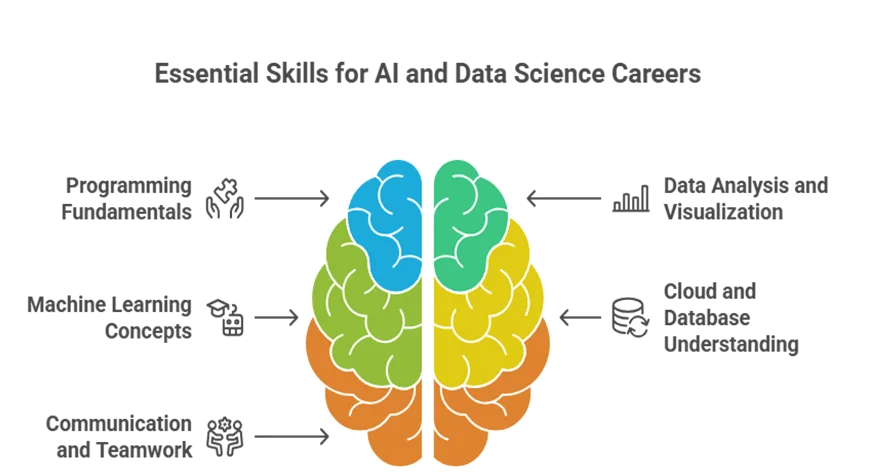
When starting off with Data Science with AI, it is important to gain some technical knowledge, analytical skills and communication skills. As a beginner you will not need to know everything straight away. Try learning one skill at a time and apply it to your projects.
key points include:
1.Python
Python is one of the most popular programming languages used within Data Science and AI. It is a simple language to get started with and has lots of libraries.You can use Python to clean data, perform calculations, visualise information, build machine learning models and automate repetitive tasks.
- Variables, data types and operators
- If statements and loops
- Functions and modules
- Lists, dictionaries and data structures
- File handling and error handling
- Using Python libraries with data
- As a beginner you can practice by building simple programe, analyzing data from spreadsheets and completing basic programming tasks.
2. Statistics and Math
Statistics can help data professionals make sense of information and understand if there are any meaningful patterns. Math is a key part of many machine learning algorithms.Important concepts to understand include mean, median, mode, probability, standard deviation, correlation, distributions and hypothesis testing. Linear algebra and calculus can also be useful to understand more advanced machine learning and deep learning techniques.Having a good maths background can be helpful but as a beginner you can start with basic statistics and work your way up.
3.SQL:
Companies store information in databases. SQL can help professionals make sense of it.
SQL can help you extract customer information, filter through sales data, join tables, group information and calculate business metrics.
You should practice using SELECT statements, WHERE clauses, GROUP BY, JOIN’S, aggregate functions and sub queries.
For example, a business analyst may use SQL to identify trends in monthly sales or compare product performance between different locations.
4.Excel:
Excel is still a useful tool to help organise and analyse business data. You can use tables, formulae, charts and pivot tables.
Data cleaning is also an important part of the process. Real world data can often have missing values, duplicates, inconsistent data and incorrect entries.
Professionals will need to know how to identify these issues and produce reliable data.
5. Machine learning
Machine learning is a key part of AI. It allows systems to learn patterns from data and make predictions.
Common techniques include:
- Supervised learning – learns from labelled examples.
- Unsupervised learning – identifies patterns or groups.
- Reinforcement learning – learns from interactions.
Examples include predicting customer churn, identifying unusual transactions, grouping customers and predicting product demand.
1.Data Visualization
Once you have analyzed your data you will need to be able to communicate your findings.
Tools such as Power BI, Tableau and Python libraries can help you produce charts from complex datasets. Having good communication skills will help you explain what the data means, why it matters and what actions the business could take.
2.Popular Tools
There are many tools available for different parts of your Data Science project. The tools will depend on the size of your data, how complex the task is, what the business needs and the technical ability of the team.
3.Python
Python can help with data manipulation, statistical analysis, visualization and machine learning.
Popular libraries include:
Pandas – organizing and manipulating structured data.
NumPy – numerical calculations.
Matplotlib/Seaborn – charting and statistical visualizations.
Scikit-learn – traditional machine learning.
Tensorflow/PyTorch – deep learning models.
4.SQL
SQL can help professionals work with structured data. It is useful for extracting data from multiple tables.
5.Excel
Excel is commonly used for basic data analysis, calculations, data cleaning and reporting.
6.Power BI/Tableau
Power BI and Tableau can help you create interactive dashboards. Businesses use these tools to track KPI’s, analyze sales and communicate insights.
Jupyter Notebook
Jupyter Notebook provides an interactive environment where you can write Python code, view charts, document your methods and review your results. This can be useful for experimenting.
7.AI/Generative AI
Generative AI can help explain code, write documentation, suggest changes to your data and summarize your findings. Machine learning platforms and cloud based AI can help teams build models.
you should always double check any code or results produced by AI. Data science course in CoimbatoreIt may not always produce accurate calculations, explanations or code that works with your data.
Real World Applications:
Data Science with AI isn’t just used by tech companies and is becoming more popular within various sectors.
1.Healthcare
Healthcare organisations can use data analysis to look into patient records, manage hospital resources and identify patterns within medical data. AI systems can also help trained professionals analyse medical images.
These systems need to be carefully validated, ensure privacy and have correct oversight.
2.Banking/Finance
Financial institutes can use data analysis and machine learning to identify any suspicious transactions, financial risks and understand customer behaviour.
AI systems can help identify any unusual activity. However, financial decisions should follow the correct regulations and have appropriate human review.
3.Retail/E-commerce
Online retailers will look into customer purchases, browsing behaviour and product performance. Recommendation systems can help recommend relevant products. Forecasting models can help businesses predict demand.
4.Education
Educational organisations can use data to understand student engagement, evaluate learning and improve course planning. AI learning tools can provide practice questions, explanations and personalised learning.
5.Manufacturing
Manufacturing companies will look into equipment performance, production data and maintenance. Predictive maintenance models can help predict when equipment may need attention.
6.Marketing/Digital
Marketing teams use Data Science to understand how their campaigns are performing, understand their audience, compare their advertising channels and understand conversions.
For example, a digital marketing team can look into their advertising costs, website analytics and leads to calculate cost per lead and identify which campaigns are providing more qualified enquiries. AI can help with reporting and identifying patterns but decisions will be made based on business goals and verified results. Data training course in coimbatore
Career Opportunities
Learning Data Science and AI can put you in a position for various technical and analytical roles. Requirements will vary depending on the employer, industry and level of the role.
Data Analyst
Data analysts will gather, clean and interpret information to help businesses understand how they are performing. Common skills required include Excel, SQL, Power BI, statistics and basic Python.
Data Scientist
Data Scientists will use programming, statistics and machine learning to investigate complex problems and build predictive models. They will also communicate their findings to the business.
Machine Learning Engineer
Machine learning engineers will build, test, implement and maintain machine learning systems. Knowledge of Python, model evaluation, software engineering and implementation is important.
Business Intelligence Analyst
BI analysts will build dashboards, produce reports and turn business data into useful insights. Skills such as SQL, Power BI/Tableau, Excel and communication are valuable.
AI Engineer
AI engineers will build applications using AI models. Depending on the role they may use machine learning, deep learning, generative AI, API’s and software implementation.
Data Engineer
Data engineers will build and maintain systems to capture, transform and deliver data. Skills such as SQL, Python, databases, data pipelines and cloud are often useful.
Other roles include Analytics Consultant, Research Analyst, Reporting Analyst, AI Application Developer and Junior Machine Learning Specialist.
Depending on the role, not all will require the same level of expertise. Entry level analyst roles may just require Excel, SQL, dashboards and basic statistics. AI and machine learning roles with a heavy focus on research may require more maths, programming and model building.
Having a plan can help you build your skills.
Step 1 – Learn the basics
Start with learning Excel, basic statistics and an introduction to data analysis. Understand how to read data sets, calculate summary statistics and common data issues.
Step 2 – Practice SQL
Practice using sample databases. Learn how to extract data, filter, group and join data. Practice answering business questions using SQL.
Step 3 – Learn Python
Learn the basics of programming. Move onto learning Pandas, NumPy and data visualisation. Practice with small data sets to understand how the code works.
Step 4 – Dashboard skills
Use Power BI/Tableau to produce reports from cleaned data. Focus on choosing the right charts and communicating the key findings.
Step 5 – Machine learning and AI
Once you understand how to prepare your data and basic statistics, move onto learning machine learning. Practice using classification, regression, clustering and model evaluation. Once you are comfortable with this move onto more advanced AI topics.
Step 6 – Projects
Projects can help you showcase your skills. Try creating:
Sales dashboard – Excel/Power BI
Customer analysis – SQL/Python
House price prediction – Machine learning
Customer segmentations – Clustering
Simple AI application – Use the right model/API.
Document your problem, data set, data cleaning, methods, results, limitations and conclusions.
Step 7 – Get ready to apply for jobs
Build a portfolio of your best projects. Keep your CV simple and focused on your skills. Practice explaining your work in simple terms.
Apply for suitable entry level roles and internships based on your actual level of skill.
Challenges and ethical considerations
While there are many benefits to using AI there can also be challenges. If your data isn’t of a high quality your predictions may not be accurate. If your data set has bias you may get unfair results. Personal data may also be at risk if not handled carefully.
AI models can give confident but incorrect answers. Professionals will need to validate their results, keep sensitive information safe, document any limitations and follow the relevant policies and regulations.
Another challenge is that you will need to continuously learn. Things are always changing so it is important to strengthen your foundations rather than relying heavily on one piece of software or AI assistant.
It is still important to use your judgement when interpreting results.
Future of Data Science with AI
In the future Data Science will likely become more integrated with traditional analytics, machine learning, generative AI and automated data. Professionals may use more AI assistants to help with writing code, exploring data sets, writing documentation and producing initial reports.
However, organisations will still need people who can identify meaningful problems, understand data quality, evaluate model performance, keep information safe and link technical results to business goals.
This means that simply learning AI won’t be enough. Having a strong foundation of programming, statistics, analytical skills, communication and project experience will help you prepare for ever changing requirements in the workplace.
The most valuable professionals will be those who understand how the technology works and when you can trust the results.
Conclusion
Data Science with AI combines data analysis, programming, statistics, and intelligent technologies to solve practical problems. From healthcare and banking to marketing and manufacturing, these skills can help organizations understand information, improve processes, and make better-informed decisions. Data science course in kochi For beginners, the best approach is to start with Excel, SQL, Python, and basic statistics before progressing to machine learning and advanced AI applications. Working on real-world projects and learning to explain results clearly can help turn theoretical knowledge into practical ability. Whether you want to become a Data Analyst, Data Scientist, BI Analyst, Machine Learning Engineer, or AI Engineer, building a strong foundation is an important first step. With consistent practice, responsible use of AI, and continuous learning, you can explore the growing range of opportunities in data-driven careers. The journey begins with a simple question: what useful information can you discover from data, and how can you use it to solve a real problem?
