
Introduction:
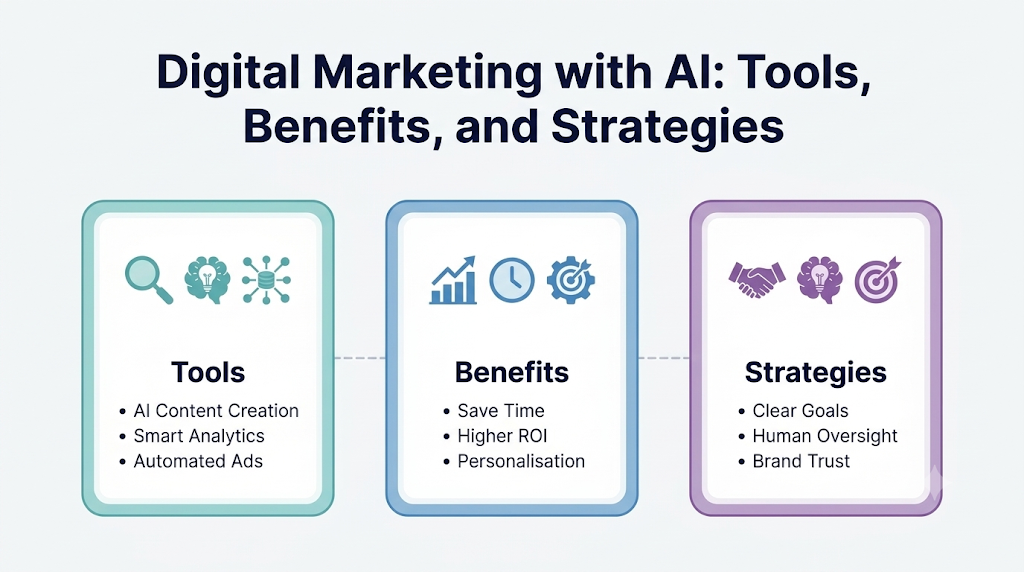
Digital marketing with ai helps businesses reach and serve customers through search engines, websites, social media, email, and online advertising. Digital marketing course in chennai Artificial intelligence (AI) is changing how marketers plan these activities. AI tools can help generate content drafts, analyze campaign data, identify audience patterns, personalize messages, and automate repetitive tasks. These capabilities can make marketing work faster and help teams make better-informed decisions.AI is not a substitute for knowing customers, setting a clear strategy, or building a trustworthy brand. Its suggestions depend on the quality of the information and instructions it receives. Marketers still need to review claims, understand context, and decide which recommendations fit their business.This article looks at useful AI tools for digital marketing, the benefits they can offer, and practical strategies for using them responsibly. The goal is to show how AI can support the full marketing process, from research and planning to campaign measurement and improvement.
Digital Marketing with ai :
AI in marketing includes several types of technology. Generative AI creates or edits text, images, and other content. Predictive and analytical tools look for patterns in data, estimate likely outcomes, or help marketers find areas that need attention. Automation tools carry out routine steps, such as sending a follow-up email after a customer action.These capabilities can be applied across the customer journey. A team might use AI to summarize customer feedback before a campaign, create draft advertisements during production, personalize email content for different segments, and review performance after launch.AI is most useful when it supports a specific decision. “Which message should we test with first-time customers?” is a more practical question than “How can AI improve marketing?” Clear questions help teams evaluate whether the output is relevant and whether it produces a worthwhile result.
ChatGPT for content, research, and analysis:
ChatGPT can support brainstorming, campaign planning, research synthesis, writing, editing, and data analysis. Marketers can use it to create a first draft of a blog outline, generate different advertising messages, adapt copy for email and social channels, or summarize customer survey responses. It can also help interpret spreadsheets and prepare a plain-language summary of campaign results.The quality of the output improves when the marketer provides context: the target audience, campaign goal, brand voice, key facts, and content format. For instance, asking for “an email for returning customers about our new product” gives the tool a more useful direction than simply asking it to “write an email.” OpenAI’s marketing guide outlines uses such as campaign planning, content creation, research, and performance analysis.Treat the output as a draft or starting point. Check factual statements, source material, and any recommendations before sharing them with customers or colleagues.
Canva AI for visual content:
Canva’s AI features can help marketers create and adapt visual assets, such as social posts, presentations, promotional graphics, and campaign materials. Features in its Magic Studio and newer Canva AI workflows support activities such as generating design drafts, editing images, and adapting materials for different formats. Canva describes these capabilities in its Magic Studio overview and its announcement of Canva AI 2.0.These tools may help small teams produce visual drafts more quickly. A marketer could develop a concept for a seasonal promotion, explore a few layouts, and resize the selected design for different channels. A person should still check the design for brand consistency, readability, accessibility, and accurate product details.
Semrush for SEO and content workflows:
Semrush’s Content Toolkit helps content and SEO teams research topics, create briefs, generate drafts, optimize pages, and repurpose content for other channels.Digital marketing course in coimbatore It combines AI features with Semrush data to support tasks across the content process. Its Content Toolkit documentation describes these workflows.A marketing team could use the toolkit to explore topics related to customer questions, develop an article brief, and review the draft for readability and topic coverage. These recommendations can inform content planning, but they do not guarantee a particular search ranking. Useful content still needs to answer real customer questions and offer information or experience that readers value.
Google Ads and Analytics AI features:
Google has introduced AI assistance across advertising and analytics products. Ask Advisor is designed to connect insights across Google marketing tools and help marketers explore performance or consider next steps. Google says Ask Advisor is in beta for English-language accounts, with features rolling out over time. See Google’s Ask Advisor announcement.AI-assisted campaign tools can help marketers investigate changes in performance, develop campaign ideas, and review data more quickly. Before applying a recommendation, check what data it used, whether the recommendation fits the campaign objective, and what effect a change might have on budget or delivery. Features and availability can vary, so marketers should check the platform for current details.
5. HubSpot and Mailchimp for automation and customer communication
AI features in customer relationship management and email platforms can help marketers manage campaign content and customer journeys. HubSpot’s Breeze Assistant and Marketing Studio are designed to help teams plan campaigns, create assets, coordinate tasks, and connect campaign work with customer information. HubSpot describes these functions in its Marketing Studio overview.Mailchimp’s AI features support email and SMS marketing tasks, including drafting copy and improving campaign workflows. These tools may help a team prepare a campaign and organize follow-up messages. The right platform depends on the business’s existing systems, audience, team size, and budget. Before adopting a tool, check its features, plan requirements, and data settings.
Greater efficiency:
AI can speed up routine work, including producing first drafts, summarizing reports, organizing feedback, and adapting content for different formats. content marketers can reduce time spent starting from a blank page and give marketers more time for strategy, customer research, and creative review.Efficiency does not mean removing review. A quickly generated draft still needs editing, and an automated report still needs interpretation. The practical benefit is often that a team can move through early steps faster and spend more time on the decisions that need human understanding.
Better use of marketing data:
Digital campaigns produce information about impressions, clicks, engagement, leads, purchases, and customer behavior. AI can help organize large amounts of data, highlight changes, and suggest areas for further analysis. It may help a marketer see that one channel attracts many visitors but few qualified leads, or that a particular message performs better with a specific audience.These observations should be verified. A pattern in the data is not always proof of cause and effect. Teams should check tracking, sample sizes, timing, and other changes that may have influenced the results.
More relevant customer communication:
AI can help adapt messages to customer interests, previous interactions, or different stages of the buying journey. A new visitor may need a clear explanation of a product, while an existing customer may benefit from a usage tip or a relevant upgrade offer. Personalization can make messages more useful when it reflects a genuine customer need.It should also respect customer expectations. Businesses should avoid using information in ways that feel intrusive and should make it easy for people to manage communications or reach a human when needed.
Faster creative testing:
AI can help generate different headlines, images, email subject lines, and calls to action. Teams can use these variations to test distinct ideas and learn which messages resonate. Testing helps businesses improve campaigns based on evidence rather than relying only on personal preference.The goal is not to produce the largest number of variations. It is to test meaningful differences, measure the result, and use what is learned to improve future work.
Support for smaller teams:
Small businesses may not have specialists for every marketing task. AI tools can help an owner or small team create a draft content plan, prepare basic designs, summarize campaign data, or organize a customer follow-up sequence. The team still needs to check the result, but AI can make some tasks more manageable with limited resources.
Start with a specific objective:
Decide what the business wants to achieve before choosing a tool. The objective might be to increase qualified leads, improve customer retention, reduce campaign preparation time, or make website content more useful. Define a measurement for success, such as cost per qualified lead, completed purchases, repeat visits, or customer satisfaction.A clear objective helps a team select the right AI use. For example, a writing assistant may help with content production, while an analytics tool may be more relevant when the challenge is understanding why conversions have changed.
Give tools accurate information and clear instructions:
AI output is shaped by the context it receives. Provide the audience, goal, channel, tone, supporting facts, and any claims or language to avoid. Use reliable customer research and current product information. If the input is outdated or incomplete, the recommendations may be irrelevant or misleading.
Keep human review in the process
Review AI-generated content before publication. Check facts, brand voice, links, accessibility, and the suitability of the message for its audience. This is especially important for claims involving health, finance, safety, or product performance. A confident-sounding answer is not necessarily a correct one.Google’s guidance says generative AI can help with research and structure, while emphasizing accuracy, quality, and human fact-checking. It also warns against using AI to produce large numbers of pages without adding value for users. See Google’s guidance on AI-generated website content.
Test before scaling:
Start with a small campaign, audience, or content project. Compare the AI-assisted approach with the existing process and use a relevant metric to judge the result. If the result is positive, expand gradually. If not, review the instructions, audience, data, and campaign design before deciding that the tool itself is unsuitable.
Protect customer information
Before uploading customer details or connecting a platform to a CRM, understand how the tool uses and stores information. Digital marketing course in kochiUse only the data needed for the task, follow organizational privacy practices, and restrict access where appropriate. Responsible data handling helps preserve customer trust.
Review performance regularly
AI use should be part of a continuous process: plan, launch, measure, and improve. Review campaign results at a regular interval and record what changed, what happened, and what the team learned. ChatGPT’s data analysis guide recommends giving the tool context about the decision, timeframe, and data definitions, then checking important numbers before acting on the results.
Conclusion
AI offers digital marketing teams useful support for content creation, design, research, SEO digital marketing, advertising, analytics, and customer communication. Tools such as ChatGPT, Canva AI, Semrush, Google’s marketing features, HubSpot, and Mailchimp can help with different parts of the workflow. Their value depends on whether they address a real business need and fit the team’s existing process.The strongest approach is to start with a clear objective, provide accurate information, test AI-assisted work on a manageable scale, and measure meaningful outcomes. Marketers should review generated content, protect customer data, and use automation in ways that improve the customer experience. AI can make marketing more efficient and adaptable, while human judgment, creativity, and trust remain central to effective strategy.