
Table of Contents
Introduction
Data has become one of the most valuable assets for organizations across industries. Every customer interaction, business transaction, website visit, and operational activity generates data that can help businesses make informed decisions. However, collecting data alone is not enough. The real value lies in analyzing it effectively to uncover meaningful insights.
Among the various branches of data analytics, two of the most widely used approaches are Predictive Analytics and Descriptive Analytics. While both rely on historical data, they serve different purposes. Descriptive analytics focuses on understanding past performance, whereas predictive analytics uses historical information to forecast future outcomes. Understanding Predictive Analytics vs Descriptive Analytics helps businesses choose the right analytical approach for better planning, risk management, customer satisfaction, and long-term growth. This guide explains both methods in detail, compares their features, explores their business applications, and highlights why combining them creates a stronger data-driven strategy.
What is Descriptive Analytics?
Descriptive analytics is the foundation of modern data analytics and focuses on understanding historical data to explain what has happened in the past. It involves collecting, organizing, and analyzing data from various sources to identify patterns, trends, and key performance indicators. Instead of predicting future outcomes, descriptive analytics presents past information through reports, dashboards, charts, and visualizations, making it easier for businesses to evaluate their performance and make informed decisions. For example, organizations use descriptive analytics to answer questions such as what their sales were last month, which products generated the highest revenue, how many customers visited their website, which marketing campaign achieved the most conversions, and what their customer retention rate was. By transforming raw data into meaningful insights, descriptive analytics helps businesses monitor performance, improve operational efficiency, and establish a strong foundation for future data-driven strategies.
Common Techniques
- Data Aggregation: Combines data from multiple sources into a single, organized dataset. This provides a unified view for accurate analysis and reporting.
- Business Intelligence Reporting: Generates reports that summarize historical business performance. These reports help organizations make informed, data-driven decisions.
- Dashboard Creation: Creates interactive dashboards to display key metrics and performance indicators. It enables users to monitor business performance at a glance.
- Data Visualization: Presents data through charts, graphs, and other visual formats. This makes complex information easier to understand and interpret.
- Trend Analysis: Examines historical data to identify patterns and changes over time. It helps businesses understand performance and plan future strategies.
- KPI Monitoring: Tracks Key Performance Indicators (KPIs) such as sales, revenue, and customer retention. This helps measure progress toward business goals.
Popular Tools
- Microsoft Power BI: A business intelligence tool used to create interactive dashboards and visualize data for better decision-making.
- Tableau: A powerful data visualization platform that helps users analyze and present data through interactive charts and reports.
- Microsoft Excel: A spreadsheet application widely used for data cleaning, analysis, calculations, and reporting.
- SQL: A programming language used to store, retrieve, and manage data from relational databases efficiently.
- Google Analytics: A web analytics tool that tracks website traffic, user behavior, and marketing performance.
- Google Looker Studio: A reporting and visualization tool that creates customizable dashboards using data from multiple sources.
What is Predictive Analytics?
Predictive analytics is an advanced branch of data analytics that uses historical data, statistical techniques, artificial intelligence (AI), and machine learning (ML) algorithms to forecast future outcomes and trends. Unlike descriptive analytics, which explains past events, predictive analytics focuses on estimating what is likely to happen next by identifying hidden patterns and relationships within data. Businesses use predictive analytics to answer questions such as which customers are likely to stop using their services, how much product demand can be expected next month, which products are likely to become popular, whether revenue will increase in the next quarter, and which equipment may require maintenance before failure. By transforming historical data into actionable forecasts, predictive analytics enables organizations to make proactive decisions, reduce risks, optimize operations, and capitalize on future opportunities.
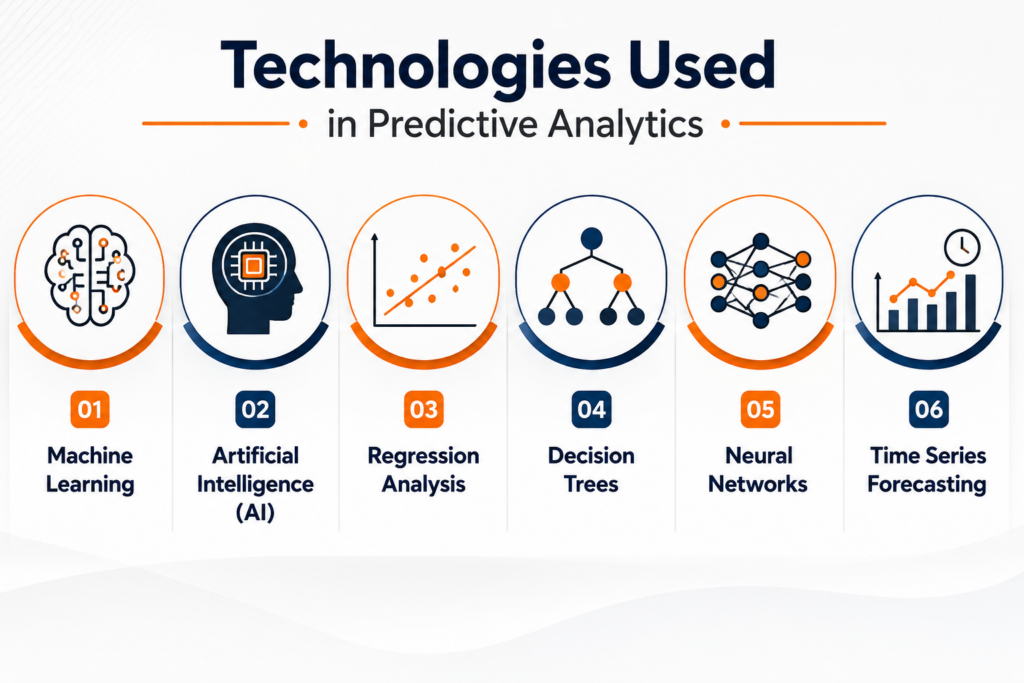
Technologies Used
- Machine Learning: Machine learning enables systems to learn from historical data and improve prediction accuracy over time. It helps businesses identify patterns and automate future predictions.
- Artificial Intelligence (AI): Artificial intelligence simulates human intelligence to analyze complex datasets and make intelligent predictions. It enhances decision-making by identifying insights that traditional methods may miss.
- Regression Analysis: Regression analysis measures the relationship between variables to predict future outcomes. It is widely used for forecasting sales, demand, and financial performance.
- Decision Trees: Decision trees classify data by following a series of logical conditions and decision rules. They help predict outcomes in areas such as customer behavior and risk assessment.
- Neural Networks: Neural networks mimic the human brain to recognize complex patterns in large datasets. They are commonly used for advanced predictive modeling and deep learning applications.
- Time Series Forecasting: Time series forecasting analyzes historical data collected over time to predict future trends. It is commonly used for demand forecasting, stock market analysis, and sales prediction.
Predictive Analytics vs Descriptive Analytics: Key Differences
Although both methods analyze data, they differ significantly in purpose, techniques, and outcomes. Both approaches complement each other and are often used together within a comprehensive data analytics strategy.
| Feature | Descriptive Analytics | Predictive Analytics |
|---|---|---|
| Goal | Understand past performance | Forecast future outcomes |
| Main Question | What happened? | What will happen? |
| Data Used | Historical data | Historical and current data |
| Complexity | Low to Medium | High |
| Output | Reports and dashboards | Predictions and forecasts |
| Technology | BI Tools | AI and Machine Learning |
| Decision Style | Reactive | Proactive |
| Accuracy | Actual historical results | Probability-based predictions |
| Skills Required | Excel, SQL, BI Tools | Python, Statistics, Machine Learning |
| Business Focus | Performance analysis | Strategic planning |
Techniques Used in Both Analytics Types
Descriptive Analytics Techniques
- Data Aggregation: Collecting data from multiple sources into one centralized database for easier analysis.
- Data Visualization: Using charts, graphs, dashboards, and reports to present information clearly.
- Trend Analysis: Examining historical patterns to identify business growth or decline over time.
- Performance Reporting: Tracking key business metrics such as sales, revenue, customer engagement, and operational efficiency.
Predictive Analytics Techniques
- Regression Analysis: Predicts relationships between variables and estimates future values.
- Machine Learning: Allows systems to learn from historical data and improve predictions over time.
- Classification Models: Used for fraud detection, customer segmentation, and risk analysis.
- Time Series Forecasting: Predicts future trends based on historical chronological data.
- Neural Networks: Recognizes complex patterns in large datasets for highly accurate predictions.
Real-World Business Applications
Retail: Descriptive analytics helps retailers understand sales performance, customer preferences, inventory levels, and seasonal trends. Predictive analytics forecasts product demand, recommends products, optimizes inventory, and predicts purchasing behavior.
Healthcare: Hospitals use descriptive analytics to analyze patient records and treatment outcomes. Predictive analytics helps forecast disease risks, patient readmissions, and healthcare resource requirements.
Banking and Finance: Banks analyze customer transactions and financial reports using descriptive analytics. Predictive analytics supports fraud detection, credit risk assessment, investment forecasting, and customer lifetime value prediction.
Manufacturing: Manufacturers use descriptive analytics to monitor production efficiency and equipment utilization. Predictive analytics identifies potential machine failures before they happen, reducing maintenance costs and production downtime.
Marketing: Marketing teams evaluate campaign performance through descriptive analytics. Predictive analytics identifies potential customers, predicts campaign success, estimates customer lifetime value, and improves personalization.
Benefits of Descriptive Analytics
- Easy to Understand: Descriptive analytics presents data in a simple and organized format. This makes it easy for both technical and non-technical users to interpret insights.
- Supports Regular Reporting: It generates routine reports on business performance and key metrics. These reports help organizations monitor progress consistently.
- Improves Operational Visibility: It provides a clear view of daily business operations and processes. This helps identify strengths, weaknesses, and areas for improvement.
- Tracks Business Performance: Descriptive analytics measures important KPIs such as sales, revenue, and customer growth. It enables businesses to evaluate their overall performance.
- Identifies Historical Trends: It analyzes past data to uncover patterns and long-term trends. These insights help organizations understand how performance has changed over time.
- Cost-Effective Implementation: Most descriptive analytics tools are affordable and easy to implement. Businesses can gain valuable insights without requiring advanced technologies.
Limitations
- Cannot Forecast Future Events: Descriptive analytics focuses only on historical data. It cannot predict future trends or business outcomes.
- Reactive Approach: It explains what has already happened rather than what will happen next. This limits proactive decision-making.
- Depends on Historical Data Quality: The accuracy of insights depends on the quality of the collected data. Incomplete or inaccurate data can lead to misleading results.
- Limited Support for Strategic Planning: It provides insights into past performance but does not offer forecasts for future planning. Businesses often need predictive analytics for long-term strategies.
Benefits of Predictive Analytics
- Forecasts Future Business Trends: Predictive analytics analyzes historical data to estimate future trends. This helps businesses prepare for upcoming opportunities and challenges.
- Improves Customer Experience: It predicts customer preferences and behavior to deliver personalized products and services. This leads to higher customer satisfaction and loyalty.
- Supports Proactive Decision-Making: Businesses can anticipate potential issues before they occur. This enables faster and more strategic decision-making.
- Enhances Risk Management: Predictive models identify potential risks such as fraud, equipment failure, or customer churn. This helps organizations take preventive actions.
- Optimizes Business Operations: It improves resource allocation, inventory management, and operational efficiency. This reduces costs and increases productivity.
- Increases Competitive Advantage: Businesses gain valuable insights into future market trends and customer needs. This helps them stay ahead of competitors and drive growth.
Limitations
- Requires Skilled Professionals: Building and managing predictive models requires expertise in data science, statistics, and machine learning. Organizations often need experienced professionals to achieve accurate results.
- Higher Implementation Cost: Predictive analytics involves advanced tools, technologies, and infrastructure. This can make implementation more expensive than basic analytics methods.
- Needs Quality Data: Accurate predictions depend on clean, complete, and reliable data. Poor-quality data can reduce the effectiveness of predictive models.
- Predictions Are Not Always 100% Accurate: Predictive models estimate future outcomes based on probabilities. Unexpected events and changing conditions can affect prediction accuracy.
- Models Require Continuous Updates: Predictive models must be regularly monitored and retrained with new data. This helps maintain their accuracy and relevance over time.
Which Analytics Approach Should Your Business Choose?
The right analytics approach depends on your organization’s goals, business requirements, and the type of decisions you want to make. If your primary objective is to understand historical performance, monitor key performance indicators (KPIs), track business growth, and generate regular reports, Descriptive Analytics is the ideal choice. It provides valuable insights into past performance, helping businesses evaluate results and identify trends. On the other hand, if your goal is to forecast future demand, minimize business risks, improve customer retention, optimize operations, and make proactive decisions, Predictive Analytics is the better option. By using historical data, statistical models, and machine learning algorithms, predictive analytics helps organizations anticipate future outcomes and prepare for upcoming opportunities and challenges.
For most businesses, the most effective strategy is to combine both approaches. Descriptive analytics provides a clear understanding of what has already happened, while predictive analytics estimates what is likely to happen next. Together, they enable organizations to make informed decisions, improve operational efficiency, and build a strong data-driven strategy for long-term success.
Future of Predictive and Descriptive Analytics
The future of data analytics is driven by artificial intelligence, cloud computing, big data, and automation. Organizations are increasingly adopting advanced analytics platforms that combine descriptive reporting with predictive intelligence. As technology continues to evolve, businesses that integrate both descriptive and predictive analytics into their operations will gain faster insights, improve customer experiences, reduce risks, and make more informed strategic decisions.
- AI-powered business intelligence
- Real-time analytics
- Self-service analytics platforms
- Explainable artificial intelligence
- Industry-specific predictive models
- Automated decision-making
Conclusion
Understanding Predictive Analytics vs Descriptive Analytics is essential for organizations that want to maximize the value of their data. Descriptive analytics provides a clear understanding of historical performance by summarizing past events into meaningful reports and dashboards. Predictive analytics builds upon this foundation by using statistical models, artificial intelligence, and machine learning to forecast future outcomes. Rather than choosing one approach over the other, businesses should leverage both as part of a comprehensive data analytics strategy. Descriptive analytics helps organizations understand where they have been, while predictive analytics helps them determine where they are likely to go. Together, these approaches enable smarter planning, improved operational efficiency, stronger customer relationships, and better business outcomes.