

Table of Contents
Introduction
In today’s digital world, data is one of the most valuable assets for businesses. Every day, organizations generate massive amounts of information that can drive smarter decisions and improve business performance. Big Data Analytics tools help transform this vast data into meaningful insights, enabling companies to innovate, enhance customer experiences, and stay competitive. This article explores the latest trends, essential tools, and future opportunities in Big Data Analytics.
What are big data analytics tools?
Big Data Analytics is the process of collecting, organizing, processing, and analyzing extremely large and complex datasets to uncover valuable insights, patterns, correlations, and trends that help organizations make informed business decisions.
Traditional databases are designed to handle structured information but often struggle with the massive scale, speed, and variety of modern data. Big data technologies overcome these limitations by processing structured, semi-structured, and unstructured data efficiently.
Concept of big data
1. Volume
Organizations generate massive amounts of data every day. Social media platforms, e-commerce websites, banking systems, healthcare institutions, and IoT devices collectively produce petabytes of information that require scalable storage and processing solutions.
2. Velocity
Data is created continuously and often needs to be processed in real time. For example, payment gateways must detect fraudulent transactions within seconds to protect customers.
3. Variety
Modern businesses collect multiple types of data, including text, images, videos, audio, emails, customer reviews, sensor data, and social media content. Big Data Analytics tools help process these diverse data formats efficiently.
4. Veracity
The accuracy and reliability of data directly impact business decisions. Organizations must clean and validate data before analysis to ensure meaningful outcomes.
5. Value
The ultimate goal of big data is to extract valuable insights that drive better decision-making, improve efficiency, increase revenue, and enhance customer experiences.
Why Big Data Analytics Matters
The digital economy depends heavily on data. Businesses that effectively use analytics gain a competitive advantage by understanding market trends, customer preferences, and operational performance more accurately than their competitors. Instead of relying on assumptions, organizations use real-time data and predictive models to make informed decisions. Analytics helps leaders identify opportunities, minimize risks, and improve overall business performance.
Improved Customer Experience
Companies analyze customer behavior, browsing history, and purchasing patterns to provide personalized recommendations and targeted marketing campaigns. This improves customer satisfaction and strengthens brand loyalty.
Fraud Detection and Risk Management
Banks, insurance companies, and financial institutions use predictive analytics to identify unusual transaction patterns and detect fraudulent activities before they cause significant losses.
Increased Operational Efficiency
Manufacturing companies, logistics providers, and supply chain organizations use data analytics to optimize workflows, reduce downtime, manage inventory, and improve productivity.
Faster Innovation
Data-driven organizations identify emerging market trends, customer needs, and product opportunities more quickly. This allows them to innovate faster and remain competitive in rapidly changing industries.
Competitive Advantage
Businesses that effectively leverage analytics can respond to customer demands, market changes, and industry disruptions more efficiently than competitors, leading to sustainable long-term growth.
Latest Big Data Analytics Trends
The field of data analytics continues to evolve as new technologies reshape the way organizations collect and analyze information.
One of the most significant data analytics trends is the integration of Artificial Intelligence and Machine Learning. These technologies automate data analysis, identify hidden patterns, and improve prediction accuracy without requiring constant human intervention.
Another growing trend is real-time analytics, where businesses process streaming data instantly instead of waiting for scheduled reports. Industries such as banking, healthcare, transportation, and e-commerce rely heavily on real-time insights to make immediate decisions.
Cloud-based analytics platforms have also transformed data management by offering scalable infrastructure, reduced operational costs, and improved collaboration. Organizations increasingly adopt cloud solutions to process large datasets efficiently without investing heavily in physical hardware.
Additionally, self-service analytics tools are becoming more popular. These platforms allow business users to create dashboards, visualize data, and generate reports without extensive programming knowledge, making analytics more accessible across organizations.
As data privacy regulations continue to evolve, companies are also placing greater emphasis on governance, cybersecurity, and ethical AI practices to ensure responsible use of customer information.
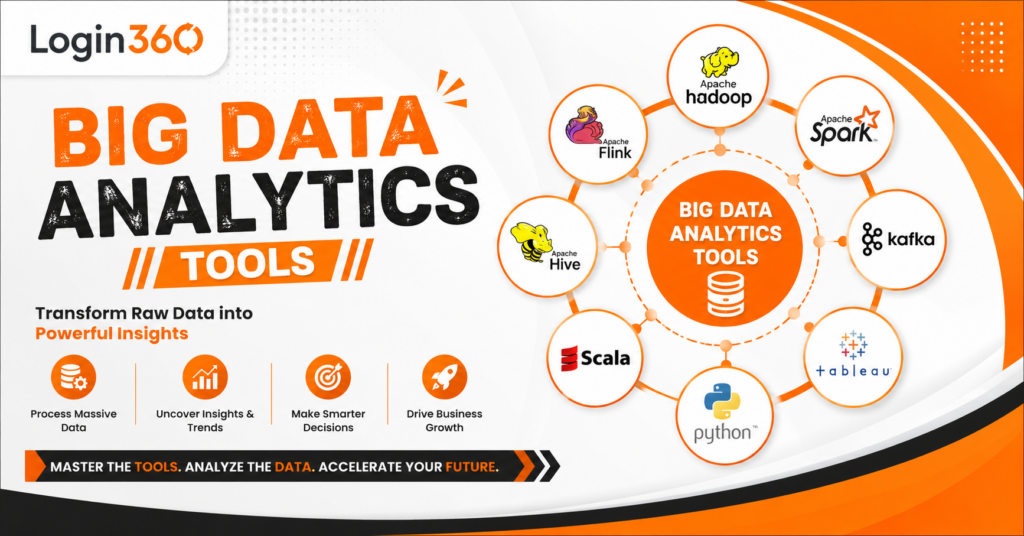
Top Big Data Analytics Tools Every Professional Should Know
1. Apache Hadoop
Apache Hadoop is one of the most widely used open-source frameworks for storing and processing large volumes of data across distributed computer systems. It is designed to handle structured, semi-structured, and unstructured data while ensuring reliability and scalability.
2. Apache Spark
Apache Spark is another powerful framework used in big data analytics. Unlike Hadoop, Spark processes data in memory, making it significantly faster for many analytical tasks.
3. Apache Kafka
Modern businesses generate data continuously from websites, mobile applications, IoT devices, and financial transactions. Apache Kafka helps organizations collect and process this streaming data in real time.
4. Python
Python has become the most widely used programming language in big data analytics because of its simplicity, flexibility, and extensive ecosystem.
5. Tableau and Microsoft Power BI
Raw data is often difficult to interpret without proper visualization. Tableau and Microsoft Power BI help organizations convert complex datasets into interactive dashboards and reports.
Applications of Big Data Analytics Across Industries
One of the reasons Big Data Analytics is growing so rapidly is its versatility. Almost every industry uses analytics to improve efficiency, reduce costs, and enhance customer experiences.
Healthcare
Healthcare organizations generate enormous amounts of patient data every day. By analyzing medical records, diagnostic reports, and wearable device data, hospitals can identify disease patterns, improve treatment plans, and predict patient risks.
Big data also supports medical research by helping scientists analyze large datasets to develop new treatments and improves healthcare outcomes.
Banking and Financial Services
Financial institutions rely heavily on predictive analytics to detect fraudulent transactions, assess credit risk, and understand customer spending behavior.
Banks use analytics to:
- Monitor suspicious activities
- Improve loan approval processes
- Personalize financial products
- Manage investment risks
These capabilities improve both customer trust and operational efficiency.
Retail and E-commerce
Retail businesses use customer data to understand buying behavior and personalize shopping experiences.
Some common applications include:
- Product recommendations
- Demand forecasting
- Inventory optimization
- Customer segmentation
- Dynamic pricing strategies
These insights help businesses increase sales while improving customer satisfaction.
Manufacturing
Manufacturers use data analytics to monitor equipment performance, optimize production processes, and reduce downtime.
Predictive maintenance allows companies to identify potential machine failures before they occur, reducing maintenance costs and improving operational efficiency.
Transportation and Logistics
Logistics companies analyze traffic patterns, weather conditions, fuel consumption, and delivery routes to improve supply chain efficiency.
Analytics helps organizations:
- Reduce transportation costs
- Improve delivery times
- Optimize fleet management
- Enhance customer satisfaction
Education
Educational institutions are increasingly adopting analytics to improve student learning outcomes. Schools and universities analyze attendance, academic performance, and engagement levels to identify students who may need additional support. This enables educators to provide personalized learning experiences.
Career Opportunities in Big Data Analytics
As organizations continue to embrace digital transformation, the demand for professionals with expertise in big data analytics continues to rise. Companies across industries actively seek skilled individuals who can transform raw data into valuable business insights.
Some of the most in-demand job roles include:
- Big Data Analyst
- Data Analyst
- Data Engineer
- Data Scientist
- Business Intelligence Analyst
- Machine Learning Engineer
- Cloud Data Engineer
- Analytics Consultant
These professionals work on collecting, processing, analyzing, and interpreting data to support strategic business decisions.
Essential Skills for Success in Big Data Analytics
Building a successful career requires both technical knowledge and analytical thinking. Employers look for professionals who can not only work with data but also communicate insights effectively.
Some of the most valuable skills include:
- SQL for database querying
- Python programming
- Data visualization
- Statistical analysis
- Cloud computing platforms such as AWS, Azure, or Google Cloud
- Machine learning fundamentals
- Business intelligence concepts
- Problem-solving and critical thinking
- Communication and presentation skills
Developing these skills through practical projects and continuous learning can significantly improve employability in the competitive analytics industry.
Future Opportunities in Big Data Analytics
The future of big data analytics is incredibly promising as businesses continue to generate and rely on vast amounts of data. Organizations are no longer using analytics only to understand past performance—they are using it to predict future outcomes, automate decision-making, and create personalized customer experiences. As digital transformation accelerates across industries, professionals with expertise in data analytics will remain in high demand.
Artificial Intelligence-Driven Analytics
Artificial Intelligence (AI) is transforming the way businesses analyze data. AI-powered analytics platforms can automatically identify trends, detect anomalies, and generate insights without extensive manual effort. This allows organizations to make faster and more accurate decisions while reducing operational costs.
Edge Analytics
With the rapid growth of Internet of Things (IoT) devices, data is increasingly being processed closer to where it is generated rather than being sent to centralized servers. This approach, known as edge analytics, reduces latency and enables real-time decision-making in industries such as manufacturing, healthcare, transportation, and smart cities.
Predictive and Prescriptive Analytics
Traditional analytics focuses on understanding what has happened in the past. Modern analytics goes a step further by predicting future outcomes and recommending the best actions to achieve desired results. Businesses use predictive and prescriptive analytics to improve forecasting, optimize operations, and reduce risks.
Cloud-Native Data Platforms
Cloud computing continues to reshape data analytics by providing scalable infrastructure and flexible storage solutions. Cloud-native analytics platforms allow organizations to process massive datasets efficiently while reducing hardware costs and improving collaboration among teams.
Data Privacy and Ethical Analytics
As organizations collect increasing amounts of customer data, privacy and security have become top priorities. Companies are investing in data governance frameworks, cybersecurity measures, and ethical AI practices to ensure compliance with regulations and build customer trust.
How to Start Learning Big Data Analytics
If you’re interested in building a career in big data analytics, following a structured learning path can help you gain the necessary skills and confidence.
Begin by understanding the fundamentals of data analysis, statistics, and databases. A strong foundation in SQL is essential because it enables you to retrieve and manipulate data efficiently. Next, learn Python, one of the most popular programming languages for data analytics, and become familiar with libraries such as Pandas, NumPy, and Matplotlib.
Once you are comfortable with programming, explore distributed computing frameworks like Apache Hadoop and Apache Spark. These technologies are widely used to process and analyze large-scale datasets.
You should also learn how to create meaningful reports and dashboards using data visualization tools such as Tableau or Microsoft Power BI. Understanding cloud platforms like AWS, Microsoft Azure, or Google Cloud will further strengthen your skill set, as many organizations now rely on cloud-based analytics solutions.
Finally, apply your knowledge by working on real-world projects, participating in hackathons, contributing to open-source initiatives, or building a portfolio. Practical experience demonstrates your capabilities to potential employers and helps you stand out in the competitive job market.
Benefits of Learning Big Data Analytics
Investing time in learning big data analytics offers numerous advantages for students, graduates, and working professionals.
Some of the key benefits include:
- High demand across multiple industries
- Excellent salary packages and career growth
- Opportunities to work with cutting-edge technologies
- Strong foundation for careers in data science and artificial intelligence
- Ability to solve real-world business problems using data
- Global job opportunities across various sectors
- Continuous learning and professional development
As organizations become increasingly data-driven, professionals with analytics expertise will continue to play a vital role in business success.
Conclusion
Big Data Analytics has become a cornerstone of modern business strategy, enabling organizations to transform massive amounts of data into actionable insights. From improving customer experiences and optimizing operations to predicting future trends and driving innovation, its impact spans nearly every industry. As technologies such as artificial intelligence, machine learning, cloud computing, and real-time analytics continue to evolve, the demand for skilled analytics professionals will only increase.
Whether you are a student exploring career options, a professional looking to upskill, or an organization aiming to become more data-driven, investing in data analytics is a smart choice. By mastering the right tools, building practical experience, and staying updated with emerging trends, you can unlock exciting career opportunities and contribute to the future of data-driven decision-making.