

Table of Contents
Introduction
Data has become one of the most valuable assets for businesses worldwide. From healthcare and finance to retail and entertainment, organizations are relying on data-driven decisions to improve customer experiences, increase efficiency, and stay ahead of the competition. As technologies continue to evolve, the future of data analytics is becoming more exciting and transformative than ever before. Artificial intelligence, machine learning, cloud computing, and real-time analytics are changing the way organizations collect, process, and interpret data. For professionals working in analytics or aspiring to enter the field, understanding these changes is essential to remain competitive in a rapidly evolving industry.
In this article, we’ll explore the future trends in data analytics, emerging technologies, essential skills, career opportunities, and what professionals need to know to thrive in the coming years.
What Is Data Analytics and Why Does It Matter?
Data analytics is the process of collecting, organizing, and analyzing data to uncover meaningful insights and support decision-making. Businesses use analytics to understand customer behavior, optimize operations, predict future trends, and drive growth. Today, companies generate massive amounts of data every second. Without analytics, this information would have little value. Data analytics transforms raw data into actionable insights that help organizations make smarter decisions. As digital transformation accelerates, the importance of analytics continues to grow. This is one of the major reasons why the future of data analytics looks incredibly promising.
The Current State of Data Analytics.
- The data analytics industry has experienced remarkable growth over the past decade, becoming a critical component of modern business strategies.
- Organizations are increasingly investing in business intelligence and analytics solutions to gain a competitive advantage and improve decision-making.
- The rapid growth of big data, cloud technologies, and AI-powered tools is transforming how businesses collect and analyze information.
- Additionally, the expansion of IoT devices and the rising demand for real-time insights are accelerating the adoption of advanced analytics across industries.
Top Trends Shaping the Future of Data Analytics
1. AI in Data Analytics: Artificial intelligence is revolutionizing how businesses analyze information. AI-powered tools can process enormous datasets faster than humans and uncover patterns that might otherwise go unnoticed.
2. Real-Time Data AnalyticsBusinesses can no longer afford to wait days or weeks for reports. Real-time data analytics enables organizations to make decisions instantly based on live information.
Industries benefiting from real-time analytics include:
- E-commerce
- Banking and finance
- Healthcare
- Manufacturing
- Logistics
3. Predictive Analytics and Prescriptive Analytics:
- Predictive analytics uses historical data and machine learning to forecast future trends and business outcomes.
- It helps organizations improve customer demand forecasting, detect fraud, reduce risks, and optimize inventory management.
- Prescriptive analytics goes beyond predictions by recommending the most effective actions to achieve desired results.
- Together, these advanced analytics techniques are expected to play a crucial role in shaping the future of data analytics across industries.
4. Cloud-Based Analytics Solutions
Cloud technology has transformed how organizations manage and analyze data. Instead of relying on expensive infrastructure, businesses can access scalable analytics platforms through cloud services. Cloud analytics solutions provide: Better scalability, Faster processing capabilities, Reduced operational costs, Improved collaboration, Enhanced accessibility.
5. Data Democratization
Analytics is no longer limited to technical teams. Data democratization allows employees across departments to access insights without requiring advanced programming skills. Self-service business intelligence tools make analytics easier for: Marketing teams, Sales departments, HR professionals, Operations managers, Executives. This trend empowers organizations to make data-driven decisions at every level.
How Generative AI Is Transforming Data Analytics
Generative AI is transforming data analytics by making data analysis faster, smarter, and more accessible. Instead of relying solely on complex SQL queries or manual processes, professionals can now interact with data using natural language to generate insights in seconds. AI-powered tools can automatically create reports, build interactive visualizations, summarize large datasets, identify patterns, and simplify data exploration, significantly improving productivity and decision-making. This technology also enables non-technical users to analyze data more confidently, allowing organizations to make data-driven decisions without requiring advanced programming expertise. As Generative AI continues to evolve, it is becoming an essential tool for modern data analytics professionals.
Essential Data Analytics Skills for the Future
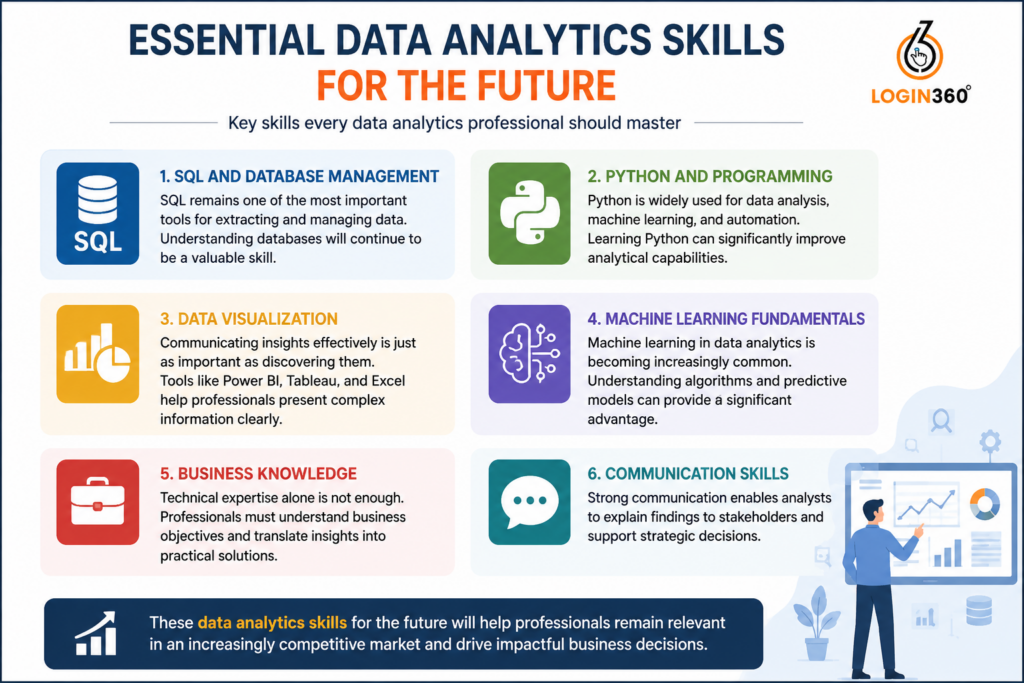
SQL and Database Management
- SQL remains one of the most important tools for extracting, managing, and analyzing data. A strong understanding of relational databases enables professionals to work efficiently with large datasets and generate meaningful business insights.
- As organizations increasingly rely on cloud-based databases and data warehouses, learning platforms such as MySQL, PostgreSQL, Microsoft SQL Server, and cloud solutions like Snowflake or BigQuery can significantly improve career opportunities in data analytics and data science.
Python and Programming
- Python is widely used for data analysis, machine learning, automation, and artificial intelligence. Learning Python enables professionals to process data efficiently, build predictive models, and automate repetitive tasks, making it one of the most valuable programming languages for data science.
- In addition to Python, understanding popular libraries such as Pandas, NumPy, Matplotlib, Scikit-learn, and TensorFlow helps professionals analyze data, create visualizations, and develop machine learning solutions for real-world business problems.
Data Visualization
- Communicating insights effectively is just as important as analyzing data. Tools like Power BI, Tableau, and Excel help professionals create interactive dashboards and visual reports that make complex information easy to understand.
- Strong data visualization skills enable analysts to identify trends, highlight key performance indicators (KPIs), and present actionable insights that support informed business decisions.
Machine Learning Fundamentals
- Machine learning is becoming an essential part of modern data analytics, helping organizations predict outcomes and automate decision-making. Understanding algorithms, predictive models, and model evaluation techniques provides a competitive advantage.
- Learning supervised and unsupervised learning concepts, along with popular machine learning frameworks, allows professionals to solve real-world business problems using data-driven approaches.
Business Knowledge
- Technical expertise alone is not enough to succeed in data analytics. Professionals must understand business goals, industry trends, and customer needs to deliver insights that create measurable value.
- Developing business acumen helps analysts ask the right questions, interpret data in context, and recommend strategies that improve organizational performance.
Communication Skills
- Strong communication skills enable data professionals to present complex findings in a clear and meaningful way to both technical and non-technical stakeholders. Effective storytelling with data helps decision-makers understand insights quickly.
- In addition to presenting reports, professionals should develop collaboration, presentation, and problem-solving skills to influence strategic decisions and maximize the impact of data analytics across the organization.
Data Analytics Career Opportunities
Data Analyst: Data analysts collect, process, and interpret information to support business decisions.
Business Analyst: Business analysts bridge the gap between business requirements and technology solutions.
Data Engineer: Data engineers build and maintain infrastructure for storing and processing large datasets.
Machine Learning Engineer: Machine learning engineers develop intelligent systems capable of learning from data.
Analytics Consultant: Consultants help organizations implement analytics strategies and improve performance. The increasing number of data analytics career opportunities makes this field one of the most attractive career choices today.
Industries Driving the Demand for Data Analytics
Data analytics is transforming industries by enabling organizations to make smarter, data-driven decisions. In healthcare, analytics helps improve patient outcomes, streamline hospital operations, and support better treatment planning. Financial institutions use data analytics for fraud detection, risk management, and customer behavior analysis, while e-commerce businesses leverage it to personalize shopping experiences, optimize pricing, and increase sales. In manufacturing, analytics powers predictive maintenance, quality control, and operational efficiency, reducing downtime and costs. Marketing teams rely on data analytics to measure campaign performance, understand customer preferences, and deliver targeted strategies that improve engagement and ROI. As digital transformation continues across industries, the demand for skilled data analytics professionals is expected to grow, creating strong career opportunities in the years ahead.
Challenges Professionals Need to Prepare For
Data Privacy and Security: Organizations must comply with regulations and protect sensitive information.
Ethical AI Concerns: AI-powered systems need to be transparent and unbiased.
Data Quality Issues: Poor-quality data can lead to inaccurate decisions and unreliable predictions.
Rapid Technological Changes: Keeping pace with evolving technologies requires continuous learning. Professionals who adapt quickly will have a significant advantage in the future.
How Professionals Can Stay Ahead
To stay ahead in the rapidly evolving field of data analytics, professionals should focus on continuously expanding both their technical and business skills. Learning AI, machine learning, cloud technologies, and modern data analytics tools such as Power BI and Tableau helps build a strong technical foundation while improving the ability to create meaningful insights from data. Gaining hands-on experience through real-world projects, earning industry-recognized certifications, and staying updated with emerging technologies are equally important for career growth. Along with technical expertise, developing strong communication, analytical thinking, and problem-solving skills enables professionals to transform complex data into actionable business decisions. Embracing continuous learning and adapting to new trends ensures long-term success in the ever-changing world of data analytics.
The Future of Data Analytics by 2030
By 2030, data analytics is expected to become more intelligent, automated, and widely accessible as advancements in artificial intelligence, machine learning, and cloud computing continue to reshape the industry. AI-powered analytics platforms will automate repetitive tasks, simplify complex data analysis, and provide real-time insights that enable organizations to make faster and more informed decisions. Businesses will increasingly adopt predictive and prescriptive analytics to forecast trends, optimize operations, and gain a competitive advantage. While automation will handle routine processes, the role of data professionals will shift toward strategic decision-making, problem-solving, and innovation. Despite rapid technological advancements, human expertise will remain indispensable, as organizations will continue to rely on professionals who can combine strong analytical skills, business knowledge, critical thinking, and adaptability to turn data into meaningful business outcomes.
Conclusion
The future of data analytics is filled with opportunities and innovation. Emerging technologies such as artificial intelligence, machine learning, cloud computing, and real-time analytics are transforming how businesses operate and make decisions. As organizations become more data-driven, the demand for skilled professionals will continue to increase. Those who invest in learning new technologies, strengthening analytical skills, and adapting to industry trends will be well-positioned for success.
Data analytics is no longer just about understanding the past—it is about predicting the future and creating smarter, faster, and more informed decisions. For professionals willing to embrace change, the future has never looked brighter.


[…] to ensure accuracy. Applying these practices consistently will improve the quality of your Data Analysis Projects in Excel and make your reports more […]
[…] analytics is the foundation of modern data analytics and focuses on understanding historical data to explain what has happened in the past. It involves […]
[…] of startups, and increased investments in technology are further strengthening the Scope of Data Analytics in India. Professionals who continuously upgrade their technical skills and stay updated with […]