

Table of Contents

Introduction
For any organization, today, data happens to be one of the most precious commodities. Information is generated in huge numbers everyday through websites, mobile apps, customers’ activities, social media, connected devices, and business processes. But collecting data alone is not enough; organizations require the right technology to collect, store, analyze and process the information to make better decisions.
And here comes the power of cloud computing and data science.
Cloud computing is the provision of various computing services such as storage, servers, databases, networking, and software via the internet. Data science, meanwhile, involves the application of statistics, programming, machine learning, and analysis techniques to derive meaningful insights from data. Combining these technologies enables organizations to do fast processing of large datasets, develop complex analytical models and take decisions with the help of data without having to make massive investment in physical infrastructure. Previously, organizations used to make heavy investments in terms of buying costly servers and setting up a data center to handle large-scale data analysis. In this regard, cloud computing has proved to be of tremendous use for data science.
What Is Cloud Computing?
Cloud computing is the delivery of computing services over the internet. Instead of storing files or running applications entirely on a local computer or private server, users can access computing resources through cloud platforms.
Cloud services commonly include:
- Cloud storage
- Virtual machines
- Databases
- Networking
- Data processing
- Application hosting
- Artificial intelligence and machine learning tools
- Analytics platforms
Popular cloud providers include Amazon Web Services (AWS), Microsoft Azure, and Google Cloud Platform (GCP). These platforms provide a wide range of services that can support everything from simple data storage to complex machine learning applications.
One of the main advantages of cloud computing is flexibility. Organizations can use the resources they need without having to build and maintain a large physical infrastructure.
What Is Data Science?
Data science is an interdisciplinary field that focuses on extracting meaningful information from structured and unstructured data. It combines programming, statistics, mathematics, data analysis, visualization, and machine learning.
A typical data science workflow may include:
- Collecting data
- Storing data
- Cleaning and preparing data
- Exploring and analyzing data
- Building statistical or machine learning models
- Evaluating model performance
- Visualizing results
- Deploying models
- Monitoring and improving the solution
Data scientists may work with datasets ranging from a few thousand records to billions of data points. Managing this scale efficiently can be challenging with traditional computing infrastructure. Cloud computing helps overcome many of these challenges.
Why Cloud Computing Is Important for Data Science
1. Scalable Data Storage
Data science projects often require large amounts of storage. Customer information, transaction records, images, videos, application logs, and sensor data can quickly consume local storage.
Cloud platforms provide scalable storage that allows organizations to store large datasets without continuously purchasing additional physical hardware. Storage capacity can be increased as the volume of data grows. This is particularly useful for organizations working with big data because they can store information centrally and access it whenever required.
2. Powerful Computing Resources
Machine learning and data analysis can require significant computing power. Training complex models on a standard computer may take hours or even days.
Cloud platforms provide access to powerful CPUs, GPUs, and other computing resources. Data scientists can use these resources when needed and reduce them after completing computationally intensive tasks. For example, a data scientist developing an image classification model may use GPU-based cloud computing to accelerate model training.
3. Cost Efficiency
Building an internal data science infrastructure can involve significant expenses. Organizations may need to purchase servers, storage devices, networking equipment, software licenses, and security systems.
Cloud computing follows a more flexible approach. Businesses can select services based on their requirements and, depending on the service model, pay for the resources they use. This can make advanced computing capabilities accessible to startups, small businesses, and educational institutions that may not have large technology budgets.
4. Easy Access to Data
Cloud-based systems allow authorized users to access data from different locations and devices. This is particularly useful for data science teams working remotely or across multiple offices.
Instead of transferring large datasets between individual computers, teams can work with centralized cloud-based data sources. This can improve collaboration and reduce unnecessary duplication.
5. Machine Learning and AI Services
Many cloud providers offer ready-to-use artificial intelligence and machine learning services. These tools can simplify tasks such as model training, prediction, natural language processing, computer vision, and automated data analysis.
Data scientists can also use cloud-based environments to develop their own machine learning models using popular frameworks and programming languages such as Python. This combination of managed services and customizable environments gives teams flexibility when developing AI solutions.
Cloud Computing in the Data Science Workflow
Cloud computing can support almost every stage of a data science project.
Data Collection
Organizations can collect data from websites, applications, business systems, IoT devices, and external sources. Cloud services can help capture and transfer this information into centralized storage systems.
Data Storage
Once collected, data can be stored in cloud databases, data warehouses, or data lakes. The choice depends on the type, volume, and intended use of the data.
Data Processing
Large datasets often need to be cleaned, transformed, and prepared before analysis. Cloud computing provides scalable processing capabilities that can handle large workloads efficiently.
Data Analysis
Data scientists can use cloud-based notebooks and analytical platforms to explore datasets, identify patterns, calculate statistics, and create visualizations.
Machine Learning
Cloud infrastructure can support the training, testing, deployment, and monitoring of machine learning models. Computing resources can be adjusted according to the complexity of the model.
Deployment
A machine learning model is valuable only when it can be used in a real-world application. Cloud platforms can help deploy models as APIs or integrate them into business applications.
Cloud-Based Data Warehouses and Data Lakes
Two important concepts in modern data environments are data warehouses and data lakes.
A data warehouse is designed to store structured and organized information for reporting and business analytics. Businesses can use warehouses to analyze sales, customer behavior, financial performance, and operational metrics.
A data lake can store large quantities of structured, semi-structured, and unstructured data. It provides greater flexibility when organizations are working with different types of information.
Cloud-based warehouses and data lakes allow organizations to build centralized data environments without maintaining all the underlying physical infrastructure themselves.
Collaboration Between Data Scientists and Teams
Data science projects are hardly ever executed by a single individual. Data scientists, data engineers, software developers, business analysts, marketing departments, and managers usually work on such projects. A cloud platform could offer a common ground where various team members will be able to use authorized data sets, applications, dashboards, and analytics tools. For instance, a data scientist could create a predictive model; a software developer would then incorporate this model into an application, and a business department would use it via a dashboard.
Security and Privacy Considerations
Despite numerous benefits of using cloud computing, it is important to maintain security and privacy.
Projects in data science can contain sensitive information such as client databases, financial information, employee information, or any other data. It is necessary to have proper access control, authentication, encryption, and monitoring policies. It is necessary to understand that cloud security is a joint effort. Cloud service providers ensure that the infrastructure is secure, but it is up to the customer to configure his/her environment correctly. Therefore, it is necessary to develop clear policies related to access, data storage, and retention of data.
Challenges of Using Cloud Computing for Data Science
Cloud computing is powerful, but it is not without challenges.
Data privacy: Sensitive information must be handled according to applicable laws, regulations, and organizational policies.
Cloud costs: Poorly managed resources can result in unexpected expenses. Monitoring and cost management are important.
Technical complexity: Cloud platforms offer hundreds of services, which can be difficult for beginners to understand.
Data migration: Moving existing datasets from local systems to cloud environments can require significant planning.
Vendor dependency: Organizations may become dependent on a particular cloud provider and its services.
Addressing these challenges requires proper planning, skilled professionals, and continuous monitoring.
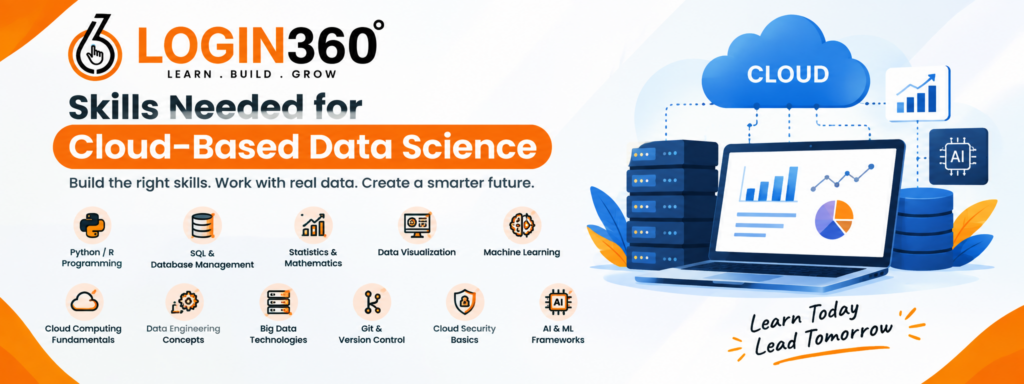
Skills Needed for Cloud-Based Data Science
Professionals interested in cloud-based data science can develop skills across several areas.
Important skills include:
- Python or R programming
- SQL
- Statistics and mathematics
- Data visualization
- Machine learning
- Database management
- Cloud computing fundamentals
- Data engineering concepts
- Big data technologies
- Git and version control
- Cloud security basics
- AI and machine learning frameworks
Learning platforms such as AWS, Microsoft Azure, or Google Cloud can further help professionals understand how cloud infrastructure is used in real-world data projects.
Future of Cloud Computing and Data Science
The connection between cloud computing and data science will likely continue to evolve with more data being generated and the usage of artificial intelligence. Modern cloud computing solutions are gradually incorporating analytics, machine learning, automation, and AI capabilities in their ecosystems. It could help organizations leverage advanced technology solutions more effectively. Generative AI, real-time analytics, automatic machine learning, and edge computing solutions are also playing their roles in forming the modern data landscape. With the development of such technologies, experts proficient in data science and cloud computing can find many applications in various industries.
Future trends may include automated data pipelines, intelligent applications, decision-making in real time, and AI on cloud.
Conclusion
The advent of cloud computing has revolutionized the way companies approach technology and data management. The benefits of cloud computing for data science include scalability of storage, computing power, infrastructure flexibility, collaboration capabilities, and machine learning services. Rather than investing in expensive physical infrastructure that is not flexible enough, organizations can utilize cloud resources based on the needs of their projects. This makes it possible to work with large volumes of data and apply advanced models. In turn, effective use of cloud services for data science is about much more than selecting the right provider. Proper data management, security measures, cost management, and expertise of specialists familiar with both data and cloud technology is a must. From the point of view of students and young professionals interested in gaining practical skills related to technology, the study of cloud computing in conjunction with data science can be a great approach. Familiarity with data collection, storage, processing, analysis, and transformation of insights can provide an opportunity to work in any number of industries including finance, healthcare, e-commerce, marketing, IT, and logistics.
Learn digital marketing, technology, analytics, and AI-related skills with the help of industry-specific training courses offered by Login360.