
Introduction
Many companies utilise data, often extracting it from a variety of sources such as websites, apps, social media and online buying. However, alongside data extraction, interpretation is also key in order for businesses to effectively utilise data and inform decision making.Historically, data analysis involved data manipulation, report creation and identification of trends. These processes often required specialist skills and familiarity with data analysis software. Technology is now transforming how data is analysed.Generative AI in data analysis to interpret data, automate processes and uncover insights. People can converse with Generative AI which can then analyse, describe and advise on data.
What Is Generative AI in Data Analytics?
Generative AI can produce original content (for example text, visual material and code) after learning from data. It can recognise and analyse instructions and respond accordingly.Within data analytics, Generative AI can be used to analyse data, recognise trends and formulate and describe data analysis. Rather than analysts undertaking each of these tasks themselves, Generative AI can carry them out more efficiently.For example, an analyst analysing sales data can request that an AI analyses which products are selling well and also investigates why sales reduced in a given month. The AI can then use data to advise accordingly.Whilst Generative AI can aid data analysis, it does not fully substitute human involvement.
Below are further ways in which Generative AI and Data Analytics can be integrated:
1. Facilitating Data Analysis
Manually analysing extensive data can be labour intensive. Generative AI can analyse data and recognise trends. It can also answer data related queries.A business owner can query aspects of business data including annual turnover, consumer purchasing and product performance – without needing to manually analyse each line of data.
2. Automating Processes
Many data analysts routinely engage in highly repetitive processes for example; writing SQL, compiling reports and recording and structuring analysis. Generative AI can be employed to automate these functions and lower the amount of time analysts spend on them.Analysts can then place greater emphasis on addressing business issues and analysing data to identify relevant insights.
3. Producing SQL and Python code
Both SQL and Python are frequently used in data analysis. Nevertheless, those new to data analysis can struggle with their use, particularly in relation to constructing complicated SQL and comprehending coding.Generative AI can produce SQL and Python code in response to straightforward requests. Analysts can then assess, amend and test this code so that it can be implemented within analysis projects.
4. Describing Data Analysis
Alongside analysing data, it is vital to be able to describe analysis outputs. Generative AI can translate data analysis into plain language and advise on potential factors that may be affecting business performance.An AI can analyse and describe for example, an organisation’s yearly sales performance and identify which products have seen increased and/or reduced demand.
Benefits of AI Enabled Data Analytics
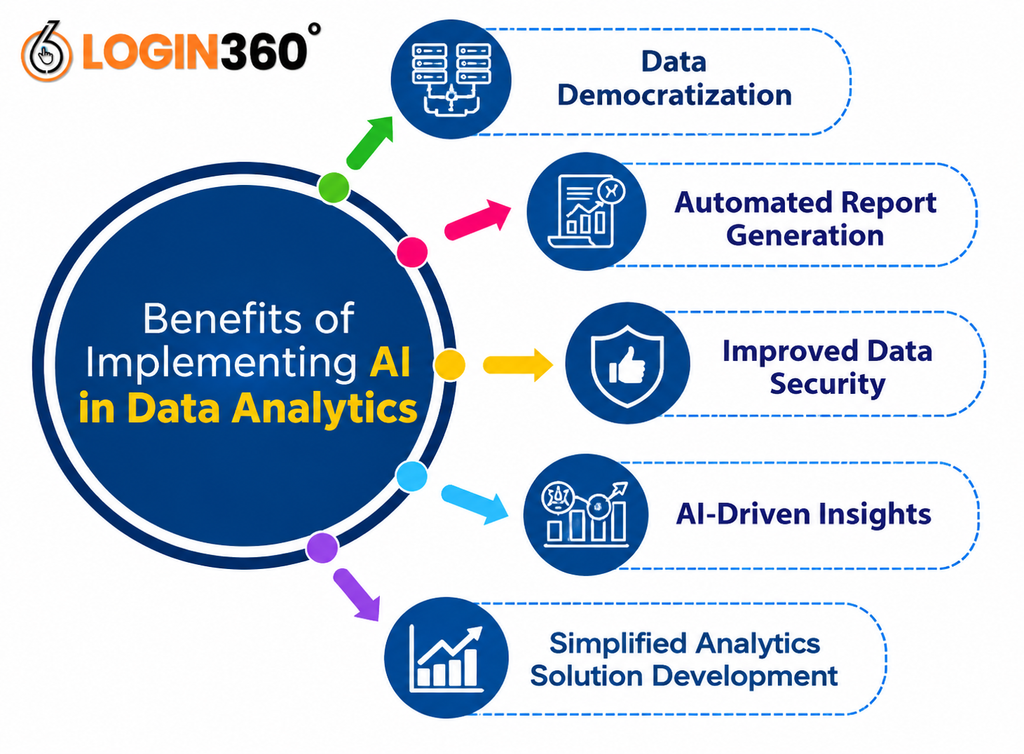
There are numerous benefits to implementing AI enabled data analytics. Correctly utilised, it facilitates easier data analysis and can therefore enhance decision making. Time and labour efficiency-An important benefit of AI is that it can automate functions and so decrease the amount of manual labour that is needed. AI can be used to automate data manipulation, query and report production.Analysts can thus dedicate more time to addressing key business issues.
- Facilitating data analysis for novices-In the past, data analysis has generally necessitated a good understanding of a range of areas including coding, statistics and relevant software. Generative AI is enabling data analysis in a more user-friendly manner by allowing individuals to query data in plain language.Novices can use Generative AI to gain an understanding of data, as well as statistical and data analysis knowledge.
- Enhancing decision Making-Businesses require quality data in order to make sound decisions. AI can detect trends and compare business performance. It can also collate information from differing sources.Such data analysis can underpin decision making for multiple business areas including marketing, sales, customer service and business operations. Nevertheless, key decisions should always be validated using quality data.
- Enhancing data visualisation-Data visualisation can be an effective means of conveying information. Generative AI can advise on which type of visualisation to implement, produce relevant coding for visualisations and describe these.An analyst can seek AI advice in developing a visualisation to display a company’s year on year turnover progression and to contrast the performance of different products.
- Identifying trends and Patterns-Businesses frequently analyse vast quantities of data. Manually recognising all relevant patterns can be difficult. Generative AI can therefore help to identify distinctive variations, links and trends.Following this, analysts can further analyse these and decide whether they are pertinent for business planning.
Commonly Used AI Tools for Data Analytics
There are several AI enabled tools that can facilitate data analysis. These tools differ in terms of the functions that they offer and these will typically depend on the nature of data analysis and the business’ needs.
Below are common AI Tools for Data Analytics.
- ChatGPT-This AI can analyse data and also produce Python code and describe SQL. Users can upload compatible documents and then query the data that is held within them.It is particularly beneficial for novices as it can advise on data analysis and enable individuals to investigate data by querying it in an easy to understand manner.
- Microsoft Power BI-Microsoft Power BI is a widely used business intelligence tool that can be used to construct interactive reports and dashboards. Within this tool, Generative AI is used to analyse data, recognise trends and convey business insights.It is a good option for businesses wishing to track business performance and to visually display information.
- Google Gemini-Google Gemini can analyse data, formulate equations and collate information. Furthermore, it can advise on and investigate differing methods of tackling data related issues and can also explain complex information.
- Tableau-This is another widely used data visualisation and business intelligence tool. Generative AI functionality can be used within Tableau to analyse data, recognise trends and to develop insightful visual reports.It is especially advantageous for organisations requiring to convey business analysis to different sections of their business.
- Microsoft Excel with Copilot-Microsoft Excel is often utilised to manipulate and analyse data. Within Excel, Copilot features can be used to advise on data, collate equations and recognise trends. Furthermore, it can analyse spreadsheet data.These examples illustrate how artificial intelligence is increasingly being incorporated into data analysis. Despite this, analysts should validate AI derived outputs prior to using them in reports and/or for decision making.
Role of Machine Learning in Data Analytics
Machine Learning in data analytics as it enables businesses to recognise trends, predict future events and analyse historical data.Machine learning is a sub-branch of artificial intelligence. It enables computer systems to learn and to become progressively more proficient at executing tasks, even without specific programming for each function.Whilst there are similarities between machine learning and generative AI, the aims of these two areas of artificial intelligence differ. Machine learning can recognise trends and predict future occurrences. Generative AI can on the other hand, formulate original content, descriptions and code according to user instructions.
Important applications of machine learning are:
- Customer Behaviour – Assists in identifying what consumers are interested in, buy and prefer.
- Sales Forecasting – Predicts future sales and demand, based on historical data.
- Fraud Detection – Enables the recognition of anomalous and potentially fraudulent business activity.
- Customer Segmentation – Categorises consumers according to shared attributes and behaviours.
- Predictive Analysis – Predicts likely future events, informed by historical trends.
Machine learning and Generative AI can be combined to further enhance data analysis. For example, a machine learning system may detect a shift in consumer behaviour and Generative AI can advise on this in plain language.
Real World Examples of Generative AI in Data Analytics
Across a wide range of sectors, Generative AI is currently being utilised to facilitate data related functions. The application of Generative AI will typically be affected by the nature of a business’ needs and the data that is available alongside the tools that are adopted.
1. Healthcare
Healthcare businesses analyse a large volume of data relating to both patients and business operations. AI can be used to collate and analyse data.Although AI can be of assistance, medical decisions must always be supervised by, and validated using, the knowledge of qualified personnel.
2. Banking and Financial Services
Within banking and financial services, data regarding business transactions, customers and market conditions is examined. Generative AI can be employed to collate financial data and to analyse trends. It can also support report production.
3. E-Commerce
E-commerce sites gather data on what consumers buy, search and view. AI can then be used to analyse this data and to ascertain consumer preferences. Moreover, it can identify popular products and hence inform marketing strategy.
4. Digital Marketing
Digital marketing professionals analyse data extracted from Google and Meta Ads along with website and social media data. Generative AI can collate data and analyse trends. Reports can also be developed.For instance, AI can advise on aspects such as the number of impressions, clicks and conversions that a digital marketing campaign receives and the expenditure incurred. Marketers can then use this information to target areas that may require further development.
5. Education
Educational establishments can utilise AI to analyse student performance and behaviour. AI can also advise novices on data analysis by describing information in plain language and providing relevant examples.
Skills Required for a Career in AI Enabled Data Analytics
As artificial intelligence continues to become further embedded within data analysis, students and professionals are encouraged to acquire relevant technical and problem solving skills.
Key skills for individuals seeking to pursue a career in this sector include:
- Excel – Suitable for data collation, calculation and basic analysis.
- SQL – Enables data to be accessed, selected and managed.
- Python – Can be used for data manipulation, analysis, automation and machine learning.
- Power BI – Good at producing interactive dashboards and reports.
- Statistics – Useful for recognising trends and links and for analysing numerical data.
- AI Tools – Familiarity with AI tools can enhance an individual’s workflow.
- Communication – Enables clear description of data analysis.
By acquiring these skills, novices can establish a solid knowledge of data analytics. This can then underpin their progression into diverse careers.
Future of Generative AI in Data Analytics
Artificial intelligence will increasingly become interlinked with data analytics in the future. As AI continues to develop, businesses may utilise it to further streamline data analysis, to optimise report production, and to more effectively analyse data.Additionally, Generative AI is anticipated to further facilitate data analysis by making it more easily accessible to those without specialist technical skills. People may be able to converse with AI to investigate business data, compile reports and analyse trends.Despite the increasing integration of artificial intelligence, technical skills will continue to be important. Individuals with good data, data analysis, coding and AI tool knowledge will be well placed to engage with artificial intelligence.
Conclusion
Generative AI is transforming data extraction, manipulation, analysis and interpretation. It is facilitating the automation of processes and the production of reports as well as the analysis of data in an accessible manner.The integration of Generative AI in Data Analytics is opening up fresh possibilities for businesses and professionals to work more efficiently. Nonetheless, it remains crucial for businesses to recognise the importance of data quality, and also to ensure appropriate human oversight.Students can establish a strong basis for a career in data analytics by acquiring skills relating to Excel, SQL, Python, Power BI and AI tools.
Frequently Asked Questions (FAQs)
What is Generative AI in Data Analysis?
Generative AI in Data Analysis uses artificial intelligence to analyse datasets, generate insights, create reports, and simplify complex analytical tasks.
How is Generative AI changing data analytics?
Generative AI is changing data analytics by automating repetitive tasks, generating SQL queries, summarising reports, identifying patterns, and helping businesses make better decisions.
What are the benefits of using Generative AI in Data Analytics?
The main benefits include faster data analysis, automated reporting, improved productivity, better data visualisation, easier data interpretation, and smarter decision-making.
Which AI tools are commonly used for Data Analytics?
Popular tools include ChatGPT, Google Gemini, Microsoft Power BI, Tableau, and Microsoft Excel with Copilot. These tools support different data analysis and reporting activities.
What is the difference between Generative AI and Machine Learning in Data Analytics?
Machine learning identifies patterns and makes predictions using data, whereas generative AI creates content, summaries, explanations, and code based on user instructions.