
Introduction:
The future of digital marketing using artificial Intelligence is now entering mainstream marketing. It can analyse data and even advise and generate content, equipping professionals trained through a Digital marketing course in Chennai to work faster and smarter Alongside other digital areas, AI is likely to continue to transform and add value to marketing. As well as the technology used, a number of other important issues will affect organisations’ use of artificial intelligence. These include the standard of data held, organisational objectives and human expertise. Customers’ confidence in a business will also play a key part. Overall, AI is likely to transform aspects of marketing.
Future of digital marketing using Artificial Intelligence supported marketing activities:
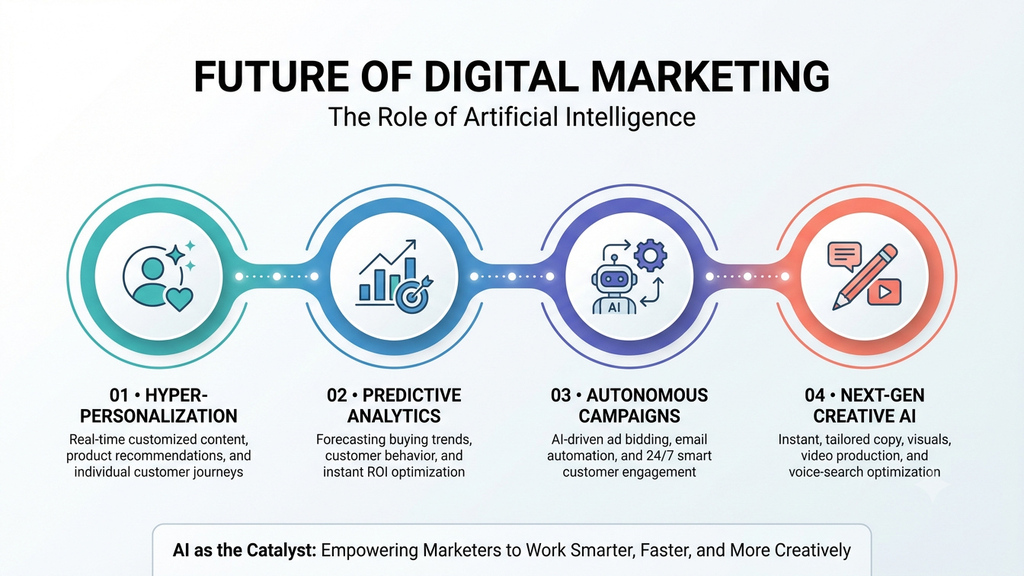
Digital marketing has continually evolved as consumer behaviour, buying behaviour and methods of interaction and decision making change. Artificial Intelligence is the next significant development as it can analyse data and advise or even generate content. Already, AI is utilised for example in digital advertising, personalised product suggestions and for analytical, marketing and customer service functions. In the future these functions may well become standard in marketing and customer management software. Although there is likely to be diversity in how different businesses implement AI, larger global retailers may extensively utilise AI for decision making given access to substantial data resources. Smaller, local service providers may choose to adopt AI for writing and basic analytical functions.
Influencing factors:
- AI ‘helpers’ may be further integrated into common business software to assist with creation, analysis, editing and re-shaping of content.
- AI can be used to analyse data to predict consumer demand, product/service standards, consumer loyalty and marketing effectiveness. This can enable improved and more thorough marketing planning and testing.
- Conversational search and AI responses may transform how consumers seek information. Consequently the importance of high quality, reliable and well organised communications will continue.
- Marketing communications (including web pages, electronic mail and product suggestions) may become increasingly personalised and react more promptly to individual consumers’ requirements and preferences.
- Cross-functional integration may be enabled by AI so that digital advertising, electronic mail, selling and customer services can function more seamlessly. This may therefore decrease the need for manual inter-departmental coordination.
- Consumer concerns and regulation may encourage more rigorous data gathering, together with open provision of choices. Businesses may also seek to increase their usage of primary data.
- Technology may easily facilitate the generation of computerised imagery, audio and video. Again, the importance of analysing, verifying and openly identifying such computer generated communications will grow.
- Additional AI functionality may allow smaller businesses to achieve functions previously associated with larger teams, specialist agencies and expensive software.
- Whilst new AI related possibilities exist, their success will largely depend on how effectively they address consumer and business needs.
Enhanced customer experience:
Marketing is likely to ever more effectively address specific consumer requirements. For instance, an e-commerce organisation can refine searches and recommend complementary products using relevant product information and consumer preferences. Software companies can customise introductory guidance for consumers according to which aspects of their software they begin to utilise. Travel businesses can advise consumers on suitable destinations according to factors including money, time and interests. Effectively and easily controllable personalisation can ease consumer experience. However, marketing can intrude if it accesses unanticipated consumer data or forms hard-to-amend misconceptions. Marketing professionals must therefore sensitively balance personalisation and privacy. Communications should explicitly state where AI has been used.
Changes to functions and functioning:
- Marketing content professionals can utilise AI to conduct research, develop structures for and author content. Human team members can then apply their specialist knowledge, creativity, accuracy and brand awareness.
- Marketing analysts can devote more time to analysing data and evaluating insights. They can also audit data quality and advise on marketing decision making.
- Marketing campaign professionals can oversee AI led bid and audience targeting processes. Budgetary controls will be important and there should be ongoing assessment of the standard of leads.
- Marketing and customer services professionals can collaborate to define chatbot replies, referral procedures and subsequent communications arising from commonly asked consumer queries.
- Marketing operations professionals can integrate software, define working processes and define user access. In turn they can guide others in software utilisation.
- New functions may involve AI oversight, content evaluation, data management and experimental and front-line digital marketing design.
- Within smaller teams individuals may undertake several functions. Strong digital skills and practical acumen will thus be highly beneficial in addition to software competences.
- Whilst technology will affect marketing, greater emphasis may shift towards strategic planning, evaluation, problem solving and cross-function co-operation.
Evaluation, Forecasting and Decision Making:
AI can analyse detailed marketing data to recognise trends and even predict future events—a data-driven approach taught in a practical Digital marketing course in Coimbatore to help marketers make smarter campaign decisions. Retailers may for example use predictive analysis to stock for peak selling periods. Subscription businesses may analyse data to recognise where extra consumer support may be required. Furthermore, unlike just last-click analysis, marketing analysts can analyse the extent to which diverse channels contribute to consumer conversion. Providing data is pertinent and well managed, such analytical techniques can effectively inform decision making. Nevertheless, poor data auditing, under-representation of consumer groupings and/or optimisation of the incorrect data metric can all exacerbate inaccuracies.
Required skills:
- Consumer awareness – Develop knowledge of research, audience sub-sections, consumer journeys and also of non-digital consumer engagement.
- Strategy – Relate marketing to business aims. Evaluate optimal channels and define what constitutes a positive outcome.
- AI comprehension – Identify how to apply AI to a challenge, incorporate relevant background and analyse the advantages and disadvantages of AI. Good definition of requirements can also enhance AI functionality.
- Data awareness – Recognise and analyse widely-employed data metrics. Evaluate data quality. Identify and assess ambiguity and also differentiate between association and causality.
- Content evaluation – Assess the accuracy, source, style, innovativeness and appropriateness of AI supported content prior to release.
- Team-working – Convey AI insights and co-operate with those working in creative, technological, sales, analytics and customer services functions.
- Ethical awareness – Show regard for consumer permission, manage consumer data, recognise potential discrimination and establish when human involvement is necessary for decision making.
- Lifelong learning – Monitor developments in software and consumer behaviours. Also cultivate versatile skills, rather than focusing solely on one software product.
- Individuals with such skills can allow businesses to effectively employ technology.
Confidence, Data and Ethical Innovation:
Consumer confidence will be highly influential for an organisation’s future AI marketing utilisation. Businesses will need to openly communicate the type of data they acquire, the reasons for doing so and consumers’ available options. Data gathering should relate solely to required functions. Data must also be securely managed and distinct access provisions defined for staff and software. Marketing leaders should also evaluate whether their AI systems are applying fair treatment to audiences. Historic data may for example not accurately represent current consumer behaviour leading to a targeting function missing out potential consumers. Likewise, an AI based suggestion facility may continually promote a limited selection. Ongoing evaluation can assist in recognising such issues.
Organisation Preparation for AI Supported Marketing:
- Identifying a particular consumer or team issue (such as persistent consumer queries, slow marketing creation or challenges in analysing marketing effectiveness).
- Define quantifiable objectives and audit present circumstances to enable progress to be assessed against existing performance.
- Select an application for AI and ensure that this can be integrated with current processes, staff competences and data handling.
- Confirm the necessity and appropriateness of data for the selected application. Avoid unauthorised dissemination of confidential data.
- Designate someone to assess, manage and amend poorly performing or inappropriate AI outputs.
- Undertake a small trial of the AI applications (perhaps with a limited number of consumers and/or items). Obtain consumer and staff feedback.
- Monitor key performance indicators such as suitable conversion rates, response quality, consumer satisfaction, expenditure and staff time investment.
- Refine, extend or discontinue the AI application depending on the trial findings. Ensure that records are up to date as software and policy evolves.
- This empowers marketing teams to educate themselves before widely implementing AI supported consumer engagement.
Conclusion:
AI is set to affect digital marketing in relation to audience analysis, content production, customer engagement, and evaluation, making well-rounded training through a Digital marketing course in Kochi essential for staying ahead Although different businesses will be affected differently by AI, core marketing principles of audience awareness, appropriate proposition development, lucid communication and evaluation will continue to be vital. Marketing professionals will require knowledge of AI, data, content, team-working and ethical issues. Businesses can prepare by appropriately defining AI applications, managing consumer data and evaluating progress. Viewing AI as a means of adding value to marketing, rather than an end in itself, will enable marketing to be more responsive.