
Introduction:
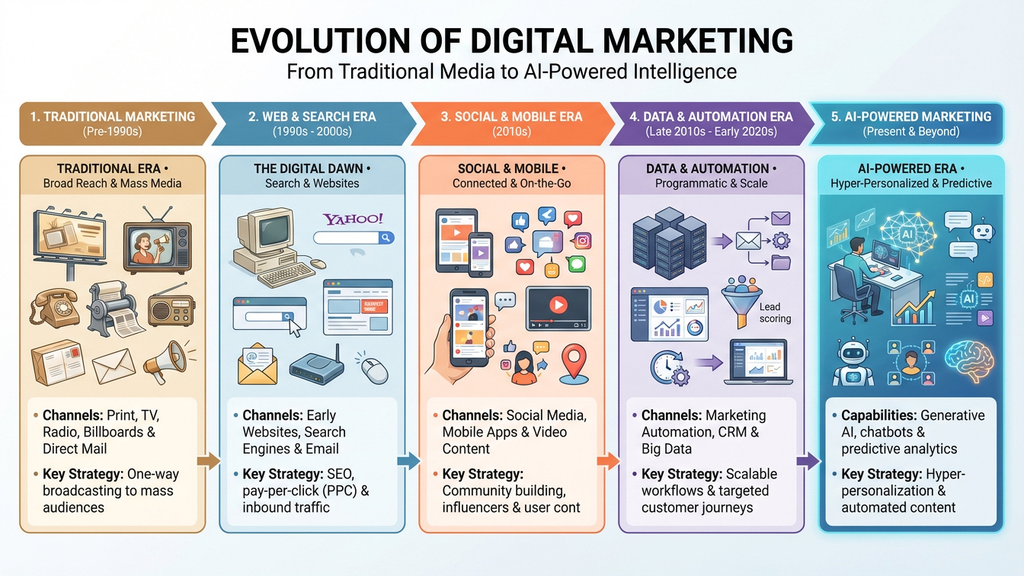
Evolution of digital marketing as society develops, so too does the way in which people communicate, access information, and buy—a shift that drives modern strategies taught in a practical Digital marketing course in Chennai. Historically organisations have used a range of avenues including print, radio, TV, face-to-face, direct mail and so on. Developments in the internet led to innovations such as websites, email and social media and so on, providing further methods of engagement and enabling firms to analyse this. The latest innovation is artificial intelligence, which can analyse, create and automate processes and enable personalisation. Although new technologies add new marketing functions, previous approaches continue to inform current practice.
Evolution of digital marketing traditionally:
Traditionally marketing has used, for example, print, radio and TV, alongside face-to-face engagement, special events and direct mail to communicate with consumers. Usually the most suitable medium(s) would be identified according to both target and geographical area. Marketing messages were developed to engage and familiarise consumers with a product/service. Further insights were often gathered from face-to-face engagement, sales, promotions, questionnaires and market research. However, it could be hard to accurately assess effectiveness. Companies may recognise that marketing has boosted in-store footfall for example, but may struggle to identify which ad in particular drove individuals’ buying behaviour. In fact, although not always, traditional marketing can be two-way and effective. Direct mail can be personalised and local events facilitate relationship building.
Digital Marketing Developments:
- Web development: Organisations began to host web-pages containing details of both their and their product’s features and contact information. Consumers could hence access information beyond regular trading hours.
- Email and e-commerce: Companies could engage directly with consumers via electronic mail and furthermore enable them to shop online. Order data provided new ways to analyse consumer interests.
- Search engines: Businesses utilised search engine marketing and optimisation to ensure visibility when individuals proactively seek out information regarding products and/or services.
- Social media: Companies could update and engage with consumers and develop communities. Public sentiment could also be analysed.
- Mobile: Smart-phones facilitated digital engagement via websites, apps and location data and alerts.
- Analysis and digital advertising: Organisations were able to more rapidly analyse consumer web-site navigation and behaviour together with associated conversion and advertising expenditure.
- Marketing automation: Marketing functions such as communications with subscribers, nurturing leads and life-cycle marketing could be automated.
- AI: Many processes benefitted from AI, for instance machine learning and generation enabled predictive analysis, advice and content creation as well as natural language engagement.
- Whilst some developments were sequential there was also cross-over. Organisations continue to integrate digital and non-digital marketing.
Digital Marketing – Engagement and Analysis:
Digital marketing has transformed how companies engage with consumers, inspiring professionals to upskill through a Digital marketing course in Coimbatore to master modern outreach channels .Websites offer 24/7 access to information. Moreover, following ad exposure, email and social media afford ongoing engagement. People seeking solutions can be targeted using search. Compared to much print media, digital marketing affords greater flexibility in targeting and enables quicker adaptation. Data can also be analysed to further inform marketing. Insights are available regarding how, and from where, consumers visit a site together with their web-site navigation and conversion. Again however, simply analysing data does not necessarily guarantee good quality insights.
Traditional, Digital and AI Marketing:
- Traditionally, mass local and/or national awareness can effectively be raised using print, radio, TV and/or direct mail. Nevertheless, there may be a longer timescale for modifying marketing and for analysing its effectiveness.
- Compared to traditional marketing, digital avenues allow consumers to search for information and engage in two-way communications. Digital media including websites, email, search, apps and social media skills can also operate more swiftly.
- AI marketing enables pattern analysis, option generation and prediction. It can further automate digital processes.
- Insights can be obtained from interviews and questionnaires, digital engagement and analyses, and/or AI supported collation of information to effectively structure multiple sources of data.
- Personalisation can vary from face-to-face tailoring of marketing messages, to segmentation of electronic mail and/or recommendation systems informed by consumer data.
- Alongside conventional engagement and analysis metrics (such as reach, response, clicks and conversion), predictions and automated optimisation can also be analysed but still require human supervision.
- Good interpersonal skills, together with provision of relevant, well explained and dependable service, are key to engendering consumer trust.
- Appropriate marketing media should be determined by target audience and aim. Not all marketing is optimally served by the most up-to-date technology.
- Indeed, rather than viewing marketing developments sequentially and considering old methods to therefore become redundant, integration of differing marketing approaches can be effective.
Introduction of AI Marketing:
Compared to digital marketing, AI further enhances functionality by enabling pattern analysis, advice, content creation and natural language engagement. For example, machine learning can inform auction bidding, product recommendation, lead scoring and prediction, all informed by historical data. Generative AI can assist in the ideation, creation, collation and/or modification of marketing content. Chatbot technology can address straightforward consumer queries and escalate more complex issues. These functions can therefore decrease mundane activity and facilitate wider exploration of marketing ideas within constrained timescales. Nonetheless, AI is reliant on data, guidance and aims for its outputs.
Application of AI in Marketing:
- Research: Search and digital advertising can be used to ascertain consumer interests. Marketers can then modify marketing accordingly and analyse effectiveness.
- Ideation: AI can collate general queries, plus review and reporting data to firstly highlight compelling areas for further article/video content explanation.
- Evaluation: Consumers can be directed to appropriate products/services via recommendation and/or evaluation facilities, according to both declared and browsed requirements.
- Sales: A web-site chat function can address consumers’ basic enquiries relating to, for example, products, delivery and reservations. More complex issues can then be escalated to a human.
- Engagement: Automation can be used to send welcome, re-subscription and/or educational emails, personalised according to consumer preference and with relevant permission.
- Analysis: Unusual conversion trends can be highlighted and digital marketing variants can be analysed against defined aims.
- Service enhancement: Common areas of consumer difficulty, revealed through analysis of support exchanges, can be identified. Appropriate information can then be reviewed to ensure it is clearly expressed.
- Content: Generative AI can produce alternative headline and/or marketing content. An editor can then verify that this is factually accurate, and is appropriately styled, novel and comprehensible.
- Across these application areas human supervision is essential. Moreover, assessment should focus on consumer value, not just activity levels.
Changes and Continuities:
From historically predominantly one-way dissemination of information and approximate effectiveness assessment, marketing has moved towards two-way engagement and greater data-led functioning. Organisations can now more rapidly analyse digital consumer behaviour and experiment with different marketing approaches. AI further enhances data analysis, ideation and automation functionalities. Despite these developments, the fundamental marketing function remains largely unchanged. It continues to involve understanding people, providing them with valuable offerings and effectively communicating this. Elements such as trust, innovation, expertise and service are nevertheless challenging to adequately automate since they require contextual awareness and supervision. Throughout marketing history, companies consistently encounter issues relating to target audience identification, efficient resource allocation, honest representation and assessment of whether marketing is generating substantive value.
Implementing AI Marketing:
- An organisation can effectively introduce AI by considering current marketing, consumer insights, internal working practices and aims. It can then identify a common issue to address (for example, delayed engagement, disordered data or limited variation in marketing).
- A quantifiable aim should be established and a baseline identified so that an organisation can assess whether and to what extent modifications result in positive impact.
- Following this, an appropriate AI marketing tool can be selected, taking into account existing infrastructure, employee competencies, data handling and financial resources. Also consumer expectations should be considered.
- Only relevant data should be analysed and care must be taken to ensure that confidential data is not unnecessarily divulged.
- An individual should oversee AI functioning, handle exceptional situations, rectify mistakes and explain how the AI is being utilised for marketing purposes.
- Pilot implementation should occur. Appropriate factors to analyse include accuracy, consumer experience, employee effort and cost effectiveness, alongside business impacts.
- Based on analysis, AI applications can then be rolled out, adapted and/or discontinued. Continued monitoring is also vital given that both tools and consumer profiles and policies will evolve.
- This process facilitates organisational learning and ensures human supervision of consumer experience.
Conclusion:
Digital marketing has advanced from traditional media and face-to-face marketing to encompass web, search, social media, mobile, automation, and AI—a full-spectrum skillset covered in a practical digital marketing course in Kochi. Each development has further enhanced marketing communication, analysis and service provision. Crucially, core marketing functions have remained consistent. Artificial intelligence can analyse, ideate and personalise marketing, and automate processes. However, it cannot substitute for strategic thinking, trust or human supervision. Effectively, organisations can utilise relevant technology, analyse data appropriately and assess impacts against significant aims. Ideally, innovative technology is underpinned by sound adherence to key marketing principles of clear communication and consumer understanding.