
Introduction:
Do you know h Netflix suggests films to people, how online retailers make personalized product recommendations, and how banks recognise unusual activity? All of this is made possible using technologies such as Python, Artificial Intelligence, Machine Learning, and AI skills for Data Science. Companies now routinely gather vast quantities of data. Individuals need to be trained to effectively analyse data, recognise patterns, and use this knowledge to solve business issues and inform decision-making. Artificial Intelligence then builds upon these processes, enabling computer systems to “learn” and carry out smart processesIf you aspire to pursue a data science career, gaining skills in Python and Artificial Intelligence through a comprehensive Data Science Course in Chennai can be highly beneficial.
Python and AI Skills for Data Science :
Python is a straightforward programming language which is frequently used within data science, artificial intelligence, and machine learning. Python and AI Skills for Data Science It is used to analyse data and automate business processes, and models can also be developed using Python.
Core Python skills to learn include:
- Variables and data types
- Lists, tuples, and dictionaries
- Conditionals
- Loops and functions
- File manipulation
- Object-oriented programming
- Exception handling
For example, an online retailer may wish to analyse and automatically calculate its daily sales figures, which can be achieved using Python. By initially studying basic Python skills, individuals can then build up to more advanced data science and AI skills.
Key Python and AI Skills for Data Science Software:
In addition to the Python programming language, key software packages are available that can further ease and speed up data science processes by helping you analyse and manipulate data.
Key Python and AI Skills for Data Science Software:
- NumPy – enables numerical and mathematical analysis and array manipulation.
- Pandas – used to manipulate and analyse structured data, particularly effective for working with Excel and CSV data.
- Matplotlib – produces various graphical data displays.
- Seaborn – used to visually display data and recognise inter-relationships.
- Scikit-learn – contains tools for constructing, testing, and assessing machine learning models.
Acquiring knowledge of such software demonstrates how Python can practically be utilised within data science.
Data Cleansing:
Prior to analysing data, data scientists must ensure that the information is both accurate and well-structured. Typically, raw data will include inaccurate, duplicated, and/or incorrectly formatted entries. Poor-quality data can result in erroneous conclusions being drawn, making data cleansing skills highly valuable for those in the data science profession.
Key data cleansing skills comprise:
- Removing duplicates
- Managing missing data
- Ensuring data is correctly formatted
- Recognising anomalies
- Scaling numerical data
- Converting non-numerical data into numerical data
An online retailer will typically collate data on its customers and may encounter issues such as incomplete contact details, duplicate email addresses, and/or erroneous purchasing records. Python and Pandas can be used to cleanse data so that it can then be analysed.
Artificial Intelligence Skills:
Artificial Intelligence is technology that enables computers to undertake tasks that would typically require human intelligence. Across multiple sectors—including healthcare, banking, education, retail, manufacturing, and transport—AI is frequently utilised. Data science professionals benefit greatly from knowledge of artificial intelligence, as it can be used to automate business processes and provide valuable insights.
Key areas within artificial intelligence include:
- Natural Language Processing
- Computer Vision
- Neural Networks
- Deep Learning
- Generative AI
- Predictive Analytics
Artificial intelligence can, for example, be utilised both to respond to customer queries using chatbot technology and to recognise items within pictures using computer vision. Such knowledge can open up a variety of career paths for those wishing to enter the world of data science.
Python and AI Skills for Data Science Machine Learning:
Machine Learning is a vital area within artificial intelligence. Unlike traditional programmes where specific coding is written to deal with each situation, machine learning allows computers to analyse past data to recognise patterns and subsequently make predictions. Python offers a range of software to facilitate the development of machine learning models.
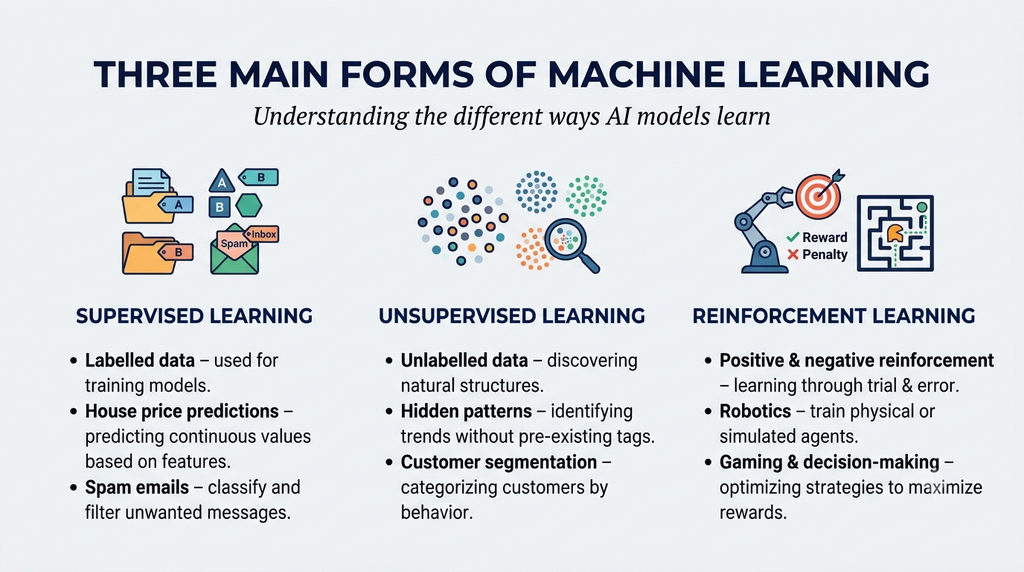
There are three main forms of machine learning:
- Supervised Learning – labelled data is analysed to enable models to learn; for instance, house price predictions can be made and spam emails recognised.
- Unsupervised Learning – involves recognising concealed patterns within unlabelled data; customer segmentation is often employed in business to classify customers according to their buying habits.
- Reinforcement Learning – models learn from positive and negative reinforcement, which is frequently applied to robotics, gaming, and decision-making.
By studying machine learning methods such as Linear Regression, Logistic Regression, Decision Trees, Random Forest, and K-Means Clustering, individuals can further comprehend how artificial intelligence can practically be applied.
Data Visualisation Skills:
Data visualisation is the representation of data in an easily comprehensible format such as graphs, charts, and dashboards. Because data can sometimes be difficult to interpret from large tables, data visualisation is an important skill for companies.
Notable data visualisation software includes:
- Matplotlib
- Seaborn
- Power BI
- Tableau
- Excel
For example, a business may wish to assess its monthly sales performance. Using visualisation software, a data science professional can produce a dashboard illustrating key metrics such as monthly turnover, best-selling goods, and customer trends rather than analysing thousands of data entries manually. Excellent data visualisation skills enable professionals to effectively convey their findings to business teams and decision-makers.
SQL and Database Knowledge:
SQL (Structured Query Language) is a key skill utilised to interact with databases. Many businesses maintain databases containing details on their customers, sales, staff members, and transactions, and data science professionals apply SQL to access and analyse this data.
Important SQL skills involve: SELECT and WHERE statements
- Applying ORDER BY and GROUP BY
- Implementing JOINs
- Using aggregate func
- Constructingtions
- Creating sub-queries
- Database management
If an e-commerce firm wishes to determine which five products sell most effectively, SQL can be used to retrieve relevant details from a sales database. Python and SQL can therefore be combined to more effectively manage and analyse data.
Generative AI and AI Software:
Generative AI is another crucial element of current technology, capable of producing text, images, code, and more in line with user instructions. Data science professionals can utilise generative AI software to boost efficiency and support their work.
Well-known AI and data science software includes:
- ChatGPT – can clarify Python code, ideate, and analyse data.
- Google Gemini – facilitates research, content creation, and issue resolution.
- GitHub Copilot – supports coders in both writing and understanding code.
- Jupyter Notebook – an interactive platform for data analysis and Python coding.
- Google Colab – enables people to write and run Python code online.
Despite the benefits of AI, professionals should still verify the accuracy, data privacy compliance, and reliability of outputs produced by this technology. Furthermore, individuals should endeavour to understand coding and data analysis rather than relying solely on AI software.
Problem-Solving and Analytical Skills:
Whilst technical skills are key to success within data science, strong problem-solving and analytical skills are equally important. Professionals must be able to determine business needs, source suitable data, and analyse it to advise on appropriate solutions.
For instance, if an online retailer identifies that its monthly sales are falling, a data science professional can:
- Obtain historical sales data.
- Cleanse and structure this data.
- Assess customer buying behaviour.
- Recognise under-performing goods.
- Construct predictive models where applicable.
- Display data analysis findings on dashboards and reports.
Such skills enable professionals to effectively transform data into valuable business insights.
Undertaking Data Science Projects:
Practical application is a highly effective way to enhance one’s Python and AI skills. Within projects, theoretical knowledge can be applied to address real business situations. Novices can begin by undertaking basic projects and then gradually progress to more advanced ones.
| Project | Required Skills |
| Sales Analysis | Python, Pandas, Matplotlib |
| Customer Segmentation | Python, K-Means |
| Spam Email Recognition | NLP, Machine Learning |
| Film Suggestion | ToolPython, Recommendation Systems |
| Housing Price | Python, Machine Learning |
| Customer Churn Forecasting | Python, AI, Data Analysis |
Undertaking projects not only allows students to practically apply their knowledge but also assists in building a portfolio that can be presented to employers during interviews to demonstrate an individual’s competencies.Those keen to further their technical knowledge can explore a Data Science Course in Coimbatore to obtain knowledge about data analysis, programming, and artificial intelligence applications.
Commencing a Python and AI Skills for Data Science Career:
Although embarking on a data science career may initially appear daunting, especially for novices, a clear learning pathway can help simplify the process. Below is a basic guide to follow:
- Study Python: Acquire knowledge of programming, variables, loops, functions, and data structures.
- Study SQL and Excel: Enhance your ability to access, structure, and analyse business data.
- Study Data Analysis: Practice utilising key data analysis software, such as NumPy, Pandas, Matplotlib, and Seaborn.
- Study Machine Learning: Understand how algorithms function together with how to train, test, and predict using models.
- Study Artificial Intelligence: Acquire knowledge of artificial intelligence, deep learning, Natural Language Processing, and generative AI.
- Undertake Projects: Use real data to construct projects and record your process.
- Construct a Portfolio: Publish your projects on a platform such as GitHub and build a resume that emphasises your technical competencies.
Students can utilise this pathway to methodically develop the knowledge essential for pursuing entry-level data science roles.
Benefits of AI skills For Data Science Training:
Whilst self-directed study can be successful, structured training can also be highly advantageous. Typically, training delivers knowledge in a logical sequence, combining practical activities, project work, and expert tuition to facilitate learning..Students and working professionals in Kerala can investigate Data Science Training in Kochi to further their technical skills and engage in project work.When deciding on which training institute to attend, it is important to investigate the training programme, tutor experience, project provision, and the level of support and career advice available.
Conclusion:
Python and Artificial Intelligence are significant technologies playing a key role in the progression of data science. Alongside areas such as data cleansing, data visualisation, machine learning, and Generative AI, they allow data science professionals to address business issues and inform decision-making.Whilst knowledge of Python, SQL, machine learning, data visualisation, and AI software is valuable for those seeking to commence a data science career, continual practice and project involvement are equally important. Whether you are a student, new graduate, or working professional, start with foundational knowledge, consistently practice your skills, and progressively investigate more sophisticated technology.