
Introduction
Data has become an integral part of most businesses. Data can be collected from websites, social media, customer interaction, sales and online transactions. Using this data can help businesses make better decisions, however AI Powered Data Analytics is proving to be increasingly helpful.Artificial Intelligence is transforming the way data is analysed and understood by businesses. Traditionally data analysts would take a long time to collect data, produce spreadsheets and determine patterns and produce reports. However AI can help simplify some of these tasks.Using AI in Data Analytics means businesses can process lots of data. Businesses can now understand their customers, see opportunities and predict trends. Using AI powered technologies can help professionals in small to large scale businesses make quicker and more informed decisions.In this blog we will explain what AI Powered Data Analytics is, what the benefits are, some popular tools, real-world examples and future opportunities.What Is AI-Powered Data Analytics is when you use artificial intelligence technology to collect, analyse and interpret data. This involves using traditional data analysis methods but also using AI technologies like machine learning, natural language processing and predictive modelling.Traditionally data would be analysed by hand. This would require creating reports and finding patterns. However this can be time consuming with large amounts of data.AI can help identify patterns, automate analytic tasks and provide insight.For example if you run an online shopping company, you will receive thousands of orders every day. Manually going through each customers’ purchasing behaviours wouldn’t be quick. Using AI powered analytics can help you understand what products your customers like, identify buying patterns and make product recommendations based on their interests.This can help give businesses a better understanding of their customers.
Benefits of AI in Data Analytics
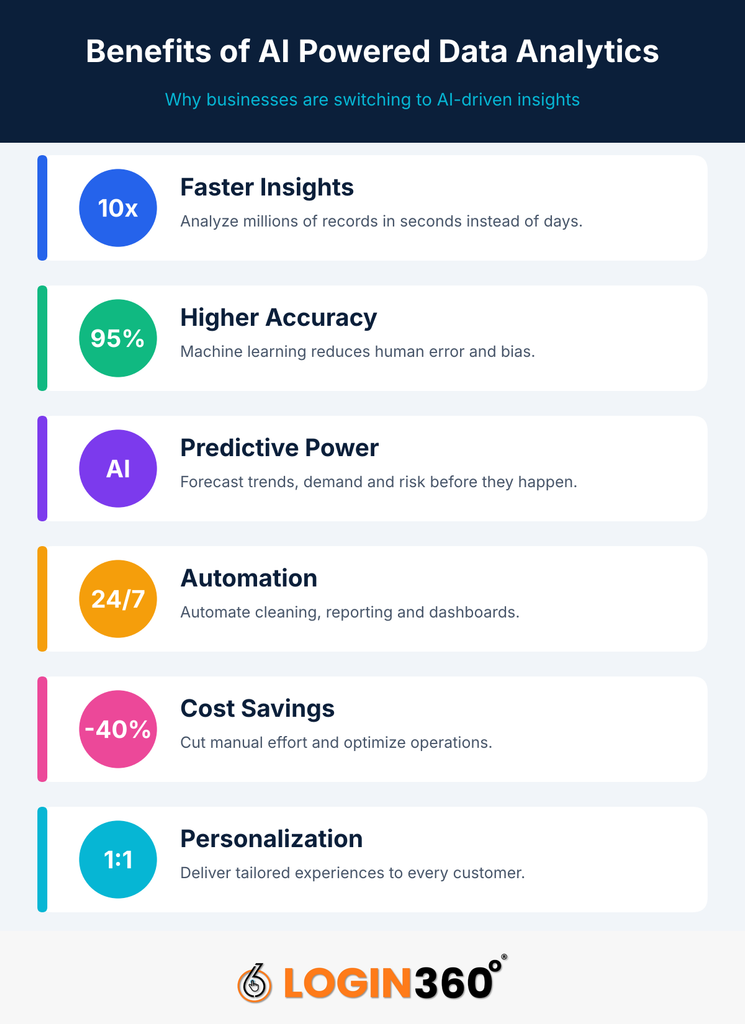
There are many benefits to using AI in data analytics. This can help improve productivity, reduce manual tasks and make decisions based on accurate data.
1. Quick Data Processing
One of the main benefits of using AI is that it can quickly process large amounts of data. Businesses will generate data from various sources such as websites, mobile apps, customer databases and social media.This can take hours and sometimes days to process by hand. AI powered tools can process large amounts of data quickly. This can help analysts identify key information.This can help professionals save time on repetitive tasks and focus on understanding business needs.
2. Better Decision Making
Using accurate data can help make business decisions more effective. AI can help organisations understand past information, identify current trends and provide useful recommendations.For example a retail company can look at past sales data to see which products are selling the most. They can then plan inventory, improve their marketing campaigns and prepare for seasonal demand.AI doesn’t replace humans, but provide extra information to help professionals make better decisions.
3. Accurate Data
Sometimes when working with large spreadsheets and complicated data sets there can be errors made by humans. This can impact the accuracy of the data analysis.AI can help identify any anomalies, missing data, duplicate data and inconsistencies.However this will depend on the quality of data being used. Professionals will need to review the analysis and ensure accuracy.
4. Predict Trends
AI can look at past data and help identify patterns which can help businesses understand what may happen in the future.For example an e-commerce company can look at past sales data, customer interests and seasonal buying behaviours to help predict future product demand.This can help businesses plan inventory, resources and marketing.
5. Reduce Manual Tasks
Many data related tasks can be repetitive. This includes cleansing data, creating reports and organising data.AI can help automate many of these tasks. This can help reduce the amount of time spent carrying out daily analysis.This can help data analysts focus on important tasks such as interpreting data, identifying business issues and providing useful insights.
Popular AI Tools for Data Analytics
There are many platforms available today to help professionals analyse data and create useful reports. Some popular AI tools for data analytics include:
1. Microsoft Power BI
Microsoft Power BI is a popular business intelligence tool which can help transform raw data into interactive dashboards and reports. This can include natural language searches, automated insights and forecasting. You can connect data from various sources to track important business KPIs.This is a great tool for professionals wanting to understand how their business is performing via visual reports.
2. Tableau
Tableau is a popular data visualisation tool. It enables users to create charts, graphs and interactive dashboards. The analytical features can help businesses identify trends.Many companies use Tableau to track sales, customer behaviours and business performance.
3. Python
Python is an important tool within AI and data analytics. It is a programming language which includes various libraries to analyse data and create machine learning models.
Some popular libraries include:
Pandas – This helps organise, clean and analyse data.
NumPy – This enables numerical calculations.
Scikit-learn – This provides tools for creating machine learning models.
TensorFlow – This enables advanced machine learning and deep learning applications to be created.
Learning Python can help aspiring data analysts work with complex data sets and understand how AI based analytics solutions are created.
4. Google Looker Studio
Google Looker Studio can help businesses create visual reports based on data collected from various platforms.This is a useful tool for digital marketers looking to analyse website traffic, adverts and customer engagement.For example a marketing team can connect their Google Analytics data to create dashboards to understand how many visitors they are getting, where the traffic is coming from and how their campaign is performing.
5. ChatGPT
ChatGPT can help data analysts in various ways. It can help explain concepts, create SQL queries, Python code and summarise data.You can use this as a beginner to understand formulas, fix simple coding issues and learn different data analysis techniques.However any data provided by AI should be checked.
Applications of AI in Data Analytics
AI is being used in many industries. Below are some examples.
1. Healthcare Industry
Healthcare organisations will generate large amounts of data. This can include patient records, medical reports and diagnostics.AI can help analyse medical data to identify patterns, help with researching diseases and help healthcare professionals understand any potential health risks.AI can help with hospital management by analysing patient data.
2. Banking & Finance
Banks and financial organisations use AI to help monitor transactions. This can help identify any unusual activity and potential fraud.For example if a customer makes an unusual transaction suddenly, an AI based system can identify this.Financial organisations also use data analytics to understand customer spending habits, assess risks and improve financial services.
3. Retail & E-commerce
Online shopping platforms use AI to understand customer interests and buying behaviours.By looking at past purchases, browsing history and product preferences businesses can make product recommendations.AI can help retailers predict product demand, manage stock and improve customer experiences.
4. Digital Marketing
Digital marketing is another area where AI powered analytics is having a big impact. Marketers will collect data from Google Ads, Meta Ads, websites and social media. By analysing the results businesses can understand if their marketing activities are achieving the desired outcome.For example AI can help identify what your audience are interested in, analyse your campaign and identify patterns.Businesses can use this information to target their audience better, manage budgets and improve their campaigns.
5. Education Industry
Educational institutions can use AI to understand student performance, attendance, progress and course preferences.By analysing this data they can understand where students may need further support.AI based learning platforms can make recommendations based on individual progress.Machine Learning in Data AnalyticsMachine Learning in Data Analytics is an important part of modern AI. It enables computer systems to learn patterns from existing data and apply this knowledge to analyse new data.Instead of manually coding every instruction, machine learning models can identify patterns within data sets and improve through training.For example an online shopping platform can use machine learning to look at customers purchase histories. Based on their past purchases, the system can make product recommendations.
Some common uses of machine learning include;
- Customer behaviours
- Sales prediction
- Fraud detection
- Product recommender
- Customer segmentation
- Predict business performance
This can help make data analysis more effective by helping professionals find patterns and correlations.
Skills Needed To Build A Career In AI Powered Data Analytics
As more businesses are using AI, there is increasing demand for professionals with data analytics knowledge.Students and beginners should focus on improving their technical and analytical skills.
Some important skills to learn include;
- Excel – Understanding how to use spreadsheets, formulas, charts and basic data analysis.
- SQL – Learn how to extract, organise and manage data from databases.
- Python – Understanding basic coding and using libraries for data analysis.
- Power BI – Create dashboards, visual reports and interactive charts.
- Statistics – Understand basic statistics.
- Artificial Intelligence – Understand how AI and machine learning can help with data analysis.
- Problem Solving – Be able to identify business issues and find solutions using data.
By learning these skills using practical examples you can help beginners understand how data analytics works in a professional environment.
Future Of Data Analytics
The Future of Data Analytics will heavily rely on AI, automation and machine learning.Businesses are looking to understand data quickly and make better decisions. AI will make analytics tools more accessible to everyone. Even those without any technical knowledge can analyse data sets using simple language.For example instead of writing complex queries, you can simply ask a question such as “Which product generated the highest sales this month?” and get an analytical answer.
Automation will help reduce repetitive tasks and predictive analytics will help organisations identify opportunities. This will help them be prepared for any potential issues.More businesses will be using real time analytics. This means they can monitor their activities and adapt to their customers needs.However humans will still be needed. Data analysts will need to understand the business needs, check the accuracy of the AI generated data and ensure customer data is treated responsibly.Those with knowledge of traditional data analytics and AI will be better prepared for future opportunities.
Conclusion
AI is transforming the way businesses collect, process and understand data. AI Powered Data Analytics is helping organisations to uncover valuable insights and improve their performance.AI is being used increasingly in Data Analytics within many industries.Using tools such as Power BI, Tableau, Python, Looker Studio and ChatGPT are helping make data analysis easier and more efficient. Machine Learning in Data Analytics is helping businesses understand patterns. Those wanting to build a career in this field should start by learning Excel, SQL, Python, Power BI and AI fundamentals.The Future of Data Analytics will provide exciting opportunities for those willing to learn, practice and adapt to new technologies. By learning these skills you can prepare yourself for the increasing role of AI within the business world.