

Introduction
The need for data science jobs is increasing because more companies are using data to make smart decisions. In fields like healthcare, finance, retail, and manufacturing, businesses create a lot of data every day. To turn this data into useful information, companies need skilled people who can look for patterns, build models that predict future events, and help solve tough problems. As artificial intelligence, machine learning, and big data tools get better, the demand for qualified data scientists is likely to stay high in 2026 and beyond. Whether you’re a student thinking about a career, a professional looking to change fields, or just curious about the area, it’s important to understand the different jobs, tasks, and skills involved in data science. This guide covers the most common data science careers, what they involve daily, the technical and soft skills needed, opportunities in various industries, salary trends, and steps you can take to start a successful career in this dynamic field.
What Are Data Science Jobs?
Data science jobs focus on gathering, arranging, examining, and understanding data to help solve business issues. People in this field use math, programming, and machine learning to find useful information that helps companies make better decisions. Unlike regular data analysis, data science brings together several areas like math, statistics, computer science, AI, and knowledge of a specific industry. Companies use these findings to enhance customer satisfaction, make operations more efficient, find dishonest activities, forecast future developments, and develop new products. Depending on the company, a data scientist might work with software developers, business analysts, engineers, leaders, and marketing staff to create solutions based on data. As more industries change to digital tools, businesses are spending a lot on data science, making it a great career choice today.
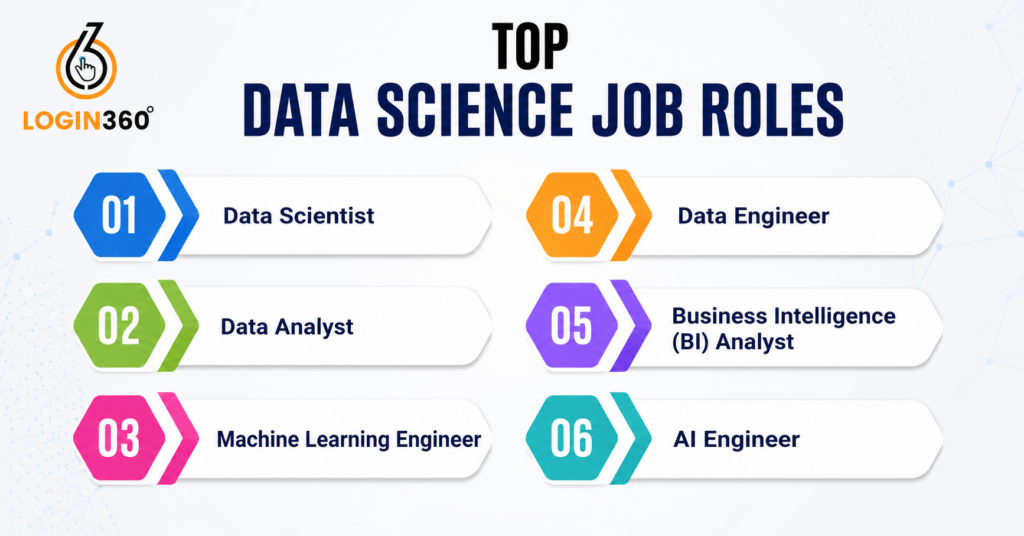
Top Data Science Job Roles
The field of data science offers numerous specialized career opportunities. While many roles share similar technical foundations, each has distinct responsibilities and career growth paths.
Data Scientist
A Data Scientist gathers and analyzes structured and unstructured data to solve business challenges. They develop predictive models, build machine learning solutions, and communicate findings to stakeholders.
Data Analyst
Data Analysts focus on interpreting existing datasets to generate reports, dashboards, and business recommendations. Their work supports decision-making using descriptive and diagnostic analytics.
Machine Learning Engineer
Machine Learning Engineers build, deploy, and optimize machine learning models for production environments. They bridge the gap between research and software engineering.
Data Engineer
Data Engineers design and maintain data pipelines, databases, and cloud infrastructure that enable efficient storage and processing of large datasets.
Business Intelligence (BI) Analyst
BI Analysts create visual dashboards and reports using tools like Power BI and Tableau, helping organizations monitor key performance indicators.
AI Engineer
AI Engineers develop intelligent systems using deep learning, natural language processing, and computer vision technologies to automate business processes.
Daily Responsibilities of a Data Scientist
Even though jobs can be different in various companies, most data scientists do similar things every day. They start by gathering data from many places like databases, APIs, spreadsheets, and cloud services. Often, this data isn’t perfect, so a big part of their job is to clean it up, change it into the right format, and get it ready for analysis. Once the data is clean, they do exploratory data analysis to find trends, patterns, and how different factors relate to each other. This helps them figure out which factors affect business results. Another key task is building machine learning models. They try out different methods, check how well the models work, and improve them by adjusting features and settings. Clear communication is also vital. They make dashboards, reports, and charts to explain complex results in an easy-to-understand way so that business leaders can make good decisions. They also work with software engineers and other teams to put models into use and keep checking how they perform over time.
Skills Employers Look For
Employers look for people who have a good mix of technical skills, the ability to think critically, and strong communication abilities. Knowing how to program is very important. Python is the most commonly used programming language for data science, and R is often used in statistical work and research. Having a good understanding of statistics helps professionals work with probability, test ideas, do regression analysis, and design experiments. Expertise in machine learning is becoming more important. Employers often want candidates who know about supervised learning, unsupervised learning, deep learning, and reinforcement learning. Managing databases is another key skill. Knowing SQL helps professionals get and work with data from databases. Cloud computing skills are also in high demand as companies move their data systems to platforms like AWS, Microsoft Azure, and Google Cloud. In addition to technical skills, employers really value communication, teamwork, critical thinking, and problem-solving. The ability to explain technical results to people who aren’t technical can set great professionals apart from others.
Popular Tools and Technologies Used
Modern data science relies on a wide range of software tools and technologies that simplify data processing, visualization, and model development. Python remains the industry’s preferred programming language because of its rich ecosystem of libraries including Pandas, NumPy, Scikit-learn, TensorFlow, PyTorch, and Matplotlib. SQL is essential for querying relational databases and extracting business information efficiently. Visualization platforms like Tableau and Microsoft Power BI transform complex datasets into interactive dashboards that support business decision-making. Jupyter Notebook provides an interactive environment for writing code, documenting experiments, and sharing research. Version control platforms such as Git and GitHub enable collaboration across development teams. Cloud platforms including Amazon Web Services (AWS), Microsoft Azure, and Google Cloud provide scalable infrastructure for training machine learning models and managing large datasets. Big data technologies such as Apache Spark and Hadoop help organizations process massive amounts of structured and unstructured information efficiently.
Job Opportunities Across Industries
Data science professionals are needed in nearly every sector because data has become a valuable business asset. Some of the most promising industries include:
- Healthcare: Hospitals and pharmaceutical companies use data science for disease prediction, medical imaging, patient care optimization, and drug discovery.
- Finance and Banking: Banks apply machine learning for fraud detection, credit risk assessment, investment analysis, and customer segmentation.
- Retail and E-commerce: Businesses analyze customer behavior, personalize recommendations, forecast demand, and optimize inventory management.
- Manufacturing: Companies improve production efficiency through predictive maintenance, quality control, and supply chain optimization.
- Information Technology: Tech companies build AI-powered applications, recommendation systems, search engines, and automation tools using data science.
Salary Trends and Future Outlook
The future for data science jobs is really bright. As companies keep investing in artificial intelligence and data analysis, the need for skilled professionals is likely to stay strong around the world. Salaries are competitive because of this increasing demand. Newcomers to the field can expect good pay, while those with experience, like data scientists, machine learning engineers, and AI experts, usually make much more because of their special knowledge. Working remotely has made it easier for people to find jobs with companies all over the globe, offering more flexible career choices. New technologies like generative AI, large language models, explainable AI, edge computing, and automation are creating brand new opportunities in data science. Those who keep learning and improving their skills will have good career growth and steady jobs in the future.
How to Become a Data Scientist
Building a successful career in data science requires consistent learning, hands-on practice, and real-world project experience.
- Build a strong foundation: Learn mathematics, statistics, probability, and linear algebra.
- Master programming: Gain proficiency in Python, SQL, and essential data science libraries.
- Learn machine learning: Understand algorithms, model evaluation, feature engineering, and deep learning concepts.
- Work on projects: Develop practical portfolios using real-world datasets available on Kaggle or public repositories.
- Gain certifications: Complete recognized courses in data science, machine learning, AI, cloud computing, and analytics to strengthen your resume.
Conclusion
Data science has become one of the most exciting and rewarding careers in today’s digital world. Companies in healthcare, finance, retail, manufacturing, and technology depend on skilled experts who can turn raw data into useful business knowledge. As AI and machine learning change how industries work, the need for talented data scientists is growing faster than ever. Whether you’re beginning your career or looking to switch paths, learning data science skills can lead to well-paid jobs, chances to keep learning, and steady career progress. By gaining skills in programming, statistics, machine learning, cloud tools, and clear communication, you’ll be ready to succeed in this quickly changing field.
Key Takeaways
- Data science jobs are in high demand across industries and continue to offer excellent career prospects.
- Strong technical skills in Python, SQL, statistics, and machine learning are essential for success.
- Practical experience matters, so building projects and maintaining a portfolio can significantly improve employability.
- Continuous learning is crucial because new AI tools, cloud platforms, and analytics technologies emerge regularly.
- A career in data science offers excellent growth, competitive salaries, and opportunities to solve meaningful real-world problems.