

Table of Contents
Introduction
The demand for data driven professionals has grown rapidly as organizations increasingly rely on information to make smarter business decisions. Companies across industries such as healthcare, finance, retail, manufacturing, education, and technology collect enormous amounts of data every day. However, raw data alone has little value unless it is transformed into meaningful insights that help businesses improve performance, understand customer behavior, reduce costs, and identify new opportunities. This growing dependence on data has created exciting career opportunities in fields like Business Intelligence vs Data Analytics. Although Business Intelligence and Data Analytics are closely related, they are not identical. Many students, fresh graduates, and working professionals often confuse these career paths because both involve analyzing data and supporting business decision making. However, they differ in their objectives, tools, methodologies, and day to day responsibilities. Business Intelligence primarily focuses on analyzing historical and current business data to create reports, dashboards, and visualizations that assist management in making operational decisions.
What Is Business Intelligence?
Business Intelligence is the process of collecting, organizing, analyzing, and presenting business data to support informed decision making. It enables organizations to convert raw information into meaningful reports and dashboards that help managers monitor business performance and identify opportunities for improvement. Instead of relying on assumptions, businesses use Business Intelligence to make strategic decisions based on accurate and real time information. Business Intelligence professionals work with structured data gathered from multiple sources such as customer relationship management systems, enterprise resource planning software, sales platforms, financial applications, and operational databases. They combine this information to create comprehensive reports that provide insights into revenue, customer behavior, inventory management, employee productivity, and overall business performance.
What Is Data Analytics?
Data Analytics is the process of examining raw data to discover meaningful patterns, trends, relationships, and insights that support business decision making. Unlike Business Intelligence, which primarily focuses on reporting historical data, Data Analytics tools explores why events occurred, predicts future outcomes, and recommends actions that organizations can take to achieve better results. Data Analysts collect data from various internal and external sources before cleaning, organizing, and transforming it into a format suitable for analysis. Since real world data often contains missing values, duplicate records, and inconsistencies, data preparation is a crucial step in the analytics process. Once the data is cleaned, analysts use statistical techniques, programming languages, and visualization tools to identify valuable business insights. A Data Analyst answers questions such as why sales declined, which marketing campaign generated the highest return on investment, which customers are most likely to leave, and how future demand can be predicted.
Business Intelligence vs Data Analytics: Key Differences.
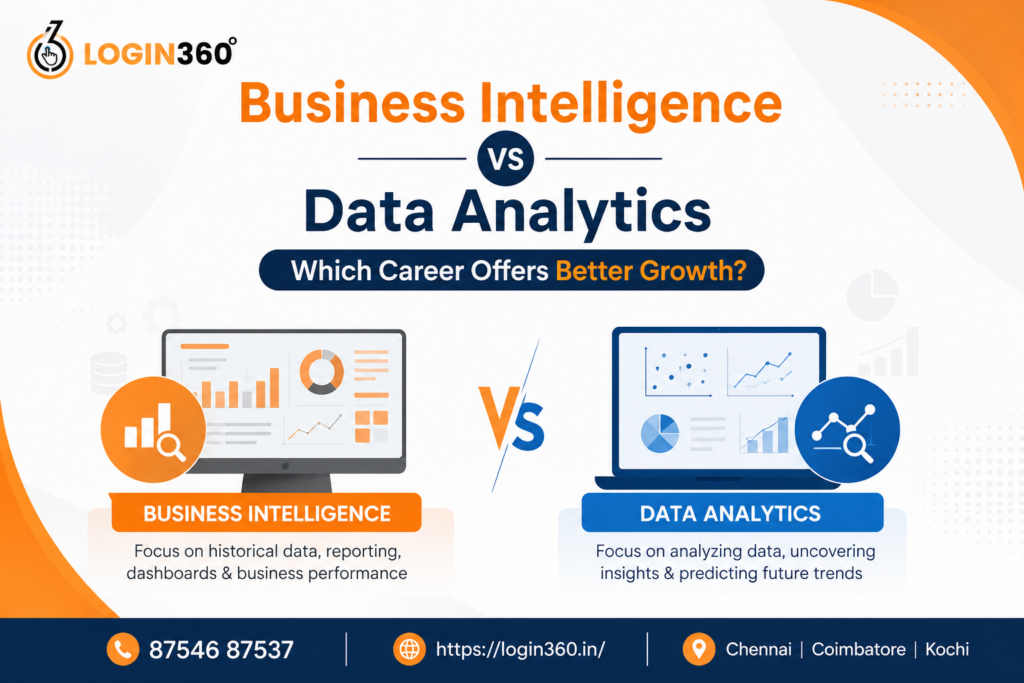
- Business Intelligence focuses on monitoring business performance by analyzing historical and current data. It emphasizes reporting, dashboard creation, KPI tracking, and data visualization to help management understand what has already happened within the organization.
- Data Analytics takes a broader and more advanced approach. Instead of only reporting past performance, it investigates the reasons behind business outcomes, predicts future trends, and recommends strategies for improvement.
- Data Analysts use statistical models, programming, and advanced analytical techniques to answer complex business questions and uncover hidden opportunities.
- Another important difference lies in the tools and technical expertise required. Business Intelligence professionals primarily work with SQL, Power BI, Tableau, Excel, and reporting platforms, while Data Analysts frequently use Python, R, SQL, machine learning libraries, cloud analytics services, and statistical software alongside visualization tools.
Essential Skills and Tools Required for Both Careers
Success in both Business Intelligence and Data Analytics depends on developing a combination of technical expertise, analytical thinking, business knowledge, and communication skills. While both professions work with data, the depth of technical knowledge and the nature of daily tasks differ considerably. Understanding these skill requirements can help aspiring professionals choose the career path that best matches their interests and long term goals. Data Analytics professionals require a broader technical skill set because their responsibilities extend beyond reporting and visualization. They frequently work with programming languages such as Python and R to clean datasets, automate repetitive tasks, perform statistical analysis, and build predictive models. SQL remains an essential skill for accessing and managing data stored in relational databases. Familiarity with statistical concepts, probability, hypothesis testing, regression analysis, and data modeling enables analysts to uncover patterns and draw meaningful conclusions from large datasets. Many organizations also expect Data Analysts to have experience with cloud platforms, machine learning fundamentals, and big data technologies as businesses increasingly process large volumes of information. Continuous learning has become another essential requirement.
Career Roles, Responsibilities, and Job Opportunities
A Business Intelligence professional primarily focuses on collecting, organizing, and presenting business data in a meaningful way. Their responsibilities include designing dashboards, creating reports, monitoring KPIs, maintaining data warehouses, writing SQL queries, and collaborating with business leaders to support operational and strategic decision-making. They often work closely with finance, sales, marketing, operations, and executive teams to provide accurate business insights that improve organizational performance. Data Analytics professionals have a wider range of responsibilities because they focus on identifying trends, solving business problems, and predicting future outcomes. Their daily tasks include collecting data from multiple sources, cleaning and preparing datasets, performing statistical analysis, creating visualizations, developing predictive models, and presenting recommendations to stakeholders. Depending on the organization, Data Analysts may also work with machine learning algorithms, automation techniques, and artificial intelligence applications to support decision making.
Salary Comparison and Career Growth Prospects
Business Intelligence professionals generally begin their careers with competitive entry-level salaries. As they gain expertise in SQL, dashboard development, data visualization, reporting systems, and business strategy, they can progress into senior analyst, BI developer, solution architect, or management roles with significantly higher compensation. Organizations value professionals who can transform complex business information into meaningful visual insights that support executive decision making. Data Analytics professionals often experience faster salary growth because their work involves advanced statistical analysis, programming, predictive modeling, and problem solving. Individuals with expertise in Python, R, machine learning, cloud analytics, and artificial intelligence frequently receive higher compensation due to the growing demand for advanced analytical skills.
How to Choose Between Business Intelligence and Data Analytics
Choosing between Business Intelligence and Data Analytics depends on your interests, strengths, and long term career aspirations. While both careers involve working with data, the type of work you perform each day differs considerably, making it important to understand which responsibilities align better with your personality and professional goals. On the other hand, if you enjoy solving complex problems, analyzing patterns, working with programming languages, and discovering hidden insights from data, Data Analytics may be a better fit. This field appeals to individuals who enjoy mathematics, statistics, logical reasoning, and continuous learning. Data Analytics offers opportunities to work with predictive modeling, machine learning, artificial intelligence, and advanced analytical techniques that help businesses anticipate future trends rather than simply understanding past performance. Ultimately, there is no universally better career. Both Business Intelligence and Data Analytics play essential roles in modern organizations, and many companies integrate both functions within their data strategy.
Future Trends and Industry Demand in 2026 and Beyond
The future of both Business Intelligence and Data Analytics looks exceptionally promising as organizations continue to embrace digital transformation and data driven decision making. Businesses are generating more data than ever before through online transactions, mobile applications, IoT devices, social media platforms, cloud services, and enterprise software. This rapid increase in data volume has made it essential for organizations to invest in professionals who can convert raw information into meaningful business insights. Business Intelligence is evolving beyond traditional reporting. Modern BI platforms now offer real time dashboards, self service analytics, automated reporting, and AI powered data visualization. Business users no longer need extensive technical knowledge to access critical business information, as advanced BI tools allow decision makers to interact with data through intuitive dashboards and natural language queries. Organizations are increasingly adopting cloud based Business Intelligence solutions that enable employees to access reports securely from anywhere while improving collaboration across departments. At the same time, Data Analytics is advancing rapidly through artificial intelligence, machine learning, predictive analytics, and automation.
Conclusion
Business Intelligence and Data Analytics are two of the most in demand career paths in today’s technology driven business environment. Although both disciplines focus on using data to support decision making, they differ in their objectives, methodologies, tools, and day to day responsibilities. Business Intelligence primarily emphasizes reporting, dashboard creation, and performance monitoring, enabling organizations to understand current and historical business performance. Data Analytics takes a broader approach by identifying patterns, predicting future outcomes, and providing actionable insights that support long term strategic planning. Choosing between these two careers depends on your interests, technical abilities, and professional goals. If you enjoy creating interactive dashboards, working closely with business teams, and presenting information visually, Business Intelligence offers a rewarding and stable career path. If you prefer programming, statistical analysis, predictive modeling, and solving complex business problems, Data Analytics provides broader opportunities for specialization and long term career advancement.