
Do you still spend hours renaming files, copying data between spreadsheets, or repeating the same clicks every day? Those small tasks quietly drain your time and they add up faster than you think. With just a few lines of Python, you can automate them and take back control of your workflow.
This guide shows you exactly how to do that. python scripting for beginners starting from the basics, you’ll learn how to write simple scripts that handle everyday tasks like file management, data processing, and interacting with web services.Login360 Step by step, you’ll move from the python scripting for beginners to confidently building practical automation tools that save time, reduce errors, and make your work far more efficient.
Why Python Scripting For Beginners is Your Next Essential Skill
Python’s simplicity and readability make it the ideal language for python scripting for beginners. Unlike complex programming paradigms, scripting focuses on quick, efficient solutions to specific problems. Python excels here, offering a vast ecosystem of libraries and a straightforward syntax that allows python scripting for beginners to write functional code almost immediately. For professionals in Chennai, the value of mastering Python scripting becomes even more tangible when viewed through the city’s unique industrial, technological, and economic landscape.
Chennai is often called the “Detroit of India” due to its massive manufacturing and automobile ecosystem. Companies like Hyundai Motor India, Ford India (historically), and Ashok Leyland operate large production units here. In these environments, Python scripting for beginners is increasingly used for automation of repetitive production tasks, predictive maintenance, and data analysis from IoT sensors. Professionals who know Python scripting for beginners can streamline workflows, reduce downtime, and directly contribute to operational efficiency.
On the IT and services side, Chennai hosts major tech parks like Tidel Park and DLF Cybercity Chennai, with companies such as Infosys and Cognizant employing thousands. Here, Python is essential for automation testing, backend development, data engineering, and AI/ML applications. With increasing demand for digital transformation, professionals skilled in Python scripting for beginners gain a strong advantage in securing roles in these expanding tech hubs.
Chennai’s strategic coastal position and the presence of Chennai Port and Kamarajar Port also create opportunities in logistics and supply chain optimization. Python scripting for beginners is widely used to analyze shipping data, optimize delivery routes, forecast demand, and automate reporting systems—all critical for improving efficiency in port operations and logistics companies.
Additionally, the city is experiencing rapid growth in startups and fintech, where Python plays a key role in building scalable applications, automating workflows, and handling financial data analysis. This opens doors for professionals to transition into emerging sectors without needing to switch cities.
In essence, for professionals in Chennai, mastering Python scripting for beginners translates directly into:
- Securing high-demand roles in IT corridors and tech parks
- Driving automation and efficiency in manufacturing units
- Optimizing logistics and port-based operations
- Transitioning into data science, AI, and startup ecosystems
This local relevance makes Python not just a global skill, but a strategic career accelerator tailored to Chennai’s evolving economy. From automating system administration tasks to processing large datasets, the applications are limitless.

Setting Up Your Python Environment: The Foundation
Before you write your first script, you need a stable environment. This section guides you through the essential setup process.
1. Installing Python
Python 3 is the standard. Visit the official Python website (python.org) and download the latest version for your operating system (Windows, macOS, Linux). During installation on Windows, ensure you check the box that says “Add Python to PATH.” This crucial step allows you to run Python commands from any directory in your terminal.
2. Choosing an Integrated Development Environment (IDE) or Text Editor
While you can write Python scripting for beginners in Notepad, a dedicated editor or IDE significantly enhances productivity.
- VS Code (Visual Studio Code): Highly recommended for beginners. It’s free, lightweight, cross-platform, and boasts excellent Python support through extensions. Install the “Python” extension by Microsoft for features like syntax highlighting, linting, debugging, and intelligent code completion.
- PyCharm Community Edition: A more full-featured IDE specifically designed for Python scripting for beginners. It offers advanced debugging, refactoring, and project management tools, ideal as your scripts grow in complexity.
- Sublime Text / Atom: Excellent, highly customizable text editors that can be configured for Python development.
For this guide, we’ll assume a basic familiarity with using a text editor or IDE to write and save .py files and running them from your terminal.
Python Basics Revisited: Python scripting for beginners is essentials (with Variables, Control Flow, and Functions woven into one practical story)
A Running Example: “Your Mini Coffee Shop Script”
Imagine you run a small coffee shop and want a simple Python scripting for beginners to track your day—orders, revenue, and decisions. Think of your script like a barista assistant: it keeps notes, makes decisions, and performs tasks for you.
1. Variables — “Labeled Jars on the Counter”
In your coffee shop, you store ingredients in labeled jars: Sugar, Coffee Beans, Milk.
Variables work the same way—they store data with a label.
daily_revenue = 1500.50
new_customers = 12
coffee_price = 120
Think of:
- daily_revenue → jar holding today’s earnings
- new_customers → jar counting people who walked in
These variables are your script’s memory they hold important information your “assistant” needs.
2. Control Flow — “The Barista’s Decisions”
Now imagine your assistant deciding what to do based on the situation:
“If we made more than ₹1000 today, celebrate. Otherwise, offer discounts.”
That’s control flow decision-making in code.
if daily_revenue > 1000:
print(“Great day!”)
else:
print(“Let’s attract more customers!”)
It’s like giving your assistant rules to follow:
- If condition is true → do this
- Otherwise → do something else
You can also repeat actions, like serving multiple customers:
for customer in range(new_customers):
print(“Serving coffee”)
That’s your assistant working through a queue!
3. Functions — “Reusable Coffee Recipes”
Instead of repeating the same steps for every coffee, you create a recipe.
Functions are exactly that: reusable instructions.
def make_coffee(type_of_coffee):
print(f”Making a {type_of_coffee}…”)
Now your assistant can reuse it:
make_coffee(“Latte”)
make_coffee(“Espresso”)
Think of functions as:
- A recipe card
- You call it whenever needed
- It saves time and avoids repetition
Bringing It All Together
Here’s your mini coffee shop script in action:
daily_revenue = 1500.50
new_customers = 3
def greet_customer(customer_number):
print(f”Welcome customer #{customer_number}!”)
def make_coffee():
print(“Preparing coffee…”)
for i in range(1, new_customers + 1):
greet_customer(i)
make_coffee()
if daily_revenue > 1000:
print(“Awesome sales today!”)
else:
print(“Let’s improve tomorrow!”)
Big Picture Analogy
Your Python script is like a smart coffee shop assistant:
- Variables → labeled jars storing data
- Control Flow → decisions the assistant makes
- Functions → reusable recipes
Core Scripting Concepts: Your Automation Toolkit
This is where the real power of scripting begins.
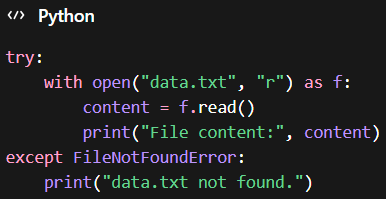
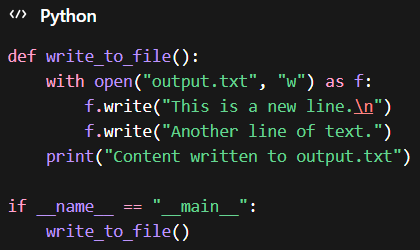
1. File I/O: Reading and Writing Files
Most scripts interact with files. Python makes this incredibly simple.
Reading a file:
Writing to a file:
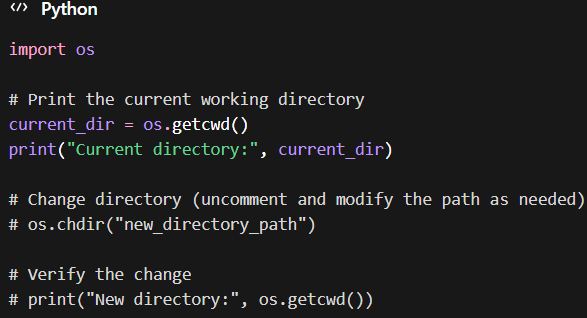
2. Working with the Operating System (os module)
The os module is your gateway to interacting with the underlying operating system.
Navigating directories:
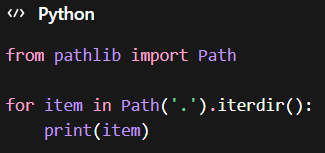
Listing files and directories:
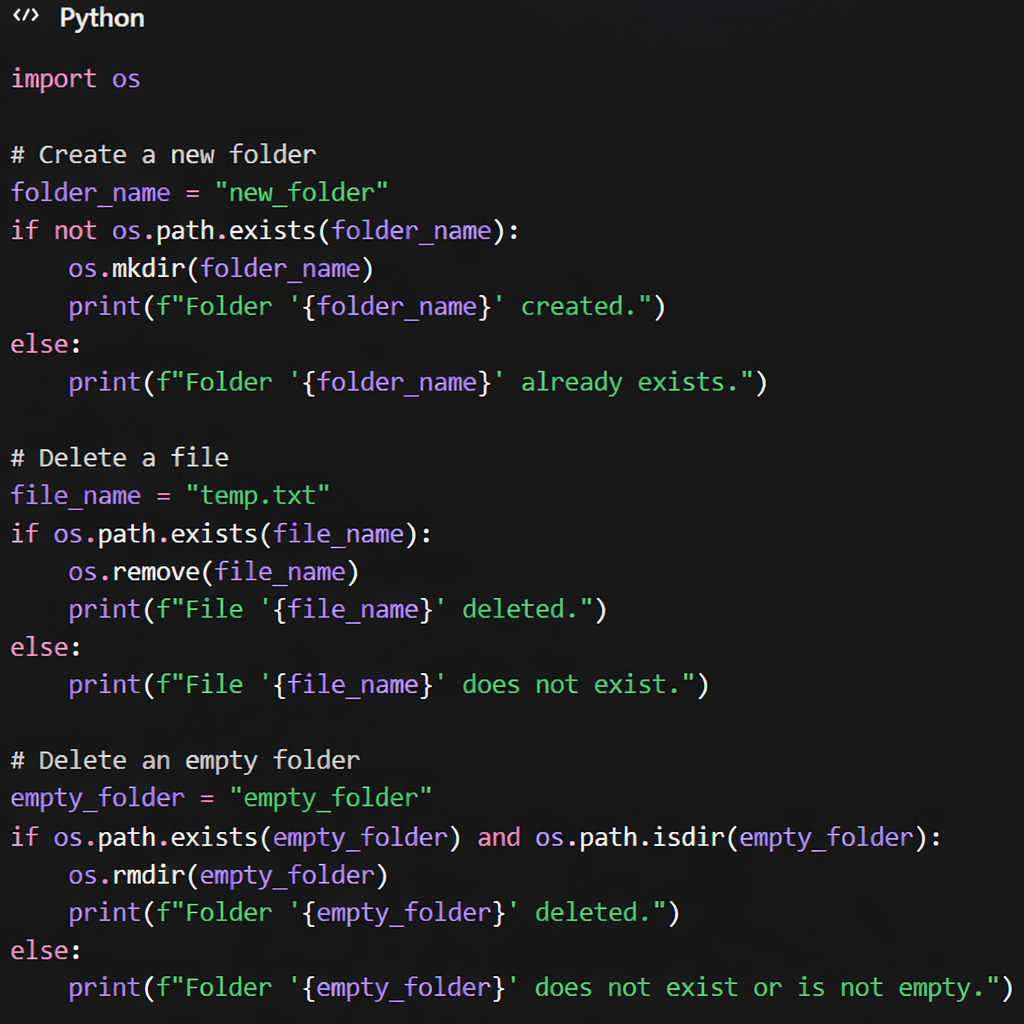
Creating/deleting files and folders:
3. Command Line Arguments (sys module)
Allow your scripts to accept input directly from the terminal, making them more flexible.
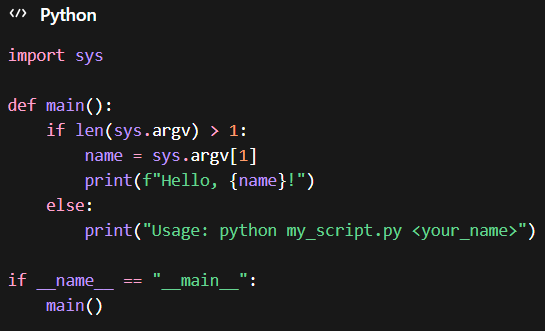
Run this script as python my_script.py Alice.
4. Automating Tasks: Practical Examples
Let’s combine these concepts for simple automation.
Example: File Organizer
Imagine you have a downloads folder full of various file types. A script can sort them into Documents, Images, Videos folders.
import os
import shutil
def organize_files(source_dir):
# Create folders if they don’t exist
folders = {
“Documents”: [“.pdf”, “.docx”, “.txt”, “.xlsx”],
“Images”: [“.jpg”, “.png”, “.gif”],
“Videos”: [“.mp4”, “.mov”, “.avi”]
}
for folder in folders:
    os.makedirs(os.path.join(source_dir, folder), exist_ok=True)

# Organize files
for filename in os.listdir(source_dir):
    file_path = os.path.join(source_dir, filename)

    if os.path.isfile(file_path):
        _, extension = os.path.splitext(filename)
        extension = extension.lower()

        for folder, extensions in folders.items():
            if extension in extensions:
                destination = os.path.join(source_dir, folder, filename)
                shutil.move(file_path, destination)
                print(f"Moved {filename} → {folder}")
                break
#Example usage
if name == “main“:
path = input(“Enter folder path: “)
organize_files(path)
5. Web Scraping (Basic Introduction)
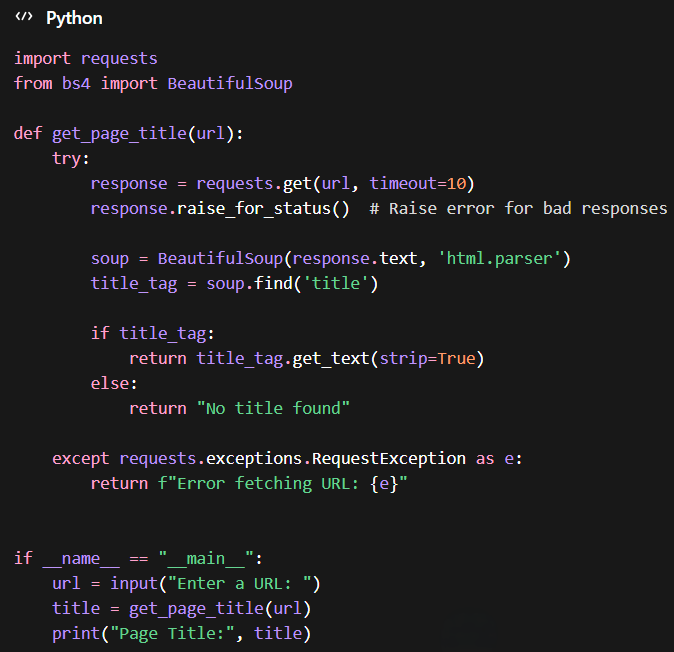
Python’s requests library allows you to fetch web pages, and BeautifulSoup helps parse HTML content. This is invaluable for collecting data from websites.
6. Working with APIs (Introduction)
Many web services offer APIs (Application Programming Interfaces) for programmatic interaction. Python’s requests library is perfect for this.
import requests
def fetch_weather(city, api_key):
base_url = “https://api.openweathermap.org/data/2.5/weather”
params = {
“q”: city,
“appid”: api_key,
“units”: “metric”
}
try:
    response = requests.get(base_url, params=params)
    response.raise_for_status()

    data = response.json()
    temperature = data["main"]["temp"]
    description = data["weather"][0]["description"]

    return f"Current weather in {city}: {temperature}°C, {description.capitalize()}."

except requests.exceptions.HTTPError:
    return "City not found or API request failed."
except requests.exceptions.RequestException as e:
    return f"Error fetching weather: {e}"
except KeyError:
    return "Unexpected response format."
#Run the program
if name == “main“:
API_KEY = “YOUR_OPENWEATHERMAP_API_KEY” # Replace with your API key
city_name = input(“Enter city name: “)
result = fetch_weather(city_name, API_KEY)
print(result)
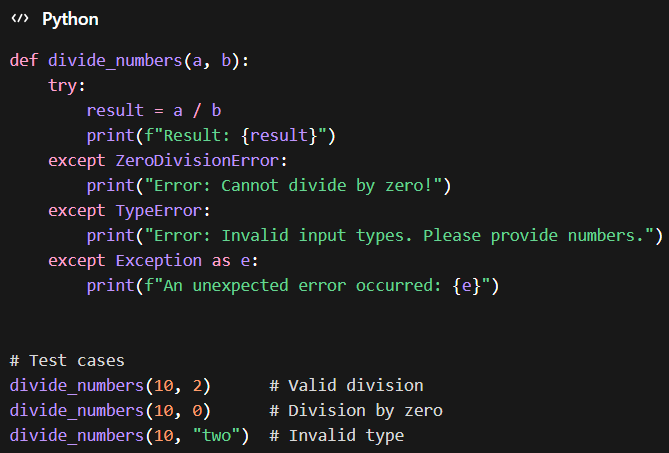
7. Error Handling (try-except)
Robust scripts anticipate and gracefully handle errors. The try-except block is crucial for this.
Intermediate Scripting Techniques
As your scripts grow, these techniques become indispensable.
1. Modules and Packages: Structuring Larger Projects
Break down large scripts into smaller, manageable files (modules). Collections of modules form packages. This promotes reusability and maintainability.
- Creating a module: Save functions/classes in a .py file (e.g., utils.py).
- Importing a module: import utils or from utils import my_function.
2. Virtual Environments: Dependency Management
Different projects might require different versions of the same library. Virtual environments (venv) create isolated Python environments, preventing conflicts.
- Create: python -m venv myenv
- Activate:
- Windows: .\myenv\Scripts\activate
- macOS/Linux: source myenv/bin/activate
- Install packages: pip install requests beautifulsoup4
- Deactivate: deactivate
3. Scheduling Scripts: Automating Execution
For python scripting for beginners that need to run at specific times or intervals:
- Linux/macOS: cron jobs: Use crontab -e to edit your cron table and add entries like 0 9 * * * /usr/bin/python3 /path/to/your/script.py to run daily at 9 AM.
- Windows: Task Scheduler: A GUI-based tool to configure tasks to run automatically.
4. GUI Automation (Brief Mention)
Libraries like pyautogui can simulate keyboard and mouse actions, enabling automation of desktop applications. Selenium is a popular choice for automating web browser interactions.
Real-World Scripting Examples: Build Your Portfolio
Let’s explore some practical mini-projects that solidify your understanding.
Automated File Renamer (Advanced Twist)
Scenario: Rename thousands of scanned documents from different folders into a standardized format like YYYY-MM-DD_Invoice_ClientName.pdf.
- Challenge: What if files are buried in nested subfolders and you need to flatten the structure into one directory without overwriting duplicates?
- Constraint: Handle duplicate filenames by appending incremental IDs automatically.
- Pro Tip (Gotcha): File metadata (like creation date) can be unreliable—use embedded text (via OCR) or filename patterns instead.
- Bonus Idea: Add a “dry run” mode to preview changes before applying them.
Basic Log Analyzer (Niche Use Case)
Scenario: Analyze a web server log to detect suspicious login attempts from repeated IP addresses.
- Challenge: What if the log file is extremely large (GBs)? You can’t load it fully into memory.
- Constraint: Process the file line-by-line efficiently using generators.
- Pro Tip (Gotcha): Timezones in logs can mess up analysis—normalize timestamps before comparing.
- Bonus Idea: Output a ranked list of “most suspicious IPs” with frequency counts.
Simple Web Scraper for Product Prices (Real-World Angle)
Scenario: Track price drops for a specific product (e.g., a laptop) on an e-commerce site and alert when it falls below a threshold.
- Challenge: What if the website dynamically loads prices using JavaScript?
- Constraint: Use a headless browser (like Selenium) instead of basic requests + BeautifulSoup.
- Pro Tip (Gotcha): Websites may block repeated requests—add delays or rotate headers to mimic human browsing.
- Bonus Idea: Store historical price data and plot trends over time.
Password Generator (More Practical Spin)
Scenario: Generate secure passwords based on user-defined constraints (length, symbols, etc.).
- Challenge: What if the password must meet specific rules (e.g., at least 2 symbols, no repeating characters)?
- Constraint: Ensure randomness using a cryptographically secure generator (secrets module in Python).
- Pro Tip (Gotcha): Avoid using random for passwords it’s not secure enough.
- Bonus Idea: Add an option to generate memorable passphrases instead of random strings.
Less Common (But Beginner-Friendly) Project Ideas
Daily Habit Tracker (CLI Tool)
Scenario: Track habits like water intake, exercise, or reading time from the command line.
- Challenge: Persist data across sessions using a simple JSON or CSV file.
- Constraint: Allow users to edit past entries.
- Pro Tip: Add streak tracking it makes the tool more engaging and “real.”
- Unexpected Twist: Generate weekly summaries automatically.
Duplicate File Finder
Scenario: Find and remove duplicate files on your system.
- Challenge: Files may have different names but identical content.
- Constraint: Use hashing (e.g., SHA-256) instead of filename comparison.
- Pro Tip: Compare file sizes first to avoid unnecessary hashing (performance boost).
Email Attachment Organizer
Scenario: Automatically download and sort email attachments into folders by type (PDFs, images, etc.).
- Challenge: Connect securely to an email server (IMAP).
- Constraint: Avoid downloading the same attachment twice.
- Pro Tip: Use unique message IDs to track processed emails.
Conclusion:
Python scripting for beginners isn’t just a tool it’s a shift in mindset. It teaches you to see inefficiency as an opportunity and repetition as something you never have to tolerate again. You now have the foundation, but the real transformation begins when you apply it. This week, pick one small, repetitive task in your daily life something you usually ignore and automate it. Don’t aim for perfection; aim for progress. Because the future of automation doesn’t belong to those who know Python scripting for beginners it belongs to those who use it to rethink how problems are solved.