

In Technical and Non Technical Skills, today’s rapidly evolving professional landscape highlights that true career value goes beyond a single skill set. Career growth Technical and Non Technical Skills is essential, as technical expertise alone is not enough without strong interpersonal abilities. The balance of Technical and Non Technical Skills is increasingly recognized as the key to long-term career success and organizational growth. Understanding Technical and Non Technical Skills is crucial whether you’re a fresher or an experienced professional.
What are Technical Skills?
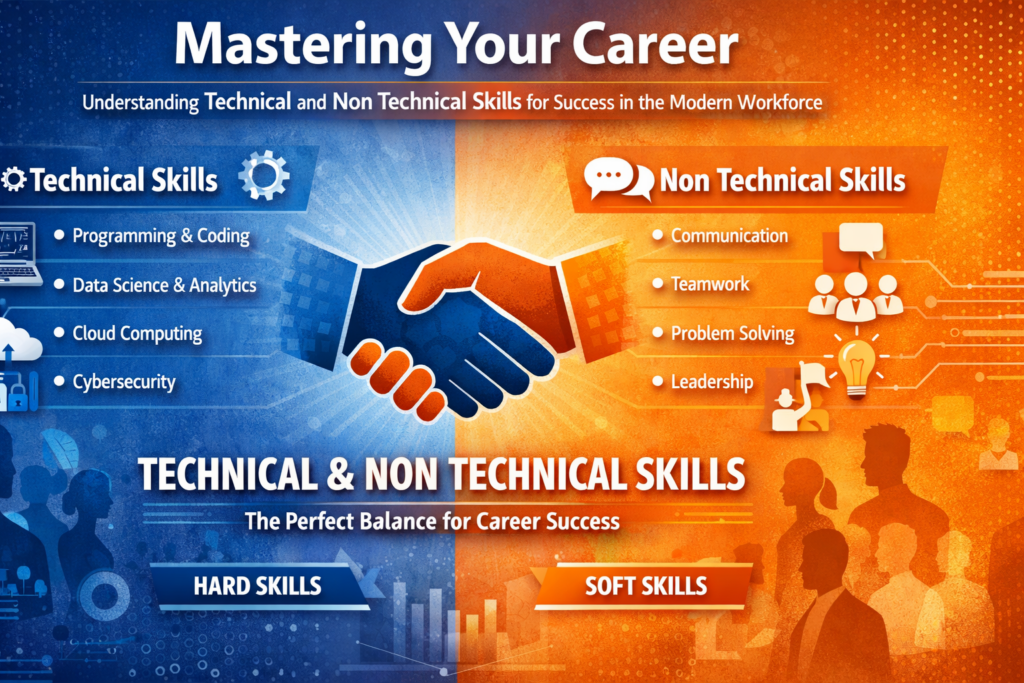
Technical skills are specific, measurable abilities acquired through learning and practice, often involving tools, software, or machinery. They are typically job-specific and essential for performing core functions in fields like IT, engineering, and science. These skills are quantifiable and demonstrated through certifications, portfolios, or hands-on work. They form the backbone of industries and continuously evolve, requiring ongoing learning and adaptation.
To deepen this idea, consider more nuanced and less obvious technical skills and their real-world impact. For instance, prompt engineering in AI systems directly influences the accuracy and usefulness of outputs in tools like chatbots, affecting decision-making speed in businesses. Data annotation and labeling—often overlooked—are critical for training machine learning models, where even small errors can significantly impact model performance. In cybersecurity, threat hunting using behavioral analytics enables professionals to detect attacks before they fully manifest, reducing potential damage in real time. Similarly, version control conflict resolution in collaborative coding environments ensures smoother teamwork and prevents costly deployment errors.
Technical skills are also evolving in unexpected ways within niche sectors. In agriculture, precision farming using IoT sensors and satellite imaging allows farmers to optimize water usage and increase crop yield with data-driven decisions. In healthcare, interoperability standards like FHIR (Fast Healthcare Interoperability Resources) are becoming essential technical knowledge, enabling seamless data exchange between systems and improving patient outcomes. Even in creative industries, skills like real-time rendering optimization in game engines or procedural content generation are reshaping how digital content is produced.
Technical skills are measurable abilities gained through practice and learning. These form one half of Technical and Non Technical Skills, focusing on tools, technologies, and job-specific knowledge. Mastering the technical side of Technical and Non Technical Skills enables professionals to perform core tasks efficiently in fields like IT, engineering, and data science.
Login360 excels in providing cutting-edge training in a wide array of technical skills that are highly sought after by employers. Our meticulously designed courses, delivered by industry experts, focus on practical application and real-world scenarios, ensuring our students gain hands-on experience. We understand that in a competitive market like kochi, having robust technical skills is non-negotiable for securing a high-paying job in the IT sector.
Examples of Core Technical Skills in Demand:
- Programming Languages: Proficiency in Python, Java, C++, JavaScript, Go, or Ruby is fundamental for roles in software development, web development, data science, and automation.
- Data Science & Analytics: Skills in SQL, R, Python (with libraries like Pandas, NumPy, Scikit-learn), machine learning algorithms, deep learning frameworks (TensorFlow, PyTorch), and data visualization tools (Tableau, Power BI) are critical for extracting insights from vast datasets.
- Cloud Technologies: Expertise in platforms like Amazon Web Services (AWS), Microsoft Azure, or Google Cloud Platform (GCP) is vital for cloud architecture, DevOps, and scalable application deployment.
- Cybersecurity: Knowledge of network security, ethical hacking, penetration testing, security information and event management (SIEM), and compliance frameworks is essential for protecting digital assets.
- Web Development: Front-end skills (HTML, CSS, JavaScript, React, Angular, Vue.js), back-end skills (Node.js, Django, Spring Boot), and full-stack development competencies are crucial for building modern web applications.
- Database Management: Understanding relational databases (MySQL, PostgreSQL, Oracle) and NoSQL databases (MongoDB, Cassandra) for efficient data storage and retrieval.
- DevOps Tools: Familiarity with tools like Docker, Kubernetes, Jenkins, Git, and Ansible for streamlining software development and operations.
What are Non Technical Skills (Soft Skills)?
Non-technical skills, often referred to as soft skills, are personal attributes that enable individuals to interact effectively and harmoniously with others. Unlike technical skills, which are about what you do, soft skills are about how you do it. They are less about specific knowledge and more about personality traits, communication habits, and social intelligence. These skills are universally applicable across all industries and roles, significantly impacting an individual’s ability to collaborate, innovate, and lead.
Non-technical skills are the interpersonal side of Technical and Non Technical Skills, focusing on communication, teamwork, and emotional intelligence. While technical expertise is important, the non-technical aspect of Technical and Non Technical Skills determines how effectively you apply your knowledge in real-world situations.
They are crucial for navigating workplace dynamics, resolving conflicts, inspiring teams, and effectively communicating complex technical information to non-technical stakeholders. In an increasingly interconnected world, where projects are often collaborative and cross-functional, strong soft skills are indispensable for success.
Here are a few refined versions, including one with a concrete example:
- Simple rephrase: Technical expertise may open the door, but it’s your ability to communicate, collaborate, and adapt that convinces employers to let you in—and keeps you moving forward.
- More polished version: Hard skills might earn you a seat at the table, but soft skills determine whether you’re trusted, remembered, and ultimately promoted.
- With a concrete example (active listening): A candidate with strong technical knowledge made it to the final interview, but what secured the offer was their active listening during a client simulation. Instead of jumping straight into solutions, they carefully understood the client’s concerns, asked thoughtful follow-up questions, and tailored their response accordingly. This demonstrated empathy and clarity—qualities the employer valued just as much as technical ability.
- Career growth angle: Knowing what to do gets you hired; knowing how to work with people is what earns you leadership opportunities.
Key Non Technical Skills for Career Success:
- Communication: The ability to convey information clearly and concisely, both verbally and in writing, is fundamental. This includes active listening, public speaking, presentation skills, and the capacity to adapt communication style to different audiences.
- Problem-Solving & Critical Thinking: The capacity to analyze complex situations, identify root causes, and develop effective solutions. This involves logical reasoning, creativity, and the ability to think strategically under pressure.
- Teamwork & Collaboration: Working effectively with others towards a common goal, respecting diverse perspectives, contributing constructively, and fostering a positive team environment. This includes conflict resolution and negotiation skills.
- Adaptability & Flexibility: The willingness and ability to adjust to new situations, technologies, and changing priorities. In a fast-paced industry like IT, continuous learning and embracing change are vital.
- Leadership & Mentorship: Inspiring and guiding others, delegating tasks effectively, motivating team members, and nurturing talent. This doesn’t necessarily mean being in a managerial role; it can involve leading projects or mentoring junior colleagues.
- Time Management & Organization: Prioritizing tasks, meeting deadlines, managing multiple projects simultaneously, and maintaining an organized workflow to maximize productivity.
- Emotional Intelligence: Understanding and managing one’s own emotions, as well as recognizing and influencing the emotions of others. This is critical for building strong relationships, empathy, and effective leadership.
- Creativity & Innovation: Thinking outside the box, generating new ideas, and finding novel approaches to challenges. This is especially valuable in fields driven by constant innovation.
The Synergy: Why Both are Indispensable
The modern professional landscape demands a symbiotic relationship between technical and non-technical skills. Possessing only one set of skills, no matter how refined, often leads to limitations. A brilliant programmer who cannot effectively communicate their ideas to the team or a client might find their innovations remain unappreciated or unimplemented. Conversely, an excellent communicator without the underlying technical knowledge might struggle to grasp the nuances of a project or provide credible solutions.
The true power of Technical and Non Technical Skills lies in their combination. Professionals who master Technical and Non Technical Skills can not only execute tasks but also collaborate, innovate, and lead effectively. Without the balance of Technical and Non Technical Skills, even highly skilled individuals may struggle in team environments.
Consider a scenario in a software development firm. A new feature needs to be implemented. The technical skills involved are clear: coding, testing, debugging, and deploying. However, the project’s success hinges equally on non-technical skills. The project manager needs strong leadership and communication to coordinate the team, set realistic deadlines, and articulate the vision to stakeholders. Developers need teamwork skills to collaborate on code, problem-solving to overcome unexpected bugs, and adaptability when requirements change. The ability to present the finished product clearly to end-users or clients requires polished presentation and communication skills. Without this synergy, even the most technically sound project can falter due to miscommunication, interpersonal friction, or a lack of strategic direction.
Together, they create a well-rounded professional who is not only capable of performing complex tasks but also of navigating the intricate social and organizational dynamics of the workplace.
Think of it like cooking a great meal.
Technical skills are your ingredients and recipes — they tell you what goes into the dish. You know the exact measurements, the cooking times, the techniques like chopping, sautéing, or baking. With just this, you can produce something that is technically correct — edible, maybe even good.
Non-technical skills, however, are your sense of taste, timing, and hospitality — they shape how the meal comes together. They guide you to adjust seasoning when something feels off, coordinate multiple dishes so everything is ready at the right moment, and present the food in a way that delights the people eating it. They also help you collaborate with others in the kitchen without chaos.
Now imagine two chefs:
- The first follows the recipe perfectly but ignores feedback, rushes plating, and doesn’t adapt when something goes wrong. The result is technically correct but forgettable.
- The second understands the same recipe but also reads the room, adjusts flavors, communicates smoothly with the team, and presents the dish beautifully. The result is not just food it’s an experience.
That’s the difference.
Technical skills answer:
👉 “Can you cook this dish?”
Non technical skills answer:
👉 “Can you make people love the experience of eating it?”
Bridging the Gap: How Login360 Cultivates Holistic Talent
At Login360, we emphasize Technical and Non Technical Skills equally. Our programs are designed to ensure students develop both aspects of Technical and Non Technical Skills, making them industry-ready professionals who can adapt and succeed.
Technical and Non Technical Skills, located in the bustling IT hub of kochi, we are keenly aware that the most successful professionals are those who master both the technical and non-technical dimensions of their roles. Our mission is to bridge this gap by offering comprehensive training programs that go beyond mere coding or theoretical knowledge. We integrate soft skill development into our curriculum, understanding that a truly affordable education means providing complete preparedness for the job market.
Our instructors, who are seasoned industry veterans, not only impart deep technical knowledge in areas like Data Science, Cloud Computing, and Full Stack Development but also emphasize the importance of effective communication, critical thinking, and collaborative problem-solving. Through group projects, mock interviews, presentation exercises, and real-time case studies, students at Login360 learn to apply their technical skills in a team setting, articulate their solutions, and adapt to evolving project requirements. We foster an environment that encourages questions, debates, and peer learning, all of which are crucial for honing interpersonal skills.
Our commitment to affordability ensures that high-quality, holistic IT education is accessible to a wider demographic, empowering more individuals to become well-rounded professionals capable of making significant contributions to the industry. We understand that investing in a student’s technical and non-technical growth simultaneously offers the best return on their educational journey, preparing them not just for their first job, but for a sustainable and progressive career path.
Conclusion:
In today’s competitive world, mastering Technical and Non Technical Skills is no longer optional. Professionals who develop strong Technical and Non Technical Skills gain a significant edge, enabling them to build successful and sustainable careers.
In the competitive global workforce, the dichotomy of technical and non technical skills is no longer a choice but a necessity. True career mastery lies in the harmonious integration of both. Technical skills provide the foundational expertise and the ability to execute specialized tasks, making you capable. Non-technical skills, on the other hand, enable effective collaboration, communication, and adaptation, making you invaluable. Professionals who cultivate both sets of abilities are better equipped to innovate, lead, and drive success in any organization.
As the IT landscape accelerates toward an era defined by AI collaboration, distributed teams, and constant reinvention, the most valuable professionals will not simply be those who can write efficient code—but those who can translate complexity into clarity, lead across cultures, and adapt faster than technology itself evolves. At Login360 in kochi, we’re not just preparing learners for today’s jobs—we’re shaping individuals who can thrive in roles that don’t even exist yet. The future won’t reward specialists or generalists alone; it will belong to those rare builders who can think, communicate, and create across boundaries—and that is exactly who we aim to develop