
Table of Contents
Introduction
Every business today leans on websites and web apps to reach customers, offer services and run daily work. Think of online stores, banking sites, learning portals and social media apps. All of them need technologies to work together smoothly. If you want a career in software development, understanding how these pieces fit together is a first step.
Full Stack Development means building both the frontend and the backend of a web app, plus handling the databases that hold and sort information. A full stack developer knows how each part of an app works and how the parts talk to each other. Learning frontend, backend and database skills gives you a base for building complete, working and easy-to-use web apps.
What Is Stack Development?
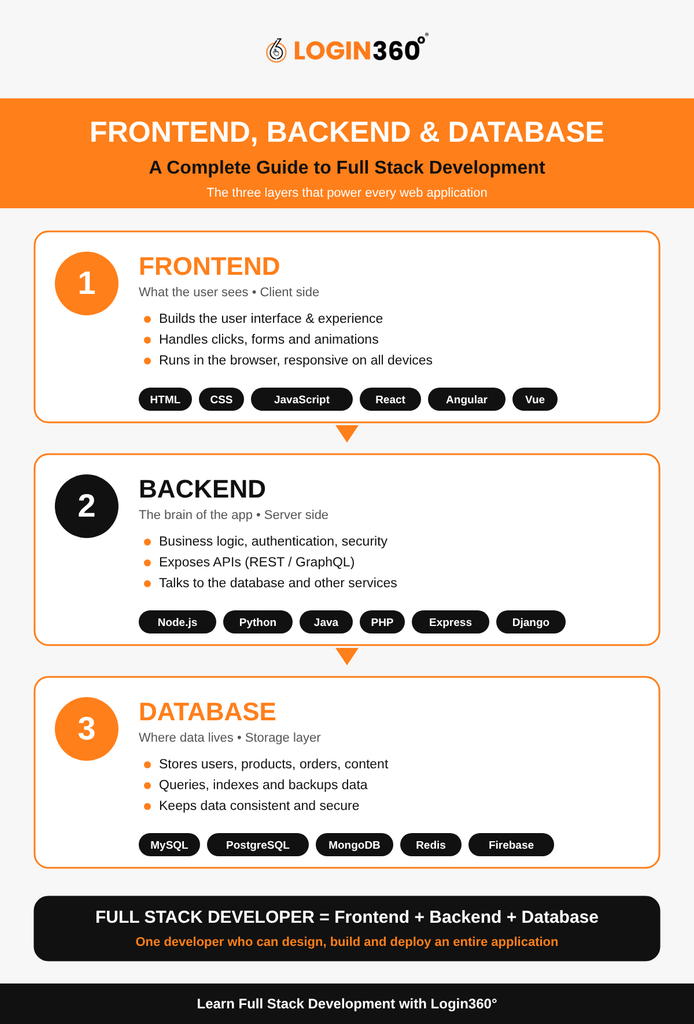
Full Stack Development covers all the layers of a web app. That includes the user interface, the server-side logic and data storage. Of sticking to just one area, full stack developers work across many technologies to build apps from start to finish.A normal web app has three parts:
- Frontend: The visible interface users interact with.
- Backend: The server-side logic that processes requests and manages application functionality.
- Database: The system that stores organizes and retrieves application data.
These three parts work as a team to give users a web experience. Full Stack Development helps developers see the flow of an app, from the users click all the way to data processing and showing results.
Frontend Development: Building the User Interface
Frontend development is about the visual and interactive side of a website or app. It shapes how people see the platform, move around it and use it. A made frontend makes things easier to use, more accessible, more responsive and friendlier overall.
Technologies Used in Frontend Development
- HTML (HyperText Markup Language): Creates the structure of web pages, including headings, paragraphs, images, forms and other elements.
- CSS (Cascading Style Sheets): Controls the appearance of a website, including colours, layouts, spacing, typography and responsive design.
- JavaScript: Adds interactivity and dynamic functionality, such as form validation, dropdowns, animations and real-time updates.
- React: A popular JavaScript library used to build UI components and interactive web applications.
Frontend developers also use tools such as Bootstrap, Tailwind CSS, Git and browser developer tools to improve their workflow. Frontend is often the first thing beginners learn in Full Stack Development. It helps them see how websites are put together and how people use them.
Backend Development: Managing Application Logic
Backend development handles the server-side work that users never see directly. It takes care of business logic, login and access checks, data processing, API requests and the link between the frontend and the database.When someone logs in, fills out a form, buys something or looks up information, the backend handles the request. Sends the right answer back to the frontend.
Popular Backend Technologies
- Node.js: Allows developers to run JavaScript on the server and build applications.
- Python: Commonly used for web development, automation, data processing and backend services.
- Java: Widely used for enterprise applications and large-scale backend systems.
- PHP: Used for server-side web development and platforms such as WordPress.
- Express.js:A lightweight framework for developing web applications and APIs using Node.js.
Backend work also means learning about REST APIs, login and permissions, server management, error handling and security habits. These skills help developers build apps that people can trust and that run well.
Database: Storing and Managing Information
- A database is a must-have part of Full Stack Development. Apps need a way to keep and fetch information. User accounts, product details, customer orders, employee records, messages and payment details all live in databases.Good database management helps apps keep data in order, find records fast, stay accurate and handle amounts of data.There are two types of databases.
- Relational Databases (SQL): Store data in tables containing rows and columns. They are useful for information and relationships between records.Examples include:
- MySQL
- PostgreSQL
- SQL Server
- Oracle Database
- Non-Relational Databases (NoSQL): Store data using structures such as documents, key-value pairs or other formats. They are useful for applications that require data models and scalability.Examples include:
- MongoDB
- Firebase Firestore
- Redis
How Frontend, Backend and Database Work Together
The frontend, backend and database join forces to give users an experience. Picture a store where a shopper looks for a product.
Step 1:The user enters a product name in the frontend search bar.
Step 2:The frontend sends the search request to the backend through an API.
Step 3:The backend processes the request. Queries the database.
Step 4:The database returns matching product information.
Step 5:The backend sends the results back to the frontend.
Step 6:The frontend displays the products to the user.
Essential Skills Required for Full Stack Development
Becoming a stack developer takes both technical know-how and real problem-solving ability. Some key skills include:
- HTML, CSS and JavaScript fundamentals
- Frontend frameworks and libraries such as React
- Backend programming using Node.js, Java, Python or other languages
- Database management using SQL or NoSQL technologies
- API development and integration
- Git and GitHub for version control
- Web design
- Debugging, testing and problem-solving
- Basic security and deployment knowledge
Career Opportunities in Full Stack Development
Full Stack Development opens doors at startups, IT firms, product companies and tech-driven businesses. As companies keep building and improving platforms, developers who know frontend, backend and database skills are valued members of any dev team.Some job roles include:
- Stack Developer
- Frontend Developer
- Backend Developer
- Web Application Developer
- Software Engineer
- Application Developer
Why Learn Full Stack Development?
Learning Full Stack Development gives you a view of how software apps are built and kept running. It lets you work on parts of a project, grasp technical needs, team up with other developers and build apps on your own.It is also a path for students, freshers and working folks who want to sharpen their skills, try out software development or move into IT careers. With practice and project work, learners can grow the confidence to build full web apps.
Frequently Asked Questions (FAQs)
1. What is Full Stack Development?
Full Stack Development is the process of building both the frontend and backend of a web application while working with databases, APIs and other technologies required to create an application.
2. What are the three main components of Full Stack Development?
The three main components are frontend development, backend development and database management. They work together to create interactive web applications.
3. Is Full Stack Development suitable for beginners?
Yes. Beginners can learn Full Stack Development by starting with HTML, CSS and JavaScript, followed by backend technologies, databases, APIs and practical projects.
4. Which programming language is best for Full Stack Development?
JavaScript is a choice because it can be used for frontend development and backend development through Node.js. However, Java, Python and other programming languages are widely used.
5. How long does it take to learn Full Stack Development?
The learning duration depends on your background, consistency and practice. With learning and regular project work, beginners can develop foundational skills over several months.
Conclusion
Frontend, backend and database skills are the base of every web app. Frontend work shapes what users see and feel. Backend work runs the apps logic. Databases keep information in order. Anyone chasing a path in Full Stack Development needs to grasp how these pieces fit together.
Learn the tools, code often and build real projects. Do that. You can pick up the skills this industry asks for. If web development is where you want to start, training and hands-on time can give you a firm base and get you set for what comes next.
Start your tech career with Login360! Explore industry-oriented training, hands-on projects and career-focused learning opportunities at Login360 to strengthen your development skills and take the step towards becoming a full stack developer.