
Introduction:
Artificial Intelligence (AI) is increasingly embedded across industries such as healthcare, banking, education, and e-commerce. Among its branches, Generative AI in Data Science is transforming how the field is practiced—shifting professionals from manual execution to strategic problem-solving, validation, and AI orchestration, a shift now emphasized in modern Data Science Training in Chennai. Specifically, Generative AI supports data scientists across several core functions, including explaining complex code and logic, generating SQL queries and Python scripts, cleaning, summarizing, and analyzing datasets, as well as accelerating machine learning prototyping and reporting.
What is Generative AI in Data Science:
Unlike traditional AI—which focuses on analyzing historical data and predicting outcomes,Generative AI creates new content (text, code, images, audio, and video) from natural language instructions.
- ChatGPT: Generates explanations, blogs, and analytical summaries.
- GitHub Copilot: Suggests and autocompletes code in real time.
- Google Gemini: Assists with research, data querying, and multimodal analysis.
- Text-to-Image Models: Generate custom visuals and diagrams from text prompts.
By enabling natural language interaction, Generative AI lowers technical barriers and speeds up daily workflows.
Generative AI and Data Data Science Enhances Data Analysis:
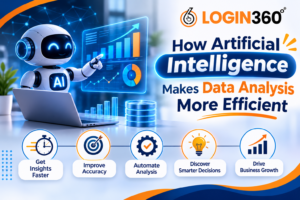
Businesses collect vast amounts of data from websites, apps, sales, and social media to understand consumer behavior and spot growth opportunities. Traditionally, analysts rely on Excel, SQL, Python, and Power BI to extract insights.Generative AI acts as a conversational analytics assistant. For example, if monthly sales decline, an analyst can prompt an AI tool to generate SQL queries, segment customer behavior, and summarize potential causes. However, human analysts must still verify query logic, joins, and business definitions before making decisions.
Automating Data Processing:
Raw datasets frequently contain missing values, duplicate entries, inconsistent formatting, and irrelevant fields. Manual cleaning often consumes the majority of a data scientist’s time.
Generative AI streamlines data preparation by:
- Identifying gaps, anomalies, and duplicate records.
- Recommending data cleaning and standardization strategies.
- Generating Python scripts (e.g., using Pandas) to automate cleaning pipelines.
- Debugging syntax and formatting errors.
For instance, when handling 10,000 customer records with missing emails, duplicate phone numbers, and mixed date formats, an AI assistant can rapidly generate Python code to clean and standardize the dataset—freeing experts for deeper analysis.
Supporting Python and SQL Coding:
Python and SQL remain foundational tools in data science. Generative AI accelerates coding for both beginners and experienced practitioners:
- Python Assistance: Prompts like “Write Python code to calculate average monthly sales from an Excel file” yield ready-to-run scripts with step-by-step explanations. Integrating Generative AI in Data Science turns modern tools into conversational analytics assistants.”
- SQL Assistance: Prompts like “Generate SQL code to display the top 5 best-selling products” produce structured queries immediately.Using Generative AI in Data Science accelerates coding for both beginners…”
- Code Optimization: AI tools highlight inefficiencies, suggest best practices, and assist with debugging.
Despite these capabilities, strong foundational coding knowledge remains essential so professionals can audit, debug, and safely deploy AI-generated code.
Improving Machine Learning Using Generative AI in Data Science:
Machine learning enables systems to learn patterns from data and make predictions without explicit rule-based programming. Generative AI enhances the machine learning lifecycle by:
- Explaining algorithms and statistical concepts clearly.
- Generating baseline model code and suggesting architectures.
- Assisting with hyperparameter tuning and performance diagnostics.
- Creating privacy-safe synthetic data for training and testing when real data is scarce or restricted.
For example, when a bank builds a loan-repayment prediction model, Generative AI can help draft the modeling pipeline and suggest validation metrics. Data scientists must still audit the model for fairness, accuracy, and real-world reliability.
Fast Business Reporting and Data Visualization:
Clear reporting enables leaders to track performance and make informed decisions. Generative AI accelerates dashboard and report creation by analyzing datasets and recommending the most effective visual formats:
- Bar Charts: Compare product-level sales performance.
- Line Graphs: Track monthly revenue and growth trends.
- Pie/Donut Charts: Illustrate customer segment proportions.
- Interactive Dashboards: Consolidate KPIs in tools like Power BI, which now integrate built-in AI features for natural-language data exploration.
- Generative AI :Accelerates dashboard and report creation…” with “Adopting Generative AI in Data Science accelerates dashboard and report creation..”
Industry Applications of Generative AI in Data Science:
- Healthcare: Summarizes medical research, organizes clinical records, and supports diagnostic data analysis (requiring strict clinical verification).
Masai School - Banking & Finance: Monitors transaction patterns, detects fraudulent activity, summarizes risk reports, and accelerates financial variance analysis.
Masai School - E-Commerce: Analyzes customer reviews for common pain points, powers personalized recommendations, and generates product descriptions.
Amquest Education - Education: Builds tailored learning materials, simplifies complex coding concepts, and provides interactive tutoring.
Great Learning - Marketing: Evaluates Google Ads and Meta Ads campaign performance, summarizes audience feedback, generates reports, and suggests content ideas.
Popular Generative AI Tools:
| Popular Tools for Generative AI in Data Science | Primary Strength in Data Science |
| ChatGPT | Explains Python/SQL concepts, writes scripts, and summarizes unstructured data. |
| Google Gemini | Conducts deep research, queries datasets, generates content, and integrates across productivity workflows. |
| Microsoft Copilot | Embeds AI assistance directly into Excel, Power BI, and Microsoft 365 workflows. |
| Hugging Face | Offers open-source machine learning models, datasets, and tools for fine-tuning and experimentation. |
| GitHub Copilot | Provides real-time code autocompletion, refactoring, and debugging inside code editors. |
Essential Generative AI In DataScience for the Future:
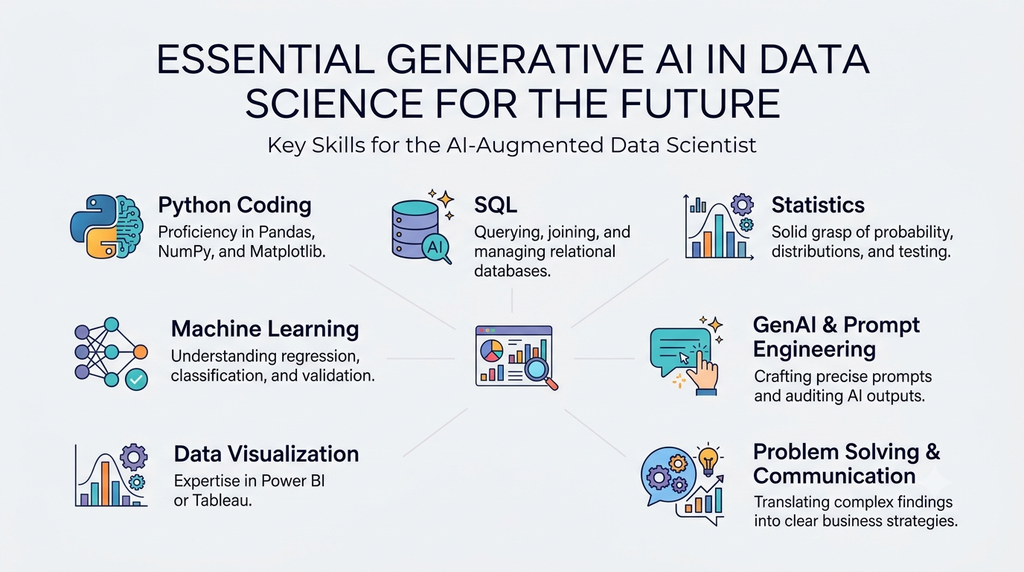
As routine tasks become automated, employers value professionals who combine core technical mastery with AI fluency and business judgment:
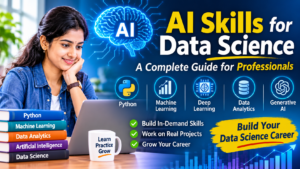
- Python Coding: Proficiency in libraries such as Pandas, NumPy, and Matplotlib for data manipulation and visualization.
- SQL: Ability to query, join, and manage relational databases accurately.
- Statistics: Solid grasp of probability, distributions, correlation, and hypothesis testing.
- Machine Learning: Understanding of regression, classification, clustering, and rigorous model validation.
- Data Visualization: Expertise in Power BI or Tableau to build actionable executive dashboards.
- Generative AI & Prompt Engineering: Skill in crafting precise prompts, auditing AI outputs, and understanding model limitations.
- Problem Solving & Communication: Translating complex analytical findings into clear business strategies.
Key Challenges and Limitations of Generative AI in Data Science:
- Unreliable Outputs (Hallucinations): AI can generate plausible-sounding errors or buggy code, making human verification mandatory.
- Data Security & Privacy: Uploading sensitive customer or proprietary data to public AI platforms risks confidentiality breaches.
- Algorithmic Bias: Models trained on skewed historical data can reproduce or amplify unfair biases.
- Limited Business Context: AI lacks intrinsic awareness of organizational nuances, market shifts, or strategic trade-offs.
- Over-Reliance: Depending solely on AI without mastering fundamentals weakens critical thinking and debugging skills.
- Mastering these foundational and AI-driven competencies through a hands-on Data Science Course in Coimbatore equips aspiring professionals to stand out in an evolving job market.
The Future of Generative AI In Data Science:
Looking ahead, greater integration between humans and AI is expected. Generative AI is anticipated to further support data analysis, continue automating routine processes, and expedite decision-making. In the near future, professionals will increasingly rely on AI assistants to explore data, build initial machine learning models, and report data-driven insights.However, businesses will still require highly skilled staff to evaluate data, identify suitable analytical approaches, verify results, and solve complex problems. Students and freshers can capitalize on this shift by actively working with both data science and AI. Building strong expertise in Python, SQL, statistics, machine learning, and AI will be essential for adapting to future industry expectations.
Conclusion:
Generative AI in Data science is transforming the data science industry by supporting data analysis, coding, reporting, and machine learning while accelerating data exploration and overall efficiency. Nevertheless, core technical expertise, analytical thinking, data security, and human judgment remain indispensable.Engaging with data science and AI is one of the best ways for students, graduates, and professionals to future-proof their careers. To build these practical capabilities, you can explore Data Science Training in kochi (covering Python, SQL, statistics, machine learning, and AI). Ultimately, combining strong foundational skills with practical experience and continuous learning will prepare you for the growing opportunities in Data Science and Artificial Intelligence.