
Table of Contents
Introduction
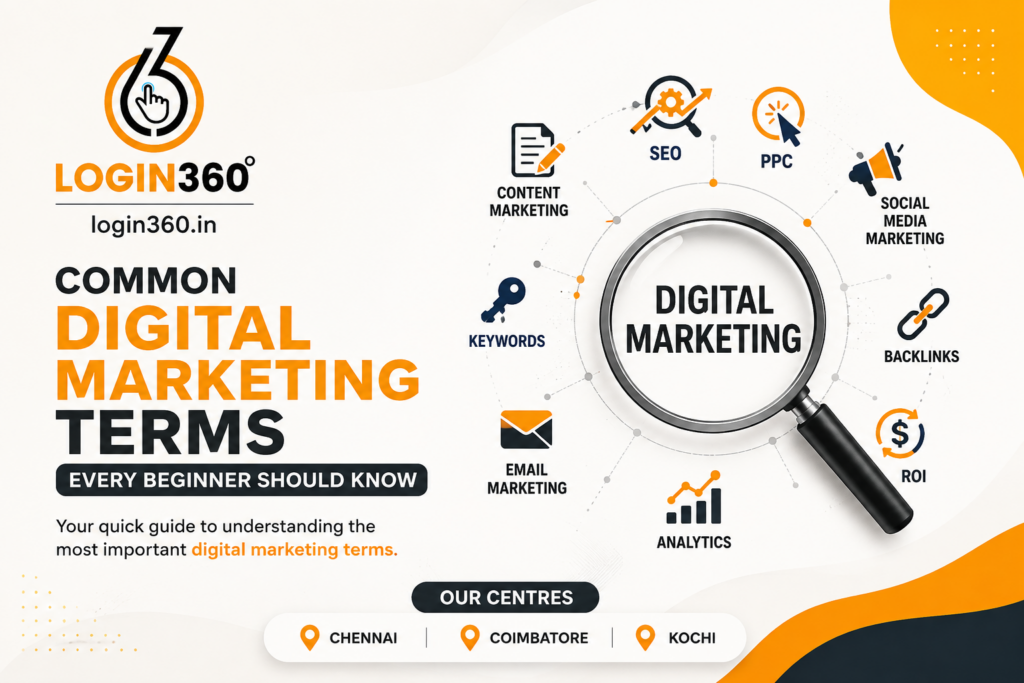
Digital marketing has become one of the most in demand skills for students, job seekers, entrepreneurs and business owners. However, beginners often come across technical terms that can feel confusing at first. Understanding these digital marketing terms is essential because they form the foundation of online marketing strategies. In this guide, you’ll learn the most common digital marketing terms every beginner should know and how they are used in the real world.
What Is Digital Marketing?
Digital marketing is the practice of promoting products, services or brands using digital channels such as search engines, social media platforms, websites, email and mobile applications. Unlike traditional marketing, digital marketing allows businesses to reach a targeted audience, measure campaign performance and optimize their strategies using real time data. Today, businesses of all sizes rely on digital marketing to generate leads, increase brand awareness, improve customer engagement and drive online sales. Whether you’re planning to become a digital marketer or grow your own business, understanding the basic terminology is the first step toward mastering this field.
Why Learning Digital Marketing Terms Is Important
- Every industry has its own language and digital marketing is no exception. If you’re unfamiliar with common marketing terms, understanding tutorials, attending interviews or working on real projects can become challenging.
- Learning these terms helps you communicate effectively with marketing teams, understand campaign reports, interpret website analytics and make informed decisions while running digital marketing campaigns. It also makes it easier to learn advanced concepts such as SEO, paid advertising, email marketing and content strategy.
- Once you’re familiar with the basic terminology, you’ll spend less time trying to understand technical jargon and more time applying practical digital marketing techniques.
Common Digital Marketing Terms Every Beginner Should Know
Search Engine Optimization (SEO)
- Search Engine Optimization (SEO) is the process of improving a website so that it ranks higher in search engine results without paying for advertisements. The goal of SEO is to increase organic traffic by making web pages more relevant, valuable and user friendly.
- SEO involves optimizing website content, improving page speed, building high quality backlinks, using relevant keywords and creating a better user experience. Since most users click on results appearing on the first page of Google, SEO plays a crucial role in increasing website visibility.
Search Engine Marketing (SEM)
- Search Engine Marketing (SEM) is a digital marketing strategy that increases website visibility through paid advertisements on search engines. Businesses bid on specific keywords so their ads appear above or alongside organic search results.
- Unlike SEO, which takes time to produce results, SEM can generate traffic immediately after launching a campaign. Google Ads is one of the most widely used platforms for search engine marketing.
Pay-Per-Click (PPC)
- Pay-Per-Click (PPC) is an online advertising model where advertisers pay only when someone clicks on their advertisement. Instead of paying for the number of times an ad is displayed, payment is made only for actual clicks.
- PPC campaigns are commonly used on Google, Bing, Facebook, Instagram, LinkedIn and other advertising platforms. Businesses use PPC to drive targeted traffic, generate leads and increase sales within a short period.
Cost Per Click (CPC)
- Cost Per Click (CPC) refers to the amount an advertiser pays for each click received on a PPC advertisement. The CPC varies depending on factors such as keyword competition, audience targeting, ad quality and bidding strategy.
- Lower CPC generally means businesses can attract more visitors while spending less on advertising. Improving ad relevance and quality score often helps reduce advertising costs.
Click-Through Rate (CTR)
- Click-Through Rate (CTR) measures the percentage of people who click on an advertisement, email or search result after seeing it. It is one of the most important performance metrics in digital marketing because it indicates how attractive and relevant your content is to users.
- A higher CTR usually suggests that your headline, ad copy or call-to-action successfully encourages users to take action. Marketers frequently optimize titles, descriptions and visuals to improve CTR.
Impressions
- An impression is counted every time an advertisement, social media post or webpage appears on a user’s screen, regardless of whether the user interacts with it. Impressions measure visibility rather than engagement.
- For example, if your advertisement appears 5,000 times in users’ news feeds, it has generated 5,000 impressions even if only a small percentage of users click on it.
Reach
- Reach refers to the total number of unique users who have seen your content or advertisement. Unlike impressions, which count every display, reach counts each individual user only once.
- For instance, if one person sees your advertisement five times, it counts as five impressions but only one reach. Understanding the difference between reach and impressions helps marketers evaluate campaign exposure more accurately.
Conversion
- A conversion occurs when a visitor completes a desired action on a website or landing page. The desired action depends on the marketing objective and may include purchasing a product, filling out a contact form, downloading an ebook, subscribing to a newsletter or registering for a webinar.
- Conversions are one of the most important indicators of a successful marketing campaign because they represent meaningful business outcomes rather than just website traffic.
Conversion Rate
- Conversion Rate is the percentage of visitors who complete a desired action after visiting your website or landing page. This action could include making a purchase, signing up for a newsletter, downloading a resource, or submitting a contact form.
- A high conversion rate indicates that your marketing campaign and website are effectively encouraging visitors to take action. Businesses often improve conversion rates by optimizing landing pages, simplifying forms, improving website speed and creating compelling calls-to-action.
Bounce Rate
- Bounce Rate refers to the percentage of visitors who leave a website after viewing only one page without interacting further. A high bounce rate may indicate that visitors did not find the content relevant or engaging.
- Several factors can contribute to a high bounce rate, including slow loading pages, poor website design, irrelevant content or a confusing user experience. Improving content quality, page speed and internal linking can help reduce bounce rates.
Landing Page
- A landing page is a dedicated web page designed to encourage visitors to complete a specific action. Unlike a homepage, a landing page focuses on a single goal, such as generating leads, promoting a product or collecting registrations.
- Effective landing pages typically include a clear headline, persuasive content, strong visuals, customer testimonials and a prominent call-to-action. Since there are fewer distractions, landing pages usually achieve higher conversion rates than general website pages.
Call-to-Action (CTA)
- A Call-to-Action (CTA) is a button, link or message that encourages users to take a specific action. Common examples include “Buy Now,” “Sign Up,” “Download Free Guide” and “Get Started.”
- A well designed CTA should be clear, action oriented and easy to notice. Strong CTAs play a significant role in improving conversions because they guide users toward the next step in the customer journey.
Keywords
- Keywords are the words and phrases users type into search engines when looking for information, products, or services. They form the foundation of Search Engine Optimization (SEO) because search engines use them to understand the relevance of web content.
- Choosing the right keywords helps businesses attract the right audience. Successful keyword research considers search volume, competition and user intent to identify terms that can generate valuable traffic.
Organic Traffic
- Organic traffic refers to visitors who reach a website through unpaid search engine results. These users discover your website naturally by searching for relevant keywords on platforms such as Google or Bing.
- Unlike paid advertising, organic traffic is generated through effective SEO strategies, quality content, technical optimization and strong website authority. Although building organic traffic takes time, it often provides sustainable long term results.
Paid Traffic
- Paid traffic consists of visitors who arrive at a website through online advertisements. Businesses pay advertising platforms to display their ads to specific audiences based on demographics, interests, keywords or online behavior.
- Paid traffic delivers immediate visibility and is commonly generated through Google Ads, Facebook Ads, Instagram Ads, LinkedIn Ads and other advertising platforms. It is particularly useful for product launches, promotional campaigns and lead generation.
Backlinks
- Backlinks are links from one website to another. When a reputable website links to your content, search engines often consider it a sign of credibility and authority.
- High quality backlinks can improve search engine rankings, increase referral traffic and strengthen a website’s online reputation. However, backlinks from low quality or spam websites can negatively affect SEO performance.
Domain Authority (DA)
- Domain Authority (DA) is a metric that estimates the likelihood of a website ranking well in search engine results. It is influenced by factors such as backlink quality, website credibility, content quality and overall SEO performance.
- Although Domain Authority is not a direct Google ranking factor, it is widely used by SEO professionals to evaluate the strength and competitiveness of a website compared to others within the same industry.
Search Engine Results Page (SERP)
- A Search Engine Results Page (SERP) is the page displayed by a search engine after a user enters a search query. The SERP typically contains organic listings, paid advertisements, featured snippets, local business listings, images, videos and other search features.
- Appearing on the first page of the SERP is a major objective of SEO because most users rarely browse beyond the initial search results. Higher rankings generally lead to increased website traffic and better visibility.
Content Marketing
- Content Marketing is the process of creating and sharing valuable, relevant and consistent content to attract and engage a target audience. Instead of directly promoting products, content marketing focuses on providing useful information that builds trust and long term relationships.
- Common forms of content marketing include blog posts, articles, videos, infographics, podcasts, case studies and ebooks. High quality content also supports SEO by helping websites rank for relevant keywords.
Email Marketing
- Email Marketing is a digital marketing strategy that uses email to communicate with existing customers and potential clients. Businesses use email campaigns to share newsletters, product updates, promotional offers, educational content and personalized recommendations.
- A successful email marketing campaign focuses on delivering relevant content to the right audience at the right time. When combined with audience segmentation and automation, email marketing can significantly improve customer engagement and retention.
Social Media Marketing (SMM)
- Social Media Marketing (SMM) is the practice of promoting a brand, product or service through social media platforms such as Facebook, Instagram, LinkedIn, X and Pinterest. Businesses use these platforms to connect with their audience, increase brand awareness and drive website traffic.
- An effective social media marketing strategy involves creating engaging content, interacting with followers, running paid advertising campaigns and analyzing performance metrics. Consistent posting and audience engagement help businesses build trust and establish a strong online presence.
Affiliate Marketing
- Affiliate Marketing is a performance based marketing strategy where individuals or businesses earn a commission by promoting another company’s products or services. Affiliates share unique referral links through blogs, websites, social media, YouTube or email campaigns.
- When someone purchases a product using the affiliate link, the affiliate receives a commission. This marketing model benefits both businesses and affiliates, as companies gain more sales while affiliates generate passive income without creating their own products.
Return on Investment (ROI)
- Return on Investment (ROI) measures the profitability of a marketing campaign by comparing the revenue generated against the amount spent. It helps businesses determine whether their marketing efforts are producing positive financial results.
- A positive ROI indicates that the campaign generated more revenue than it cost to run, while a negative ROI suggests that improvements may be needed. Monitoring ROI enables marketers to allocate budgets more effectively and focus on high performing strategies.
A/B Testing
- A/B Testing, also known as split testing, is the process of comparing two versions of a webpage, advertisement, email or landing page to determine which one performs better. Marketers show Version A to one group of users and Version B to another group, then analyze the results based on predefined goals.
- A/B testing helps improve important metrics such as click-through rates, conversion rates and user engagement. Even small changes to headlines, images, button colors or call-to-action text can significantly influence campaign performance.
Analytics
- Analytics refers to the process of collecting, measuring and interpreting data to evaluate the performance of digital marketing activities. It helps businesses understand user behavior, traffic sources, conversions, audience demographics and overall campaign effectiveness.
- Tools such as Google Analytics, Google Search Console and social media insights provide valuable data that marketers can use to optimize their strategies. Regularly analyzing this information enables businesses to make informed decisions, identify growth opportunities and continuously improve marketing performance.
Tips for Beginners to Learn Digital Marketing Faster
- Learning digital marketing becomes easier when you focus on practical experience rather than theory alone. Reading about concepts is important, but applying them through real projects helps build confidence and improve problem solving skills.
- Start by creating a simple website or blog where you can experiment with SEO, content writing, keyword research and analytics. Hands on practice allows you to understand how different digital marketing strategies work together.
- Stay updated with industry trends by following trusted marketing blogs, watching educational videos and enrolling in online courses. Since digital marketing evolves rapidly, continuous learning is essential for long term success.
- Finally, develop a habit of analyzing successful marketing campaigns from well known brands. Observing how businesses use social media, email marketing, paid advertising and content marketing provides valuable insights that can be applied to your own projects.
Conclusion
Understanding digital marketing terminology is the first step toward building a successful career in online marketing. These terms form the foundation of SEO, advertising, content marketing, social media and analytics, making them essential for every beginner. As you continue learning and applying these concepts in real world projects, your confidence and practical skills will grow significantly. Mastering these fundamental terms will prepare you for more advanced digital marketing strategies and career opportunities.