

Table of Contents
Introduction
If you’ve spent any time trying to get a website to rank higher on Google, you’ve probably heard the word “backlink” thrown around more than once. Backlinks in Digital marketing are one of the oldest and most trusted signals search engines use to judge whether a website deserves a top spot in search results. In simple terms, every link from another website pointing to yours acts like a small vote of confidence, telling search engines that your content is worth showing to people. But not all votes carry the same weight, and understanding how backlinks actually work is the first step toward using them effectively. This guide walks through what backlinks are, why they matter, the different types you’ll come across, and how to build a healthy backlink profile without falling into common traps.
What Are Backlinks?
A backlink, sometimes called an inbound link or an external link, is simply a hyperlink on one website that leads to a page on another website. Structurally, a backlink is made up of two key parts: the destination URL (the page being linked to) and the anchor text (the clickable text that carries the link). When Site A links to Site B, search engines treat that connection as a signal worth analyzing. Behind the scenes, search engine crawlers follow these links across the web, building a map of how pages are connected to one another. This map helps engines like Google understand which pages are frequently referenced by others, which in turn hints at how useful or authoritative those pages might be. Every website you visit is, in a sense, part of a giant interconnected web of trust built through these links.
Why Backlinks Are Important for SEO
Search engines were originally built to sort through millions of pages and decide which ones deserved to appear first, and backlinks in Digital marketing became one of the earliest reliable ways to do that. When a reputable website links to your page, it signals that your content has value, and search engines factor that signal directly into ranking decisions. Pages with a strong, diverse backlink profile tend to rank higher for competitive keywords than pages with few or no backlinks, all else being equal. Beyond rankings, backlinks also influence a domain’s overall authority score, a metric that tools like Ahrefs and Moz use to estimate how trustworthy a site appears in its niche. This authority doesn’t just help the specific page that received the link; it can lift the visibility of the entire website over time. And because higher rankings generally translate to more clicks, backlinks end up playing an indirect but very real role in driving organic traffic and, eventually, revenue.
Different Types of Backlinks in digital marketing
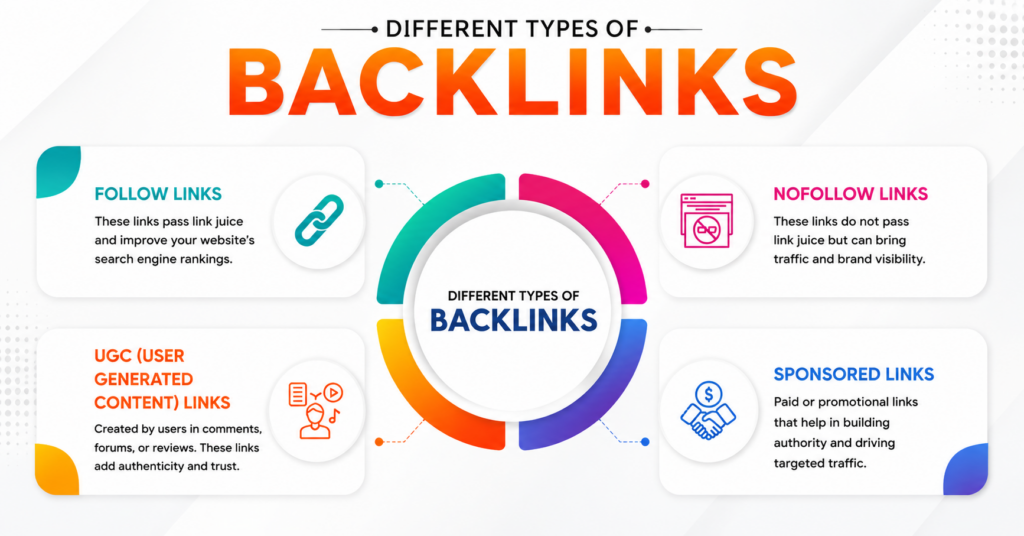
Do Follow backlinks
These are the default type of link and pass on what’s known as “link equity” or ranking value to the destination page. When most people talk about wanting backlinks, this is the kind they mean, since it directly contributes to SEO strength.
NoFollow backlinks
These carry a special tag (rel="nofollow") that tells search engines not to pass ranking credit through the link. They’re common on comment sections, forums, and paid placements, and while they don’t boost rankings directly, they still send referral traffic and can expose your brand to new audiences.
Sponsored backlinks
Marked with (rel="sponsored"), these are used for paid partnerships, affiliate links, or advertisements. Google introduced this tag so advertisers and publishers could stay transparent about paid relationships without risking penalties.
UGC (User-Generated Content) backlinks
Tagged with (rel="ugc"), these come from content that users themselves create, such as blog comments or forum posts. This tag helps search engines separate editorially placed links from ones added by the public.
High-Quality vs. Low-Quality Backlinks
Not all backlinks help your rankings, and some can actively hurt them, so learning to tell the difference matters more than simply chasing volume. A high-quality backlink typically comes from a your Rank website that is relevant to your industry, has genuine authority built over time, and sends the link within naturally written, contextual content rather than a random list. Editorial links placed by journalists, industry publications, or respected bloggers because they genuinely found your content useful are the gold standard here. Low-quality backlinks, on the other hand, usually come from link farms, unrelated foreign-language sites, or pages stuffed with dozens of outbound links that exist purely to manipulate rankings. These links often carry little to no relevance to your niche and can appear suspicious to search engines, especially when they show up in large numbers over a short period. The safest approach is to prioritize relevance and earned placement over sheer quantity, since a handful of strong, relevant links will typically outperform hundreds of weak, unrelated ones.
Benefits of Backlinks for Businesses
Brand awareness Every backlink placed on another website exposes your brand to that site’s existing audience, extending your reach beyond your own marketing channels. Referral traffic Readers who click through a backlink arrive at your site already interested in the topic, often making them more engaged than visitors from cold outreach. Credibility and trust Being linked to by well-known or respected websites acts as social proof, signaling to new visitors that your business is established and worth trusting. Lead generation Backlinks placed in relevant, high-intent content (such as comparison articles or industry roundups) can bring in visitors who are further along in their decision-making process, improving conversion potential.
Effective Backlink Building Strategies
- Guest posting — Writing articles for other reputable websites in your niche in exchange for a link back to your site remains one of the most reliable ways to earn quality backlinks while also reaching a new audience.
- Content marketing — Producing genuinely useful content such as original research, in-depth guides, or data-driven reports naturally attracts links because other creators want to reference and cite strong resources.
- Outreach — Proactively contacting website owners, bloggers, or journalists who might find your content relevant to their audience can result in organic link placements, especially when the outreach is personalized rather than mass-sent.
- Broken link building — This involves finding dead links on other websites and suggesting your own relevant content as a replacement, offering value to the site owner while earning a backlink in return.
Common Backlink Mistakes to Avoid
Using link farms Networks of low quality sites created solely to exchange links can trigger search engine penalties once detected, often erasing months of ranking progress overnight. Building spammy links Links from irrelevant, low-authority, or automatically generated websites add little value and can signal manipulative intent to search engines. Excessive link exchanges Trading links back and forth in large volumes (“I’ll link to you if you link to me”) looks unnatural at scale and is closely monitored by search algorithms. Buying paid links without disclosure Purchasing links purely to manipulate rankings, without using the appropriate sponsored tag, violates search engine guidelines and risks manual penalties.
Tools for Backlink Analysis and Monitoring
- Google Search Console — A free tool directly from Google that shows which external sites link to your pages, making it a solid starting point for basic backlink monitoring.
- Ahrefs — A comprehensive paid platform widely used for tracking backlink profiles, analyzing competitor links, and measuring domain authority through its own scoring system.
- SEMrush — Offers detailed backlink audits, toxic link detection, and link-building opportunity suggestions alongside its broader SEO toolkit.
- Moz — Known for pioneering the Domain Authority metric, Moz’s Link Explorer helps evaluate the strength and quality of both your own and competitors’ backlink profiles.
- Other tools — Platforms like Majestic and Ubersuggest offer additional ways to cross-check backlink data, which is useful since no single tool captures the entire web.
Conclusion
Backlinks in Digital marketing remains one of the most influential ranking factors in SEO, acting as votes of trust between websites and helping search engines judge which content deserves visibility. Quality consistently matters more than quantity, since a handful of relevant, authoritative links will outperform a large volume of weak ones every time. A healthy link profile blends multiple link types DoFollow, NoFollow, UGC, and sponsored earned through genuine strategies like guest posting, content marketing, and thoughtful outreach rather than shortcuts. Steering clear of manipulative tactics such as link farms and spammy exchanges protects your site from penalties and long-term damage. Regular monitoring through tools like Search Console, Ahrefs, SEMrush, or Moz keeps your backlink profile clean and steadily supports your SEO goals.