
Table of Contents
Introduction
Data science is considered to be one of the fastest-growing areas of the digital era. With each day, companies produce huge volumes of data that require analysis, interpretation, and processing. The scope of data science is growing fast since data-driven decisions help to improve customer experience and streamline organizational processes and provide a competitive advantage. Nowadays, data science is not used exclusively by tech companies anymore. Many industries, such as healthcare, banks, retail, manufacturing, education, logistics, and entertainment are actively using data science solutions to predict customers’ behavior, detect frauds, and make medical diagnoses. Due to the development of artificial intelligence, machine learning, cloud computing, and big data, data science careers will only become more diverse and in-demand with high salaries for candidates. This article will help you learn about the future of data science and find out what kind of career opportunities in data science await you in the future, what kinds of salaries can you expect, what skills are highly valued by employers in this area, and how to build your career in data science.
What Is Data Science and Why Is It Growing Rapidly?
Data science is an interdisciplinary field that combines statistics, mathematics, programming, artificial intelligence, and domain knowledge to extract meaningful insights from data. Instead of relying on assumptions, organizations use data science to make informed decisions backed by evidence. The rapid growth of digital technologies has resulted in an explosion of data. Every online purchase, social media interaction, financial transaction, healthcare record, and connected device generates valuable information. Businesses need professionals who can organize this data, identify patterns, and convert it into actionable insights.
Several factors are driving the growth of data science:
- Increasing digital transformation across industries
- Adoption of cloud computing platforms
- Growth of AI and machine learning applications
- Rising demand for predictive analytics
- Expansion of Internet of Things (IoT) devices
- Availability of powerful data visualization tools
Organizations are now recognizing that data is one of their most valuable assets. Companies that effectively leverage data can improve efficiency, reduce costs, personalize customer experiences, and make smarter strategic decisions. This growing dependence on data ensures that the future of data science remains highly promising.
The Future Scope of Data Science Across Industries
The scope of data science in the future will not be limited to the technology industry, as most other industries also depend upon data science to improve efficiency and innovation. In the health sector, it helps in making predictions about diseases, providing personalized treatment options, medical imaging, monitoring patients, and making quicker diagnoses with AI assistance. It is used in the finance and banking industry to detect fraud, risk assessment, customer segmentation, financial forecasting, and improved cybersecurity. Retail businesses use data science to analyze the behaviors of customers, manage inventories, forecast demands, and provide personalization in online shopping experiences. In manufacturing, it can help in predictive maintenance, quality control, and supply chain optimization to save on costs and increase productivity. Data science can be used by educational institutes in learning analytics to personalize education and improve results. Transportation and logistics companies also use data science in route optimization, fleet management, traffic prediction, automation of warehouses, and delivery planning.
Top Career Opportunities in Data Science
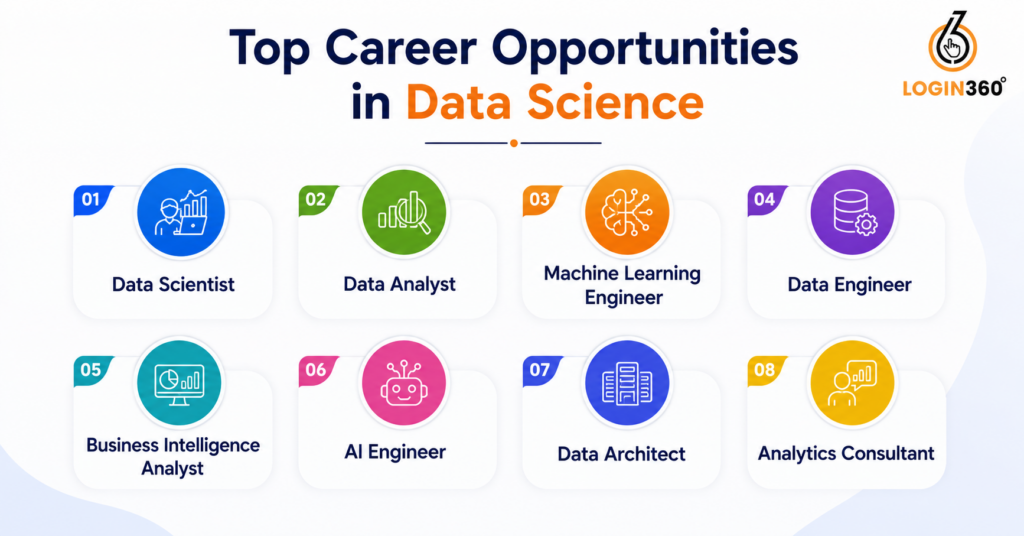
The expanding future scope of data science has created a wide variety of specialized career paths suitable for professionals with different interests and skill sets.
Data Scientist
Data scientists analyze complex datasets, build predictive models, and generate insights that support business decisions. This role combines statistical analysis, programming, and machine learning.
Data Analyst
Data analysts focus on collecting, cleaning, and visualizing data to help organizations understand business performance and identify trends.
Machine Learning Engineer
Machine learning engineers design and deploy AI models that automate tasks, improve predictions, and support intelligent applications.
Data Engineer
Data engineers build and maintain the infrastructure required to store, process, and manage massive datasets efficiently.
Business Intelligence Analyst
BI analysts create dashboards and reports that enable executives to monitor performance and make strategic decisions based on real-time data.
AI Engineer
AI engineers develop intelligent systems capable of speech recognition, computer vision, recommendation systems, and natural language processing.
Data Architect
Data architects design secure and scalable data systems that support organizational data management strategies.
Analytics Consultant
Consultants help businesses implement data-driven strategies and improve operational efficiency through advanced analytics.
As organizations continue investing in AI and big data technologies, these roles are expected to experience strong demand for years to come.
Essential Skills Required for a Successful Data Science Career
Building a successful career in data science requires a balance of technical knowledge and soft skills. Professionals need strong programming abilities, mathematical foundations, and expertise in machine learning to analyze data and build predictive models. Familiarity with data visualization tools helps present insights clearly, while knowledge of big data technologies enables efficient handling of large datasets. Equally important are communication and problem-solving skills, which allow data scientists to explain complex findings and develop practical business solutions. Since technology evolves rapidly, continuous learning is essential to stay updated with the latest tools, frameworks, and industry trends, ensuring long-term career growth and success.
Key Skills:
- Programming Languages: Python, R, and SQL for coding and data management.
- Mathematics & Statistics: Essential for data analysis and predictive modeling.
- Machine Learning: Build intelligent and automated systems.
- Data Visualization: Use Tableau, Power BI, Matplotlib, and Plotly.
- Big Data Technologies: Hadoop, Spark, and cloud platforms.
- Communication Skills: Present insights to technical and non-technical audiences.
- Problem-Solving: Analyze challenges and create data-driven solutions.
- Continuous Learning: Stay updated with emerging technologies and industry trends.
Emerging Trends Shaping the Future of Data Science
The future scope of data science is closely connected to several rapidly evolving technologies.
Artificial Intelligence
AI continues to automate business processes, improve decision-making, and enhance customer experiences.
Generative AI
Large language models and AI assistants are transforming content creation, customer support, software development, and business automation.
Explainable AI
Organizations increasingly require transparent AI systems that explain how decisions are made, especially in regulated industries.
Edge Computing
Processing data closer to devices reduces latency and improves performance in applications like autonomous vehicles and smart cities.
Data Privacy
Companies must balance innovation with regulatory compliance, making secure data handling increasingly important.
Cloud Computing
Cloud-based analytics platforms enable organizations to process enormous datasets without investing heavily in infrastructure.
Professionals who stay updated with these technologies will enjoy greater career opportunities in the coming years.
Data Science Salary Trends Around the World
A major factor that draws people towards working as data scientists is their potential to earn money. Salary varies depending on the level of experience, education, country, and industry. Entry-level professionals tend to earn competitive salaries as organizations have difficulties in recruiting skilled employees. Mid-level professionals usually see large jumps in salary as they develop skills in machine learning, cloud computing, and advanced analytics. Senior data scientists, AI engineers, and data architects usually earn high salaries owing to their leadership skills and ability to provide tangible business value from projects. Salaries remain high for experienced data science professionals in countries like the US, Canada, Germany, UK, Australia, and Singapore. India has seen high salary growth too as multinational organizations extend their reach into analytics. Apart from base salaries, professionals get bonuses, stock options, performance bonuses, remote working benefits, and career development advantages.
Factors That Influence Data Science Salaries
Several factors determine how much a data science professional can earn.
Experience
Professionals with proven project experience generally receive higher compensation than fresh graduates.
Technical Skills
Expertise in AI, deep learning, cloud computing, and big data technologies significantly increases earning potential.
Industry
Finance, healthcare, consulting, and technology companies often offer higher salaries compared to traditional industries.
Education
Advanced degrees, certifications, and specialized training demonstrate expertise and improve career prospects.
Geographic Location
Major technology hubs generally provide higher salaries due to increased demand and living costs.
Business Impact
Professionals who consistently deliver measurable business results often receive promotions and higher compensation packages.
Developing specialized expertise and continuously upgrading skills can substantially improve long-term earning potential.
How to Build a Successful Career in Data Science
Continuous learning, gaining practical experience, and being flexible are crucial for building a successful career. Firstly, you should have good skills in mathematics, statistics, and programming. Acquire knowledge in Python, SQL, and machine learning, and then proceed to studying such advanced disciplines as deep learning and natural language processing. Next, make sure that you are able to solve business-related tasks by working with data. Creating a portfolio on GitHub will help employers assess your technical skills. Taking part in data science competitions, being involved in open-source development, and having internships will be beneficial in gaining practical experience. In addition, networking is essential. Visiting various industry events, taking part in webinars and workshops, and participating in online forums will keep people aware of innovations and help them meet future employers. Lastly, keep improving yourself constantly.
Conclusion
Data science has an extremely bright future ahead of it as companies across all industries adopt technologies like digitalization, artificial intelligence, and data analysis. Nowadays, there is a need for specialists able to analyze raw data to gain insights that would increase the company’s efficiency, lower its costs, and enable innovations. There are many different career options, attractive salaries, and continuous technological advances in the field of data science which make it a great choice of career not only for fresh graduates but also for experienced specialists. If you dream about becoming a data scientist, machine learning engineer, AI specialist or analytics consultant, you should consider acquiring necessary skills and gaining practical experience. The future belongs to data and data professionals, therefore if you decide to choose a career in the field of data science now, you can be sure that your future career path will be very interesting.