

Introduction

React, Angular, and Vue are the three popular technologies in the contemporary era. Making a website or application demands more than good design. The technologies that can produce responsive interfaces, interact with users, build applications and provide a good user experience are needed by developers. With many technologies available in the market, choosing the appropriate one becomes difficult at times. React, Angular, and Vue are some of the popular technologies utilised for developing web applications. Though all three of them can be used for creating interactive interfaces, there are still differences between them in terms of architecture, methodology, ease of learning, flexibility, and community support. React is well-known for being very flexible and component-based; Angular is a framework, whereas Vue is relatively easier to understand. Knowing these differences will help developers, firms, and even aspiring web developers choose appropriate technology according to their needs.
React, Angular or Vue: Understanding the Differences
Before choosing a particular technology, it is necessary to figure out what React, Angular, and Vue really provide. React is a JavaScript library created by Meta for creating user interfaces. It uses a component-based architecture that enables splitting an application into reusable components. React mainly concentrates on user interface creation, so developers can choose any additional libraries and frameworks depending on the project needs. Angular is a frontend framework that is supported and managed by Google. It is created with TypeScript and includes many features that are necessary for application creation.
Routing, forms, HTTP requests, dependency injection, and other development opportunities can be found in its environment.Vue is a progressive JavaScript framework for creating user interfaces and web applications. Similar to React and Angular, it uses the component-based architecture for application building.All three technologies allow developing modern frontend applications, but they have different approaches.
React: Flexible and Component-Based Development
React has now become a preferred technology by many programmers while developing modern web applications and websites. The first distinguishing characteristic of React is its component-based model. In React, a user interface can be broken down into smaller units and components that can be used repeatedly across an application. As an illustration, a website may be made up of a navigation bar component, a product card, a search bar, a login form, and a footer. These components can be independently programmed and managed, which makes the application more organised.The other notable aspect of React is its flexibility. Because React deals mostly with the user interface, developers can choose any other libraries and tools they want depending on the requirements of the project. React uses a virtual DOM to handle interface updates effectively. With React, when the data of an application changes, only the updated section of the interface needs to be updated.
React’s Advantages
- Component-based development
- Reuse of UI components
- Flexible architecture
- Rich ecosystem
- Strong developer community
- Abundant learning materials
- Can be used for various applications
Angular: A Comprehensive Framework for Web Applications
Angular is much more structured when it comes to front-end development. In contrast to React, Angular is not just a library, but a framework, offering many tools needed to develop web apps. Angular has a lot of tools available in addition to TypeScript (which allows creating well-structured code). Some of these include routing, forms, dependency injection, HTTP services, and app architecture. A well-structured environment can be helpful when developing large-scale applications by a group of developers. Well-defined patterns and built-in tools can help to keep the whole process consistent. Angular is perfect for developing applications with advanced functionality and future scalability. Nevertheless, a vast range of features may complicate the learning process at the beginning.
Advantages of Angular
- Full Frontend Framework
- Uses TypeScript
- Provides an application structure
- Has built-in routing
- Handles forms
- Offers dependency injection
- Good for complex apps
Vue: Easy and Progressive Approach
Vue is yet another famous option for frontend development. Vue can be used progressively, which means developers can utilise its features progressively based on their needs. Vue has a component-based architecture like React. Developers are able to develop reusable components and combine them to build an interface and application. Another feature of Vue worth mentioning is the easy syntax of Vue. Developers familiar with HTML, CSS, and JavaScript might find it more comfortable working with this framework from the very beginning of frontend development. Vue also offers an ecosystem for routing, state management, development tools, and other application necessities.
Advantages of Vue
- Ease of Learning
- Component-Based Architecture
- Incremental Approach
- Flexibility
- Excellent Documentation
- Applicable for Various Projects
- Useful Ecosystem
React, Angular or Vue: Which One Is Easy to Learn?
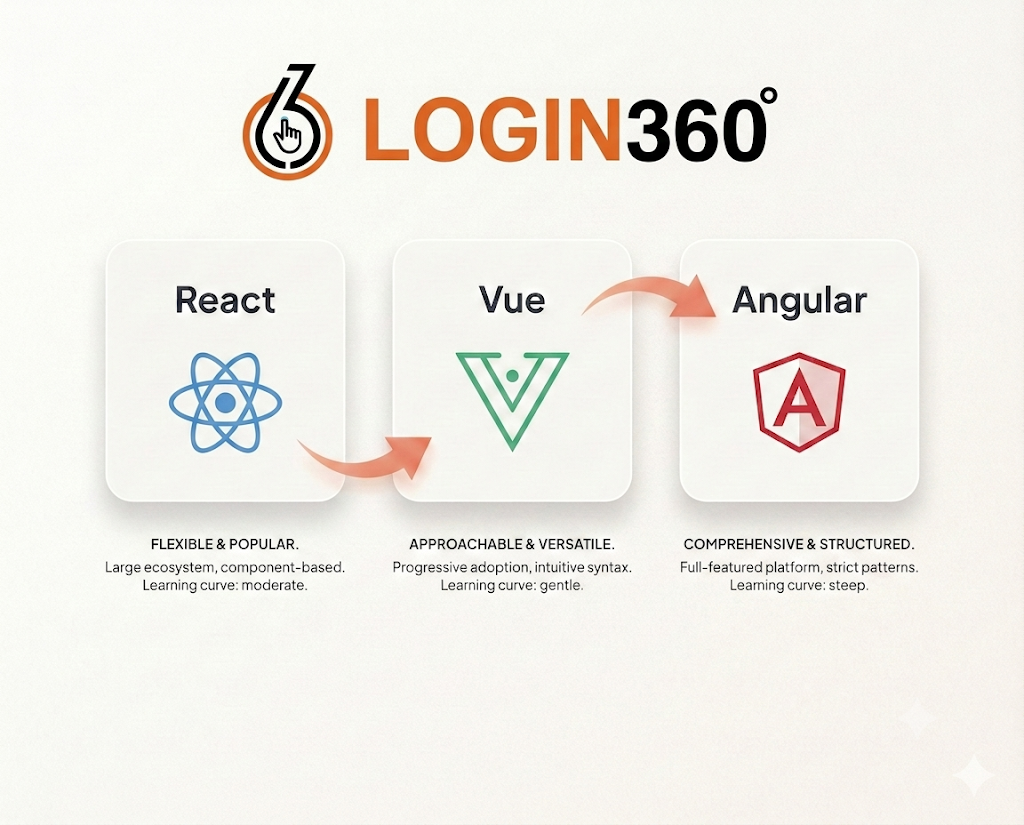
The ease of learning a frontend technology is dependent on how much a programmer knows about coding and how complex his or her project will be.React is an easy technology to pick up since a beginner can concentrate on components, JSX, props, and states initially. However, other technologies and libraries will have to be learned once one gets into the process of building applications.Angular needs more work when it comes to learning since developers have to learn TypeScript along with things like services, dependency injection, and routing among others.Vue is generally regarded as a friendly technology to learn since its syntax is easier to grasp for beginners and one’s projects get more complicated, developers can learn more.
As a beginner, one needs to consider more than just the easiest technology. One needs to build projects and know basic web development concepts.
Performance and User Experience Comparison
When it comes to choosing a frontend tool, website performance plays an important role. Website performance means that websites and applications should be fast, responsive, and work well on various platforms.It is possible to develop responsive and highly performant applications using React, Angular, or Vue frameworks. Nevertheless, performance is not dependent only on the chosen framework or library.
Other elements include:
- Application architecture
- Size of JavaScript bundles
- Image optimization
- Code splitting
- Rendering strategy
- Performance of APIs
- Caching
- Hosted environment
- Component optimization
Which Technology Is Suitable for Large-Scale Development?
Large-scale applications should have such qualities as scalability, maintainability, architecture, and effective cooperation between the teams of developers.Angular offers a structured environment with many features inside, and it might be useful for complex applications and those organizations that have a preference for standard development practices.React is able to be applied for development of large-scale applications as well. The flexibility of React enables development teams to apply certain libraries according to their needs. Nevertheless, certain development patterns should be defined by teams.Vue might also be applied for large-scale applications, but developers should be well-aware of the architecture and the use of ecosystem.
Thus, the size of application is not the only factor that should be taken into consideration.
Support from Ecosystem and Community
A good ecosystem could help ease frontend development through the provision of libraries, tools, documentation, tutorials, and community resources to the developers.React has a very good ecosystem, as well as a wide range of third-party libraries. There are numerous solutions available to the developers for all sorts of application needs, such as routing, state management, testing, and UI creation.Angular offers a more integrated ecosystem and most of the required functions and solutions can be found within the ecosystem and the framework itself.Vue has also formed an ecosystem which provides tools for routing, state management, development, and app creation.Community support is another key factor to consider in this case. A big developer community will definitely simplify the search for learning resources and development support.
React, Angular or Vue: Which Technology to Select
There are no universal technologies suitable for every project. One must select the most appropriate technology according to application requirements and the development team’s skills.
-
- Determine the Project Requirements
First, determine what application requirements are. For example, a small interactive website requires a different approach compared to an enterprise application.
-
- Take into Account Existing Skills
Team expertise might have an effect on the pace and effectiveness of the development process. It might be better to select the technology known to your team and avoid long training.
-
- Think About Scalability
The growth of an application should be taken into account when developing its architecture. New functionalities and more users should not pose any problems to the application structure.
-
- Take Development Speed Into Account
Development tools, reusable components and experienced developers might affect the development pace of your application.
-
- Think about Maintenance
It is necessary to maintain web applications after their release. Code organization, documentation, support, and developers with relevant expertise matter.
-
- Ecosystem
Selected technology should be compatible with backend, APIs, database, deployment and development tools.
What Should Beginners Learn First?
Beginning frontend developers need to have a solid knowledge base before learning any complex frameworks.HTML gives webpages their structure, whereas CSS is responsible for style and layout. JavaScript allows for interactivity and functionalities of pages. Knowing the basics helps to grasp the concepts related to more complex tools like React, Angular, and Vue.
Having learned the basics, beginners may choose one of the technologies and concentrate on developing their skills through practical work. They can develop a personal website, an e-commerce interface, task manager, or a dashboard.Developing real-world projects allows them to learn about responsive design, API, state management, debugging, Git, optimization, and UX.It is unnecessary to learn three technologies at once; it will be better to gain a deep knowledge of one and learn others afterward.
Career Possibilities with Frontend Development Skills
The field of frontend development remains a broad area with different kinds of knowledge and technologies. Web developers who know modern frontend technologies can develop websites, dashboards, e-commerce sites, SaaS applications, and more.Knowledge of React.js, Angular, or Vue.js can also help a developer who knows backend technologies in their quest to become a full stack developer.Nevertheless, technical knowledge is not sufficient. A company might require its employees to possess such qualities as problem-solving, experience in practical projects, communication skills, debugging skills, and knowledge about web development.Creating a portfolio with examples of actual projects can be an important stage in the education process of students and developers.
Conclusion
Selection among React, Angular, or Vue will rely on specific project needs, the developer’s proficiency and scalability needs, as well as architecture preferences and maintainability.React is flexible with components, whereas Angular comes as an already defined framework with lots of built-in features and is progressive like Vue, which offers easy development experience.Every of these technologies has its strong sides and could be applied to a different scenario.The primary advice for beginners is to become proficient in HTML, CSS, and JavaScript before mastering any advanced frontend technology. This combination will allow the learner to gain the necessary skills.
Build Your Web Development Skills with Login360
Looking to develop practical skills in modern web development? Login360 offers industry-focused training that helps learners build technical knowledge through practical learning and real-world projects. Explore full stack development and other technology-focused courses to strengthen your skills and prepare for opportunities in the IT industry.
Start learning, build real projects, and take the next step toward your web development career with Login360.