
Table of Contents
Introduction
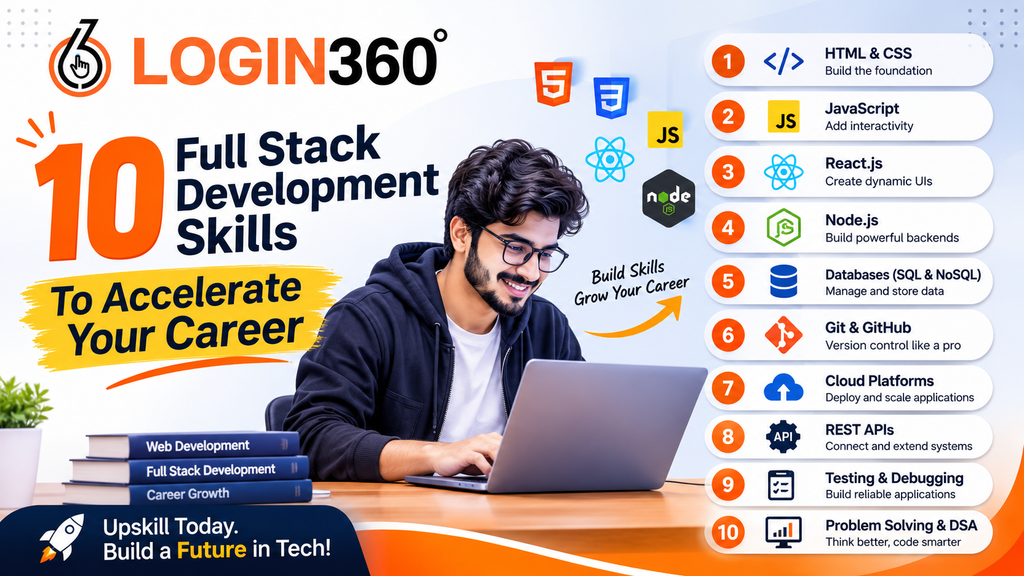
Full stack development skills have become some of the most valuable and in-demand skills in today’s technology industry. As businesses continue to build websites, web applications, and digital platforms, the demand for developers who can handle both frontend and backend development is growing rapidly. Companies are looking for skilled professionals who understand how different parts of an application work together to create smooth, responsive, and user-friendly digital experiences. Learning full stack development skills can open up several exciting career opportunities for beginners and experienced professionals. A full stack developer should have a good understanding of frontend technologies, backend programming, databases, APIs, and application development. These skills help developers manage the complete development process, from designing an attractive user interface to building powerful server-side functionality.
HTML and CSS
HTML and CSS are two of the most important technologies every developer should learn when starting a career in web development. HTML (HyperText Markup Language) provides the basic structure of a website by organizing elements such as headings, paragraphs, images, links, and forms. CSS (Cascading Style Sheets) is used to improve the appearance of web pages by adding colours, layouts, fonts, spacing, and responsive designs. Having strong HTML and CSS knowledge is one of the essential full stack development skills required to build modern websites and web applications. A skilled full stack developer should know how to combine HTML and CSS to create attractive, user-friendly, and mobile-responsive web pages. Mastering these fundamental full stack development skills also makes it easier to learn advanced frontend technologies and develop professional websites that deliver a better user experience.
Some important concepts include:
- Semantic HTML
- CSS Flexbox
- Grid
- Responsive web design
- Media queries
- Animations
- Accessibility
JavaScript
JavaScript is one of the most important programming languages and an essential part of modern web development. It is a must-have technology for anyone looking to master full stack development skills. JavaScript is mainly used to make websites interactive and dynamic by adding features such as animations, form validation, dropdown menus, and real-time updates. With Node.js, developers can also use JavaScript for backend development, allowing them to build complete web applications using a single programming language. Having strong JavaScript knowledge is one of the key full stack development skills that companies look for when hiring developers. Every aspiring full stack developer should understand fundamental concepts such as variables, functions, objects, arrays, events, promises, and asynchronous programming. However, learning the basics alone is not enough to stand out in today’s competitive technology industry. To improve your full stack development skills, it is important to explore advanced JavaScript concepts such as destructuring, arrow functions, template literals, spread operators, callbacks, promises, and Async/Await. Understanding these concepts will help you write cleaner, more efficient code and develop powerful applications using modern JavaScript frameworks and libraries.
Advantages of mastering JavaScript :
- Used to develop dynamic web pages
- Runs on the frontend and backend
- Easy to learn and work with
- Has a large support community
- Many frameworks and libraries
React or Another Frontend Framework
Modern web applications are increasingly developed using powerful frontend frameworks and libraries that make websites more interactive, responsive, and easier to maintain. React.js is one of the most popular frontend libraries used by developers, while Angular and Vue.js are also widely used technologies in modern web development. Learning these technologies is an important part of developing strong full stack development skills, as they help developers create professional and user-friendly applications. For example, React.js allows developers to build websites using a component-based development approach. This means that developers can create reusable UI components, manage application interfaces efficiently, and simplify the development process. Angular and Vue.js also provide useful features for building dynamic web applications. Understanding frontend frameworks is one of the valuable full stack development skills that can help developers improve their coding efficiency and build scalable applications. By gaining practical experience with React.js, Angular, or Vue.js, aspiring developers can strengthen their technical knowledge and prepare themselves for career opportunities in the software development industry.
Some of the concepts developers should master include:
- Components
- Props and state
- Hooks
- Routing
- API
- Forms
- State management
- Performance optimization
Backend Development
While HTML, CSS, JavaScript, and React.js are commonly used to build the frontend of websites, full stack developers must also understand how backend development works. The backend is responsible for handling the server-side operations that make web applications function smoothly. It includes managing databases, handling user authentication, processing client requests, managing application data, and implementing business logic. Developing strong backend knowledge is one of the essential full stack development skills required to build complete and reliable web applications. Some of the most popular backend technologies used in the software industry include Node.js, Express.js, Python, Java, and .NET. Each technology offers different features and advantages depending on the requirements of a project. To become a successful full stack developer, it is important to gain practical knowledge of at least one backend programming language and its framework. Mastering these full stack development skills helps developers connect frontend interfaces with server-side functionality, manage application data efficiently, and build secure, scalable, and high-performing web applications.
Important concepts include:
- REST APIs
- Authentication
- Authorization
- Business logic
- Application security
- Error handling
Database
Almost every modern web application depends on databases to store, organize, manage, and retrieve information efficiently. Therefore, understanding database management is one of the essential full stack development skills every aspiring developer should learn. Databases help applications manage important information such as user accounts, customer details, product information, transactions, and other business data. Full stack developers should have a good understanding of both SQL and NoSQL databases. Popular SQL databases include MySQL and PostgreSQL, while MongoDB is a widely used NoSQL database. Developers can also work with cloud-based database solutions such as Firebase to store and manage application data. Learning how to create databases, write queries, retrieve information, manage records, and maintain data security can significantly improve your full stack development skills. With practical database knowledge, developers can build reliable, scalable, and data-driven applications that meet modern business requirements.
Key concepts to master:
- Create Read Update Delete (CRUD)
- Create and manage database relationships
- Execute SQL queries
- Indexing
- Data modeling
- Transactions
- Database security
APIs
APIs (Application Programming Interfaces) play an important role in modern web development by allowing different software applications and systems to communicate and exchange data. They help developers connect websites, mobile applications, databases, and third-party services to improve application functionality. Understanding API development and integration is one of the essential full stack development skills required to build modern and feature-rich web applications. A full stack developer should know how to create APIs for their own applications and integrate existing APIs developed by third-party providers. For example, payment gateway APIs allow businesses to accept online payments securely without having to build an entire payment processing system from scratch. Similarly, developers can integrate APIs for maps, email services, authentication, and other useful features. REST APIs are among the most widely used approaches for connecting applications, while GraphQL is another popular technology that offers flexible data-fetching capabilities. Learning how to create, test, consume, and integrate APIs can significantly strengthen your full stack development skills. These abilities help developers build connected, scalable, and efficient applications that meet real-world business requirements.
Some concepts to master:
- HTTP methods
- Handling requests and responses
- REST
- JSON
- Authentication
- Testing and debugging
- API error handling
- Third-party API Integration
Git and GitHub
Version control is an essential part of modern software development and one of the important full stack development skills every developer should learn. It helps developers track changes in their source code, manage different versions of a project, fix errors, and collaborate with other team members. Git is one of the most widely used version control systems, making it easier to manage code throughout the development process. GitHub is a popular cloud-based platform that allows developers to store and manage their projects using Git repositories. It also provides useful collaboration features such as pull requests, issue tracking, code reviews, and project management tools. Developers can upload their projects to GitHub, share their work with others, and contribute to open-source projects. Learning Git commands, creating repositories, managing branches, committing changes, and resolving merge conflicts can significantly improve your full stack development skills. Having practical experience with Git and GitHub also helps developers maintain an organized project workflow and build a professional portfolio to showcase their coding abilities to potential employers.
Developers should be well-versed in such basic commands as:
- git clone
- git add
- git commit
- git push
- git pull
- git branch
- git merge
When it comes to job interviews, having a good GitHub account can significantly increase your chances of landing a remote software development job. With a good GitHub account, one can showcase their coding skills to potential employers by demonstrating their projects and code.
Testing and Debugging
Software development involves writing, testing, and improving code to make sure applications work as expected. However, creating error-free software is not always easy, especially when working with complex web applications. This is why testing and debugging are important full stack development skills that every aspiring developer should master. Testing helps developers identify errors, check application performance, and ensure that different features work correctly. Debugging involves finding and fixing problems in the code before they affect the end user. Full stack developers should understand how to write test cases, execute automated tests, inspect browser errors, and identify issues in API responses. Developers can use tools such as Chrome DevTools, Jest, and Postman to test application functionality and troubleshoot common problems. Learning different testing methods, including unit testing, integration testing, and end-to-end testing, can further improve your full stack development skills. These practices help developers build secure, stable, and reliable applications while delivering a better user experience.The most important concepts around testing and debugging include:
- Writing test cases
- Debugging edge cases
- Debugging the browser console
- API response validation
- Validating user input
Cloud and Deployment
After completing the development process, the next important step is deploying the application so that users can access it online. Therefore, understanding cloud computing, application deployment, and web hosting is another valuable part of full stack development skills. Developers should know how to move applications from a local development environment to a live server and make them available to users. Some of the most popular cloud computing platforms include Amazon Web Services (AWS), Microsoft Azure, and Google Cloud Platform (GCP). These platforms provide services that help developers host applications, manage databases, store files, and handle increasing user traffic. A successful full stack developer should also understand important deployment concepts such as containers, environment variables, server configuration, and application monitoring. Tools like Docker can simplify application deployment by packaging software and its dependencies into containers. Developing practical knowledge of these technologies can strengthen your full stack development skills and help you build, deploy, and maintain scalable applications in real-world development environments.
Concepts to master:
- Hosting
- Cloud
- Deployment
- Environment variables
- Monitoring
- Servers
Problem-Solving and Soft Skills
Having strong technical knowledge is important, but becoming a successful developer requires more than just writing code. Problem-solving and communication are equally valuable full stack development skills that help developers succeed in the software industry. Software development is all about identifying challenges, understanding requirements, researching possible solutions, and choosing the most effective approach to solve real-world problems. A good full stack developer should be able to analyze technical issues, think logically, troubleshoot errors, and find efficient solutions. These problem-solving abilities help developers handle complex projects, improve application performance, and deliver better results. Along with technical knowledge, soft skills such as communication, teamwork, time management, and adaptability are also important. Developers regularly interact with clients, designers, project managers, and other team members to understand project requirements and share ideas. Strong communication skills help avoid misunderstandings and ensure smooth project collaboration. Developing both technical and interpersonal full stack development skills can make you a more confident and capable professional. By combining coding knowledge, logical thinking, and effective communication, you can prepare yourself for long-term career growth in the software development industry.
Some of the relevant soft skills include:
- Analytical skills
- Communication
- Teamwork
- Time management
- Adaptability
- Detail-oriented
- A growth mindset
Boost Your Career With These Hard and Soft Skills
Developing all the essential full stack development skills discussed above can open the door to exciting career opportunities in the technology industry. These skills not only help you become a better developer but also prepare you to handle real-world software development projects with confidence. By mastering frontend and backend technologies, databases, APIs, testing, and deployment, you can gain a complete understanding of how modern applications are developed and maintained.
Conclusion
The more practical knowledge and technical abilities you develop, the better your chances of securing exciting job opportunities, including remote software development positions. Employers are looking for developers who can work with different technologies and handle the complete application development process. Some of the most important full stack development skills include HTML and CSS, JavaScript programming, frontend frameworks, backend development, database management, Git and GitHub, API integration, and strong problem-solving abilities. Are you ready to take the next step towards your IT career? Join Login360 today and gain the knowledge and practical experience needed to become a skilled full stack developer. Start learning, build impressive projects, and take your first step towards a successful career in full stack development!