

Introduction
Full stack development has always been a popular choice among people who want to pursue a career in the tech industry. But in 2026, employers are looking for individuals who can build complete web applications using Full Stack Development in 2026 modern frameworks and libraries, manage databases, secure APIs, deploy and maintain web apps, and gain a high-level understanding of how their applications work.
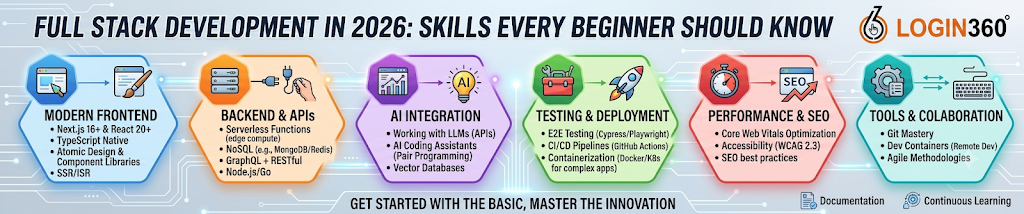
What is full stack development?
Full-stack development refers to the combined knowledge of frontend and backend development.
A full-stack developer typically builds user interfaces, servers, databases, and APIs.
They also design, test, debug, deploy, and maintain web applications and websites.
In other words, full-stack developers possess Full Stack Development in 2026 end-to-end application development expertise and can work with designers, DevOps engineers, database administrators, and product owners.
1. HTML, CSS, and JavaScript
The first step in learning full-stack development is to get familiar with basic web technologies such as HTML, CSS, and JavaScript. Full Stack Development in 2026
HTML stands for Hyper Text Markup Language and is used to define the content structure of a web page.
CSS means Cascading Style Sheets and is responsible for the visual appearance and presentation of web pages.
JavaScript is a programming language that brings websites to life by giving them dynamic behavior.
Forms
Layouts
Flexbox
Grid
Responsive design
JavaScript basics
Variables
Functions
Arrays
Objects
DOM
Events
Async JavaScript
These technologies provide the underlying layer of modern web application development and will become very useful when learning more complex frameworks and libraries such as React,
2. Angular, Vue, and Next.js.
It is advisable to start with at least one frontend framework or library in 2026.
Frontend frameworks help developers build maintainable and interactive digital products with relative ease.
The best way to choose which frontend framework to learn is to research which ones are popular in the industry and Full Stack Development in 2026 which ones are preferred in the company or field of interest.
Some of the best frontend frameworks and libraries to consider include
React.js
Angular
Vue.js
Next.js
Among these, React dominates the market and is the most popular frontend framework for building component-based UIs.
Therefore, every aspiring Full Stack Development in 2026.
The following concepts are critical when learning frontend frameworks:
Components
Props and State
Hooks
Routing
Forms
APIs
State Management
Performance Optimization
While you might feel tempted to learn multiple frameworks at the same time, it is better to focus on one and master it.
3. Backend development
If you thought full-stack development is all about the frontend, you are in for a surprise.
Full-stack developers should also have at least some foundational knowledge and skills in backend development. Full Stack Development in 2026
While the frontend runs on the user’s device, the backend operates on servers and is responsible for handling the application’s business logic.
A backend developer typically works with databases, APIs, application programming interfaces (APIs), and other infrastructural components.
The following are some of the best backend development skills to learn in 2026:
Node.js
Express.js
Python
Django
Java
Spring Boot
PHP
Laravel
For the sake of time and simplicity, it is advisable to pick one programming language and one framework to start with.
Node.js is the obvious choice for many beginners in 2026 because you can use JavaScript on both the frontend and the backend.
The following concepts should be prioritized when learning backend development:
Servers
Routing
Middlewares
Authentication
Authorization
Error handling
File uploads
APIs
Databases
At this point, it is worth noting that while frontend developers can deliver great digital products, the role of a full-stack developer goes beyond frontend development.
4. Databases
A full-stack developer should also have some database management skills because modern applications would not be complete without them. Full Stack Development in 2026
There are two main types of databases: Relational and Non-relational.
Each type consists of several databases, including:
MySQL
PostgreSQL
MongoDB
Redis
SQL is the standard programming language of relational databases.
Every beginner should make an effort to learn SQL because it is critical for working with relational databases.
The following topics should be covered when learning SQL:
Create
Update
Retrieve
Delete
Queries
Joins
Indexes
Relationships
Transactions
Optimization
The above skills are not only vital for working with relational databases but also serve as the foundation for working with non-relational databases since most modern databases have adopted elements of SQL.
The next step is to start working on a project that can bring together your frontend, backend, and database skills.
5. REST APIs
The truth is APIs (Application Programming Interfaces) play an essential role in modern software development.
A full-stack developer is expected to be able to work with APIs, including designing and consuming them.
While API development works may involve more advanced skills than what a beginner would expect in 2026, Full Stack Development in 2026 it is critical to familiarize yourself with some of the most fundamental concepts.
The following topics are critical when working with APIs:
HTTP methods
GET, POST, PUT, PATCH, DELETE
Status codes
JSON
Request/response structure
Authentication
Validation
Error handling
RESTful API standards
It is also critical to understand how to make HTTP requests using JavaScript fetch or Axios.
6. Git and GitHub
Git is the world’s leading version control system that enables developers to modify files, keep track of changes, and collaborate with other developers. Full Stack Development in 2026
The following are some of the most important Git concepts every developer should know:
Repositories
Commits
Branches
Conflicts
Merge
Push
Pull
Remote
GitHub is a web-based platform for hosting repositories and managing projects.
Beginners can use it to showcase their work to potential employers.
7. Responsive and accessible web design
The modern web development landscape is all about responsiveness and accessibility.
Full Stack Development in 2026 A responsive website looks good on all devices regardless of their screen size.
Some of the most critical responsive web design concepts include
Fluid (responsive) layouts
CSS Grid
Flexbox
Media queries
Images
Mobile-first approach
On the other hand, accessibility entails designing applications that meet the needs of persons with disabilities.
The key concepts include
Semantic HTML
Keyboard accessibility
Labels
Contrast
Tables
Images and alt text
Form controls
8. Authentication and security
We can never overlook the importance of implementing authentication and security features in our web applications. Full Stack Development in 2026
A full-stack developer should have at least some conceptual knowledge of the following security topics:
Authentication
Authorization
Hashing
JWT
HTTPS
Input validation
Secure cookies
SQL injection
Cross-site scripting
CSRF protection
9. Cloud and deployment
Modern software development is all about deploying applications for others to use.
Full Stack Development in 2026 A full-stack developer is expected to have at least some foundational concepts when it comes to cloud and deployment, including the following:
Hosting, servers, domains, DNS
Configuration
Cloud and deployment tools such as Vercel, Netlify, Render, and AWS
Environment variables
Logs
The bottom line is that every developer should learn how applications are hosted and made public so that they can deploy their own apps.
10. Testing and debugging
Full Stack Development in 2026 testing and debugging are critical parts of the web development process.
Beginners should not skip or underestimate this part of development since it will save them a lot of time and headaches.
Some of the most critical concepts to cover when it comes to testing and debugging include
Unit testing
API testing
Browser testing
Integration testing
Testing best practices
Debugging techniques
Jest
Vitest
Playwright
Cypress
11. AI assisted coding
AI-assisted coding has changed the game for many developers and has introduced a new level of efficiency in software development.
Full Stack Development in 2026 developers can use AI to explain code, write code snippets, debug code, run tests, develop unit tests, and research complex concepts that they do not fully understand.
However, it is important to remember that these tools are only assistants and should not be relied upon entirely.Full Stack Development in 2026
The best way to work with AI coding assistants is to understand the code they provide and not blindly adopt it in your projects.
The truth is, having fundamental coding knowledge will always be critical, and AI will most likely never replace coding.
12. Problem solving and soft skills
Technical skills alone will not make you a good developer.
Many employers are looking for problem-solving abilities, including logical reasoning and analytical skills. Full Stack Development in 2026
Some of the best soft skills to emphasize while pursuing a career in full-stack development include
Communication
Teamwork
Collaboration
Time management
Leadership
Adaptability
Curiosity
A career in software development calls for continuous learning long after initial development courses or certifications.
How to get started in 2026: The ultimate roadmap
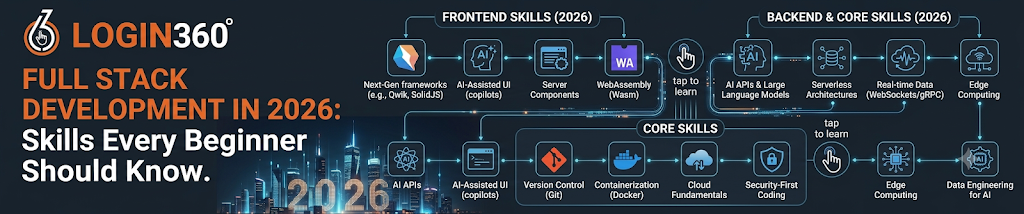
Based on the skills highlighted above, we can summarize everything in a roadmap that beginners can use to get started with full-stack development in 2026.
Step 1: Learn HTML, CSS, and JavaScript.
Step 2: Build simple static web pages using HTML and CSS.
Step 3: Build interactive web pages using JavaScript.
Step 4: Build landing pages, dashboards, and other static projects using HTML/CSS and JavaScript. Full Stack Development in 2026
Step 5: Learn a frontend framework such as React.
Step 6: Build interactive projects using the frontend framework.
Step 7: Learn backend development using Node.js, Python, or another preferred programming language and framework. Full Stack Development in 2026
Step 8: Learn SQL and a NoSQL database of your choice.
Step 9: Build RESTful APIs and connect your frontend and backend projects.
Step 10: Learn Git and GitHub.
Step 11: Learn authentication, security, testing, and debugging.
Step 12: Deploy your projects to a cloud platform or a web hosting service.
Step 13: Build a project portfolio that contains all the best projects you have built.
Projects to invest time in as a beginner
When learning to code, it is easy to fall into the trap of only building simple practice pages.
However, as a beginner, it is better to focus on learning how to build real web applications.
Full Stack Development in 2026 a new full-stack developer should aim to build at least the following projects:
E-commerce app
Online learning platform
Job portal
Expense tracker
Restaurant management system
Social media app
Appointment booking system
Task management tool
Personal finance dashboard
Each of these projects requires a combination of frontend and backend skills as well as databases and other relevant tools.
Conclusion
A lot of information has been covered in this ultimate guide to full-stack development skills for 2026. Here is a summary of what has been discussed: Full Stack Development in 2026
Full stack developers must have a strong foundation in frontend and backend development, databases, deployment, and security.
Join Login360 today and start building your future in technology!