

Table of Contents
Introduction
Data analytics Scope in future is now one of the most valuable areas of career choice in the digital economy. Companies in all different industries produce large quantities of data from their websites, applications, customers, sales, social media, finance, and operations. Yet data only becomes useful when professionals are able to analyse it and draw out meaningful insights. Because of this, the future scope of data analytics is expected to stay strong. The World Economic Forum lists AI and big data as two of the fastest-growing fields of skill, and the U.S. Bureau of Labor Statistics forecasts a 34% increase in employment for data scientists between 2024 and 2034. Learning data analytics is therefore an option for students, graduates, and current professionals that can lead to opportunities in a variety of industries and job positions.
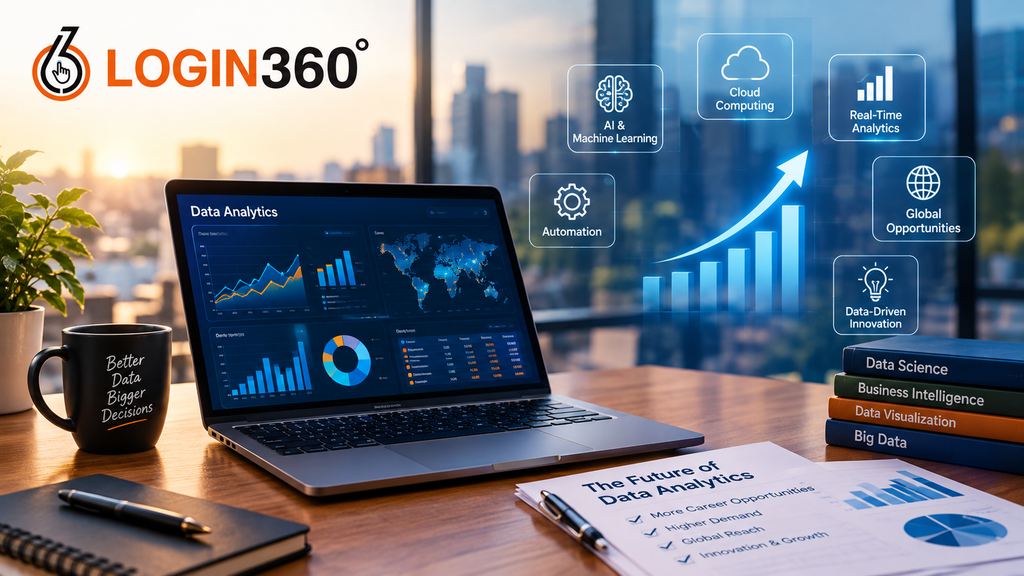
There is an increasing demand for professionals in the field of data analytics.
The need for experts in data analytics is growing since businesses want to reach better decisions based on actual business data. Rather than relying just on assumptions, companies now use data to understand their customers, measure their performance, identify problems, forecast demand, and improve their business strategies.
Since businesses are continually taking up digital technologies the quantity of data that they generate will also rise. There is therefore a demand for people who are able to effectively collect, clean, analyse, visualise and communicate data.
The future of data analytics is therefore very much linked to the expansion of digital businesses and to the practice of making decisions based on data.
Artificial Intelligence and Data Analytics
A major factor influencing the future of data analytics is Artificial Intelligence (AI), as it is able to quickly process large quantities of information, detect patterns, automate repetitive tasks, and assist with predictive analysis.
On the other hand, the need for data professionals is not eliminated by AI; rather, analytics professionals who understand AI tools can make use of them in order to work more efficiently and concentrate on more valuable tasks such as interpreting the results, solving business problems, and making recommendations.
According to the World Economic Forum, AI and big data are listed as two of the skills which are expected to grow most rapidly by the year 2030.
More Career Opportunities
There is a wide variety of career opportunities available through data analytics. According to their skills and level of experience, professionals can advance into various positions such as:
Data Analyst
Business Analyst
Data Scientist
Business Intelligence Analyst
Marketing Analyst
Financial Analyst
Product Analyst
Operations Analyst
Data Visualization Specialist
BI Developer
Data analytics is attractive to people coming from a variety of educational and professional backgrounds.
The application of data analytics in various industries
Data analytics is not only a concern of technology companies; almost all industries produce data and therefore require people who are able to understand it.
Important industries using analytics include:
Banking and Finance: fraud detection, risk analysis, and customer insights
Healthcare: patient data, operational efficiency, and healthcare research
E-commerce: customer behavior, sales analysis, and recommendations
Marketing: campaign performance and customer segmentation
Manufacturing: production monitoring and quality improvement
Telecommunications: customer usage and network analysis
Education: student performance and learning analytics
Logistics: delivery optimization and demand forecasting
One of the main reasons why data analytics has a strong future prospect is the demand for it across different industries.
The importance of business intelligence
Besides raw data, businesses also need information that is easy to understand so that managers can make decisions. That is why Business Intelligence (BI) and data analytics are important.
Using tools like Power BI and Tableau it is possible to turn complex datasets into dashboards, reports, and visualisations. Analysts can then use these dashboards to detect trends and pass on the key findings to decision-makers.
The more data-driven companies become, the more valuable it will be for professionals who are able to combine data analysis with an understanding of business.
The importance of predictive analytics will increase.
Traditional analytics usually concentrates on what has already happened, while predictive analytics goes a step further by making use of historical data, statistical techniques, and machine learning in order to estimate what might happen in the future.
Businesses can use predictive analytics for:
Sales forecasting
Customer churn prediction
Demand forecasting
Risk assessment
Fraud detection
Inventory planning
Customer behavior prediction
When organisations are seeking methods of preparing for future changes in the market, predictive analytics will probably turn into an ever more important element of business strategy.
The skills involved in data analytics will continue to evolve.
The future of data analytics will demand more than a basic understanding of spreadsheets, as professionals will have to possess a mix of technical, analytical, and communication skills.
Important skills include:
Excel
SQL
Python
Power BI
Tableau
Statistics
Data visualization
Data cleaning
Critical thinking
Business communication
Problem-solving
Basic machine learning
AI and automation tools
The World Economic Forum also regards analytical thinking, technological literacy, an understanding of AI and big data, and creative thinking as important skills for the future workforce.
Data analytics and opportunities in remote careers
The fact that analytics work is digital also opens up possibilities for people to work from home or on a hybrid basis. Generally, analysts work using cloud platforms, databases, dashboards, collaboration tools, and online reporting systems.
Companies have the possibility of obtaining analytics talent from various locations, and professionals may then have the opportunity to work with different organizations outside their local area.
For those who are just starting out, it can be very helpful to build a strong portfolio, since projects relating to sales, marketing, finance, customer behaviour, or business performance can show employers one’s practical analytical skills.
There is a greater demand for decision making based on data.
More and more companies are aiming for results that can be measured. If it’s about launching a product, carrying out a marketing campaign, enhancing customer experience, or cutting costs, data can assist organisations in assessing their decisions.
According to the U.S. Bureau of Labor Statistics, the demand for data scientists is expected to increase since organisations need experts to analyse the growing amounts of data and to assist in making informed decisions.
What this implies is that future analytics professionals will be required not only to produce reports but also to explain what the data means, why it is important, and what action the business should take next.
Great potential for a long-term career career
The future prospects for careers in the field of data are very promising. The U.S. Bureau of Labor Statistics states that employment of data scientists will increase by 34% from 2024 to 2034, with an average of about 23,400 new positions each year over that period.
The computer and mathematical occupations as a whole are also expected to grow at a speed that will be considerably faster than the average level of employment, since organisations require AI solutions and data analysis capabilities.
The fact that these trends exist indicates that skills relating to data are likely to stay important as businesses keep making investments in technology and data-driven operations.
What should people who are just starting out learn if they want to have a career in data analytics?
When you begin your career in data analytics, you should gradually develop your skills.
Start with the Basics
Data Analytics Scope in Future
Learn:
Excel and spreadsheet fundamentals
Basic statistics
SQL and database concepts
Data cleaning
Data visualization
Power BI or Tableau
Basic business and problem-solving skills
Once you have learned the basic principles, proceed with practical projects. You can build dashboards, analyze datasets, spot trends, and make business recommendations in this way to gain real-world confidence.
Is data analytics a good career choice in the future?
Data analytics is a promising career path for the future, particularly for those who enjoy working with figures, technology, solving problems, and addressing business issues; the field is developing hand-in-hand with AI, cloud computing, automation, and business intelligence.
Professionals should not rely entirely on a single tool since technology is constantly changing and therefore ongoing learning is essential. The most suitable candidates will be the ones who combine technical knowledge with analytical thinking, good communication skills, an understanding of business, and the capacity to adapt.

Conclusion
The future potential of data analytics is considerable and is still growing throughout various industries. Whether it’s artificial intelligence and predictive analytics or business intelligence and decisions based on data, organisations are becoming increasingly reliant on data in order to enhance their performance and stay competitive. The rising demand for skills relating to data and the excellent job prospects available in data-oriented positions are the reasons why a career in analytics can be so worthwhile. For students and those who are just starting out, it is helpful to learn tools such as Excel, SQL, Python, Power BI, and Tableau, along with carrying out practical projects, as this will give a solid basis for joining the field. Since technology is ever evolving, individuals who continually update their skills can build a successful and future-ready career in data analytics.
Learn practical, job-ready Data Analytics skills with Login360 Institute and take the next step toward your IT career.