

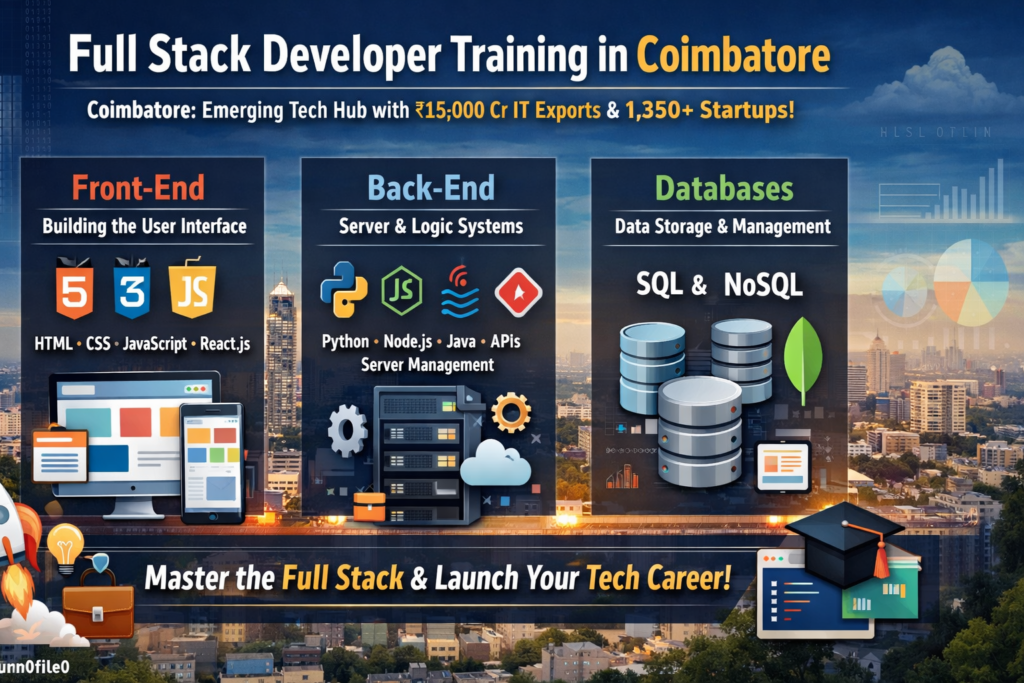
Full Stack Developer Training in Coimbatore is gaining momentum as the city’s transformation into a tech hub is no longer just a narrative—it’s backed by rapid, measurable growth. The city’s IT exports have crossed ₹15,000 crore in 2024–25, positioning it as one of India’s leading tier-2 technology destinations, while its startup ecosystem has expanded to over 1,350 startups in just four years across 50+ sectors.
What makes Coimbatore unique isn’t just growth—it’s the blend of deep industrial roots with emerging digital innovation. From SaaS and AI startups to manufacturing-tech solutions, the city is evolving into a space where traditional industries are being re-engineered through technology. For aspiring tech professionals, especially beginners, this city presents a unique blend of opportunity, affordability, and a growing ecosystem conducive to learning. If you’re contemplating a career in software development, the path to becoming a Full Stack Developer stands out as one of the most versatile and in-demand options, and understanding where to begin your journey in Coimbatore is crucial.
Demystifying Full Stack Development: More Than Just Code
At its core, Full Stack Development is about mastering the entire spectrum of web application creation. Think of building a real-world application like an online food delivery platform. A Full Stack Developer doesn’t just design how the app looks or how the server works—they understand how everything connects.
They build the user interface where customers browse menus, develop the backend logic that processes orders and payments, and manage the database that stores user details and order history. More importantly, they ensure all these parts communicate seamlessly—so when a user clicks “Order Now,” the entire system responds instantly and reliably.
This holistic approach is what defines Full Stack Development. It’s not about doing everything separately—it’s about solving problems across the entire system, understanding dependencies, and making decisions that keep the application efficient, scalable, and user-friendly.
This holistic approach encompasses three main pillars:
The Front-End: Crafting the User Experience
This is what users see and interact with directly – the visual interface of a website or application. It’s about creating intuitive layouts, engaging designs, and seamless interactions. Key technologies here include:
- HTML (HyperText Markup Language): The foundational skeleton of any webpage, defining its structure and content.
- CSS (Cascading Style Sheets): The styling language that dictates the visual presentation, from colors and fonts to layout and responsiveness across devices.
- JavaScript: The dynamic brain of the front-end, enabling interactive elements, animations, and complex user interface behaviors. Modern JavaScript frameworks like React.js, Angular, or Vue.js are essential for building sophisticated, single-page applications that offer rich user experiences.
Mastering the front-end goes beyond visuals—it’s about solving real user problems through design decisions. Take responsive design as an example. A poorly optimized website might look perfect on a desktop but becomes unreadable on a mobile device, forcing users to zoom, scroll endlessly, or abandon the page altogether.
A skilled front-end developer ensures the layout adapts seamlessly across devices—buttons remain tappable, text stays readable, and navigation feels natural. This directly improves user experience, reducing frustration and increasing engagement.
That’s where front-end mastery stands out—not just in making applications functional, but in making them effortless and intuitive to use.
The Back-End: The Engine Room of the Application
While the front-end is the face, the back-end is the brain and nervous system. It’s where the server, application, and database communicate to process requests, manage data, and ensure everything works behind the scenes. This layer handles user authentication, data storage and retrieval, business logic, and API (Application Programming Interface) creation to facilitate communication between the front-end and other services. Common back-end technologies include:
- Programming Languages: Python (with frameworks like Django or Flask), Node.js (with Express.js), Java (with Spring Boot), Ruby (with Ruby on Rails), or PHP (with Laravel) are popular choices, each offering distinct advantages in terms of performance, ecosystem, and community support.
- Server Management: Understanding how servers (like Apache or Nginx) host applications and handle requests is fundamental.
- APIs: Building and consuming RESTful or GraphQL APIs is a critical skill, allowing different parts of an application or even different applications to talk to each other efficiently.
Developing a robust back-end requires strong logical thinking, problem-solving abilities, and an understanding of data structures, algorithms, and security best practices. It’s about building scalable, secure, and efficient systems that can handle complex operations and large volumes of user traffic.
Databases: The Memory of the Application
Every application needs to store and retrieve data – user profiles, product information, transaction records, and more. Databases are organized collections of data that allow for efficient storage, querying, and management. Full Stack Developers must be proficient in at least one type of database:
- Relational Databases (SQL): Such as MySQL, PostgreSQL, or Oracle, which store data in structured tables with predefined schemas and relationships. They are excellent for applications requiring strong data consistency and complex queries.
- Non-Relational Databases (NoSQL): Such as MongoDB, Cassandra, or Redis, which offer more flexible data models (e.g., document-based, key-value, graph) and are often preferred for handling large volumes of unstructured data or for applications requiring high scalability and performance.
Understanding database design, querying languages (like SQL for relational databases), and optimization techniques is vital for ensuring data integrity and application responsiveness.
The DevOps Bridge: Seamless Deployment and Operations
While traditionally a separate role, modern Full Stack Developers often touch upon DevOps principles. This includes understanding version control systems like Git and GitHub for collaborative coding, basic cloud deployment on platforms like AWS, Azure, or Google Cloud Platform, and sometimes even containerization technologies like Docker. This knowledge ensures that the applications they build can be efficiently deployed, monitored, and maintained in production environments.
Why Full Stack Development is a Smart Career Choice for Beginners
The demand for Full Stack Developers continues to rise, and Coimbatore is part of this larger shift across South India’s growing tech ecosystem. In 2025 alone, India’s IT job market reached 1.8 million open roles, growing by 16% year-on-year, with a significant portion of hiring focused on modern development skills like full stack, cloud, and AI-driven applications.
While Tier-1 cities dominate hiring, 10–12% of this demand is now expanding into Tier-2 cities like Coimbatore, driven by the growth of startups, SaaS companies, and Global Capability Centres.
This shift reflects a clear industry trend: companies are increasingly looking for developers who can handle end-to-end application development, making Full Stack Developers one of the most sought-after roles in the evolving tech landscape of South India.Here’s why it’s an excellent path for those starting their tech journey:
- Versatility and Project Ownership: Full Stack Developers can work on any part of an application, from concept to deployment. This versatility makes them invaluable to startups and smaller teams, where a single developer might need to wear multiple hats. It also offers a deep sense of ownership over the entire project lifecycle.
- Higher Earning Potential: Due to their broad skill set, Full Stack Developers often command higher salaries than specialists who focus on only one area (front-end or back-end).
- Enhanced Problem-Solving Skills: Understanding the entire stack equips developers with a holistic view of an application, enabling them to debug issues more effectively and design more robust solutions.
- Job Security and Demand: Companies are always looking for individuals who can bridge the gap between different development layers, making Full Stack Developers highly sought after across various industries.
- Entrepreneurial Advantage: For those with startup ambitions, being a Full Stack Developer means you can build your own minimum viable product (MVP) from scratch, significantly reducing initial development costs and accelerating time to market.
Coimbatore: A Budding Ecosystem for Tech Education and Careers
Coimbatore’s tech landscape is experiencing significant growth. While Chennai and Bangalore are established giants, Coimbatore offers several distinct advantages for beginners seeking Full Stack Developer training:
- Emerging Tech Hub: The city is witnessing a surge in IT and ITES companies, backed by both global expansions and a strong startup ecosystem. Major players like Cognizant, Bosch Global Software Technologies, Wipro, and Zoho have established or expanded their delivery centers in Coimbatore, creating large-scale employment opportunities.
- At the same time, global firms are making significant investments—State Street recently leased over 2.1 lakh sq. ft. of office space in Coimbatore’s SEZ, signaling growing confidence in the city as a business and tech hub.
- On the startup front, companies like Kovai.co, Payoda Technologies, and Sparkout Tech Solutions are driving innovation in SaaS, cloud, and AI-based solutions, serving global clients and contributing to job creation.
- This combination of enterprise expansion and startup growth is creating a steady and diversified demand for skilled professionals—making Coimbatore not just a cost-effective alternative, but a strategically growing tech destination.
- Affordability: Compared to larger metropolitan cities, the cost of living and training in Coimbatore is significantly lower, making quality education more accessible to a broader range of students.
- Quality Educational Institutions: Coimbatore boasts numerous engineering colleges and technical institutes, fostering a strong academic foundation and a talent pool that training centers can tap into.
- Supportive Community: The local tech community is growing, with meetups, workshops, and networking events providing opportunities for learning and collaboration.
- Diverse Industry Needs: Beyond traditional IT services, Coimbatore’s strong manufacturing, textile, healthcare, and education sectors are increasingly digitalizing, creating unique opportunities for developers to build industry-specific solutions.
Crafting Your Path: Essential Components of a Full Stack Curriculum
A comprehensive Full Stack Developer training program for beginners in Coimbatore should meticulously cover the following, ensuring a solid foundation and practical skills:
- Foundational Web Technologies:
- HTML5 & CSS3: Deep dive into semantic HTML, responsive design with Flexbox and Grid, CSS preprocessors (Sass/Less), and modern styling techniques.
- JavaScript (ES6+): Core concepts, DOM manipulation, asynchronous JavaScript (Promises, Async/Await), and modern features.
- Front-End Frameworks:
- React.js (or Angular/Vue.js): Extensive training in component-based architecture, state management (e.g., Redux for React), routing, API integration, and performance optimization. React is particularly popular due to its vast ecosystem and component reusability.
- Back-End Development:
- Node.js & Express.js: Understanding server-side JavaScript, building RESTful APIs, middleware, authentication (JWT), and error handling.
- Optional/Alternative Back-end: Introduction to Python with Django/Flask or Java with Spring Boot, depending on the institute’s specialization and industry demand.
- Database Management:
- SQL Databases: In-depth training on MySQL or PostgreSQL, including database design, CRUD operations, joins, indexing, and basic administration.
- NoSQL Databases: Practical experience with MongoDB, covering document modeling, aggregation framework, and Mongoose (for Node.js).
- Version Control & Collaboration:
- Git & GitHub: Master branching strategies, merging, pull requests, and collaborative workflows – indispensable for team development.
- Deployment & Cloud Basics:
- Heroku/Netlify/Vercel: Hands-on deployment of front-end and back-end applications.
- Introduction to Cloud Platforms: Basic understanding of services on AWS (EC2, S3, RDS) or similar platforms for hosting and scaling applications.
- Docker Basics: Introduction to containerization for consistent development and deployment environments.
- Practical Projects and Portfolio Building:
- Crucially, the curriculum at Login360 is built around project-driven learning aligned with real hiring expectations in Coimbatore. Beginners don’t just create basic apps—they work on end-to-end full stack projects like e-commerce platforms with payment integration, SaaS dashboards, or job portals with authentication and admin panels, mirroring real company use cases. Each project is structured to simulate actual development workflows, including version control, deployment, and debugging. This results in a portfolio tailored to what local startups and IT firms actively look for, making it far more than a collection of projects—it becomes a targeted asset for job interviews.
Choosing the Right Full Stack Developer Training Institute in Coimbatore
With several options available, selecting the best training institute is a critical decision. Here’s what beginners should look for:
- Industry-Relevant and Up-to-Date Curriculum: Technology evolves rapidly. Ensure the curriculum covers the latest tools and best practices that employers demand.
- Experienced Instructors: Look for trainers with real-world industry experience who can provide practical insights, not just theoretical knowledge.
- Hands-on, Project-Based Learning: Theory is important, but practical application is paramount. The institute should emphasize building multiple projects that can form a strong portfolio.
- Placement Assistance: Comprehensive support for resume building, interview preparation, mock interviews, and connections with hiring companies is invaluable for beginners.
- Affordability and Value: Quality education shouldn’t break the bank. Look for institutes that offer high-value training at a reasonable cost.
- Batch Size and Learning Environment: Smaller batch sizes often lead to more personalized attention and better doubt clarification. A supportive and interactive learning environment is key.
- Post-Training Support: Access to mentors, alumni networks, and continued learning resources can be a significant advantage.
- Reviews and Testimonials: Check what former students say about their experience, placement success, and the quality of instruction.
The login360 Advantage: Affordable Excellence for Beginners
With Coimbatore’s growing tech ecosystem, there’s a gap between academic learning and real-world full stack skills. Login360 bridges this with project-based training aligned to local hiring needs, helping learners become job-ready quickly.
Our unique selling proposition revolves around affordability without compromising on quality or industry relevance. We understand that for many beginners, the cost of advanced technical training can be a significant barrier. login360 bridges this gap by offering a meticulously designed Full Stack Developer program that covers all the essential technologies – from HTML, CSS, and JavaScript to React, Node.js, Express, and databases like MongoDB and MySQL – at a price point that makes it achievable for everyone.
Here’s how login360 empowers beginners:
- Budget-Friendly Investment:We believe financial constraints shouldn’t limit your goals. Our fee structure is 30–50% lower than typical programs, with flexible payment options, ensuring you get quality training without a heavy financial burden.
- Practical, Project-Centric Learning: Our curriculum is built around hands-on projects. You won’t just learn theory; you’ll build functional applications that demonstrate your capabilities to potential employers. This practical exposure is crucial for beginners to gain confidence and a tangible portfolio.
- Experienced Mentors: Our instructors are industry veterans with years of practical experience, providing real-world insights and guidance that go beyond textbooks.
- Dedicated Placement Support: We offer robust placement assistance, including resume optimization, interview coaching, and connecting you with our network of hiring partners, significantly boosting your chances of securing your first developer role.
- Beginner-Friendly Approach: We tailor our teaching methodologies to suit absolute beginners, ensuring that complex concepts are broken down into digestible modules, with ample opportunities for doubt clarification and personalized attention.
- Holistic Skill Development: Beyond coding, we focus on developing essential soft skills like problem-solving, teamwork, and communication, which are vital for a successful career in tech.
Choosing login360 means investing in a future where you are equipped with in-demand skills, a strong portfolio, and the confidence to embark on a thriving Full Stack development career, all within a supportive and affordable learning environment.
Your Learning Path as a Beginner: A Step-by-Step Roadmap
Embarking on a Full Stack journey can seem daunting, but a structured approach makes it manageable:
- Foundational Concepts First: Start with a strong grasp of HTML, CSS, and core JavaScript. These are the building blocks.
- Master One Front-End Framework: Dive deep into React.js (or Angular/Vue.js). Understand its ecosystem, state management, and component lifecycle.
- Conquer the Back-End: Learn Node.js and Express.js to build robust APIs. Focus on understanding server-client communication.
- Database Proficiency: Get comfortable with both SQL (e.g., MySQL) and NoSQL (e.g., MongoDB) databases. Practice designing schemas and writing efficient queries.
- Version Control (Git/GitHub): Integrate Git into your daily workflow from day one. It’s non-negotiable for collaborative projects.
- Build, Build, Build: The most critical step. Apply what you learn by building small projects, then progressively larger ones. Contribute to open-source if possible.
- Understand Deployment: Learn how to take your application from your local machine to a live server. This completes the full cycle.
- Continuous Learning: The tech world is dynamic. Stay updated with new technologies, frameworks, and best practices.
Career Opportunities for Full Stack Developers in Coimbatore
Coimbatore’s growing IT sector offers diverse roles for Full Stack Developers. You could find yourself working at:
- IT Services Companies: Developing web applications for various clients across different industries.
- Product-Based Companies: Contributing to the development and enhancement of proprietary software products.
- Startups: Playing a crucial role in building and scaling early-stage products, often with significant responsibility across the stack.
- In-house IT Departments: For established companies in manufacturing, textiles, healthcare, and education that are building internal tools or customer-facing applications.
- Remote Roles: Coimbatore’s excellent connectivity and lower cost of living make it an attractive base for remote work opportunities with companies located anywhere in the world.
Entry-level Full Stack Developer salaries in Coimbatore are competitive and grow significantly with experience, reflecting the high demand for these comprehensive skill sets.
Tips for Success in Your Full Stack Journey
- Practice Consistently: Coding is a skill that improves with practice. Dedicate regular time to coding challenges, personal projects, and revisiting concepts.
- Build a Strong Portfolio: Your projects are your resume. Showcase diverse skills and technologies. Make sure your GitHub profile is active and well-maintained.
- Network Actively: Attend local tech meetups, workshops, and online forums. Connect with other developers, learn from their experiences, and explore potential opportunities.
- Understand the ‘Why’: Don’t just memorize syntax. Strive to understand the underlying principles and why certain technologies or approaches are used.
- Don’t Fear Debugging: Debugging is an integral part of development. Embrace it as a learning opportunity to understand how your code truly works.
- Stay Curious and Adaptable: The tech landscape changes constantly. Cultivate a mindset of continuous learning and be open to exploring new tools and methodologies.
- Seek Feedback: Share your code and projects with peers and mentors. Constructive criticism is invaluable for growth.
Conclusion: Your Full Stack Future Awaits in Coimbatore
The journey to becoming a Full Stack Developer is challenging yet rewarding—but in Coimbatore’s fast-growing tech market, the real advantage comes from building job-ready skills that companies actually need. With Login360’s project-driven training, you’re not just learning development—you’re preparing to step directly into real-world roles with confidence. Coimbatore, with its burgeoning tech scene and supportive environment, presents an ideal launchpad for beginners eager to make their mark in the digital world.
By choosing a comprehensive, project-driven, and affordable training program like that offered by login360, you can equip yourself with the full spectrum of skills needed to build compelling web applications from front to back. Your ability to understand and contribute to every layer of a software project will not only make you a highly sought-after professional but also open doors to endless possibilities in the dynamic realm of technology. Embrace the challenge, commit to continuous learning, and prepare to code your way to a successful and impactful career in Coimbatore’s vibrant tech ecosystem. The future of web development is Full Stack, and your place in it starts now.