

What if the biggest threat to your IT jobs career in 2026 isn’t job scarcity but having the wrong skills in a market that’s rapidly redefining ‘in demand’? This isn’t about chasing fleeting trends, but strategically positioning oneself in roles that promise not only demand but also significant evolution and impact. The future of top IT jobs careers is a blend of specialized technical mastery, adaptive problem-solving, and a deep understanding of emerging paradigms like AI, cloud infrastructure, and robust cybersecurity, making them among the top IT jobs.
At Login360, a Chennai-based IT training institute, we witness firsthand the rapid evolution of skill requirements. Our mission, rooted in affordability and practical, industry-relevant training, is to bridge the gap between today’s skills and tomorrow’s demands. This article delves into the top IT jobs poised for exceptional career growth in 2026, offering a roadmap for those ready to invest in their future.
The Shifting IT Landscape: Drivers of Demand
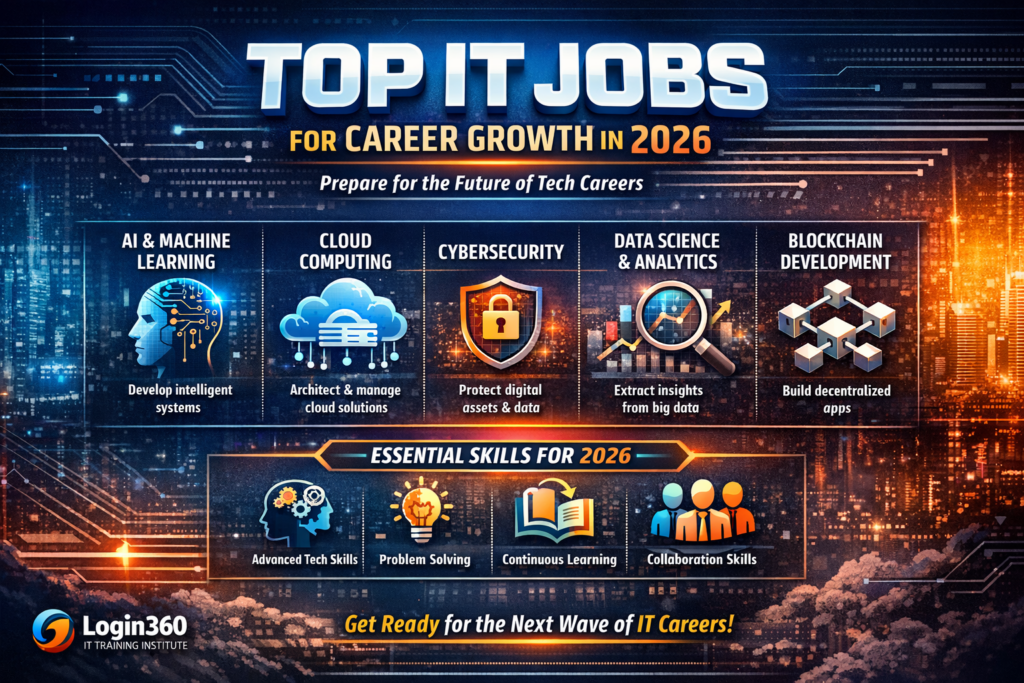
Several macro trends are coalescing to create unprecedented demand in specific IT jobs sectors, shaping the top IT jobs of the future. Artificial Intelligence and Machine Learning continue their pervasive integration across all business functions, from automating customer service to optimizing supply chains.Cloud computing has transitioned from a supplementary IT jobs to the critical foundation of modern enterprises, powering highly scalable, secure, and performance-driven infrastructure across global operations.
Cybersecurity, in response to increasingly sophisticated threats, remains a paramount concern, demanding specialized expertise to protect digital assets. Furthermore, the explosion of data necessitates skilled professionals who can extract insights and build robust data ecosystems, all contributing to the rise of top IT jobs.
Key Growth Areas & Specific Roles for 2026
These roles clearly represent the top IT jobs that will dominate the industry.
Artificial Intelligence & Machine Learning (AI/ML)
AI capabilities are moving into routine application, supporting operations in various industries. By 2026, a solid understanding of AI and ML will be necessary for designing and operating intelligent technologies.
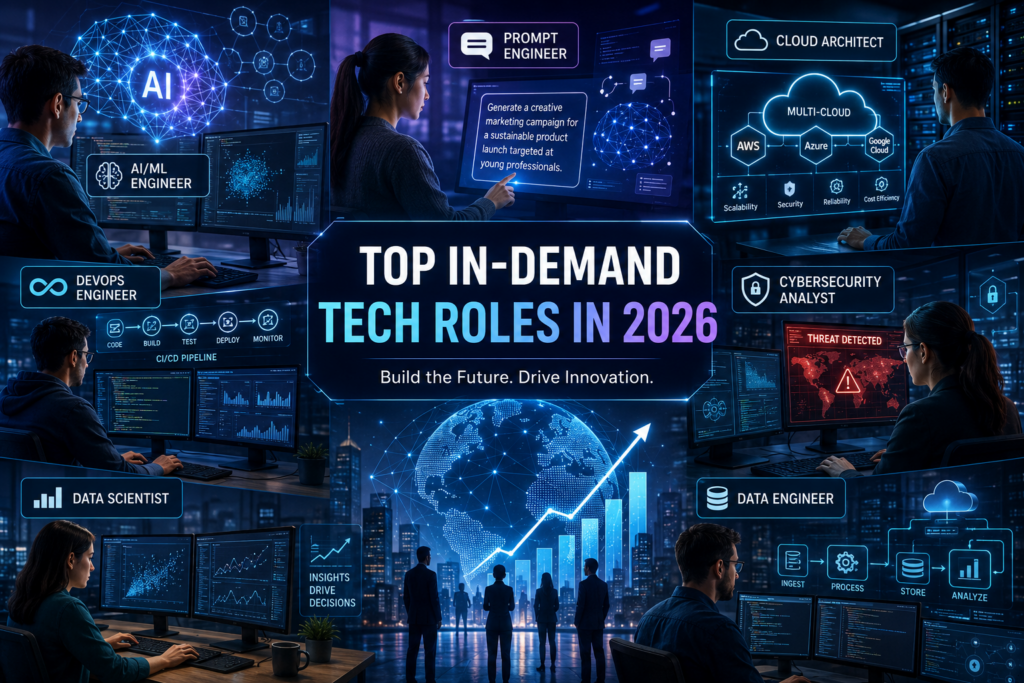
- AI/ML Engineer: These professionals are at the forefront of developing intelligent algorithms, building predictive models, and deploying AI solutions across various platforms. Their work involves everything from data preprocessing and model training to optimizing performance and integrating AI into existing software. With the proliferation of AI tools, the engineer’s role now extends to understanding ethical AI implications and ensuring fairness and transparency in models. Career growth here is exponential, branching into specialized areas like computer vision, natural language processing (NLP), or reinforcement learning. An AI/ML Engineer might, for instance, develop a sophisticated fraud detection system for a financial institution, learning from transactional data to identify anomalous patterns in real-time. This requires strong programming skills (Python, R), deep understanding of machine learning frameworks (TensorFlow, PyTorch), and statistical analysis capabilities.
- Prompt Engineer: An emerging, yet rapidly critical, role, Prompt Engineers specialize in crafting effective prompts for large language models (LLMs) and other generative AI systems. As AI becomes more conversational and creative, the ability to elicit precise, valuable, and contextually appropriate outputs from these models is invaluable. This role requires a unique blend of linguistic understanding, logical reasoning, and an iterative, experimental mindset. They ensure AI tools are used efficiently and ethically, maximizing their utility for tasks ranging from content generation to complex problem-solving. A Prompt Engineer might optimize queries for a customer service chatbot to handle nuanced inquiries more effectively, reducing the need for human intervention while maintaining high user satisfaction.
Cloud Computing
Cloud adoption continues its relentless ascent, with multi-cloud and hybrid-cloud strategies becoming the norm. The demand for professionals who can architect, deploy, and manage these complex, distributed environments is skyrocketing.
- Cloud Architect: Cloud Architects are the master planners of an organization’s cloud strategy. They design robust, scalable, and secure cloud infrastructures, choosing the right services from providers like AWS, Azure, or Google Cloud Platform to meet business objectives. Their expertise spans networking, security, data storage, and application deployment within cloud environments. As businesses migrate more critical operations to the cloud, the architect’s role in ensuring resilience, cost-efficiency, and compliance becomes paramount. A Cloud Architect might design a global e-commerce platform’s infrastructure, ensuring high availability during peak sales periods and seamless data replication across multiple regions for disaster recovery. This demands deep knowledge of cloud service offerings, infrastructure as code (IaC) tools like Terraform, and strong problem-solving skills.
- DevOps Engineer: Bridging the gap between development and operations, DevOps Engineers are crucial for accelerating software delivery and improving system reliability. They implement automation, continuous integration/continuous delivery (CI/CD) pipelines, and foster a culture of collaboration. By 2026, the demand for DevOps professionals who can streamline workflows, manage containerization technologies like Docker and Kubernetes, and monitor performance will be immense. Their ability to ensure rapid, error-free deployments is vital for competitive advantage. A DevOps Engineer might automate the entire software release cycle for a mobile application, from code commit to deployment in production, significantly reducing manual effort and potential errors.
Cybersecurity
With cyber threats growing in sophistication and frequency, cybersecurity remains a non-negotiable priority for every organization. Professionals in this domain are the digital guardians, protecting sensitive data and critical infrastructure.
Cybersecurity Analyst/Engineer: These roles are the frontline defense against cyberattacks. Analysts monitor systems for vulnerabilities, investigate incidents, and implement security measures. Engineers design and build secure systems, networks, and applications. Specializations are abundant, including ethical hacking (penetration testing), incident response, security operations center (SOC) analysis, and compliance. The continuous cat-and-mouse game with attackers ensures constant learning and skill development in this field. A Cybersecurity Analyst might detect and mitigate a ransomware attack, isolating affected systems and leading recovery efforts to restore operations. This requires a strong understanding of network protocols, operating systems, security tools, and regulatory frameworks.
Cloud Security Engineer: As more data and applications move to the cloud, securing these distributed environments becomes a specialized discipline. Cloud Security Engineers focus on securing cloud infrastructure, platforms, and applications. They implement identity and access management (IAM) policies, configure cloud firewalls, ensure data encryption, and maintain compliance with cloud-specific security best practices. Their expertise is vital in preventing data breaches and maintaining the integrity of cloud-based operations. A Cloud Security Engineer might implement robust security controls for a company’s sensitive customer data stored in a public cloud, ensuring compliance with data privacy regulations like GDPR or CCPA.
Data Science & Analytics
Data is a critical asset that enables organizations to make informed, strategic decisions. Data Scientists play a key role in analyzing complex datasets to uncover patterns, generate insights, and guide actions—such as predicting customer behavior, optimizing operations, or identifying risks ultimately driving measurable business outcomes.
The sheer volume and complexity of data necessitate skilled professionals.
- Data Scientist: Data Scientists are the investigative minds who extract knowledge and insights from vast datasets. They use statistical methods, machine learning algorithms, and advanced analytical techniques to solve complex business problems, predict future trends, and inform strategic decisions. Their role often involves data collection, cleaning, analysis, visualization, and communication of findings to stakeholders. By 2026, the demand for Data Scientists who can not only build models but also interpret and explain their implications will be critical. A Data Scientist might analyze customer purchasing behavior to identify patterns that lead to personalized marketing campaigns, significantly boosting sales. This requires strong mathematical and statistical foundations, programming skills (Python, R), and domain knowledge.
- Data Engineer: While Data Scientists focus on analysis, Data Engineers build and maintain the robust infrastructure that makes data accessible and usable. They design, construct, install, and maintain large-scale data processing systems. This includes building data pipelines, ensuring data quality, and managing data warehouses and lakes. Their work is foundational, enabling Data Scientists and analysts to perform their tasks efficiently. With the increasing scale of data, the role of a Data Engineer in creating efficient and reliable data ecosystems is indispensable. A Data Engineer might build an automated pipeline that ingests real-time sensor data from IoT devices, transforming and storing it in a cloud data warehouse for subsequent analysis.
Specialized Software Development
While general software development remains a core IT function, specialized areas are seeing intensified growth, often integrating new technologies.
- Full-Stack Developer (with AI/ML Integration): The traditional Full-Stack Developer, proficient in both front-end and back-end development, is evolving. By 2026, those who can seamlessly integrate AI/ML capabilities into their applications will be highly sought after. This means understanding how to consume AI APIs, implement machine learning models into web or mobile applications, and create intelligent user experiences. They might, for example, build an e-commerce platform that uses an integrated AI model to recommend products based on user browsing history and preferences, enhancing user engagement and sales. This requires proficiency in multiple programming languages (e.g., JavaScript, Python), frameworks (React, Angular, Node.js), database management, and a foundational understanding of AI/ML concepts.
- Blockchain Developer: Though still a niche, blockchain technology continues to mature, finding applications beyond cryptocurrencies in areas like supply chain management, digital identity, and secure record-keeping. Blockchain Developers design and implement decentralized applications (dApps), smart contracts, and blockchain protocols. As industries explore the potential of distributed ledger technology for transparency and security, the demand for these specialized developers will grow significantly. A Blockchain Developer might build a secure, transparent system for tracking pharmaceutical supply chains, ensuring the authenticity and origin of products. This requires expertise in Solidity, Web3.js, and an understanding of cryptographic principles.
Essential Skills for 2026 and Beyond in IT Jobs:
1. Problem-Solving & Critical Thinking
Problem-Solving for Debugging & System Optimization
In modern IT jobs roles, problem-solving goes far beyond logical thinking it’s about diagnosing invisible issues in complex systems. With distributed architectures, cloud-native apps, and AI integrations, failures are rarely obvious.
- Why it’s critical: Systems today involve microservices, APIs, and third-party dependencies. A small issue in one service can cascade across the entire system.
- Practical example: A backend engineer notices increased latency in an application. Instead of guessing, they trace logs across services, identify a memory leak in a container, and optimize resource allocation—restoring performance without downtime.
- Unique angle: It’s not just solving problems it’s solving them under pressure, at scale, and with incomplete information.
2. Adaptability & Continuous Learning
Adaptability for Rapid Tech Evolution & Lifelong Upskilling
The IT jobs landscape evolves faster than almost any other field. Tools, frameworks, and even IT jobs roles can become outdated within a few years.
- Why it’s critical: Technologies like AI, cloud computing, and cybersecurity are constantly shifting. Professionals must continuously reskill to stay relevant.
- Practical example: A developer skilled in traditional web apps transitions to learning cloud platforms like AWS or Azure, adopts DevOps practices, and integrates AI APIs into applications to stay competitive.
- Unique angle: Adaptability in IT jobs isn’t optional it’s about embracing change as part of your daily workflow, not reacting to it later.
3. Communication & Collaboration
Communication for Cross-Functional Team Integration
IT jobs is no longer isolated. Developers, designers, product managers, and stakeholders must work together seamlessly.
- Why it’s critical:
Miscommunication can delay releases, introduce bugs, or misalign products with user needs. Clear communication ensures efficient teamwork and accurate execution. - Practical example:
A software engineer explains a technical limitation to a non-technical product manager, helping adjust project expectations and avoid unrealistic deadlines. - Unique angle:
The real value lies in translating complex technical ideas into simple, actionable insights that everyone on the team can understand.
Leveraging Training for Career Acceleration:
Our programs are designed to prepare students for top IT jobs through practical and affordable training.
Recognizing these evolving demands, Login360 is committed to empowering individuals with the skills necessary to thrive in these high-growth top IT jobs roles. Our Chennai-based institute offers a comprehensive suite of courses designed to be both affordable and highly relevant to current industry needs. We focus on practical, hands-on training that equips students with job-ready skills, making the transition into these demanding fields smoother and more successful. Whether it’s mastering Python for AI/ML, becoming proficient in cloud architecture, or delving into advanced cybersecurity, our programs are structured to provide a strong foundation and specialized expertise. Our USP of affordability ensures that quality IT jobs education is accessible to a broader audience, fostering a robust talent pipeline for the tech industry.
Strategic Career Planning for Lasting Growth:
Proper planning and upskilling can help professionals land top IT jobs and achieve long-term success.
Securing a top IT job in 2026 isn’t just about acquiring skills; it’s about strategic career planning. This involves actively networking within your desired field, pursuing industry-recognized certifications to validate your expertise, and building a robust portfolio of projects that showcase your capabilities. Engaging with online communities, attending webinars, and contributing to open-source projects can significantly enhance your visibility and learning. Furthermore, actively seeking mentorship and staying informed about industry trends through reputable publications will keep your career trajectory on an upward path.
Conclusion:
The IT jobs sector in 2026 will be defined by innovation, complexity, and unprecedented opportunities. The roles discussed represent the top IT jobs for future growth and stability. For individuals in Chennai and beyond, focusing on these top IT jobs can lead to a successful and rewarding career.
This is where Login360 can differentiate itself more clearly: instead of just offering “training,” it can position itself as a hands-on career accelerator—providing guided projects, mentorship from industry professionals, mock interviews, and placement-focused preparation tailored to Chennai’s hiring ecosystem. Affordability matters, but outcomes matter more—so the emphasis should be on IT jobs readiness, not just course completion.