

Introduction
Frontend vs Backend Development With the current rise of software development, businesses are continuously looking for skilled developers to build reliable and user-friendly applications. This trend has increased the demand for Full Stack Developer Journey who understand the backend and frontend of web development.
What Is a Full Stack Developer?
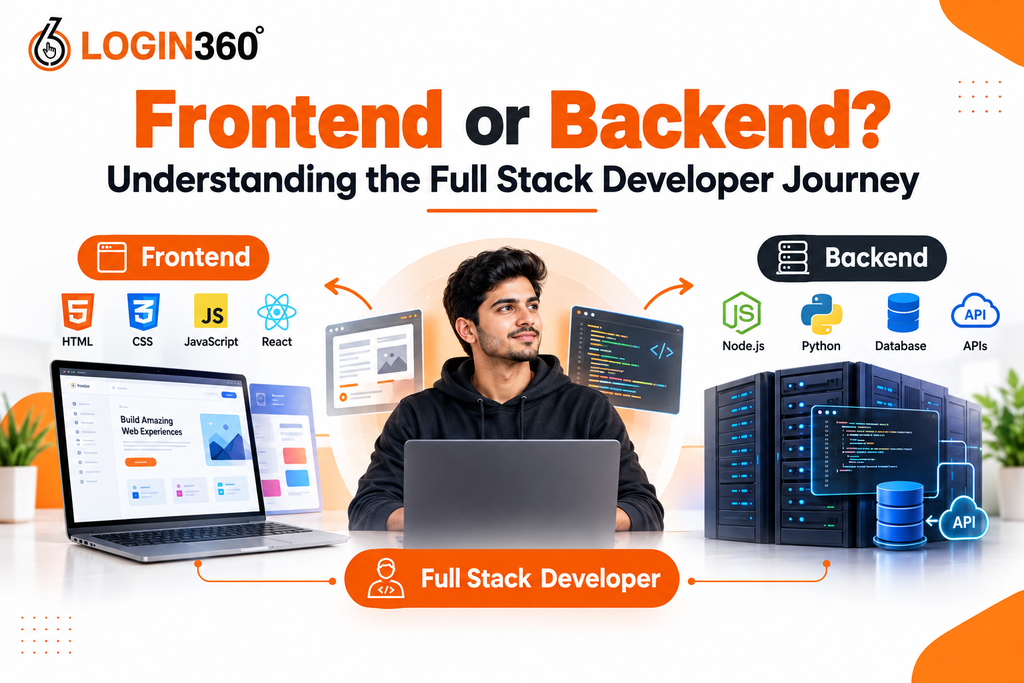
Frontend and backend development are two distinct but equally significant fields of software development. Understanding the frontend vs backend of the development process and how they communicate will provide a solid base for a Full Stack Developer Journey.
Whether you are a career changer or interested in a tech career, this guide will share how the Full Stack Developer learning journey works and the skills required in this field.
2. What Is Frontend Development?
Frontend vs Backend Development, also known as the client-side, is a component of web development that focuses on directly interacting with website visitors. Frontend developers code web interfaces, making products visually appealing and accessible to end-users.
Frontend developers implement the visual and interactive elements of websites and web applications. Full Stack Developer Journey
The following are the Full Stack Developer Journey three fundamental frontend technologies:
HTML – provides websites’ structure;
CSS – adds style to the website; and
JavaScript – makes websites interactive.
After learning the basic technologies, web developers usually proceed to learn the frontend frameworks and libraries such as React, Angular, and Vue.js.
The following are the many frontend aspects that developers usually learn:
Navigation;
Forms;
Buttons;
Layouts;
Dashboards;
Landing pages;
User-interface (UI) elements;
Animations.
3. What Is Backend Development?
Frontend vs Backend Development deals with coding and designing web servers, server side scripting, and databases. The primary focus of backend development is to create the logic that powers web applications.Full Stack Developer Journey
The following are some of the backend programming languages and tools:
Python;
Java;
JavaScript;
PHP;
C#; and
Ruby.
Most backend developers also need to know about databases, including MySQL, PostgreSQL, MongoDB, and others.
The following are the main areas of backend development:
Server-side;
APIs;
Authorization/authentication;
Databases;
Security;
Hosting;
And application logic.
Backend development is ideal for logical thinkers who are interested in the hidden aspects of web development and creating the application’s core systems.
4. Frontend vs Backend Development: What Is the Difference?
Frontend and backend development have distinct requirements, but the two are closely related. Understanding the differences can help in determining which of the two fields to get involved in. Full Stack Developer Journey Whereas the frontend deals with the presentation and design aspect of web development, the backend deals with the application’s logic and data storage.
The table below highlights the main differences between frontend and backend development.
Frontend Development Backend Development
Focuses on the visual presentation of the application Focuses on the application logic
Runs in the browser Runs on the server
Uses HTML, CSS, and JavaScript Uses Python, Java, PHP, Node.js, C#, Ruby
Handles the application’s UI Handles user data, database, and security
Uses frontend frameworks such as React, Vue, and Angular Uses backend frameworks such as Django, Laravel, and Express
Focuses on the UX Focuses on performance and security
While it might be tempting to focus only on one side of web development, building reliable web apps requires both frontend and backend development. A comprehensive understanding of the frontend and backend aspects of web development is needed to become a Full Stack Developer.
5. Why Learn to Be a Full Stack Developer?
There are several reasons for learning to become a Full Stack Developer Journey. For instance, learning both frontend and backend development makes one versatile and marketable.
The following are the best reasons to pursue a career as a Full Stack Developer Journey:
The following are some of the best reasons to pursue a career as a Full Stack Developer Journey:
A Full Stack Developer Journey has the following advantages over a Frontend and Backend Developer:
Broadened skill set: Unlike a Frontend or Backend Developer, a Full Stack Developer Journey has a wide skill set. In addition to learning frontend and backend development, Full Stack developers also learn deployment and other related subjects. As a result, a Full Stack Developer Journey is more versatile than a Frontend vs Backend Developer.
More opportunities: Unlike frontend and backend developers, Full Stack developers have better work opportunities as they can work on more diverse projects. Moreover, businesses prefer Full Stack Developers because they can fulfill hybrid roles.Full Stack Developer Journey
Easy collaboration: A Full Stack Developer Journey has the knowledge of all aspects of web application development. This means that they can easily modify and customize existing web apps.
Career advancement: With a broad skill set, Full Stack Developers can advance their careers faster. Moreover, with versatile skill sets, Full Stack Developer Journey can also become certified IT experts.
Becoming a Full Stack Developer Journey will not make one an expert in every programming language. To become a Full Stack Developer Journey, one only needs to gain a solid understanding of the major concepts and develop strong practical skills.
6. The Full Stack Developer Learning Journey
A competent Full Stack Developer Journey learning path should be linear rather than scattered. To become a Full Stack Developer, one should start by learning the basics of web development and then proceed to learn more advanced skills. Aspiring Full Stack Developers should consider the following practical learning path:
Step 1: Learn HTML and CSS
The first step towards learning web development is to learn HTML and CSS. HTML and CSS are the foundation of web development. HTML helps in providing the basic structure of web pages whereas CSS helps in giving websites their design and layout. Anyone interested in being a web developer should ensure that they are familiar with HTML semantic tags, responsive design, forms, layout, and accessibility.
Step 2: Learn JavaScript
The next step for a beginner Full Stack Developer Journey is to learn JavaScript, one of the most needed web development skills. JavaScript enables one to make web pages dynamic. Some of the important aspects of JavaScript are variables, functions, arrays, objects, DOM, events, asynchronous functions, and APIs.
Step 3: Learn a Frontend Framework
After learning HTML, CSS, and JavaScript, the next step is to learn how to use frontend frameworks and libraries such as React, Angular, and Vue.js. One should ensure that they fully understand components, state, props, router, and API calls before proceeding to the next step. Full Stack Developer Journey
Step 4: Learn Git and GitHub Full Stack Developer Journey
The next step towards becoming a Full Stack Developer Journey is to learn version control tools such as Git and GitHub. Understanding how version control works is vital since it helps in managing codes efficiently, especially when working in a team.
Step 5: Learn a Backend Programming Language
The next stage is to pick a preferred backend programming language and start learning backend development. Some of the popular backend programming languages are Python, Java, and PHP.Full Stack Developer Journey
Step 6: Learn Databases
After learning a preferred backend programming language, the Full Stack Developer Journey learning path requires one to learn databases. There are two main types of databases: graphical and non-graphical databases. Developers need to learn Structured Query Language (SQL) and No-SQL.
Step 7: Learn APIs
The next step towards becoming a Full Stack Developer is to learn how to use APIs to connect the frontend and the backend of a web application. Most of the current web apps use RESTful APIs to power their applications. Full Stack Developer Journey
Step 8: Building Projects Full Stack Developer Journey
The last stage in the Full Stack Developer journey is to build projects. Anyone considering a career in web development should spend more time practicing coding and completing several projects to become a full-stack developer. Developers can start building their project portfolio by completing the following projects:
E-commerce website;
Blog website;
Job portal;
Student management system;
Task manager application;
Hotel booking system;
Personal portfolio.
7. Essential Skills to Learn as a Full Stack Developer
In addition to the above skills required to become a Full Stack Developer Journey, the following additional skills are also crucial:
Problem-solving;
Communication;
Collaboration;
Testing;
Fundamental cybersecurity skills;
Cloud computing;
Debugging;
The ability to complete a wide range of applications.
Anyone interested in a career as a Full Stack Developer should also constantly update their technical skills since technology requires continuous learning. Additionally, developing a strong portfolio is also an important part of a career as a Full Stack Developer. A strong portfolio showcases the skills and expertise of the developer rather than the certifications they may have.
8. From Beginner to Full Stack Developer: What’s Next?
Becoming a Full Stack Developer is a long process that requires continuous practice. However, there are several skills that one can start learning to become a Full Stack Developer. A beginner can start their Full Stack developer career with the following steps:
Pick a technology stack and master it;
Practice coding;
Complete projects;
Continue learning;
Master Git and GitHub;
Develop the skill set of a problem solver;
Create a portfolio;
Apply for internships;
And continue learning new tools and technologies.
Once a beginner gains a strong understanding of the frontend and backend of web development, they can consider specializing in the following areas:
Cloud computing;
DevOps;
Cybersecurity;
Mobile application development;
Artificial intelligence; and
Software architecture.
One should also avoid the following when aiming to become a Full Stack Developer: trying to master every tool or technology, skipping the most fundamental skills, avoiding the use of version control tools, and practicing only simple coding exercises.
Conclusion
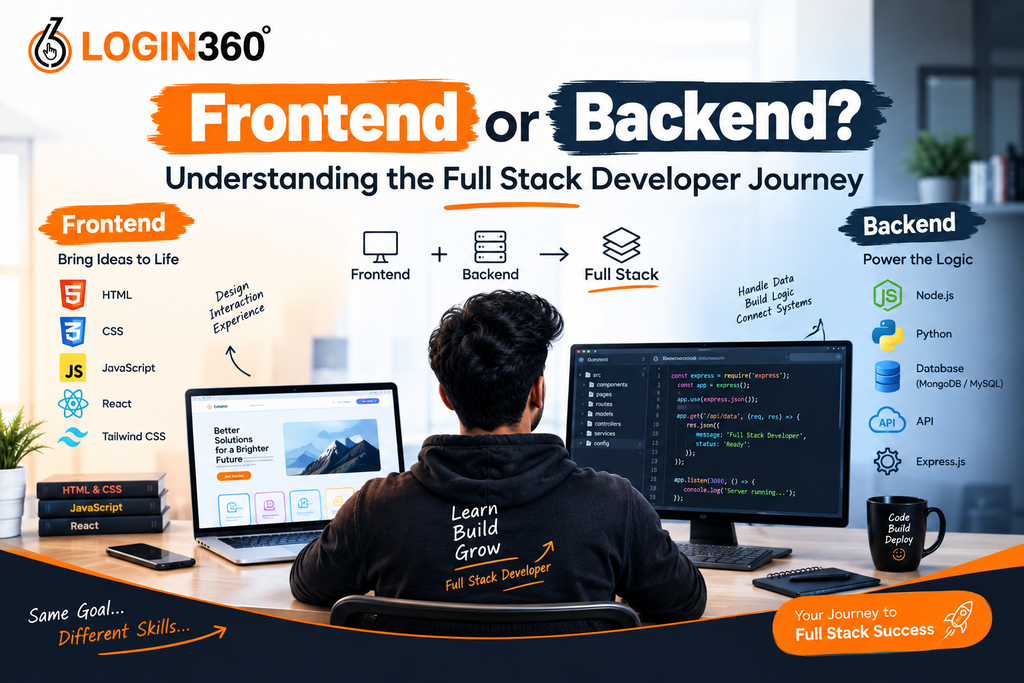
The question “the Frontend or the Backend?” should not be a problem for an aspiring developer since the two aspects of web development are interconnected Full Stack Developer Journey and play an important role in modern software development. Whereas the Frontend focuses on the design and interaction of websites, the Backend focuses on databases, application logic, and API.
Start Your Full Stack Development Journey with Login360