
Email marketing in 2026 isn’t just about sending newsletters it’s about navigating AI-saturated inboxes, stricter privacy regulations, and rising expectations for hyper-relevance. While many marketers struggle with declining open rates due to smart inbox filtering and AI-generated competition, those who embrace advanced personalization like real-time product recommendations based on live browsing behavior or automation systems that self-adjust send times and messaging are seeing unprecedented returns. Despite the complexity, understanding these innovations early gives beginners a powerful edge. This guide will equip you with the essential email marketing best practices to launch your first campaign that doesn’t just send messages, but genuinely converts.
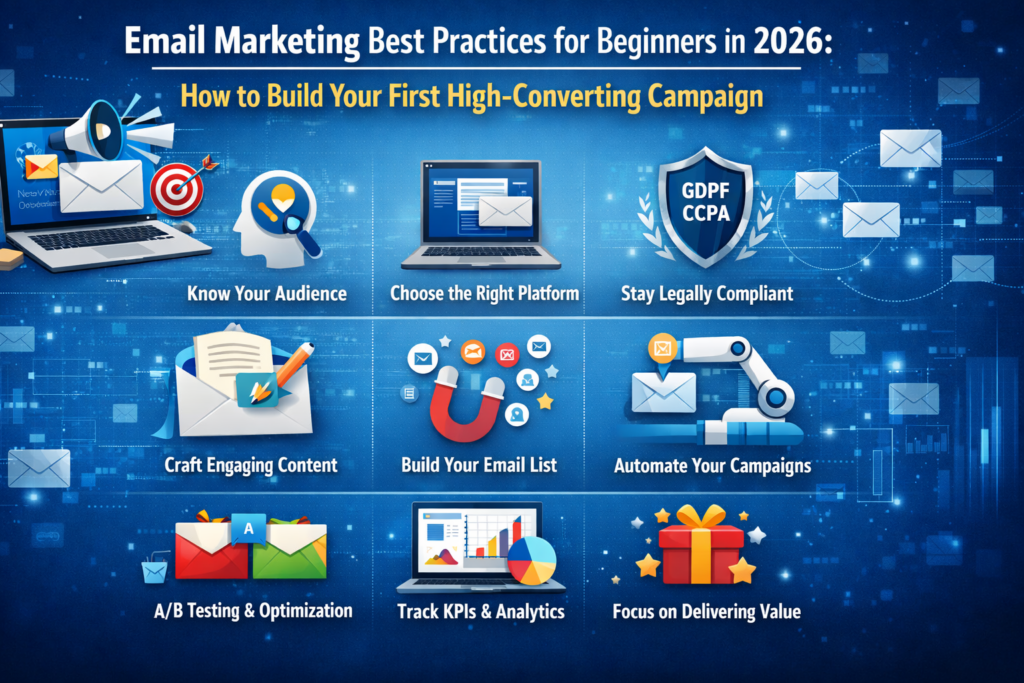
The Foundational Pillars of Email Marketing in 2026
If email marketing before you even think about crafting your first email, a robust foundation is critical. This isn’t just about tools; it’s about strategy and understanding aligned with email marketing best practices.
The “Deep Signal Audience Matrix” (2026 Framework)
A privacy-first, insight-rich model that blends psychology, behavior, and contextual data to understand people beyond surface-level segmentation.
Instead of just who they are, this framework focuses on:
why they act, when they act, and what invisible forces shape their decisions
Psychographics → “Emotional Triggers & Identity Signals”
2026 shift: Move from static traits to dynamic identity states (how people see themselves today, not just who they are).
Emerging Data Sources:
- AI-inferred sentiment from email replies (privacy-safe aggregation)
- Content consumption patterns (not tracking individuals, but clusters)
- Community participation (Discord, niche forums, etc.)
Less-common example:
A SaaS productivity tool discovers a segment that doesn’t just value “efficiency” they identify as “anti-hustle professionals.”
They reject burnout culture and prefer calm productivity.
Granular Insight:
- Motivation: Control over time, not maximizing output
- Hidden fear: Becoming replaceable due to burnout cycles
- Messaging shift:
❌ “Get more done faster”
✅ “Protect your energy while doing meaningful work”
Pain Points → “Friction Mapping”
2026 shift: Identify not just problems, but micro-frictions across the user journey.
New Angle: Map pain across moments, not categories.
Hypothetical Case Study: An e-commerce skincare brand tracks anonymized behavioral patterns and finds:
- Users abandon carts not due to price
- But because they don’t trust routine complexity
Hidden Pain Point:
“I don’t want to commit to a 6-step routine I’ll fail at.”
Granular Insight:
- Problem isn’t skincare → it’s fear of inconsistency
- Email strategy:
“Start with just 1 step. That’s enough.”
Aspirations → “Future Self Mapping”
2026 shift: People don’t just buy products — they buy identity upgrades.
New Method:
Map the gap between:
- Current self
- Feared self
- Ideal self
Less-common example:
A finance app targets freelancers.
Traditional aspiration:
“Save more money”
Deeper aspiration:
“Feel like a financially stable adult despite unpredictable income”
Granular Insight:
- Emotional goal: Stability, not wealth
- Email narrative:
“Even in inconsistent months, you’re still in control.”
Behavioral Data → “Intent Layering”
2026 shift: Move beyond clicks and opens → understand intent depth.
Privacy-First Approach:
- Use zero-party data (user-declared preferences)
- Cohort-level behavior (not invasive tracking)
- On-site micro-interactions (scroll pauses, hover zones)
Less-common example:
A learning platform notices:
- Users rewatch the same 2-minute clip multiple times
- But don’t progress further
Traditional view:
Low engagement
Granular insight:
High anxiety + desire to understand deeply
Email strategy:
“Still stuck on this concept? Here’s a simpler breakdown.”
Bonus Layer: Contextual Intelligence (2026 Edge)
Context → “Moment-Based Relevance”
Understand when and why now.
Emerging signals:
- Time-of-day engagement rhythms
- Economic mood (macro sentiment APIs)
- Device context (work vs leisure behavior)
Example:
A B2B tool finds emails sent:
- Monday morning → ignored
- Sunday evening → high engagement
Insight:
Users mentally prepare for the week on Sunday.
Strategic shift:
Email becomes part of their weekly reset ritual
Putting It All Together (Mini Case)
Brand: Mental wellness app
Instead of targeting:
“Women aged 25–40 interested in self-care”
They target:
- Identity: “High-functioning but emotionally exhausted achievers”
- Pain: “Can’t switch off their mind at night”
- Aspiration: “Feel calm without losing ambition”
- Behavior: “Consumes content late at night but avoids long formats”
- Context: “Engages most between 10pm–12am”
Choosing the Right Email Marketing Platform (EMP)
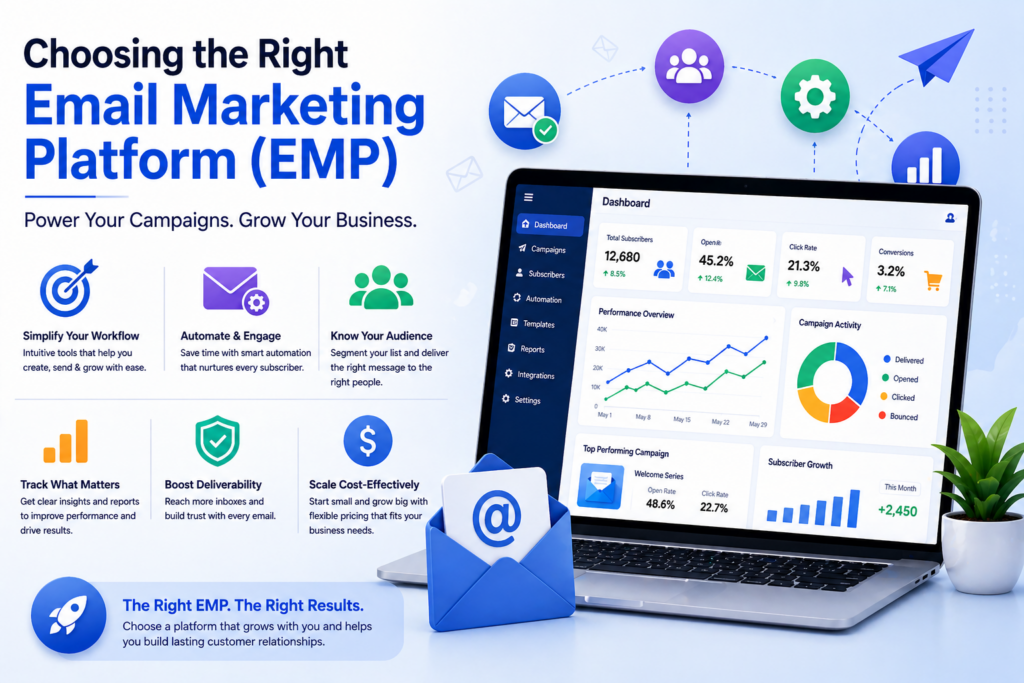
Your EMP is the engine of your email strategy. For beginners, the key is to balance powerful parts of strong email marketing best practices, features with ease of use and, crucially, affordability. Consider these factors:
- Ease of Use: A beginner-friendly interface is paramount. You don’t want to spend hours deciphering complex dashboards.
- Automation Capabilities: Look for platforms that allow for basic automation like welcome series, drip campaigns, and re-engagement flows.
- Segmentation: Can you easily segment your list based on various criteria (e.g., engagement, purchase history, interests)?
- Analytics and Reporting: Robust reporting helps you understand what’s working and what isn’t.
- Deliverability: A good EMP works hard to ensure your emails land in inboxes, not spam folders.
- Pricing Structure: Many platforms offer free tiers for small lists, which is perfect for starting out. As a training institute like Login360, understanding cost-effectiveness is crucial for your audience, and EMPS often align with this principle.
Deeper Comparison Insight (Beyond Surface Features)
- Platforms like Mailchimp and Constant Contact are great for ease of use—but can feel limiting when you need behavioral targeting at scale.
- HubSpot excels as an all-in-one ecosystem, but its pricing grows quickly as your contact list expands.
- Newer or less mainstream tools often outperform in automation depth and cost-efficiency, especially for startups or niche use cases.
Popular choices for beginners include Mailchimp, Sendinblue, Constant Contact, and HubSpot (for those ready to scale). Research and leverage free trials to find the best fit.
Legal Compliance: GDPR, CCPA, and Beyond
Email marketing in 2026, data privacy is non-negotiable. Ignoring regulations like GDPR (Europe) and CCPA (California) can lead to hefty fines and severe reputational damage. Even if your primary audience isn’t in these regions, adhering to these principles is a global email marketing best practice.
- Explicit Consent: Always get clear, affirmative consent before adding someone to your list. Pre-checked boxes are generally non-compliant.
- Transparent Privacy Policy: Clearly state how you collect, store, and use subscriber data.
- Easy Unsubscribe: Provide a clear, one-click unsubscribe link in every email.
- Data Security: Ensure your EMP and internal processes protect subscriber data.
Building Your Email List Strategically
Your list is your most valuable asset, and growing it ethically is one of the key email marketing best practices.
Opt-in Forms That Convert
Don’t just stick a sign-up form in your footer. Integrate compelling forms strategically of Your list is your most valuable asset, and growing it ethically is one of the key email marketing best practices.
- Pop-ups (Time-based or Exit-intent): Use these sparingly and ensure they are not intrusive. Offer immediate value.
- Inline Forms: Embedded within blog posts or relevant content.
- Dedicated Landing Pages: A page solely focused on capturing email addresses, often for a specific lead magnet.
- Compelling Lead Magnets: Offer something valuable in exchange for an email. This could be an exclusive e-book, a free mini-course (e.g., a ‘Taste of Python’ from Login360), a checklist, a webinar recording, or a discount code. The perceived value must outweigh the friction of providing an email address.
Keep forms short (usually just email address and maybe first name) and clearly state the benefit of subscribing.
Ethical List Growth Strategies
Never buy email lists. These lists are almost always low-quality, lead to poor engagement, high bounce rates, and can get your domain blacklisted. Focus on organic growth through Your list is your most valuable asset, and growing it ethically is one of the key email marketing best practices.
- Content Marketing: High-quality blog posts, videos, and resources that naturally attract your target audience.
- Social Media Promotion: Share your lead magnets and sign-up opportunities across your social channels.
- Partnerships: Collaborate with complementary businesses for joint promotions.
- Offline Sign-ups: If you have a physical presence (like Login360’s Chennai campus), offer sign-up opportunities at events or workshops.
Crafting High-Converting Email Content
Once you have a list, applying email marketing best practices ensures engagement and conversions.
Compelling Subject Lines
The subject line is your email’s gatekeeper. It determines whether your email gets critical part of email marketing best practices. Aim for:
- Clarity and Conciseness: Get to the point. Most people scan their inbox.
- Curiosity: “Unlock the Secret to [Benefit]…”
- Urgency/Scarcity: “Last Chance: 50% Off IT Courses!”
- Personalization: Include the subscriber’s name or reference their recent activity.
- Benefit-Oriented: Focus on what the reader will gain. For Login360, this might be “Boost Your Career: Master Data Science in 3 Months.”
A/B test your subject lines relentlessly to find what resonates best with your audience.
Personalization and Segmentation
Generic emails are ignored. Personalization goes beyond just using a first name. It involves sending highly relevant content based on:
- Demographics: (If collected) age, location.
- Psychographics: Interests, preferences.
- Behavioral Data: Past purchases, website visits, email opens/clicks, course enrollments (for Login360).
- Lifecycle Stage: Are they new, engaged, or at risk of churning?
Segment your list into smaller, targeted groups. A student interested in Python might receive different content than someone interested in DevOps. This is a core email marketing best practice for maximizing relevance and conversions.
The Art of Storytelling in Emails
People connect with stories, not just facts. Use narratives to:
- Illustrate a problem: Describe a common challenge your audience faces.
- Introduce a solution: Show how your product/service (e.g., Login360’s affordable training) provides the answer.
- Share success stories: Testimonials or case studies of previous students who upskilled and landed great jobs.
- Build rapport: Share a personal anecdote or insight related to your industry.
Stories make your emails memorable and foster a deeper connection.
Clear Call-to-Actions (CTAs)
Every email should have a single, clear primary call to action. Make it:
- Prominent: Easy to spot (e.g., a button).
- Action-Oriented: Use strong verbs like “Enroll Now,” “Download Your Guide,” “Learn More.”
- Benefit-Driven: Tell them what they’ll get by clicking: “Get Your Free Demo,” “Start Your Career Journey.”
Avoid overwhelming subscribers with too many choices.
Mobile Responsiveness
In 2026, the majority of emails are opened on mobile devices. Your emails must be mobile-responsive. This means:
- Single-column layouts.
- Large, readable fonts.
- Ample white space.
- Clickable buttons, not just text links.
- Optimized images that load quickly.
Test your emails across various devices and email clients before sending.
Value-Driven Content
Every email should provide value. Don’t just sell. Educate, inform, and entertain. For Login360, this could mean:
- Tutorials: Quick tips for coding, data analysis, or software usage.
- Industry Insights: Trends in IT, job market analysis, future skills.
- Exclusive Content: Early access to new course modules, special webinars.
- Behind-the-scenes: A glimpse into student success stories or instructor expertise.
This builds loyalty and positions you as an authority in your field.
Automation and Nurturing Sequences
Automation allows you to deliver timely, relevant messages without manual effort, scaling your efforts efficiently.
Welcome Series
This is arguably the most critical automation. When someone signs up, they’re highly engaged. Capitalize on this with a series of 3-5 emails delivered over a few days:
- Email 1 (Immediately): Welcome, thank them, deliver the lead magnet, set expectations.
- Email 2 (Day 2-3): Introduce your brand story, unique selling proposition (e.g., Login360’s affordable, quality IT training in Chennai), and key benefits.
- Email 3 (Day 4-5): Share social proof (testimonials, success stories) or valuable content.
- Email 4 (Day 6-7): Gentle nudge towards a primary CTA, like exploring your courses or booking a consultation.
Onboarding Sequences
For students who enroll in a course, an onboarding sequence can significantly improve retention and satisfaction:
- Confirmation and Next Steps: What to do immediately after enrollment.
- Course Overview: What they’ll learn, key milestones.
- Resource Sharing: Links to learning platforms, community forums, support.
- Tips for Success: How to get the most out of their training.
Re-engagement Campaigns
Subscribers inevitably become inactive. A re-engagement campaign aims to win them back:
- Identify Inactive Subscribers: Those who haven’t opened or clicked in 60-90 days.
- Offer Value: A special discount, a free resource, or a survey asking for their preferences.
- “We Miss You” Subject Lines: Acknowledge their inactivity.
- Clear Choice: Offer an easy way to update preferences or unsubscribe if they’re no longer interested.
Measuring Success and Iterating
Email marketing in 2026 is powered by continuous experimentation loops—where predictive models flag underperforming segments, auto-adjust send times, and recommend content variations before metrics drop, turning optimization into a proactive system rather than a reactive task.
Key Email Marketing Metrics (KPIs)
Focus on these core metrics:
- Open Rate (OR): Percentage of recipients who opened your email. Good for subject line effectiveness.
- Click-Through Rate (CTR): Percentage of recipients who clicked a link in your email. Good for content and CTA effectiveness.
- Conversion Rate: Percentage of recipients who completed a desired action (e.g., course enrollment, download). The ultimate measure of campaign success.
- Bounce Rate: Percentage of emails that couldn’t be delivered. High bounce rates indicate list hygiene issues.
- Unsubscribe Rate: Percentage of people who opted out. Helps identify content or frequency issues.
- ROI (Return on Investment): The revenue generated from email marketing relative to its cost. This is where the true power of email marketing best practices shines.
A/B Testing Best Practices
Test one variable at a time to isolate its impact:
- Subject Lines: Different lengths, emojis, personalization.
- CTAs: Wording, color, placement.
- Email Content: Short vs. long copy, image vs. text-heavy.
- Send Times and Days: When is your audience most receptive?
Small, iterative improvements add up to significant gains over time.
Analyzing Data and Optimizing
Regularly review your analytics. Look for patterns:
- Which email types perform best?
- Which segments are most engaged?
- Are there specific times or days that yield higher engagement?
- What content leads to the most conversions?
Use these insights to refine your strategy, improve your content, and continuously enhance your email marketing best practices.
Conclusion:
Email marketing in 2026 is a dynamic, powerful tool for any beginner willing to invest the time in mastering its best practices. From deeply understanding your audience and selecting the right platform to crafting personalized, value-driven content and leveraging automation, each step builds upon the last using proven email marketing best practices. Remember Login360’s commitment to affordable upskilling – email marketing, when done correctly, offers an incredibly affordable and effective path to connect with your audience, build trust, and drive conversions. Start implementing these strategies today, measure your progress, and iterate using email marketing best practices. Your first high-converting email campaign isn’t just a possibility; it’s an achievable goal that will lay the groundwork for sustained digital success.