

In early 2025, Amazon reported that incremental improvements in its supply chain algorithms powered by advanced data analytics helped cut delivery times and reduce operational costs across multiple regions, translating into significant efficiency gains at scale. This is just one example of how organizations are no longer passively collecting data but actively using it to drive measurable business outcomes.
This shift reflects a much larger global trend. The economy is undergoing a transformation fueled by an insatiable demand for data-driven decision-making. Businesses, governments, and even non-profits are increasingly relying on data not just for insights, but for predictive capabilities and strategic advantage. By 2026, the ability to interpret and leverage data won’t be a niche skill—it will be a fundamental requirement across nearly every industry.
For ambitious individuals aiming to future-proof their careers and step into high-impact, high-paying roles, Data Science and Analytics Training is no longer optional—it’s one of the smartest, most strategic investments you can make.
The Irreversible Data Tsunami and Its Impact
- Data generation is growing exponentially, creating massive volumes of structured and unstructured data.
- It’s not just volume—velocity and variety make data both complex and valuable.
- Industries like healthcare use data for personalized treatments and disease prediction.
- Finance relies on analytics for risk assessment, fraud detection, and real-time trading decisions.
- Retail and manufacturing use data to optimize pricing, inventory, and operational efficiency.
- Even sports teams leverage analytics to improve performance and strategy.
- By 2026, data-driven decision-making will dominate every industry.
- As a result, professionals who can extract insights from data are in extremely high demand.
The Core Value Proposition of Data Science and Analytics
While often used interchangeably, Data Science and Data Analytics represent distinct yet complementary disciplines, both critical to today’s data-driven world. Understanding their core value propositions illuminates why training in these fields is so potent.
Data Science: Unveiling Future Possibilities
Data Science is the broader, more interdisciplinary field, focusing on developing models and algorithms to answer complex questions, make predictions, and discover hidden patterns. Data scientists are typically involved in:
- Machine Learning and AI Development: Designing and implementing AI systems that can learn from data and perform tasks that typically require human intelligence, such as image recognition, natural language processing, and autonomous decision-making.
- Complex Problem-Solving: Tackling ambiguous business challenges by formulating hypotheses, designing experiments, and using advanced analytical techniques to derive actionable insights.
- Predictive Modeling: Building statistical models and machine learning algorithms to forecast future trends, customer behavior, or market movements.
- Data Engineering: Often overlapping, data scientists may also be involved in designing and managing data infrastructure to ensure data is clean, accessible, and ready for analysis.
Their work often involves deep statistical knowledge, advanced programming skills (primarily Python and R), and a strong understanding of various machine learning frameworks. Data scientists are the architects of the future, enabling organizations to anticipate, innovate, and automate.
Data Analytics: Interpreting the Present and Past
Data Analytics, while foundational to data science, is more focused on interpreting historical data to identify trends, measure performance, and inform current business decisions. Data analysts are crucial for:
- Business Intelligence (BI): Creating dashboards, reports, and visualizations that provide clear, actionable insights into key performance indicators (KPIs).
- Exploratory Data Analysis: Sifting through datasets to uncover patterns, anomalies, and relationships that might not be immediately obvious.
- A/B Testing and Experimentation: Designing and analyzing experiments to determine the effectiveness of new products, marketing campaigns, or operational changes.
- Reporting and Communication: Translating complex data findings into understandable narratives for stakeholders, enabling data-driven decision-making across all levels of an organization.
Data analysts typically possess strong SQL skills, proficiency in data visualization tools (like Tableau or Power BI), and a keen eye for detail. They are the storytellers of data, transforming raw numbers into compelling narratives that drive operational efficiency and strategic adjustments.
Both roles are indispensable. Data analysts provide the crucial understanding of what happened and why, while data scientists build models to predict what will happen and how to make it happen. Training that covers both aspects, as comprehensive Data Science and Analytics Training should, equips professionals with a versatile and highly valuable skill set that drives strategic decisions and fuels innovation across the entire business ecosystem.
Unpacking the Demand: Why 2026 is the Apex
The trajectory of data-related careers has been upward for years, but 2026 is projected to be a pivotal year, marking an apex in demand due to several converging factors.
Market Projections: A Tsunami of Openings
Global reports increasingly show that data science is no longer limited to IT companies alone—it has become a core business necessity across every major industry. According to IE University’s recent Uncover IE analysis, organizations around the world are redesigning operations around AI, forecasting, automation, and intelligent decision-making. In parallel, NASSCOM reports that India’s demand for AI and data science professionals is expected to exceed one million by 2026, despite an existing shortage of industry-ready talent. This widening gap is creating major opportunities in developing technology hubs such as Chennai, where sectors like fintech, healthcare, e-commerce, and enterprise analytics are actively seeking trained professionals who can turn raw data into strategic business outcomes.
But beyond raw growth numbers, what’s truly compelling is the specialization within these roles. The market is no longer just looking for “data scientists” as a broad title—it’s demanding niche expertise in areas like machine learning engineering, data engineering, business analytics, and AI-driven decision systems. This signals a maturing ecosystem where companies need highly targeted skill sets rather than generalists.
By 2026, the explosion of data generation will only intensify this demand. Organizations aren’t just struggling to hire—they’re struggling to find the right kind of talent. This widening gap between demand and specialized skills makes Data Science and Analytics Training not just valuable, but strategically essential for anyone aiming to stay competitive in today’s evolving job market.
Technological Advancements: AI Integration and Maturing Tools
The rapid rise of Artificial Intelligence and Machine Learning isn’t simply increasing demand for data professionals—it’s reshaping what kind of expertise is required. One of the most critical and often overlooked aspects is the growing need for ethical oversight and bias mitigation in AI systems. As models become more deeply embedded in decision-making—whether in hiring, lending, or healthcare—the risk of biased or flawed outputs becomes a serious concern. Organizations are now actively seeking professionals who can audit datasets, identify hidden biases, and ensure fairness and transparency in AI systems.
At the same time, the real complexity lies in the interplay between multiple technologies. Modern AI ecosystems rarely rely on a single model—they involve interconnected systems powered by tools like Apache Spark, Hadoop, and various NoSQL databases, all running on scalable cloud infrastructures. These systems must work together seamlessly, requiring skilled professionals who can design, integrate, and continuously monitor entire data pipelines—not just build isolated models.
This shift introduces a new layer of responsibility: human oversight is no longer optional. Data professionals must ensure that AI systems remain accurate, ethical, and aligned with real-world goals over time. As these technologies become more accessible and widespread, the demand will increasingly favor those trained in Data Science and Analytics Training who can navigate not just the technical side, but also the ethical and operational complexities of modern AI ecosystems.
Competitive Advantage: The Data-Driven Imperative
In today’s hyper-competitive landscape, data-driven decision-making is no longer a luxury but a necessity for survival and growth. Businesses that fail to capitalize on their data assets risk losing market share, missing critical opportunities, and making costly errors. This imperative drives organizations to invest heavily in data infrastructure and, more importantly, in human capital capable of extracting value from that data. Companies are actively seeking professionals who can translate raw data into actionable strategies that improve customer experience, optimize operations, and identify new revenue streams. This creates a powerful pull for anyone with comprehensive Data Science and Analytics Training.
Case Study Example: How Walmart Quietly Uses Data to Stay Ahead
Retail giant Walmart faced common challenges such as overstocked inventory, empty shelves, and sudden demand fluctuations. Instead of relying on guesswork, the company turned to data-driven decision-making to improve efficiency and customer satisfaction.
Today, Walmart uses advanced analytics tools to process real-time information, including customer buying behavior, local weather updates, and shopping trends. This allows the company to predict demand more accurately and ensure the right products are available at the right time.
Through predictive analytics, Walmart has significantly reduced out-of-stock situations in several product categories, leading to better sales performance and improved customer experience. The success of this system is not just about technology—it depends heavily on skilled data professionals who can analyze patterns, build predictive models, and refine operations continuously.
This real-world example clearly shows why Data Science and Analytics Training has become so valuable. Businesses are no longer winning by simply collecting data—they are winning by hiring people who know how to turn that data into action.
What Does “Data Science and Analytics Training” Entail?
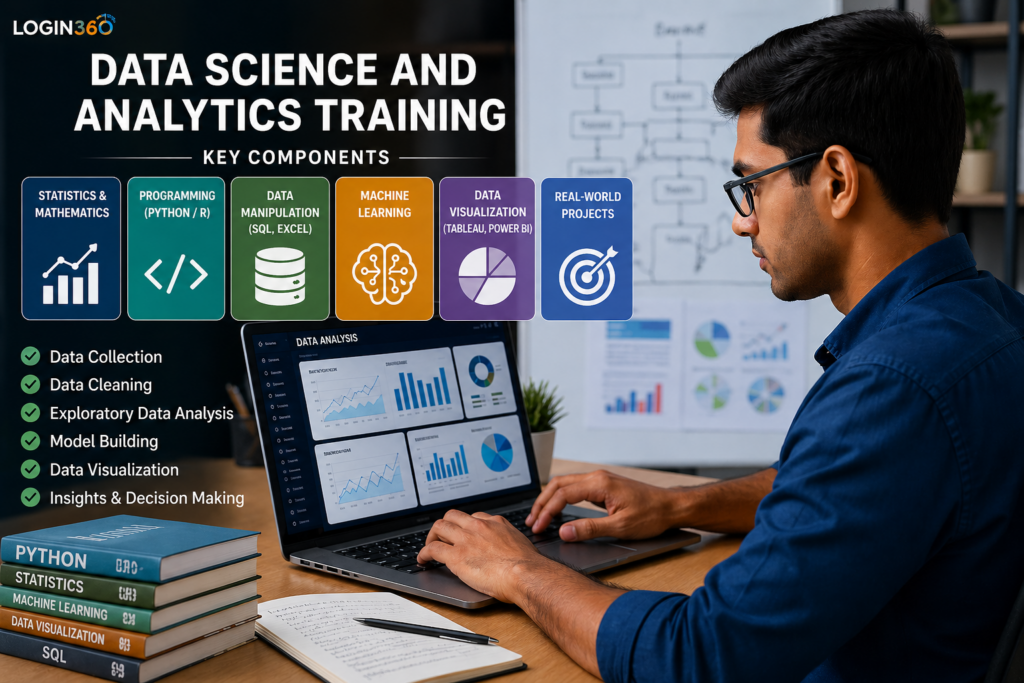
Embarking on Data Science and Analytics Training means acquiring a robust blend of technical, analytical, and soft skills essential for success in this dynamic field. A comprehensive program should cover several key areas.
Core Technical Curriculum
- Statistics and Probability: The foundational language of data. Understanding statistical inference, hypothesis testing, regression analysis, and probability distributions is crucial for making sound data-driven conclusions.
- Programming Languages: Proficiency in Python and/or R is paramount. Python, with its extensive libraries (Pandas, NumPy, SciPy, Scikit-learn, TensorFlow, PyTorch), is a powerhouse for data manipulation, machine learning, and AI development. R is highly valued for statistical analysis and data visualization.
- Machine Learning: Core concepts including supervised and unsupervised learning, classification, regression, clustering, deep learning fundamentals, model evaluation, and deployment strategies.
- Data Visualization: Tools like Tableau, Power BI, Matplotlib, Seaborn, and ggplot2 are essential for transforming complex data into understandable and compelling visual narratives.
- Database Management (SQL): Structured Query Language (SQL) is indispensable for querying, managing, and manipulating data stored in relational databases, which form the backbone of many organizational data systems.
- Big Data Technologies: Exposure to platforms like Apache Spark, Hadoop, and cloud-based big data services (AWS S3, Google Big Query, Azure Data Lake) is increasingly important as datasets grow larger and more complex.
Essential Soft Skills
- Problem-Solving
- Sales drop, everyone guesses the reason. A data professional checks the data and finds the real issue—high delivery charges. No guesswork, just clarity.
- Critical Thinking
- Traffic suddenly spikes. Looks good—but it’s actually bots. A sharp analyst catches this before the company makes a bad decision.
- Communication & Storytelling
- A confusing report can lead to costly mistakes. A good data professional simplifies it: “This change can increase revenue by 20%.” Clear message, better decisions.
- Curiosity & Continuous Learning
- Tools keep changing. Those who keep learning stay valuable. Those who don’t, fall behind.
- Bottom Line
- It’s not just about data skills—it’s about thinking clearly, explaining simply, and constantly improving.
Practical Application and Project-Based Learning
The best Data Science and Analytics Training programs emphasize hands-on experience. This means working on real-world datasets, undertaking capstone projects, and building portfolios that demonstrate practical skills. Theoretical knowledge alone is insufficient; the ability to apply concepts to solve actual business problems is what truly prepares individuals for the demands of the 2026 job market.
login360: Your Gateway to a Data-Driven Future
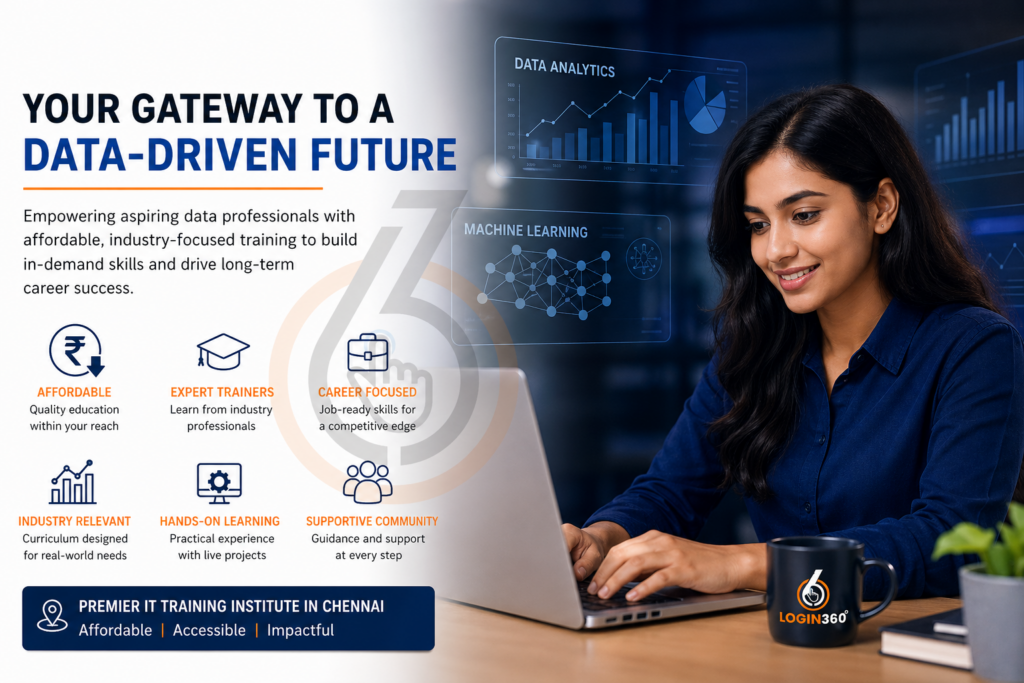
Recognizing the burgeoning demand for skilled data professionals, login360, a premier IT Training Institute based in Chennai, has designed its Data Science and Analytics Training program to meet the exact needs of today’s industry. Our Data Science and Analytics Training is carefully structured to help students build practical, job-ready skills in data analysis, machine learning, programming, and business intelligence. At login360, we believe that quality Data Science and Analytics Training should not be a luxury, but an accessible opportunity for every aspiring data professional
Our unique selling proposition (USP) at login360 is Affordability, ensuring that aspiring data scientists and analysts can easily access high-quality education without financial strain. We believe that talent should be nurtured, not limited by cost. Our programs are meticulously designed to provide comprehensive coverage of all the core technical and soft skills discussed, preparing our students not just for entry-level positions, but for long-term career growth in a rapidly evolving field.
At login360, you’ll benefit from:
- Expert-Led Instruction: Our instructors are industry veterans with extensive real-world experience, bringing practical insights and current best practices directly into the classroom.
- Hands-on, Project-Based Curriculum: We prioritize practical application, ensuring students work on numerous projects that simulate real-world scenarios, building a robust portfolio even before they enter the job market.
- State-of-the-Art Resources: Access to the latest tools, software, and datasets to ensure a cutting-edge learning experience.
- Career Support: Beyond training, we offer guidance on resume building, interview preparation, and job placement assistance, leveraging our network within the Chennai tech ecosystem and beyond.
- Flexible Learning Options: Designed to accommodate diverse schedules, making it easier for students and working professionals to upskill.
By choosing login360 for your Data Science and Analytics Training, you are not just enrolling in a course; you are investing in a future-proof career with a trusted partner committed to your success, all within an affordable framework that truly makes quality education accessible in Chennai and beyond.
Beyond the Hype: Tangible Career Benefits
The allure of data science and analytics goes far beyond mere industry trends. It translates into concrete, tangible benefits for individuals who commit to Data Science and Analytics Training.
High Earning Potential
Data professionals consistently rank among the highest-paid individuals in the tech sector. Entry-level data analysts and scientists can expect competitive salaries, which grow significantly with experience and specialized skills. As of 2023-2024, average salaries for data scientists in India, particularly in major tech hubs like Chennai, range from INR 6-12 lakhs for freshers, quickly escalating to INR 15-30 lakhs and beyond for experienced professionals. By 2026, with the continued talent shortage, these figures are only expected to rise, making it one of the most lucrative career paths available.
Unparalleled Job Security
In an era where automation is a buzzword, careers shaped by Data Science and Analytics Training offer remarkable job security. While AI and machine learning automate many routine tasks, they fundamentally rely on human data scientists and analysts developed through Data Science and Analytics Training to design, implement, and interpret their outputs. These roles are about critical thinking, problem-solving, and strategic insight—qualities that are exceedingly difficult to automate. As long as businesses generate data and seek competitive advantages, the opportunities opened by Data Science and Analytics Training for skilled data professionals will remain robust.
Versatility Across Industries
One of the most attractive aspects of Data Science and Analytics Training is the immense versatility it offers. The skills acquired through Data Science and Analytics Training are transferable across virtually every industry imaginable. Whether your passion lies in healthcare, finance, entertainment, manufacturing, marketing, or environmental science, there is a critical need for data expertise that makes Data Science and Analytics Training highly valuable. This versatility allows professionals to pivot between sectors, explore diverse challenges, and continually refresh their career paths, preventing stagnation and fostering continuous engagement.
Impactful Work and Innovation
Data professionals are not just number crunchers; they are at the forefront of innovation. Their work directly influences strategic business decisions, product development, operational efficiencies, and even societal advancements. Imagine contributing to the development of life-saving medical treatments, optimizing logistics to reduce carbon footprints, or personalizing educational experiences for millions. The ability to derive actionable insights from data means your work has a direct, measurable impact, providing a profound sense of purpose and achievement.
Continuous Learning and Growth
The field of data science and analytics is dynamic and ever-evolving. New algorithms, tools, and methodologies emerge regularly. This constant evolution means that data professionals are perpetually learning, adapting, and expanding their skill sets. For those who thrive on intellectual challenge and continuous growth, this offers an incredibly stimulating and rewarding career environment, ensuring that your skills remain relevant and your expertise continues to deepen over time.
Addressing Common Concerns & Misconceptions
It’s natural to have questions when considering a significant career shift. Let’s address some common concerns about pursuing Data Science and Analytics Training.
“Is it too late to start a career in data science and analytics?”
Absolutely not. While the field has gained prominence over the last decade, the demand is still growing exponentially. We are still in the early to mid-stages of data adoption across many industries. As more companies realize the full potential of data and as the volume of data continues to explode, the need for skilled professionals will only increase. The talent gap remains significant, meaning there’s ample room for new entrants, especially those with comprehensive and up-to-date training. 2026 is still very much within the prime window for entry.
“Do I need a PhD or a master’s degree in a highly quantitative field?”
While advanced degrees can certainly be beneficial, they are by no means a prerequisite for a successful career in data science and analytics. Many highly successful data professionals come from diverse academic backgrounds (e.g., economics, business, engineering, even humanities) and have transitioned through specialized training programs. What truly matters are demonstrable skills, practical experience, and a strong portfolio of projects. Focused Data Science and Analytics Training programs like those offered by login360 provide the concentrated knowledge and hands-on experience employers value, often making them a faster and more direct path to employment than traditional academic routes.
“Is it only for highly tech-savvy people or coding geniuses?”
This is a common misconception. While programming is a core component, modern tools and training methodologies make data science and analytics accessible to individuals with a logical mindset and a willingness to learn. You don’t need to be a coding genius; you need to be a problem-solver who can apply programming as a tool. Many successful data professionals excel because of their strong analytical thinking, curiosity, and communication skills, not just their coding prowess. With structured Data Science and Analytics Training, individuals from various backgrounds can acquire the necessary technical skills.
“Is data science just a fad?”
Data science is not a fad; it is a fundamental shift in how businesses operate and make decisions. It is an evolution driven by the sheer volume and complexity of data being generated globally, which is why Data Science and Analytics Training has become essential for professionals looking to stay relevant in this changing landscape. Just as the internet fundamentally changed commerce and communication, data science is fundamentally changing how we understand and interact with the world. Its principles are deeply rooted in statistics, computer science, and domain expertise, making it a robust and enduring field that will continue to evolve and integrate into new technologies rather than disappear.
Conclusion: Your Strategic Leap into 2026
2026 is a turning point where data, technology, and business needs are coming together—making data science and analytics one of the most in-demand career paths. It offers strong salaries, job security, and real impact.
Investing in Data Science and Analytics Training now isn’t just learning a skill—it’s a smart career move. For those in Chennai and beyond, login360 provides an affordable, practical path to enter this growing field.
Don’t wait for the future—start building it with data today.