
Table of Contents
Introduction
Digital marketing Trends 2026is changing faster than ever. Artificial intelligence changing search behavior, social commerce, personalization, automation and data-driven decision-making are transforming how businesses attract and engage customers. In 2026 marketers are no longer simply asking, How can we reach people?. They are asking, How can we reach the people with the right message at the right moment?. Recent 2026 marketing research shows that AI is becoming a part of marketing workflows while human creativity, brand trust, personalization and strong customer relationships remain critical differentiators.
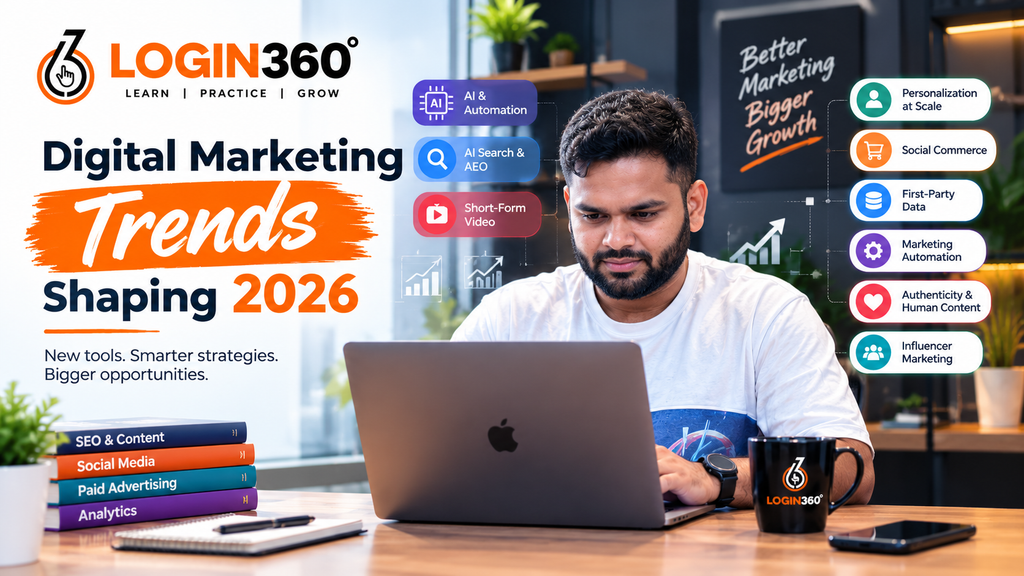
Here are the major digital marketing trends 2026.
1. AI Is Becoming a Core Marketing Tool
Artificial intelligence is no longer an experimental technology. In Digital Marketing Trends 2026,marketers are using AI for content creation media production, advertising optimization, customer insights, brainstorming, automation and strategic planning. HubSpots 2026 research found that 86.4% of marketing teams use AI in at some areas of marketing with content creation and media creation among the most common applications. ([HubSpot Blog][1]). However successful marketers are not simply publishing everything generated by AI. Human review is becoming increasingly important. AI can help with speed and scale while marketers provide creativity, strategy, brand voice, accuracy and emotional understanding.
2. AI Search and Answer Engine Optimization
Digital Marketing Trends 2026, Search is undergoing a transformation. Of typing short keywords into a traditional search engine users increasingly ask detailed questions and expect direct answers from AI-powered search experiences. Google reported in May 2026 that its AI Mode had surpassed one billion active users globally while AI Mode queries had more than doubled each quarter since launch. This creates an opportunity for marketers: Answer Engine Optimization (AEO). AEO focuses on creating content that can be understood referenced and surfaced by AI-powered search systems. Marketers should create answers, structured content, useful explanations original insights and authoritative resources.
3. Personalization at Scale
Digital Marketing Trends 2026,Customers increasingly expect brands to understand their interests and needs. Generic marketing messages are becoming less effective in digital environments. AI allows marketers to personalize content and campaigns at a larger scale. Businesses can use customer behavior, preferences, purchase history and engagement data to create relevant experiences. According to HubSpots 2026 research, personalized or segmented experiences are producing business results for many marketers.
4. Short-Form Video Continues to Grow
Digital Marketing Trends 2026, Short-form video remains one of the content formats in 2026. Instagram Reels, YouTube Shorts similar formats allow brands to communicate ideas quickly and creatively.
Short videos can be used for:
- Product demonstrations
- tips
- Customer testimonials
- Behind-the-scenes content
- Tutorials
- Brand storytelling
- User-generated content
The key is not simply creating videos. Marketers need to create videos that provide value within the few seconds.
5. Social Media Is Becoming a Search Engine
Digital Marketing Trends 2026, media is no longer only a place for entertainment and networking. People increasingly use platforms to discover products, restaurants, services, creators, tutorials and brands. HubSpots2026 social media research describes a shift toward interest-based discovery, where content relevance and quality can matter more than follower count. It also identifies search and social commerce as important developments. This means marketers should optimize content using relevant keywords, clear descriptions, captions, hashtags where appropriate and content that directly answers audience questions.
6. Social Commerce Is Becoming More Important
Digital Marketing Trends 2026, Social media and e-commerce are becoming increasingly connected. Customers can discover a product through a video research it through comments or creator content and purchase it without leaving the platform or with friction. Social commerce can be particularly effective for fashion, beauty, food, lifestyle, electronics and other driven industries. Brands should combine engaging content with product information, customer reviews, creator partnerships and simple purchasing experiences.
7. First-Party Data Is Becoming Valuable
Data is one of the most important assets in modern marketing. As privacy expectations and regulations evolve businesses need relationships with their own customers and better ways to collect information with appropriate consent.
First-party data can include:
- Website interactions
- CRM information
- Purchase history
- Email engagement
- Customer preferences
- App activity
- Customer feedback
Experians 2026 trends research highlights first-party data as a major area of investment among B2B marketers. ([Experian][5]). Businesses should focus on collecting customer information transparently and using it to improve customer experiences rather than simply collecting data for its own sake.
8. Automation Will Improve Marketing Efficiency
Digital Marketing Trends 2026, Marketing automation is another trend in 2026. Automated workflows can help businesses manage activities such as email campaigns lead nurturing audience segmentation, reporting and customer follow-ups. Automation allows marketers to spend time on strategy and creativity. The best approach is to automate processes while keeping human interaction where it adds value.
9. Authenticity and Human-Led Content Matter More
As AI makes content creation easier the internet is becoming increasingly saturated with AI-generated material. This makes originality and authenticity more important. Brands need a voice and a clear point of view. Customers want content that feels useful, trustworthy and relevant than content created simply to fill a publishing schedule. HubSpots 2026 State of Marketing research emphasizes that AI efficiency needs to be balanced with creativity and authenticity. ([HubSpot][6])
10. Influencer Marketing Is Becoming More Strategic
Influencer marketing continues to evolve. Brands are increasingly looking beyond celebrity influencers. Considering creators whose audiences closely match their target customers. Micro-influencers can be particularly valuable because they have focused communities and strong audience relationships.
Successful influencer campaigns should prioritize:
- Audience relevance
- Authenticity
- Engagement
- Content quality
- Brand alignment
- Measurable results
The objective should be more than gaining views. Marketers should connect influencer activity to awareness, engagement, leads or sales.
11. Data and Analytics Are Essential for Marketing Decisions
In 2026 marketers need to be comfortable working with data. Campaign performance cannot be evaluated through likes and impressions alone.
Important metrics include:
- Conversion rate
- Cost per acquisition
- Customer acquisition cost
- Return on ad spend
- Return on investment
- Customer lifetime value
- Engagement rate
- Website traffic
- Lead quality
Marketing leaders continue to identify proving ROI as one of the challenges facing marketing teams. Marketers should connect campaign metrics to business outcomes and use analytics to continuously improve performance.
12. Channel-Specific Content Will Perform
Repurposing content remains useful but simply copying the same post across every platform is becoming less effective. A blog post can become a YouTube video, Instagram Reel, LinkedIn post carousel, email or infographic—. Each version should be adapted to the platform and audience. This approach saves time while maintaining platform- relevance. HubSpots 2026 research also highlights channel- content as an important consideration for marketers. ([HubSpot Blog][1])
13. Customer Experience Will Drive Brand Loyalty
Digital marketing is no longer about attracting customers. The complete customer experience matters. Customers expect responses, useful information, easy navigation, personalized communication and convenient purchasing processes. A strong marketing strategy should therefore connect advertising, website experience, sales, customer support, email, social media and retention. When customers receive an experience across channels they are more likely to trust and continue interacting with a brand.
14. Marketing Skills Are Changing
The modern marketer needs more than advertising knowledge. Digital marketing professionals increasingly need skills in AI, analytics, SEO, content creation, automation, social media, customer psychology and strategic thinking. AI will automate repetitive tasks but marketers who know how to use AI effectively will have an advantage. The future is not necessarily AI versus marketers. It is marketers who know how to combine, AI efficiency with creativity and strategic thinking.
Conclusion
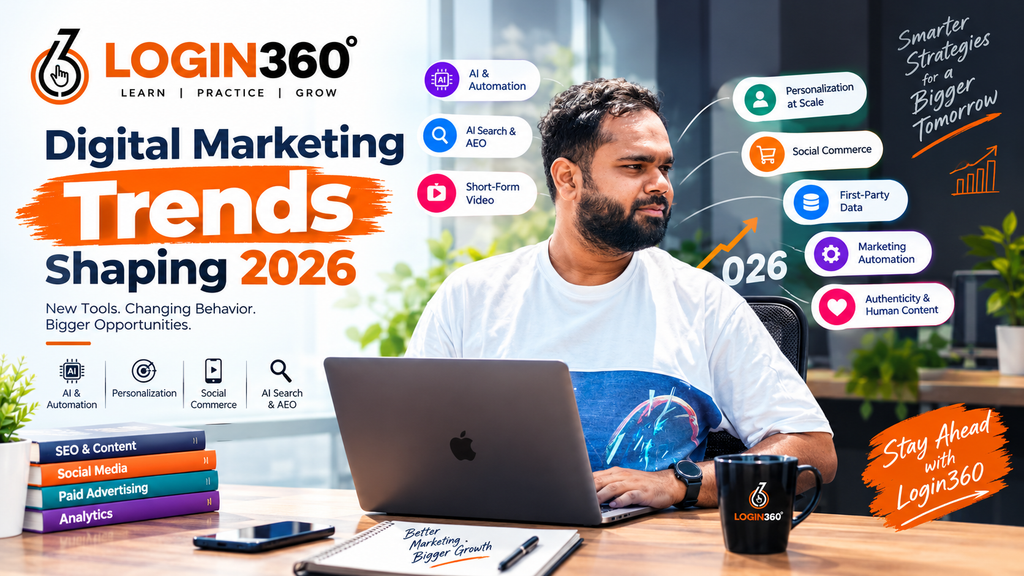
The digital marketing landscape of 2026 is being shaped by AI changing search behavior, personalization, social commerce, automation first-party data, short-form video, analytics and authentic brand communication. AI is making marketing faster and more scalable. Technology alone is not enough. Successful brands will combine data with creativity, automation with judgment and personalization, with privacy and trust. Marketers who continuously learn tools understand customer behavior, measure performance and adapt to changing platforms will be better prepared for the future. The biggest digital marketing lesson for 2026 is simple: use technology to work but keep people at the center of your marketing strategy.
LEARN MORE WITH LOGIN360