

Introduction
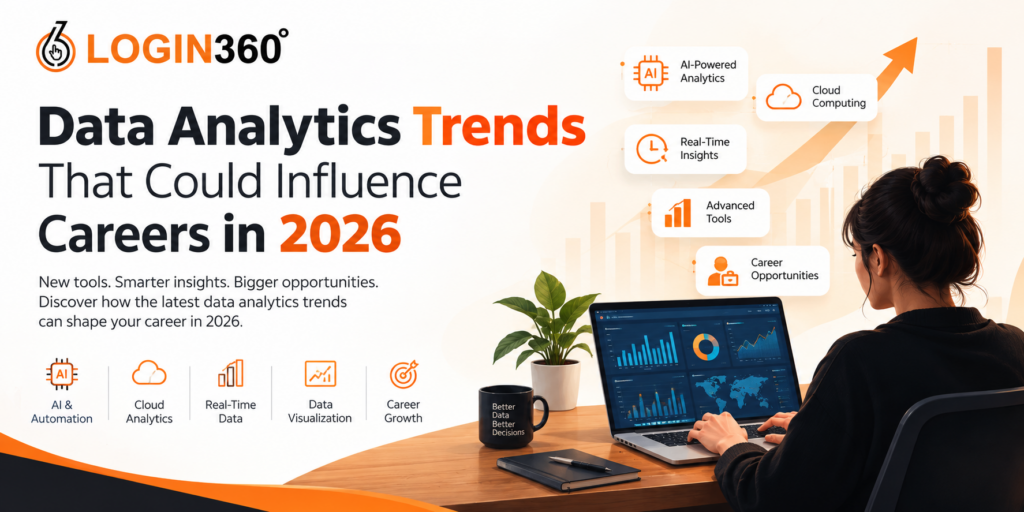
Data analytics trends in 2026 has turned out to be one of the most valuable assets for modern enterprises. It allows them to understand their customers’ behavior, predict market changes and improve operational efficiency. The development of technology brings about the change in the importance of data analytics for companies.
For students, freshers, and professionals who would like to make a career in this field, getting acquainted with the main trends in data analytics in 2026 can help gain an advantage. Tools that were considered to be high-end become simpler to use, and such technologies as artificial intelligence, automation, cloud computing, and real-time analytics become a part of everyday work of many businesses in the sphere.
There is no doubt that the demand for specialists who are able to turn raw data into useful insights will remain high. Nevertheless, the requirements for skills of these specialists will change. Nowadays, being able to use spreadsheets or reporting tools does not suffice for many jobs.
In this blog post, we will talk about the main data analytics trends in 2026 and find out what impact they can have on future careers.
1. Artificial Intelligence Influences Data Analytics
One of the major drivers that affect the industry of analytics is artificial intelligence. Many activities performed during the process of data analysis can be automated with the help of AI-based tools.
They include pattern recognition, generation of summaries, visualization of data, detection of anomalies, and construction of predictive models. Instead of spending the bulk of time on creating manual reports, analysts can spend it on interpretation of results and recommendations for business.
AI is becoming a technology which helps people communicate with data through natural language queries. The users can now pose questions concerning their datasets without the necessity to write queries.
This means that AI technologies will not substitute data analysts, but will change their roles. Those professionals who are capable of utilizing AI tools successfully and validating their output will be highly valued by companies.
Career impact: Data analysts should become familiar with AI in order to remain competent specialists.
2. Automation of Data Preparation and Cleaning
It is known that data cleaning has been one of the most labor-intensive stages of the analytics process. Datasets obtained in real-life situation can contain missing values, duplicate records, inconsistencies,
3. Real-Time Data Analytics
Organizations are seeking instant insights instead of waiting for periodic reporting on daily, weekly, or monthly basis.
Real-time analytics makes it possible for businesses to track and analyze data continuously and react promptly to any changes. Sectors like finance, e-commerce, logistics, healthcare, and digital marketing might find real-time data useful.
For instance, an e-commerce business may track website visits and sales during the course of a campaign. Logistics business can make use of real-time data to monitor and detect any potential delivery delays.
This development is making it more important to have tools that can handle constantly changing data.
Career impact: There might be new job opportunities in the field of analytics for people who have knowledge about real-time dashboards, streaming data, and contemporary data platforms.
4. Growth of Cloud-Based Analytics
The advent of cloud computing has changed the way organizations collect and analyze data. Rather than depending on local servers, enterprises now have the option of storing large data sets and conducting analysis through cloud platforms.
The benefit of cloud-based analytics is that it can help ensure scalability and increased collaboration among teams in the organization.
As enterprises create more data, cloud platforms can help organizations cope with their increased demands.
As far as career aspirations are concerned, learning about the basics of cloud computing will help candidates learn a valuable additional skill.
Impact on Career: Learning about cloud technologies can become an important complementary skill for aspiring data analysts and business intelligence professionals.
5. Self-service Business Intelligence
It is becoming easier for employees from outside the traditional IT and analysis teams to use business intelligence.
Tools like Power BI, and other BI platforms, enable users to connect data sources, build dashboards, identify trends, and produce reports, without relying as much on the technical staff.
The trend is giving rise to a self-service analysis environment in many firms.
But increased access to data also demands that there be people who know how to construct accurate dashboards and communicate findings effectively. It is not enough just to make appealing charts. Analysts must pick the right type of chart and tell what the data tells about the firm.
Career implications: Power BI, dashboards, data visualization, and business communication could all be career assets.
6. Predictive Analytics and Forecasting
Companies not only seek to analyze the past. In many cases, they need to forecast what might happen next.
Using both historical and current data, predictive analytics helps to determine the possible future outcomes. It allows companies to predict sales, customer demand, inventory, business performance, and many other factors.
Although some advanced forecasting may require specific statistical and machine learning skills, one can start the learning process with understanding the basics, including trend, correlation, regression, forecasting, and probability.
With the increasing importance of data analysis for many organizations, it may become possible to build a career on the transition from descriptive to predictive analytics.
Career implications: Statistics, forecasting, and basic machine learning knowledge can help to move toward advanced analytics.
7. Visualizing Data and Data Storytelling
Simply having numbers will not necessarily bring business value. The decision-makers have to know the meaning behind the numbers.
This increases the importance of data visualization and storytelling even further. Analysts must take complex data sets and turn them into clear stories based on analysis.
The dashboard must not inundate the users with dozens of different graphs. It must focus on key metrics and trends.
Data storytelling is the synthesis of analytics, visualization, and communication. Individuals who can articulate their findings effectively to technical and nontechnical stakeholders can be very valuable indeed.
Career Impact: Communication and storytelling should not be viewed as additional soft skills but core data analytics skills.
8. Data Governance, Privacy and Ethical Analytics
As the amount of data that is collected by businesses increases, issues related to data privacy, security, accuracy and ethical use of data become relevant.
Businesses require procedures to define who can have access to the data, how data should be stored, how sensitive data should be protected, and how data should be used.
AI raises new issues of data use such as bias, transparency and ethical decision-making.
Data professionals should have an understanding of fundamental principles of data governance, privacy, security and ethical analytics.
Career impact: Those professionals who have knowledge of analytics along with responsible data use will enable better data-driven decisions.
9. SQL Is Going to Stay Relevant
Even with the rise of AI and tools that require zero code, SQL is still going to remain an important skill for data-oriented jobs.
Companies keep vast amounts of structured data in their databases and SQL enables analysts to extract, filter, join, and aggregate data from them.
AI software might assist the user in generating queries in SQL, but the analyst needs to know what those queries do. They will have to verify the results and spot the wrong queries.
For newbies who wish to pursue a career in data analytics, SQL is going to be one of the most relevant technical skills to acquire.
Impact on career: Good knowledge of SQL can continue to give you an edge while applying for junior data analyst and business intelligence positions.
10. Analytics Engineering Emerges
The old divide between data engineering and data analytics is becoming more flexible.
Analytics engineering involves taking raw data and converting it into clean and structured datasets that analysts can use. It draws from data engineering, analytics, and software development.
Increasingly complex data ecosystems might mean that people who know how to transform data and have knowledge of analytics needs will become increasingly sought after.
It could even allow for new career opportunities for analysts interested in technical positions.
Career implications: By learning about data modeling, data transformation, version control, and other data skills, analysts can open up new career opportunities.
11. Domain Knowledge Will be More Valuable
Technical competencies matter, but at its heart, analytics is all about solving business problems.
The analyst with an in-depth knowledge of a certain industry may be able to deliver more insightful results than the one who just knows how to use analytics software.
For instance, the marketing data analyst will find it useful to have knowledge of customer acquisition, conversion rates, campaign effectiveness, and customer lifetime value. In a similar manner, the one in finance needs knowledge of financial performance measures and risks.
This increases the value of domain knowledge alongside technical competencies.
Career implications: The combination of analytics and industry knowledge in fields like finance, healthcare, marketing, retail, or logistics can give professionals an edge.
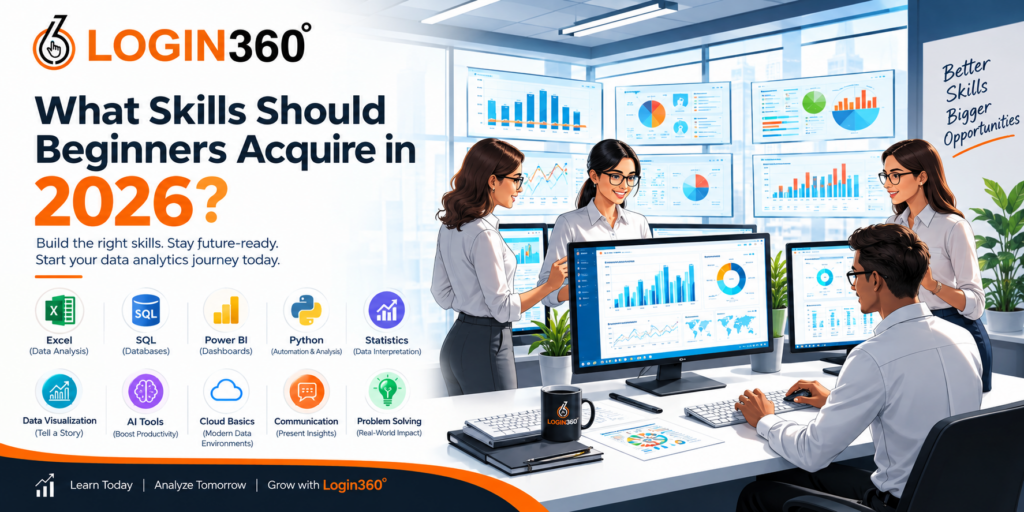
12. What Skills Should Beginners Acquire in 2026?
With all of the changes occurring, it is reasonable that new learners might wonder where to begin.
A feasible way to learn could include the following:
- Excel or spreadsheet software for basic analysis
- SQL for database analysis
- Power BI or any other BI software for dashboards and reporting
- Python for more advanced analysis
- Statistics for analyzing data and results
- Data visualization for presenting the results
- AI tools for increased productivity
- Cloud basics for understanding data-related technology
- Business communication for presentations
- Problem-solving for dealing with analytical tasks in reality
The objective should be to acquire basic skills and not to learn each and every software available.
How Such Trends May Impact Data Analysts’ Careers
Perhaps the biggest change is likely to be the move from analysts spending most of their time generating reports to analysts being strategic problem solvers.
Through automation and artificial intelligence, the amount of time that an analyst spends working on reports manually can be reduced. The significance of the process of interpreting data, uncovering business opportunities, validating insights created by the AI, and communicating recommendations may be amplified.
Therefore, beginners in the profession should not concentrate solely on tools when assembling their portfolios. The candidate’s ability to use data to solve real-life problems can be demonstrated through portfolio projects.
Examples of portfolio projects that may be completed by entry-level candidates include projects analyzing sales, evaluating marketing campaigns, segmenting customers, creating financial dashboards, and analyzing e-commerce data.
Conclusion
The field of analytics is developing very fast and having knowledge about the data analytics trends for 2026 will be beneficial for the students, freshers, and professionals to prepare themselves for upcoming career needs.
Automation through AI, real-time analytics, cloud computing, self-service BI, predictive analytics, and data storytelling are growing the scope for data specialists, while such skills as SQL, statistics, visualization, communication, data governance, and domain knowledge are important too.
The right strategy for the beginners is not to try learning everything new. Instead, they need to create a strong base for their knowledge and learn modern technologies.
For sure, the future of the data analytics will be bright for specialists with combined technical skills, knowledge about AI, business, critical thinking, and communication.
If you want to become a data analyst, 2026 might be a good period for you.
Build In-Demand Skills. Work on Real Projects. Prepare for Your Career. Join Login360