
Introduction
Modern organisations collect data through various channels, including websites, apps, social media, purchasing, and customer-related areas. This information can subsequently be analysed to improve understanding and identify the most appropriate course of action for a company. Although this may be carried out manually, it can frequently be time-consuming and labour-intensive. Consequently, many companies have adopted artificial intelligence to support and accelerate data analysis.Artificial Intelligence in Data Analytics examines and interprets data while using smart technology to learn from and identify important information. Companies can then use this to assess markets, improve the customer experience, and identify new opportunities for growth.
What Are Artificial Intelligence and Data Analytics?
Artificial intelligence and data analytics involve using smart technology to collect, analyse, and interpret data. When combined with data analytics, artificial intelligence can enable computer systems to learn, identify correlations, and produce informative outputs.Standard data analytics methods include collecting, cleaning, and analysing data, as well as producing reports. This often demands specialist knowledge and involves considerable labour. Artificial intelligence can therefore support labour-intensive aspects of data analytics and identify correlations within large volumes of data.Online retailers can examine historical data concerning consumers’ purchasing habits, search terms, and web browsing. Artificial intelligence can then identify consumer interests and offer appropriate product recommendations.In addition, banks can use artificial intelligence to analyse data and detect unusual activity.
How do Artificial Intelligence and Data Analytics operate?
Analysing data to obtain valuable business insights involves several steps.
- Data collection-Information may be collected from various sources, including websites, apps, databases, business software, social media, and sales records.The information must be accurate and relevant, as its quality will affect the analysis performed.
- Data cleaning-Unclean data may contain duplicates, missing information, and errors. Data cleaning involves examining and addressing these problems.Smart technology can also be applied during the data-cleaning process. It can also help organise the data in preparation for analysis.
- Data analysis-Once the data has been cleaned, suitable analysis methods are applied to the information collected. Artificial intelligence can examine large data sets and identify relationships that might otherwise be difficult to detect.
- Data interpretation-With the support of artificial intelligence, companies can analyse information to understand consumer behaviour, market development, sales, and business operations. Artificial intelligence can also examine historical data to support predictions.For example, retail companies can examine historical sales data to identify which products attract greater consumer interest at different times of the year.
- Data presentation and reporting-The results of the analysis can then be displayed visually in various formats, such as graphs, charts, and dashboards. Presenting information in this manner can make it easier to understand.Businesses can then use this information to improve their marketing, identify customer needs, and develop business strategies.
Common Artificial Intelligence Approaches used within Data Analytics
Companies can use a range of artificial intelligence approaches to analyse data and identify correlations, thereby generating valuable insights. Some of the principal approaches are outlined below.
- Machine Learning-Machine learning is widely used in modern data analytics. Computer systems can learn from historical information and improve their functionality without requiring every aspect of that functionality to be manually programmed.Artificial intelligence and machine learning can help identify correlations, understand consumer behaviour, and forecast business performance. They can also identify unusual occurrences.An online retail company can examine customers’ purchasing histories to determine which products are most popular and then forecast future demand. This can help inform a business’s stock management and product recommendation processes.
- Natural Language Processing-Natural language processing enables computers to analyse human language. Companies can use this approach to examine customer comments, emails, survey responses, and social media conversations collectively.An organisation can analyse a large number of online customer comments to determine whether consumers are satisfied or dissatisfied with its goods and/or services. Additionally, recurring issues can be identified and resolved to enhance the customer experience.
- Predictive Analytics-By combining historical data with statistical and machine learning-based analysis, predictive analytics can help determine likely future events.Companies use this to forecast sales, identify consumer demand, and manage stock. Companies can also use it to identify potential risks.For example, retailers can examine historical sales data to predict the likely demand for particular goods during festival periods. This prediction can consequently help a business determine the suitable amount of stock to hold and plan its business strategy.
- Deep Learning-Deep learning is a subcategory of machine learning. Artificial neural networks are used to examine and identify complex relationships within large data sets.Typical applications of deep learning include image and speech recognition, as well as fraud detection and recommendation system functionality.For example, financial companies can use deep learning to examine business transaction data and identify potential indications of fraudulent activity.
- Generative AI-Generative artificial intelligence is an emerging technology capable of producing new information in response to supplied information. In data analytics, it can be used to summarise data, explain correlations, and create and answer queries in natural language.Instead of examining sales data manually, a business’ data analyst can ask an artificial intelligence ‘assistant’ to summarise sales data for a specified period. This makes data investigation easier and more efficient.
Common Artificial Intelligence Data Analytics Tools
Choosing suitable software is a key part of ai tools for data analytics. Various tools are available for organising, analysing and generating reports. In addition, software can be used to build machine learning models.
Some commonly used artificial intelligence data analytics tools are listed below:
1. Microsoft Power BI-Microsoft Power BI is business intelligence software that analyses and displays data. Users can create interactive dashboards, graphs and reports.Through its data and artificial intelligence capabilities, this tool allows users to examine data and identify correlations. It is widely used for analysing sales, financial and marketing data.
2. Tableau-Tableau is a widely recognised tool that converts complex data into easy-to-understand reports. It can be used to examine information and compare business performance to identify important trends.Businesses can then use Tableau dashboards to present information clearly to employees and management.
3. Python-Python is commonly used for data analysis, process automation and machine learning. Libraries including Pandas, NumPy, Scikit-learn and TensorFlow are available to support a range of data analysis methods.Python is particularly useful for people who want to conduct detailed data analysis, build machine learning models and work with large data sets.
4. Microsoft Excel-Microsoft Excel is widely used to organise, calculate, analyse and present information. Its chart, formula and pivot table functions, along with its artificial intelligence-supported features, can help manage data efficiently.In addition, Microsoft Excel can serve as a useful introductory tool for people aiming to develop basic data analysis skills.
5. Google Looker Studio-Google Looker Studio is used to create interactive reports and dashboards containing information from various sources. Companies often use it to analyse website traffic and marketing data, as well as evaluate other business information.The appropriate tools should be chosen according to an organisation’s data needs, available resources and strategic objectives.
Emerging Artificial Intelligence and Data Analytics Trends
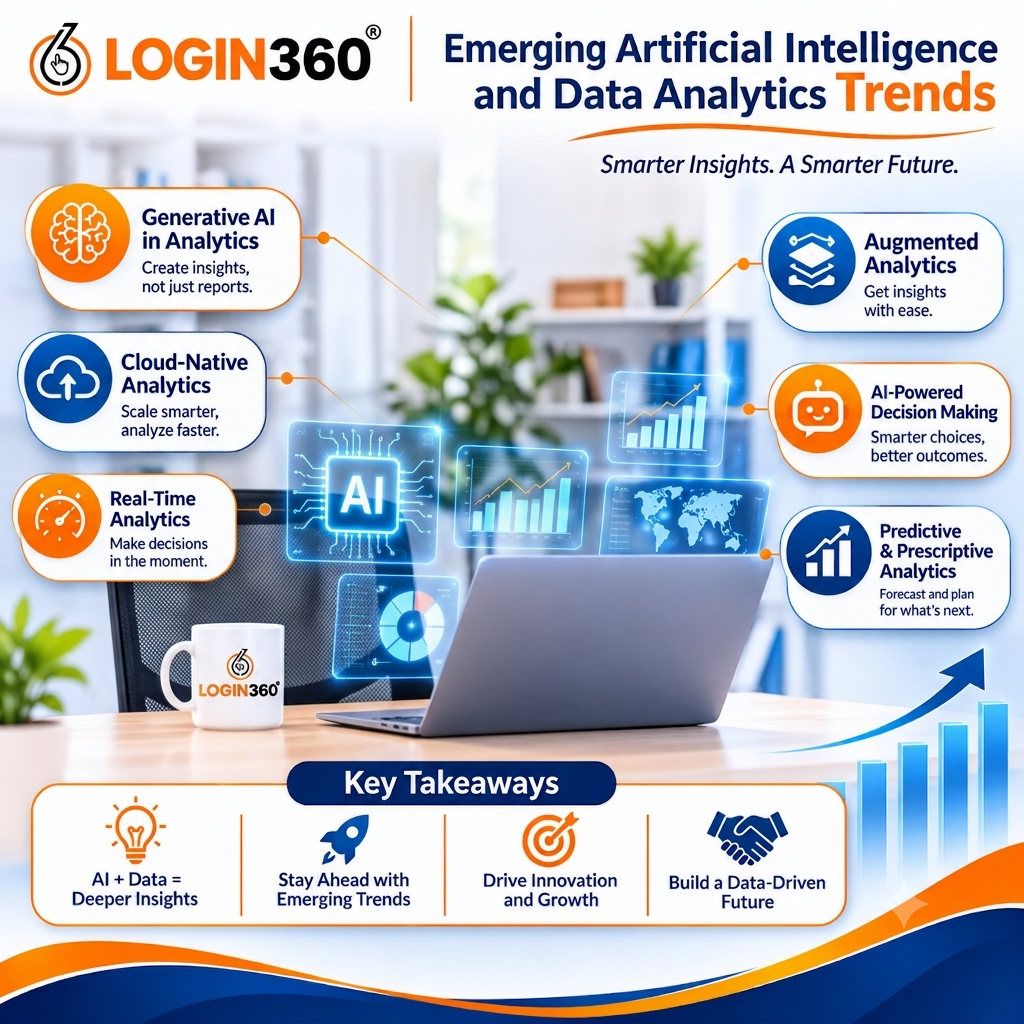
Progress in artificial intelligence continues, while several emerging trends are shaping how companies collect and interpret information.
- Generative AI for Data Analysis-Generative artificial intelligence is making data analysis more accessible. Users can ask questions in everyday language, request summaries of information and receive explanations of important trends.As a result, it reduces the need for manual data analysis and makes data investigation easier.
- Automated Data Analytics-Automation is used to reduce the labour-intensive aspects of data analysis. Smart technology can cleanse data and produce reports. Artificial intelligence can also be used to identify and examine variations in business performance.As a result, analysts can spend more time interpreting data and delivering valuable advice.
- Real-Time Data Analytics-As organisations aim to understand activities as they happen, the use of real-time data analytics is becoming increasingly common. It can monitor business transactions, customer behaviour, website usage, and developments within a business.For example, an online retailer can examine customer behaviour to gain a deeper understanding of how consumers interact with its website and products.
- Predictive and Prescriptive Analytics-Predictive analytics is used to determine probable future events. At the same time, prescriptive analytics examines information to recommend potential courses of action.Together, these approaches can help businesses adapt to changing market conditions and make well-informed decisions.
- Cloud-Based AI Data Analytics-Companies can store, manage, and analyse data in the cloud. Unlike entirely in-house facilities, businesses do not necessarily need to depend exclusively on their own physical resources for these activities.Cloud technology also allows staff to access, share, and collaborate on reports more easily, even when members of the workforce are located in different geographical areas.
Advantages of Artificial Intelligence and Data Analytics
Integrating artificial intelligence into data analytics can provide businesses with various advantages, allowing them to improve operations, gain deeper insight into customers, and make well-informed decisions.
1. Improved Decision Making-Businesses can use data analytics to gain a deeper understanding of how they operate. Business leaders can examine sales, customer, and market data before making important decisions.As a result, businesses can rely on data analysis instead of merely basing decisions on conjecture when determining future actions.
2. Improved Efficiency and Productivity-Data analytics can involve many labour-intensive processes. Artificial intelligence can automate data cleansing, correlation, and report generation. Employees can therefore dedicate their time to other important responsibilities, such as interpreting data and refining business strategies.
3. Deeper Customer Understanding-Understanding consumer needs is essential for organisations seeking to support business development. Artificial intelligence can be used to examine consumers’ purchasing behaviour, preferences, responses, and online engagement.For example, online retailers can analyse consumers’ previous purchases to provide suitable product recommendations. Businesses can consequently increase customer satisfaction and further develop their service offerings.
4. Cost Reduction-By automating business processes, artificial intelligence can help reduce unnecessary manual work. Data analytics can also help identify inefficient processes. Companies can then plan their business operations accordingly.However, the extent of cost reduction will be influenced by various factors, including software costs, the nature of implementation, data quality, and business’ needs.
5. Identifying Business Development Opportunities-Companies can use artificial intelligence to understand market changes, consumer interests, and the performance of their products. Businesses can then identify new customer groups, products, and areas for improvement.This knowledge can contribute to more effective marketing and long-term business planning.
6. Enhanced Risk Assessment-Companies, including financial institutions, can use artificial intelligence to analyse data and identify irregularities. Potential business risks can then be recognised.For example, banks can analyse business transaction data to identify possible signs of fraudulent activity. Identifying such concerns at an early stage can enable businesses to address them more effectively.
Future Directions for Artificial Intelligence and Data Analytics
In the future, greater integration between artificial intelligence and human expertise is expected. As technology advances, increased automation will become possible. Similarly, businesses will be better equipped to analyse complex data and make decisions more quickly.Methods such as generative artificial intelligence, machine learning, predictive analytics and cloud-based systems are expected to remain important areas of development. These technologies can further improve access to data analysis and help companies effectively examine information from various sources.As artificial intelligence becomes more widely adopted, it is also creating new career development opportunities for students and professionals.
Conclusion
Artificial intelligence is reshaping how companies collect, analyse and interpret information. Automating data cleansing, identifying consumer behaviour and even predicting future market developments are among the ways artificial intelligence can be used to improve business performance.In numerous industries, artificial intelligence in data analytics are becoming increasingly important. Companies can gain from applying these technologies by combining traditional data analytics methods with artificial intelligence, including machine learning, natural language processing and predictive analytics, as well as contemporary tools.Furthermore, artificial intelligence and data analytics can provide businesses with numerous opportunities to make effective decisions, understand their customers more deeply and evaluate and identify new business development opportunities.Students and professionals can gain advantages from developing expertise in artificial intelligence and data analytics.