
Introduction:
Ai in digital advertising with increased competition in advertising platforms such as Google Ads skills, Meta Ads, LinkedIn and programmatic platforms, and decreasing consumer attention spans, it is increasingly challenging to create profitable Paid Media campaigns. Rising CACs, combined with strict data privacy regulation means that third party data tracking is becoming increasingly unreliable. In order to maximise profitability and efficiency in Paid Media, it is essential to implement intelligent automation tools that can process vast amounts of consumer data in real time.
AI in digital advertising:
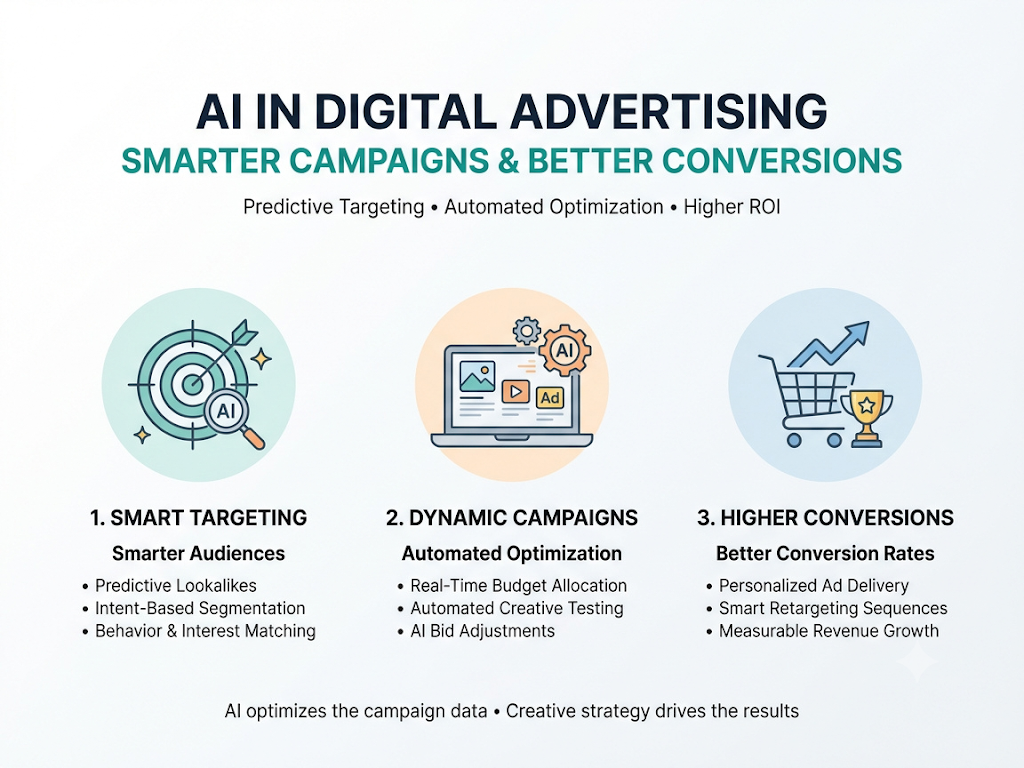
By utilizing AI in paid media a core campaign strategy taught in a practical Digital marketing course in Chennai businesses no longer need to make manual bid adjustments or build multiple niche audience segments by hand to achieve optimal results. Instead, the AI will learn about user intent, search behaviour, contextual signals and conversion information. AI in digital marketing can be used to create highly effective ad copy variations, and dynamically shift budget to the best performing placements. This allows brands to create highly effectivePaid Media strategies.
Hyper-targeted Segmentation & Prospecting:
- Pattern Recognition- Identify users with high purchase intent using AI. Thousands of different signals are analysed as users browse in real time. These include search terms, page dwell times, content engagement, and previous purchase frequency.
- Lookalike Modelling- Machine learning identifies common characteristics among your customers with the highest LTV, and scans across large volumes of advertising platforms in order to find new potential customers who have a high likelihood of converting.
- Contextual Targeting with Privacy in Mind- Due to the elimination of 3rd party cookies, AI natural language analysis is used to understand consumer sentiment, themes, and relevance on webpages or videos. This means that ads can be matched to relevant content in real time without intrusive tracking.
- Churn & Retention Audiences- Using predictive analytics, current customers at risk of churning can be identified. In turn, targeted retargeting ads or loyalty offers are sent to retain these customers.
- Purchase Intention Based on Micro- moments -AI detects purchase intent from users by analysing sudden increases in local searches, map searches, and product comparisons. This means that targeted offers can be served to consumers at the perfect time.
- Exclusion Audiences- Intelligent audience segmentation will automatically exclude recently converted, unqualified and low purchase intent users from being targeted. This ensures money isn’t being spent on unqualified people, reducing ad fatigue.
Automated Bidding & Budget:
It is impossible for humans to manually bid on hundreds of keywords, placements, devices and locations. However, AI bidding makes quick decisions on how much to bid for every single impression based on how likely the user is to convert. Rather than making one uniform cost per click bid for all users in a campaign, machine learning considers different factors in the users context to make sure you are only bidding highly aggressively if a high value conversion is likely to occur, and reducing bids if a click is unlikely to produce revenue. These factors include what device the user is on, location, time of day, browser activity and previous conversion value.Not just in bidding, but in budget allocation.
- Headlines and Body Copy- Multiple different headlines and body copy can be created using generative AI. Dozens of different hooks, value propositions and CTAs can be made to target specific audiences and character limits.
- Dynamic Creative Optimisation- Multiple different headlines, images, videos and bodies of text can be combined automatically to create the most converting ad for different users.
- Image and Video Creation- Design tools can be used to change the size of static banners, create unique product backgrounds, add captions and edit long videos into short vertical videos.
- Creative Fatigue Detection- If multiple impressions of an ad have been made and CTR is decreasing, machine learning can detect that the ad is becoming ineffective. The AI can suggest new visuals to be used in order to increase performance.
- Multivariate Testing- Unlike normal A/B tests which take many weeks to complete with very few variations, AI multivariate testing can test many variations of an ad quickly. It will direct traffic to the most statistically effective variations.
- Localised copy- Intelligent translation tools enable your ads to be translated and adapted to fit different countries. The copy, values and local phrases will be changed to suit each country, but will keep the impactful message consistent.
Personalised Advertising:
Consumers often don’t convert from a single ad; instead, they interact with multiple ads across various devices, social platforms, search engines, and websites—a multi-touch buyer journey explored in any practical Digital marketing course in Coimbatore. Artificial intelligence and digital marketing Using AI, businesses can provide a personalised sequence of ads for users in line with their stage in the funnel. If a user has first come across your brand by watching an informative video or reading a blog, the AI will know that they are in the initial awareness stage. They may then receive helpful information about the product/ customer reviews, rather than an aggressive discount offer.
- Multi-Touch Attribution- Machine learning can be used to understand the full conversion path of a customer across search, social, display and video. Each ad interaction can be accurately weighted to understand what effect it had on the final sale.
- Predictive Customer Lifetime Value (pLTV)- Within hours of a new lead signing up, analytics can predict how valuable that customer will be for revenue. This means businesses can optimise their campaigns to attract high margin customers, rather than cheap, poor quality leads.
- Automated Incrementality Testing- AI incrementality tools run regular geo holdout and audience split tests to understand how many conversions were genuinely driven by advertising, and how many would have occurred naturally.
- Conversion Modelling with Privacy- If restrictions prevent tracking of conversions through browsers, machine learning can be used to accurately attribute conversions using aggregated data from user behaviour.
- Issue Detection- Intelligent dashboards mean that if there is suddenly a spike in your CPC, issues with pixels on landing pages, or unusual drops in conversions, you will be alerted instantly
- Insights for Executives- Natural language reporting means that complex data across multiple channels can be summarised clearly. Key insights for performance and projections for revenue in different budget scenarios can be provided.
Preventing Fraud & Protecting Brand:
Many fraud issues can affect Paid Media budgets. Click fraud, bot traffic, domain spoofing and exposure to unsuitable content can all cause problems. Using AI verification tools, billions of impressions and clicks can be reviewed in real time. Subtle anomalies in users’ behaviours, such as unrealistic mouse movement, fast clicking, suspicious IP clustering and data centre traffic, can be picked up to prevent fraudulent clicks from wasting your budget. By automatically excluding non-human interaction, clean data is ensured and your budget is invested in real human people.In addition, computer vision and NLP can be used to protect brand reputation within large programmatic and video ad spaces.
Best Practice for Effective AI Advertising Campaigns:
- High quality 1st party data- Connect your CRM, offline sales, and verified lists of customers to ad platforms in order to ensure that machine learning is optimising your campaigns to bring in real revenue, and good quality leads.
- Variety of creative assets- Ensure you include a wide range of creative assets in your AI advertising campaigns. Including short videos, carousel banners, clean product visuals and a variety of copy will give the algorithm a good basis to find winning combinations.
- Allow learning period- Give the automated bidding and targeting sufficient budget and duration to collect conversion data, before making significant changes.
- Human strategy & brand control- Set guidelines for brand tone, design, and ethics to ensure that any AI generated content and placements match core company values.
- Broad campaign structures- Avoid having many small ad sets to spend your budget on. Broader ad sets mean that AI can get out of learning phases quicker, and spend budgets more effectively.
- Check landing pages- Even with smart targeting in place, ensure that landing pages load quickly on mobile devices, and have clear conversion pathways.
Even the best AI advertising campaigns can fail if the landing page experience is confusing.
Conclusion:
The introduction of AI in digital advertising has completely changed how brands conduct paid media—a modern shift explored in depth through any practical Digital marketing course in Kochi. With smart targeting, automated bidding, multivariate testing and data attributions, brands can avoid wasted spend and effectively reach high intent audiences on all digital channels. The most successful advertisers utilise AI with clear strategic direction, high quality 1 st party data, and engaging stories to create a lasting competitive advantage, leading to consistently high conversions.