
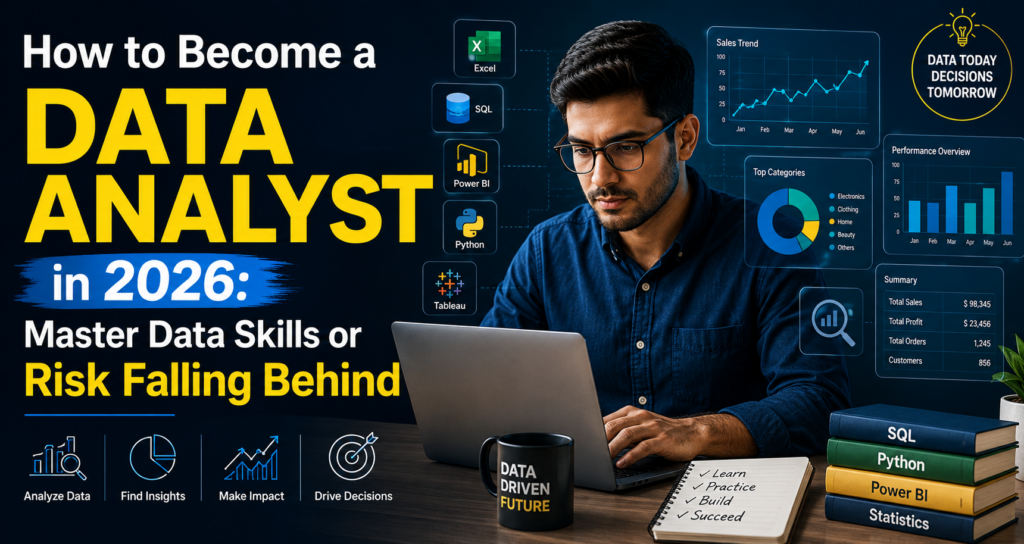
In early 2026, a mid-sized retail brand avoided a ₹12 crore inventory loss not by guessing trends, but because one Data analyst spotted a tiny pattern shift in weekend buying behavior that AI alone had overlooked. That’s the reality of modern business: the companies winning aren’t the ones with the most data, but the ones with people who know how to interpret it.
Today, organizations aren’t struggling to collect information they’re drowning in it. With AI tools generating forecasts, customer insights, and automated reports at scale, the real challenge is turning that flood of raw data into clear, strategic decisions. By 2026, the demand for skilled as a how to become a data analysts has surged not just because of digital growth, but because businesses need professionals who can question the data, connect patterns to real-world context, and translate complex findings into actions that drive measurable results.
How to become a data analyst for Understanding the Evolving Data Analyst Role by 2026
In 2026, a How to become a Data analyst at a fintech startup notices subtle user behavior changes that signal a future churn spike. Instead of just reporting an 8% dip in engagement, she uses predictive analytics to forecast a potential 20% customer loss.
Working with product and marketing teams, she identifies friction in a recent app update and recommends targeted fixes. Churn stabilizes before it becomes a crisis.Expect to interact with:
- Real-time Data Streams: Processing and analyzing data as it’s generated, requiring familiarity with streaming architectures.
- AI/ML Integration: Leveraging machine learning models for anomaly detection, forecasting, and clustering, even if not building models from scratch.
- Ethical AI & Data Governance: A deeper understanding of data privacy regulations (like GDPR, CCPA) and the ethical implications of data use.
- Cloud-Native Environments: Working predominantly with data stored and processed on cloud platforms (AWS, Azure, GCP).
- Advanced Visualization & Storytelling: Creating interactive dashboards and compelling narratives that resonate with diverse stakeholders.
- The core objective remains: transform raw data into clear, concise, and actionable intelligence that drives business value.
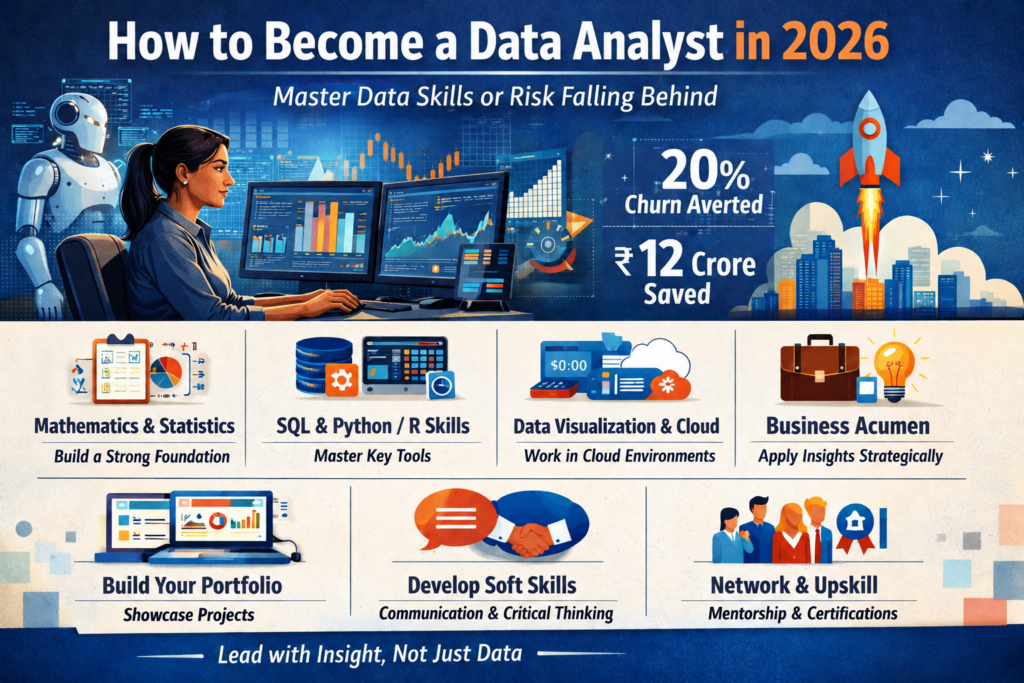
Step 1: Build a Rock-Solid Foundation in Mathematics and Statistics
Before you started to learn how to become a data analyst in dive into tools and programming languages, a strong grasp of underlying mathematical and statistical principles is paramount. This isn’t about becoming a mathematician, but about understanding the logic behind the how to become a data analyst techniques. By 2026, a superficial understanding won’t suffice; depth is key.
Essential Concepts:
- Descriptive Statistics: Measures of central tendency (mean, median, mode), variability (variance, standard deviation, range), and distribution shapes (skewness, kurtosis). These help summarize and describe the main features of a dataset.
- Inferential Statistics: Techniques used to make inferences about a population based on a sample. This includes hypothesis testing (t-tests, ANOVA, chi-squared tests), confidence intervals, and regression analysis (linear, logistic).
- Probability: Understanding probability distributions (normal, binomial, Poisson) is crucial for risk assessment, forecasting, and A/B testing.
- Linear Algebra Fundamentals: Basic concepts like vectors, matrices, and matrix operations are foundational for understanding algorithms in machine learning, which is how to become a data analyst increasingly encounter.
- Sampling Techniques: Understanding different methods of selecting data samples (random, stratified, systematic) and their implications for data validity.
Why it Matters by 2026:
By 2026, automated tools can generate insights instantly but without a strong statistical foundation, it’s easy to misread data and make costly mistakes. A true analyst goes beyond dashboards, validating automated outputs, spotting hidden biases, and ensuring decisions are based on reliable insights not just algorithms.
Step 2: Master Core Technical Skills and Tools
This is where theory meets practice. Proficiency in several key tools and programming languages is non-negotiable for anyone aspiring How to become a data analyst in 2026.
1. SQL (Structured Query Language): The Language of Databases
SQL remains the cornerstone of how to become a data analyst. It’s you communicate with databases to retrieve, manipulate, and manage data. By 2026, expect to work with more complex, larger datasets, often distributed across various systems.
Key Areas to Master:
- Advanced Querying: Beyond SELECT and WHERE, delve into JOIN types (INNER, LEFT, RIGHT, FULL OUTER), subqueries, Common Table Expressions (CTEs), and complex GROUP BY and HAVING clauses.
- Window Functions: Crucial for advanced analytical tasks like calculating moving averages, ranking data, and cumulative sums across partitions of data (e.g., ROW_NUMBER(), LAG(), LEAD(), SUM() OVER()).
- Database Management: Understanding basic database design principles (normalization, primary/foreign keys), indexing for performance, and data types.
- Stored Procedures and Functions: While often managed by data engineers, understanding how to utilize pre-built stored procedures can significantly enhance your efficiency.
- Different SQL Dialects: Be aware that SQL syntax can vary slightly across different database systems (e.g., PostgreSQL, MySQL, SQL Server, Oracle, BigQuery, Snowflake).
2. Python or R: The Powerhouses for Statistical Computing and Data Manipulation
These programming languages offer unparalleled flexibility for how to become a data analyst and data cleaning, statistical analysis, machine learning, and visualization.
Python for Data Analysis:
- Pandas: The go-to library for data manipulation and analysis. Master DataFrames, Series, merging, grouping, pivoting, and handling missing data.
- NumPy: Essential for numerical operations, especially with arrays and matrices.
- Matplotlib & Seaborn: Powerful libraries for creating static and statistical visualizations.
- Scikit-learn (Basics): Understand fundamental machine learning concepts like regression, classification, and clustering, and how to apply basic models.
- Data Cleaning and Preprocessing: Techniques for handling outliers, missing values, data type conversions, and feature engineering.
R for Data Analysis:
- Tidyverse: A collection of packages (dplyr, ggplot2, tidyr, readr, purrr) that provide a consistent and intuitive framework for data manipulation, visualization, and programming.
- Statistical Modeling: R excels in statistical analysis, offering extensive packages for various models (linear models, generalized linear models, time series).
- Shiny: For building interactive web applications and dashboards directly from R.
Choose one to specialize in initially, but be open to learning how to become a data analyst the basics of the other, as both are prevalent in the industry.
3. Excel: Beyond Basic Spreadsheets
Despite the rise of more powerful tools, Excel remains a ubiquitous tool for quick for how to become data analyst in data exploration, ad-hoc analysis, and stakeholder communication. Your proficiency should extend far beyond basic sums.
Advanced Excel Skills:
- Power Query: For connecting to various data sources, transforming, and cleaning data efficiently.
- Power Pivot: For building robust data models and performing advanced calculations using Data Analysis Expressions (DAX).
- Advanced Formulas: INDEX/MATCH, XLOOKUP, SUMIFS, COUNTIFS, array formulas, and logical functions (IF, AND, OR).
- Pivot Tables & Charts: Creating dynamic summaries and visualizations.
- VBA (Macros – Basics): Automating repetitive tasks.
- What-If Analysis & Goal Seek: For scenario planning.
4. Data Visualization Tools: Tableau, Power BI, or Looker Studio
Communicating insights effectively is as crucial as finding them. Interactive dashboards and compelling visualizations are key.
Key Visualization Skills:
- Dashboard Design Principles: Understanding layout, color theory, chart choice, and user experience (UX) best practices.
- Connecting to Data Sources: Importing and preparing data from various databases and files.
- Creating Interactive Visualizations: Building various chart types (bar, line, scatter, pie, maps), filters, parameters, and drill-down capabilities.
- Storytelling with Data: Guiding users through a data narrative, highlighting key findings, and enabling self-service exploration.
- Calculated Fields & Expressions: Creating custom metrics and dimensions within the visualization tool.
Step 3: Understand Data Warehousing and Cloud Platforms
By 2026, most organizations will operate heavily, if not entirely, in cloud environments. Understanding how to become a data analyst at how data is stored, processed, and accessed in the cloud is vital.
Core Concepts:
- Data Warehouses vs. Data Lakes: Differentiating between structured, schema-on-write data warehouses (e.g., Snowflake, Google BigQuery, AWS Redshift) and schema-on-read data lakes (e.g., AWS S3, Azure Data Lake Storage) for raw, unstructured data.
- ETL/ELT Processes: Understanding how to become a data analyst and data is Extracted, Transformed, and Loaded (or Loaded, then Transformed) into analytical systems.
- Cloud Basics: Familiarity with at least one major cloud provider (AWS, Azure, GCP). Understand services like object storage (S3, Blob Storage, Cloud Storage), compute instances (EC2, VMs), and managed database services.
- Data Governance & Security: Basic awareness of data access controls, encryption, and compliance within cloud environments.
Step 4: Develop Strong Business Acumen and Domain Knowledge
Technical skills are a prerequisite, but true value comes from applying them within a business context. How to become a data analyst in 2026 must understand the business problems they are trying to solve.
How to Acquire It:
- Understand Key Performance Indicators (KPIs): Know what metrics drive success in different industries (e.g., customer churn in SaaS, conversion rates in e-commerce, patient outcomes in healthcare).
- Industry Research: Read industry publications, follow business news, and understand market trends relevant to your target sector.
- Ask Incisive Questions: Don’t just deliver data; question the underlying business problem, the assumptions, and the potential impact of your findings.
- Shadowing & Mentorship: If possible, observe business teams, participate in meetings, and seek mentorship from experienced professionals within your chosen domain.
- Case Studies: Work through public business case studies (e.g., Harvard Business Review cases) to practice connecting data to strategic decisions.
Step 5: Cultivate Essential Soft Skills
In 2026, How to become a data analyst built a model that could cut costs by 15%, but poor communication stalled approval and the opportunity was lost. When the same insights were presented in clear business language, leadership acted immediately. Technical skill creates insights but strong communication turns them into results.
- Communication: Clearly articulate complex findings to non-technical stakeholders, both verbally and through written reports and presentations. This includes active listening to understand requirements.
- Problem-Solving: Deconstruct complex business problems into manageable data questions. Think critically about data limitations and potential biases.
- Critical Thinking: Question assumptions, validate data sources, and interpret results with skepticism. Avoid jumping to conclusions.
- Attention to Detail: Small errors in data can lead to massive misinterpretations. Meticulousness in data cleaning and analysis is vital.
- Collaboration: Work effectively with data engineers, business stakeholders, and other analysts.
- Adaptability: The data landscape is constantly evolving. Be open to learning new tools, techniques, and methodologies.
Step 6: Build a Robust Data Analyst Portfolio
Your portfolio is your resume in action. It demonstrates your skills, problem-solving abilities, and passion for data analysis. By 2026, a strong portfolio is often more impactful than a traditional resume.
Project Ideas:
- Predictive Analytics: Predict customer churn for an e-commerce store using historical data.
- Market Basket Analysis: Identify frequently co-purchased items in a retail dataset.
- Customer Segmentation: Group customers based on their purchasing behavior or demographics.
- Sentiment Analysis: Analyze social media data to gauge public opinion on a product or brand.
- Web Analytics: Analyze website traffic data to identify user behavior patterns and suggest improvements.
- Geospatial Analysis: Visualize and analyze location-based data to identify trends or optimize logistics.
Showcase Your Work:
- GitHub: Host your code, project documentation, and results. Ensure your repositories are clean, well-commented, and include a clear README.md file explaining the project’s objective, methodology, and key findings.
- Blogs/Medium: Write articles explaining your projects, insights, and learning journey.
- Interactive Dashboards: Embed links to your Tableau Public, Power BI Service, or other interactive dashboards.
- Kaggle: Participate in competitions and share your solutions. Even working on public datasets and sharing your analysis can be valuable.
Focus on projects that tell a story, demonstrating your ability to go from raw data to actionable insights. Quantify the potential business impact of your findings.
Step 7: Networking and Mentorship
In a competitive job market, who you know can be as important as what you know. Networking opens doors to opportunities and insights.
- LinkedIn: Optimize your profile, connect with data professionals, follow companies, and engage with relevant content.
- Industry Events & Meetups: Attend local data science meetups, conferences, and webinars (many are virtual now).
- Online Communities: Participate in forums, Slack groups, and online communities dedicated to data analysis.
- Find a Mentor: A mentor can provide invaluable guidance, share industry insights, and help you navigate your career path.
Step 8: Tailored Job Search Strategies for 2026
The job search itself requires a strategic approach, especially as hiring processes evolve.
- Optimize Your Resume/CV: Tailor your resume for each application, highlighting relevant keywords from the job description. Use an Applicant Tracking System (ATS)-friendly format.
- Master Interview Skills: Prepare for technical interviews (SQL coding challenges, Python/R problem-solving), behavioral questions, and case study interviews where you analyze a hypothetical business problem.
- Showcase Your Projects: Be ready to walk through your portfolio projects in detail, explaining your thought process, challenges, and outcomes.
- Consider Internships/Entry-Level Roles: These are excellent ways to gain practical experience and make industry connections.
- Personal Branding: Maintain a professional online presence. Your LinkedIn profile, GitHub, and any personal blogs should reflect your expertise.
Step 9: Continuous Learning and Specialization
The defining challenge of 2026 won’t just be learning new tools it will be staying intellectually adaptable in a world where data moves faster than job titles.
- Stay Updated: Follow industry leaders, read research papers, and subscribe to data-focused newsletters.
- Explore Specializations: As you gain experience, consider specializing in areas like Marketing Analytics, Financial Analytics, Healthcare Analytics, Product Analytics, or even delving deeper into Machine Learning Operations (MLOps) relevant to data analysts.
- Learn New Technologies: Keep an eye on emerging tools and techniques, such as Generative AI applications for data summarization or code generation for analysis, advancements in data streaming platforms, or new visualization paradigms.
- Formal Certifications: Consider professional certifications from cloud providers (AWS Certified Data Analytics, Azure how to become a Data Analyst Associate) or platforms like DataCamp, Coursera, or edX to validate your skills.
Why Data Analytics Skills Are Becoming Essential in 2026
The demand for skilled for how to become a data analysts is rapidly increasing as companies rely more on data-driven decisions to improve business performance and customer experience. In 2026, professionals with knowledge of how to become a data analyst tools like Excel, SQL, Power BI, Python, and Tableau will have a strong advantage in the job market. Organizations across industries such as healthcare, finance,e-commerce, and digital marketing are actively hiring candidates who can interpret data, identify trends, and generate meaningful insights. Learning data analytics not only improves career opportunities but also helps professionals stay relevant in an increasingly technology-driven world.
Your Journey with Login360: Accessible and Affordable Data Education
Embarking on this journey can feel daunting, but you don’t have to navigate it alone. For those in Coimbatore and beyond, institutions like Login360 are dedicated to making high-quality IT education accessible and affordable. With a focus on practical, industry-relevant training, Login360 empowers aspiring to look how to become a data analysts to gain the foundational and advanced skills required to thrive in the 2026 data landscape. Whether you’re starting from scratch or looking to upskill, finding a supportive learning environment that understands the evolving demands of the industry is crucial.
Conclusion: Charting Your Course to Data Analyst Success in 2026
How to become a data analyst in 2026 is more than learning tools it’s about building a strong foundation in statistics, mastering SQL and Python or R, understanding cloud data systems, and developing sharp communication skills. With the rise of AI, automation, and big data, professionals who understand tools such as Excel, SQL, Power BI, Python, and Tableau are gaining a major advantage in the job market. The real opportunity isn’t just analyzing how to become data analyst, but shaping the decisions that drive businesses in an AI-powered world. By 2026, the question won’t be whether data matters it will be whether you’re leading with insight or struggling to keep up.