

By 2026, organizations are expected to automate over 70% of their software delivery pipelines, yet a significant talent gap persists in professionals who can design, secure, and scale these systems making advanced devops course with placement expertise one of the most sought-after capabilities in tech.. This article outlines how a comprehensive program, exemplified by institutions like Login360 in Chennai, can equip you with the skills and career pathways to thrive in the competitive IT landscape of 2026 devops course training with placement.
The Evolving DevOps course Landscape: Why 2026 Demands More Than Ever Before
DevOps course was built on bedrock principles collaboration, automation, continuous delivery, and feedback but the ground beneath them keeps shifting. What once meant automating scripts on local servers now extends to orchestrating ephemeral cloud-native ecosystems, forcing these principles to stretch, adapt, and sometimes redefine their own boundaries. By 2026, the industry will have fully embraced several key shifts, making DevOps course with placement more essential than ever.
Hyper-Automation and AI-Driven Operations
Concrete Example Project (Login360 Curriculum)
Project Title: AI-Powered Self-Healing DevOps course Pipeline
Scenario
Students build a CI/CD pipeline that doesn’t just deploy applications but monitors, predicts, and fixes issues automatically.
Components
- CI/CD Tool: Jenkins / GitHub Actions
- Monitoring Stack: Prometheus + Grafana
- ML Model: Python (scikit-learn / TensorFlow)
- Cloud Platform: AWS / Azure
What the AI Does
- Anomaly Detection Model
- Trained on metrics like CPU, memory, latency
- Detects unusual spikes before failure
- Failure Prediction
- Uses historical deployment data
- Predicts probability of deployment failure (e.g., 85% risk)
- Self-Healing Automation
- If anomaly detected:
- Auto-restart service
- Rollback deployment
- Scale resources
- If anomaly detected:
- Intelligent Alerting
- Reduces alert noise by clustering incidents
- Sends only high-confidence alerts
Student Outcome
By the end, students can:
- Integrate ML models into pipelines
- Build predictive monitoring systems
- Automate infrastructure decisions
Quantifying “Rapidly Diminishing”
While not zero, manual DevOps tasks are shrinking significantly:
- Studies suggest 60–80% of routine DevOps course tasks (like log analysis, alert triaging, scaling decisions) are automatable using AI/ML
- Incident response time can be reduced by up to 70% with AIOps
- Alert fatigue (thousands/day) can be cut by ~90% using anomaly detection models
Real Industry Challenge
Problem:
Modern systems generate massive telemetry data (logs, metrics, traces)—far beyond human capacity.
Example:
- A large system can produce TBs of logs daily
- Engineers cannot manually analyze or correlate them in real time
Why AI/ML is Essential
AI uniquely solves:
- Pattern detection across millions of events
- Predicting failures before they happen
- Automatically correlating root causes
- Reducing downtime without human intervention
Stronger Reframed Line (Optional Improvement)
You could refine your original statement like this:
Manual DevOps course training with placement tasks are rapidly diminishing with up to 70% of operational activities now automatable through AIOps. The future lies in hyper-automation, where AI/ML systems not only assist but autonomously manage pipelines through predictive monitoring, intelligent testing, and self-healing infrastructure.
Advanced Cloud-Native Architectures
Cloud-native isn’t just about moving to the cloud; it’s about building applications specifically for the cloud’s distributed, scalable, and resilient nature. This means a deeper understanding of microservices, serverless computing, service meshes (like Istio or Linkerd), and advanced Kubernetes deployments. Expertise in managing multi-cloud or hybrid-cloud environments will be a significant differentiator, requiring proficiency across major providers like AWS, Azure, and GCP, and an understanding of interoperability standards.
Pervasive DevSecOps
Security can no longer be treated as a final checkpoint or a compliance checkbox. In today’s DevOps ecosystem where code is deployed dozens of times a day every misconfigured pipeline, exposed secret, or unscanned dependency becomes an attack surface. This is why DevSecOps is no longer optional; it is foundational.
However, most training programs still approach DevSecOps as a tool-centric checklist teaching SAST, DAST, IAM, or vulnerability scanners in isolation. This creates engineers who know tools, but not threats.
Edge Computing and IoT Integration
As data generation moves closer to the source (IoT devices, smart cities, industrial automation), edge computing will become a critical domain for DevOps. Managing deployments, updates, and monitoring for applications running on distributed edge devices presents unique challenges and opportunities. Understanding how to extend DevOps course principles to these environments, ensuring consistency and reliability across vast, disparate infrastructures, will be a specialized and highly sought-after skill. to get devops course training with placement
Beyond Certification: The “Placement” Advantage in DevOps course Training With Placement
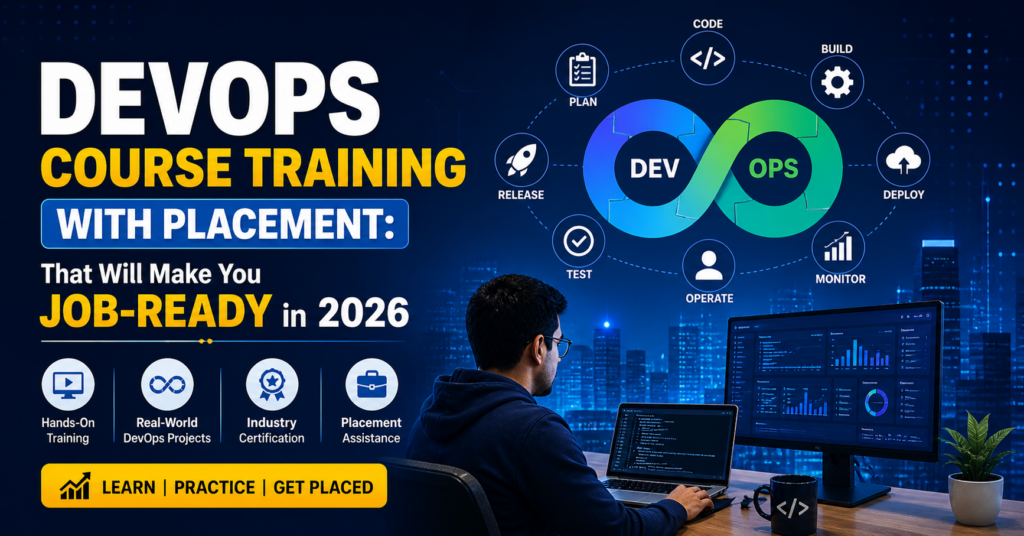
Login360’s placement program stands out because it is built around measurable outcomes, not promises. Instead of generic resume tips or mock interviews, candidates are trained on real-world DevOps projects that mirror actual job environments, ensuring they can demonstrate hands-on expertise during hiring processes. The program integrates company-specific interview preparation, including scenario-based problem solving and tool-specific assessments that reflect what recruiters actually ask. Additionally, learners are directly connected to hiring partners through structured pipelines rather than passive job portals, significantly reducing the time between course completion and job placement. This focused, execution-driven approach results in candidates not just being “prepared,” but consistently interview-ready with proven skills that employers can immediately trust.
Real-World Project Experience
Theoretical knowledge, however vast, pales in comparison to practical application. A quality training program integrates hands-on projects that mirror real-world scenarios. Students should work on building end-to-end CI/CD pipelines, deploying microservices to Kubernetes clusters, automating infrastructure with Terraform, and implementing monitoring solutions. This practical exposure builds a portfolio that demonstrates tangible skills to potential employers.
Mock Interviews and Resume Building Workshops
Technical prowess alone isn’t enough. Many qualified candidates falter in the interview process or fail to articulate their value on a resume. Placement support typically includes dedicated sessions on crafting an impactful resume and LinkedIn profile, along with mock interviews that simulate actual job interviews. These sessions provide invaluable feedback on technical answers, behavioral responses, and presentation skills, preparing candidates to confidently face recruiters.
Industry Connections and Networking Opportunities
Often, the best jobs aren’t advertised widely. A training institute with strong industry ties can open doors through its network. This includes guest lectures from industry veterans, workshops with hiring managers, and alumni networking events. These connections can lead to referrals, internships, and direct interview opportunities that might otherwise be inaccessible.
Soft Skills Development
DevOps training with placement is as much about culture and collaboration as it is about tools. Effective communication, problem-solving, teamwork, and adaptability are crucial. A comprehensive program will weave in soft skill development, recognizing that a well-rounded professional is more employable and successful in the long run.
Core Pillars of a Job-Ready DevOps Course Curriculum for 2026
To be truly job-ready in 2026, a DevOps course training with placement program must cover a broad spectrum of tools and concepts, with an emphasis on depth and practical application.
Cloud Platforms Mastery
- AWS (Amazon Web Services): Deep dive into EC2, S3, VPC, IAM, Lambda, RDS, ECS, EKS, CloudFormation, CodePipeline, CodeBuild, CloudWatch. Focus on architecting resilient, scalable solutions. Case studies involving multi-tier application deployment and disaster recovery strategies using AWS services.
- Microsoft Azure: Comprehensive understanding of Azure Virtual Machines, Azure Storage, Azure Networking, Azure AD, Azure Functions, Azure Kubernetes Service (AKS), Azure DevOps (Boards, Repos, Pipelines, Test Plans, Artifacts). Emphasize hybrid cloud integration and enterprise-level deployments.
- Google Cloud Platform (GCP): Explore Compute Engine, Cloud Storage, VPC, IAM, Cloud Functions, Cloud SQL, Google Kubernetes Engine (GKE), Cloud Build, Cloud Monitoring. Focus on serverless architectures and big data pipelines.
Containerization and Orchestration Expertise
- Docker: Advanced Dockerfile best practices, multi-stage builds, Docker Compose for local development, Docker Swarm for basic orchestration. Understanding image security scanning and registry management.
- Kubernetes: In-depth study of K8s architecture, Pods, Deployments, Services, Ingress, ConfigMaps, Secrets, Persistent Volumes. Advanced topics like Helm charts for package management, Custom Resource Definitions (CRDs), Operators, service meshes (Istio/Linkerd) for traffic management and observability, and GitOps with tools like ArgoCD or FluxCD. Practical exercises involving deploying complex microservice applications and scaling them.
CI/CD Pipeline Automation
- Jenkins: Advanced pipeline scripting (Declarative and Scripted Pipelines), shared libraries, plugin management, Jenkinsfile optimization, integration with various SCMs (Git), build tools, and deployment targets. Focus on security and scalability of Jenkins masters and agents.
- GitLab CI/CD: Leveraging GitLab’s integrated CI/CD capabilities, pipeline configuration with .gitlab-ci.yml, runners, stages, jobs, artifacts, and caching. Advanced features like parent-child pipelines, dynamic child pipelines, and environment management.
- ArgoCD/FluxCD (GitOps): Implementing GitOps principles for continuous delivery, automated synchronization of application states with Git repositories, and managing Kubernetes deployments declaratively. Practical scenarios for rolling updates, rollbacks, and blue/green deployments.
Infrastructure as Code (IaC)
- Terraform: Mastery of HCL (HashiCorp Configuration Language), managing state files (remote backends), modules for reusability, workspaces, and provider configurations for multi-cloud IaC. Focus on advanced resource provisioning, dependency management, and security considerations.
- Ansible: Playbooks, roles, modules, inventory management, dynamic inventories, Ansible Vault for sensitive data. Automating configuration management, application deployment, and orchestration tasks across various operating systems and cloud instances. Integrating Ansible with CI/CD pipelines.
Monitoring, Logging, and Observability
- Prometheus & Grafana: Setting up comprehensive monitoring solutions, custom metrics, alerting rules, and building insightful dashboards. Understanding service discovery and PromQL for advanced querying.
- ELK Stack (Elasticsearch, Logstash, Kibana): Centralized log management, data ingestion with Logstash, indexing with Elasticsearch, and visualization with Kibana. Implementing log correlation and anomaly detection.
- OpenTelemetry/Jaeger: Distributed tracing for microservices, understanding request flows, identifying bottlenecks, and performance optimization.
DevSecOps Principles and Tools
- Static Application Security Testing (SAST): Integrating tools like SonarQube, Bandit, or Checkmarx into CI pipelines for early vulnerability detection.
- Dynamic Application Security Testing (DAST): Understanding tools like OWASP ZAP or Burp Suite for runtime vulnerability scanning.
- Container Security: Image scanning with Clair, Trivy, or Anchore, runtime security with Falco, and best practices for securing containerized environments.
- Compliance as Code: Automating adherence to regulatory standards using policy engines like OPA (Open Policy Agent).
Scripting and Automation
- Python: Advanced scripting for automation tasks, API interactions, data processing, and custom tool development. Using libraries like boto3 (AWS), azure-sdk (Azure), google-cloud-sdk (GCP) for cloud resource management.
- Bash/Shell Scripting: Essential for system administration, task automation, and orchestrating commands within pipelines. Focus on robust, error-handling scripts.
The Login360 Difference: Affordable Excellence in Chennai
For aspiring DevOps course professionals in Chennai and beyond, Login360 stands out as a premier institute offering DevOps course with placement that is uniquely tailored for the 2026 job market. Our core philosophy revolves around providing high-quality, industry-relevant education without the prohibitive costs often associated with specialized IT training.
Unbeatable Affordability, Uncompromised Quality
“While certifications validate knowledge, securing a job requires more and this is where DevOps training with placement delivers real value. In India, DevOps courses range widely from ₹5,000 self-paced programs to ₹80,000 premium bootcamps, but the most effective programs fall in the ₹20,000–₹40,000 range, offering live training, real-world projects, and structured placement support.
Chennai’s Hub for IT Talent
Located in Chennai, a burgeoning IT hub, Login360 benefits from proximity to numerous tech companies and startups. This geographical advantage translates into better networking opportunities, more relevant industry insights, and a stronger local placement network. Our instructors are often industry veterans from Chennai’s tech scene, bringing real-world, localized experience directly into the classroom.
Hands-On, Practical Learning Environment
Our curriculum is meticulously designed to be intensely practical. Students spend a significant portion of their training time engaged in hands-on labs, live project simulations, and troubleshooting exercises. This immersive approach ensures that graduates are not just conceptually aware but are proficient in executing complex DevOps tasks from day one.
Dedicated Placement Support
Login360’s commitment to your career extends beyond the classroom. Our dedicated placement cell works tirelessly to connect students with leading companies. This includes:
- Personalized Career Counseling: Guiding students on career paths, industry trends, and job market expectations.
- Interview Preparation: Conducting multiple mock interviews, focusing on both technical depth and behavioral aspects.
- Resume & Portfolio Building: Assisting in creating compelling resumes and showcasing project portfolios that grab recruiter attention.
- Exclusive Job Fairs & Drives: Organizing recruitment events and connecting students directly with hiring partners.
- Alumni Network: Leveraging our strong alumni base for referrals and mentorship.
Continuous Curriculum Updates
The tech world never stands still, and neither does our curriculum. At Login360, we don’t just update content occasionally we follow a structured, real-time approach to staying aligned with industry evolution.
For example, in the past year, we introduced GitOps practices using tools like ArgoCD, enabling learners to manage infrastructure directly from Git repositories now considered a core DevOps course model. We also expanded our modules to include Platform Engineering concepts, where students learn to work with internal developer platforms and ‘golden paths’ used by modern enterprises to accelerate delivery.
Navigating Your DevOps Course Career Path in 2026: What to Expect
Post-training, the career landscape for a DevOps course professional is diverse and rewarding. Common roles include:
- DevOps Engineer: The foundational role, focusing on building and maintaining CI/CD pipelines, automating infrastructure, and improving system reliability.
- Site Reliability Engineer (SRE): A specialized role focusing on the reliability, scalability, and performance of large-scale systems, often using a software engineering approach to operations.
- Cloud Engineer: Specializing in designing, deploying, and managing applications and infrastructure on specific cloud platforms.
- Automation Engineer: Focused purely on identifying and automating repetitive tasks across the software development lifecycle.
- DevSecOps Engineer: Integrating security practices and tools into the DevOps course pipeline.
Salaries for skilled DevOps course professionals are consistently among the highest in the IT sector, reflecting the critical value they bring to organizations. Continuous learning and adaptation to new technologies will be key to sustained career growth.
Choosing the Right DevOps course Training with Placement: A Checklist
When evaluating DevOps course with placement programs, consider the following:
- Curriculum Relevance: Is it up-to-date with 2026 trends (AI, DevSecOps, advanced cloud native)?
- Hands-on Experience: Does it offer extensive practical labs and real-world projects?
- Instructor Expertise: Are the trainers industry professionals with current experience?
- Placement Success Rate: Does the institute have a proven track record of placing graduates?
- Placement Support: What specific services are offered (resume, mock interviews, networking)?
- Alumni Network: Is there an active and supportive alumni community?
- Affordability & Value: Does the cost align with the quality and career outcomes?
- Location & Local Industry Ties: For local job markets, is the institute well-connected?
Conclusion:
The demand for highly skilled DevOps course professionals will only intensify by 2026. Merely understanding tools won’t suffice; the market will reward those who demonstrate deep expertise, practical application, and a strategic mindset. A comprehensive DevOps training with placement program, like the one offered by Login360 in Chennai, provides not just the technical knowledge but also the critical career support necessary to navigate this evolving landscape.
With its focus on affordability, practical learning, and dedicated placement assistance, Login360 empowers aspiring professionals to confidently step into the job market of 2026, equipped with the skills and connections to secure a thriving career. Don’t just learn DevOps; launch your DevOps course career with a program designed for your success. Invest in your future today and become job-ready for tomorrow’s challenges. With Login360, you’re not just trained you’re mentored, guided, and prepared for real-world roles from day one.