
Introduction
In today’s society, the ability to make appropriate decisions is key to the success of an organisation. As well as managing a variety of information (for example, customer, sales, web usage, marketing and financial data), companies must be able to analyse and utilise this to enhance their business.importance of data analytics assists with this. Rather than basing organisational decisions on assumptions, data can be analysed to allow a business to determine a course of action.With an ever increasing emphasis on digital technology, there is currently high demand for people that can effectively analyse and utilise data. Students and professionals can study the Best Data Analytics Courses in Chennai to obtain key skills for this area.
What Is Data Analytics?
Data analytics is the process of gathering, sorting, analysing and analysing data. It enables a business to analyse and develop a better understanding of its operation, and in turn decide on how to further improve the business.A company that sells goods online could analyse data regarding what customers buy and ascertain which items are most popular. They can therefore tailor their marketing to meet customers’ needs. Furthermore, a business’ marketing team can analyse the success of varying marketing campaigns to establish which adverts yield the most leads and conversions.Microsoft Excel, SQL, Python, Power BI and Tableau are just some of the tools that can be employed for data analytics. Companies can then base decisions upon data.
Why Is Data Analytics Important?
As competition continues to increase, companies must utilise precise information in order to stay ahead. It can also be utilised within various sections of a business to further an organisation’s overall comprehension of itself and of its operation.
1. Improve decision making
Businesses can base decisions on data. For example, business owners can analyse sales, customer responses, market and financial data to inform decision making.A retail business can analyse sales data on a monthly basis and thereby determine which goods are most successful. They can then alter stock, pricing and marketing accordingly.Such data therefore facilitates Data-Driven Business Decisions and allows organisations to confidently make decisions.
2. Analyse customer behaviour
An understanding of customers underpins business development. Within this context, data analytics provides an insight into areas including customers’ likes, buying behaviour and web activity.An e-commerce business can analyse a customer’s web and purchase data to suggest goods that the individual may enjoy. Customers can therefore receive a customised shopping experience.Furthermore, a business can analyse why someone may no longer wish to buy its goods and even why a customer may switch to a competitor. Such information can be used to refine a business’ services and enhance customer relationships.
3. Enhance business performance
Organisations can utilise data analytics to assess how well their business is functioning. Businesses can analyse key areas including income, sales, client loyalty, conversion and expenditure.Constantly assessing these areas enables a business to highlight and address any areas of concern.For example, a marketing department may analyse marketing data and conclude that one of its advertising campaigns yields more leads and does so more economically when compared to other campaigns. This can then inform decisions relating to, and optimisation of, both its marketing expenditure and approach.
4. Minimise business risk
All businesses are exposed to a range of risks. These include financial, market, customer related and internal risks.Organisations can analyse data to proactively detect and address issues. Analysing both past and current business data can also enable companies to recognise and respond to atypical scenarios.A financial institution could analyse data on transactions in order to detect any irregular activity. Likewise, a manufacturing firm may analyse data surrounding the health of its machinery to anticipate maintenance needs.Therefore, data analytics empowers businesses to manage uncertainties and protect assets.
Role of Data Analytics in Business Development
Whilst data analytics can be utilised to analyse data, it also enables a company to comprehend its current situation and to devise a course of action for the future. It can also assist a business to spot areas for further development.Various departments can benefit from data analytics – such as marketing, sales, finance, human resources and operations.
- Marketing and Sales:Marketing and sales departments can utilise data analytics to analyse information including consumer interest, marketing effectiveness and web and customer engagement.Digital marketers can analyse statistics relating to Google and Meta adverts to assess which marketing campaigns produce most beneficial leads. Businesses can then refine marketing by comparing ‘impressions’, ‘clicks’, cost per lead and conversion data.Sales professionals can also utilise data analytics to analyse sales data and therefore recognise consumer preferences. This can inform anticipation of future sales.
- Finance:Precise and well thought out financial decision making is key. Data analytics can assist a business to track expenditure, compare income and conduct profit analysis. It can also be used to formulate financial forecasts.Businesses can also analyse data to detect superfluous expenditure and to assess which areas of their operations provide the greatest returns.This in turn facilitates enhanced Financial Planning and ensures that an organisation’s finances are effectively utilised.
- Operational effectiveness:Efficiency is crucial to a business’ ability to supply goods and services in a timely manner. Data analytics can facilitate a business’ assessment of operational inefficiencies, production and stock and staff/resource limitations.A manufacturing business can for example analyse production data to detect where inefficiencies exist. Management can then refine processes and decrease superfluous expenditure.
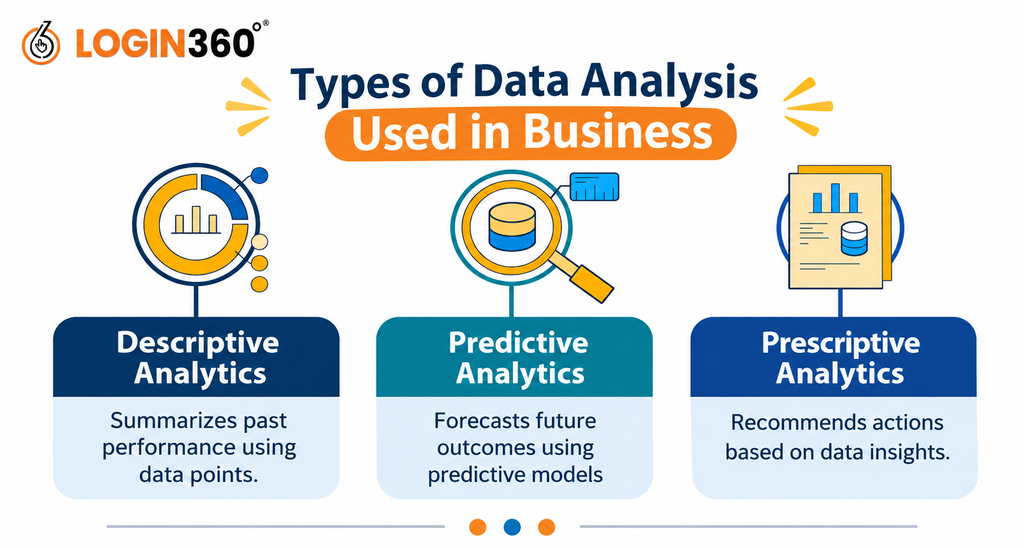
Types of data analytics
There are various forms of data analytics and each addresses different areas of interest.
- Descriptive-Descriptive data analytics analyses and simplifies past events. Information is typically analysed using data, reports and graphical data representation.A business can for example analyse sales data from a specific month to determine the volume of income received in that period.
- Diagnostic-Diagnostic data analytics enables organisations to analyse and understand the reasons for particular events. A variety of aspects can be investigated and interlinked to deduce causes.If for example, a business experiences a drop in sales within a given month, diagnostic data analytics can be used to assess factors including consumer interest, price, marketing and competitor activity to investigate why this is so.
- Predictive-Drawing on historical data, alongside statistical and machine learning analysis, predictive data analytics allows a business to anticipate future occurrences.Retailers can utilise this data analytics type to predict sales volumes for specific goods so that they can optimally manage stock. Financial businesses can also apply it to assess potential risks.
- Prescriptive-Prescriptive data analytics advises on potential actions that can be taken, based on data and predictive data analytics.A delivery business could for example analyse traffic, delivery destinations and vehicle availability to determine optimal delivery routes.Taken together, these four data analytics types enable businesses to analyse past occurrences, analyse issues and anticipate future events. Appropriate guidance can then be provided.
Popular Data Analytics Tools
Various tools are available for businesses to utilise in data collection, analysis and presentation. The appropriate tool will often depend on a company’s needs and the complexity of the information being analysed.
Commonly used data analytics tools include:
- Microsoft Excel – suitable for data management and numerical analysis, as well as producing fundamental reports.
- SQL – used to access, manage and analyse data within a database.
- Python – can be used for data cleansing, automation, statistical analysis and machine learning.
- Power BI – can be used to construct dynamic dashboards and reports.
- Tableau – simplifies analysis of complicated information via graphical representation. Google
- Analytics – can be used to analyse web traffic, and examine consumer and digital marketing behaviour.
Acquiring knowledge and understanding of such tools can help individuals to effectively establish data analysis skills. It can further prepare them for a variety of career paths.How to develop a data driven culture.As well as obtaining suitable data analysis tools and employing appropriate analysts, to optimally implement data analytics, companies should motivate staff to refer to data to inform their Data Driven Business Decision.
Below are some methods through which a company can develop a data driven culture:
- Define business aims – for example, those relating to enhancing sales, customer satisfaction and/or operational efficiency.
- Obtain precise data – information should be sourced from trustworthy origins and then correctly documented.
- Access suitable tools – as previously mentioned, this will largely depend on a business’ needs and the skill level of its personnel.
- Provide data related training – in how to effectively analyse and analyse data and to comprehend business related data.
- Continually assess business performance – regularly analyse crucial business data and adapt business strategy as required.
- Ensure data security – and uphold customer confidentiality by appropriately managing data.
Businesses can thus effectively utilise data by implementing these approaches and can in turn enhance their decision making.Students and professionals can further develop their understanding of data analytics by considering Data Analytics Training in Coimbatore, and in doing so obtain knowledge and experience of relevant tools, and of practical and theoretical data analytics applications.
Career paths in data analytics
Increasingly, data is integral to business operations. Due to this, data analytics has become an important career path. Across multiple industries, organisations are in need of individuals that can both analyse and effectively convey key data insights.
Potential careers within this sector include:
- Data Analyst
- Business Analyst
- Business Intelligence Analyst
- Marketing Analyst
- Financial Data Analyst
- Data Visualisation Specialist
- Junior Data Analyst
New entrants to the profession should ideally possess robust knowledge and skills in key areas such as statistics, Microsoft Excel, SQL and Python. Likewise, undertaking practical projects is highly beneficial as it allows individuals to see how data analysis theory can be practically applied.Having a portfolio of work which includes sales and consumer behaviour analysis, as well as marketing and business related reporting and dashboards can effectively showcase an individual’s data analysis capabilities.
Challenges associated with the application of data analytics
Despite the numerous benefits that data analytics can offer, businesses may encounter particular difficulties in relation to its implementation.Often, the quality of data can be sub-standard. Imprecise, incomplete or out-of-date data can negatively impact data analysis.In addition, there is frequently a shortage of appropriately skilled staff to both analyse and effectively communicate data.Furthermore, there are data security and confidentiality considerations particularly for firms that deal with clients’ private data.Businesses can address the aforementioned issues by ensuring that data is accurately documented, providing staff with data related training and accessing fitting data analytics tools. Companies should also competently manage data.
Conclusion
The significance of data analytics in contemporary business decision making is continually rising. Therefore, rather than basing decisions on suppositions, data can be utilised to inform decision making.Data analytics is of benefit in multiple sectors, for example, marketing, finance, sales, customer service and operations.Individuals (both students and professionals) keen to pursue a career within data analytics can effectively begin by acquiring skills in importance of data analytics related tools, such as Microsoft Excel, SQL, Python and Power BI. People can further augment their expertise by investigating the Best Data Analytics Course in Kochi.As businesses increasingly focus on data, individuals with strong data analysis and problem solving skills are set to have highly relevant career prospects within diverse industries.