
Table of Contents
Introduction
Every click, online purchase, digital payment, and mobile app interaction generates massive amounts of data. For modern businesses, raw data alone isn’t enough—the real value lies in turning that information into smart, actionable decisions.By combining Data Science and Artificial Intelligence (AI), organizations can uncover hidden patterns, forecast future trends, and build intelligent systems that automate complex tasks. Today, industries ranging from healthcare and banking to retail, education, and manufacturing rely heavily on these technologies to stay competitive.
Whether you are a student, a recent graduate, or a working professional looking to pivot, understanding Data Science with AI through a Data Science Course in Chennai opens the door to some of the most in-demand careers in tech. In this guide, we’ll break down how these two fields work together, the essential skills and tools you need, top job roles, and a practical roadmap to get started.
What is Data Science with AI?
- Data Science: It is the practice of collecting, cleaning, and analyzing large datasets to extract meaningful insights. It blends mathematics, statistics, programming, and domain expertise to make sense of past and current data.
- Artificial Intelligence (AI): It refers to technology that enables machines to simulate human intelligence—such as recognizing patterns, understanding natural language, learning from experience, and making autonomous decisions.
- How they connect: Think of an online retail store. Data Science analyzes customer search histories and purchasing habits to identify buying trends. AI then uses those insights to power a recommendation engine that suggests personalized products to each shopper in real time.
How Data Science and AI Work Together
Machine Learning (ML) acts as the bridge between Data Science and AI, allowing algorithms to learn from historical data and make predictions without being explicitly programmed for every scenario.
A typical end-to-end workflow follows six stages:
- Data Collection: Collecting raw data from websites, mobile apps, sensors, and internal databases. This data serves as the foundation for analysis and AI model development.
- Data Cleaning: Removing duplicate records, correcting errors, and filtering irrelevant information. This ensures the data is accurate, consistent, and ready for analysis.
- Exploratory Analysis: Examining cleaned data to identify patterns, trends, and relationships. It also helps detect unusual values and useful insights.
- Model Training: Applying Machine Learning algorithms to historical data to train predictive models. These models learn patterns and make data-driven predictions.
- AI Deployment: Integrating trained models into real-world applications to automate tasks and generate predictions. It also helps deliver personalized recommendations to users.
- Evaluation & Monitoring: Regularly checking model performance, accuracy, and reliability after deployment. Updating models with new data helps maintain better results.
Why Businesses Rely on Data Science and AI
- Smarter Decision-Making: Leaders replace guesswork with strategies backed by hard data and historical trends.
- Enhanced Customer Experience: AI-driven personalization tailors content, support, and product recommendations to individual user preferences.
- Faster Data Processing: Automated pipelines analyze massive datasets in seconds, freeing up teams to focus on high-level strategy.
- Accurate Forecasting: Predictive models anticipate shifts in customer demand, seasonal sales spikes, and market risks.
- Operational Efficiency: Real-time performance monitoring helps companies spot bottlenecks early and allocate resources effectively.
Key Skills You Need to Succeed
Breaking into AI Data Science requires a blend of technical proficiency, analytical thinking, and business communication. Beginners can build these core competencies step by step through a structured AI Data Science Course in Coimbatore.
- Python Programming: Python is the industry-standard language for Data Science and AI due to its readable syntax and vast ecosystem of libraries.Variables, conditionals, loops, functions, data structures (lists, dictionaries), and basic algorithms
- Mathematics & Statistics: A solid grasp of math ensures you understand why an algorithm works and whether its results are reliable.Probability, descriptive statistics (mean, median, standard deviation), correlation, and probability distributions.
- SQL & Database Management:Because most company data lives in relational databases, SQL is non-negotiable for extracting and organizing information.Essential Commands: SELECT, WHERE, GROUP BY, ORDER BY, and JOIN.
- Machine Learning:Machine Learning enables systems to identify patterns and improve over time.Supervised learning (regression and classification), unsupervised learning (clustering), model training, and performance evaluation.
- Data Visualization:Raw numbers rarely persuade stakeholders. Visualization translates complex findings into clear, visual stories. Key Tools: Power BI, Tableau, and Python libraries like Matplotlib.
- Problem-Solving & Communication:Technical expertise only matters if it solves real business problems. Professionals must be able to translate technical findings into clear recommendations for non-technical teams.
Popular Tools & Technologies
| Python | Core programming, scripting, and data analysis |
| SQL | Querying and managing relational databases |
| Pandas | Data cleaning, manipulation, and tabular analysis |
| NumPy | Numerical computing and mathematical operations |
| Scikit-learn | Traditional Machine Learning algorithms and model evaluation |
| TensorFlow | Building and deploying Deep Learning neural networks |
| PyTorch | Developing flexible AI and Deep Learning models |
| Power BI | Interactive business intelligence reporting and visualization |
| Tableau | Executive dashboards and visual data exploration |
| Jupyter Notebook | Interactive coding, experimentation, and documentation |
Real-World Applications Across Industries
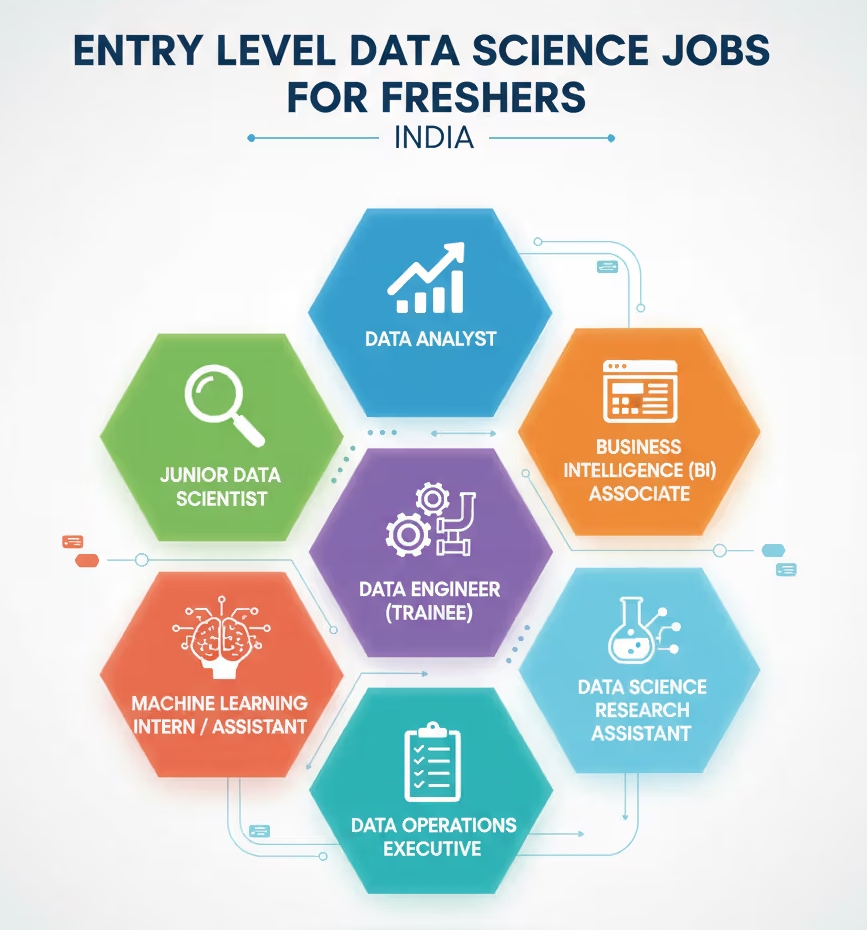
- Data Analyst: Collects, cleans, and interprets business data to uncover trends and create reports. (Key skills: SQL, Excel, Python, Power BI)
- Data Scientist: Applies advanced statistics, programming, and Machine Learning to solve complex problems and build predictive models.
- Machine Learning Engineer: Designs, builds, tests, and deploys scalable ML models into production environments.
- AI Engineer: Builds intelligent applications using Deep Learning, Natural Language Processing (NLP), and computer vision.
- Business Intelligence (BI) Analyst: Transforms raw organizational data into interactive dashboards and KPIs to guide executive strategy.
- Data Engineer: Builds and maintains the data pipelines, warehouses, and infrastructure required to collect and store clean data.
Top Career Opportunities & Job Roles
- Data Analyst: Collects, cleans, and interprets business data to uncover trends and create reports. (Key skills: SQL, Excel, Python, Power BI)
- Data Scientist: Applies advanced statistics, programming, and Machine Learning to solve complex problems and build predictive models.
- Machine Learning Engineer: Designs, builds, tests, and deploys scalable ML models into production environments.
- AI Engineer: Builds intelligent applications using Deep Learning, Natural Language Processing (NLP), and computer vision.
- Business Intelligence (BI) Analyst: Transforms raw organizational data into interactive dashboards and KPIs to guide executive strategy.
- Data Engineer: Builds and maintains the data pipelines, warehouses, and infrastructure required to collect and store clean data.
Step-by-Step Roadmap for Beginners
- Master the Foundations: Learn basic algebra, probability, and statistics to understand how data works. Develop logical thinking and problem-solving skills.
- Learn Python: Start writing Python programs and understand the basics of coding. Practice using libraries that help with data analysis.
- Learn SQL: Learn to write queries to retrieve and manage data from databases. Practice filtering, joining, and grouping data from different tables.
- Practice Data Wrangling: Work with real datasets and learn how to clean and organise data. Identify patterns, correct errors, and prepare data for analysis.
- Explore Machine Learning: Understand how regression, classification, and clustering algorithms work. Practice building models and checking their performance.
- Dive into AI: Explore Deep Learning, Natural Language Processing, and Generative AI. Learn how these technologies are used in real-world applications.
- Build Practical Projects: Work on projects such as sales forecasting, customer segmentation, and fraud detection. Use these projects to apply what you have learned.
- Create a Portfolio: Upload your projects to GitHub or showcase them on a personal website. Explain the project goals, tools used, process, and final results.
The Future of Data Science and AI
Data Science and AI continue to evolve rapidly, driven by breakthroughs in Generative AI, Natural Language Processing (NLP), and Computer Vision. Businesses are increasingly embedding intelligent automation into customer service, healthcare diagnostics, and everyday software products.However, technical skills alone won’t guarantee long-term success. Employers place high value on professionals who understand data privacy, data governance, ethical AI practices, and the real-world limitations of automation. Staying adaptable and continuously updating your toolkit will keep you ahead in this fast-moving industry.
Conclusion
Combining Data Science with AI through a Data Science Course in Kochi empowers learners to understand how organizations turn massive volumes of raw data into meaningful insights and intelligent solutions—transforming industries from healthcare and finance to retail and manufacturing.For students, graduates, and career switchers, building a strong foundation in Python, SQL, statistics, and Machine Learning is the best way to enter the field. Focus on learning one concept at a time, practice consistently with real datasets, and showcase your work through hands-on projects. With steady effort, you’ll be well-positioned for a rewarding career in a rapidly growing sector.
Frequently Asked Questions (FAQs)
1. What is Data Science with AI?
It is the combination of data analysis, programming, statistics, and Artificial Intelligence to uncover patterns in data, predict future outcomes, and build intelligent automated solutions.
2. Is Data Science with AI suitable for beginners?
Yes. Beginners can start with foundational math, statistics, Python, and SQL before gradually progressing to Machine Learning and advanced AI concepts.
3. Which programming language should I learn first?
Python is the best starting point due to its beginner-friendly syntax and rich libraries for data analysis and AI. Learning SQL alongside Python is also essential for working with databases.
4. What career paths are available in this field?
Popular roles include Data Analyst, Data Scientist, Machine Learning Engineer, AI Engineer, Business Intelligence Analyst, and Data Engineer.
5. Can non-computer science students enter Data Science with AI?
Yes. Professionals from mathematics, economics, engineering, business, and science backgrounds regularly transition into Data Science by building practical coding skills and project portfolios.