

Introduction:
Data has become one of the most valuable resources in the current digital environment. We generate massive amounts of data every time we purchase something online, visit a website, interact with social media or carry out transactions with customers. So, to help organizations make the best decisions, they need to use effective methods to help them process, understand and utilize the data. In the past, data scientists would spend a lot of time manually gathering data, tidying up spreadsheet data, writing long and complicated SQL queries, and analyzing large databases. But now with the use of Artificial Intelligence (AI), we can use automation to help us carry out repetitive tasks and identify hidden patterns within the data. By incorporating Artificial Intelligence into Data Science, we can benefit from new opportunities for businesses across various industries. With the use of technologies such as Machine Learning (ML), Deep Learning and Natural Language Processing (NLP), organizations can analyze complex datasets and predict what may happen in the future. Data science training in Chennai Artificial Intelligence is a powerful tool to compliment data scientists to increase productivity, accuracy and decision making. In this blog we will take a look at how Artificial Intelligence can be used within Data Science, the key applications, benefits, challenges and opportunities available.
1. Understanding Artificial Intelligence in Data Science
Let’s first look at what Data Science and Artificial Intelligence actually are.
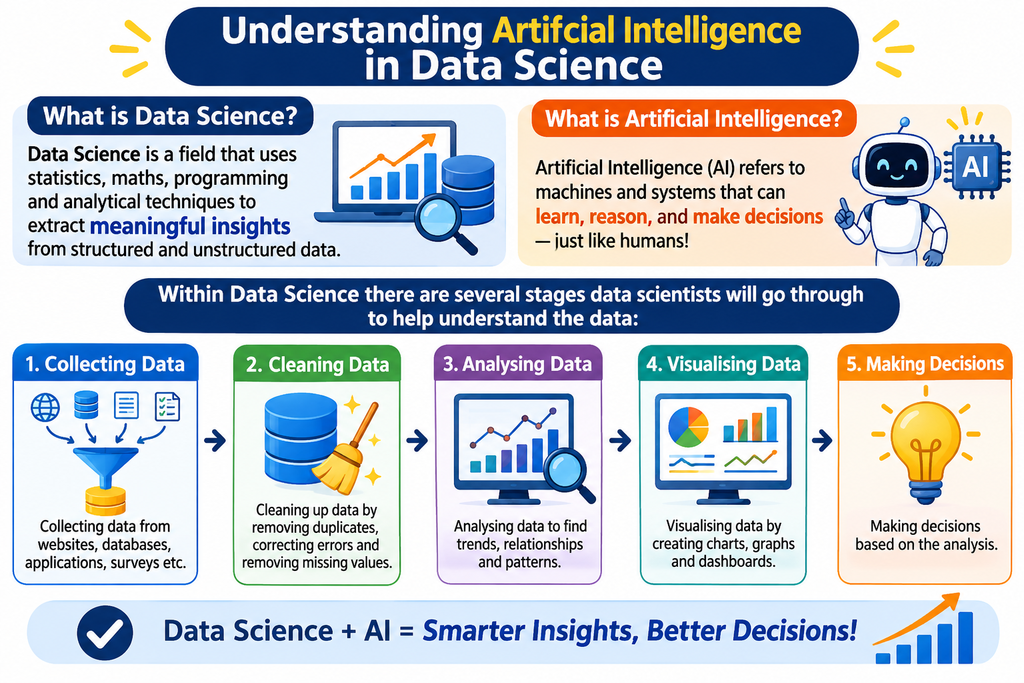
- What is Data Science?
Data Science is a field that uses statistics, maths, programming and analytical techniques to extract meaningful insights from structured and unstructured data.
Within Data Science there are several stages data scientists will go through to help understand the data:
- Collecting data from websites, databases, applications, surveys etc.
- Cleaning up data by removing duplicates, correcting errors and removing missing values.
- Analysing data to find trends, relationships and patterns.
- Visualising data by creating charts, graphs and dashboards.
For example, an online shopping business can analyze customer purchase data to see what products are popular.
- What is Artificial Intelligence?
artificial intelligence and data science is a technology that helps computers carry out tasks that would typically be done by humans. These include learning from data, identifying patterns, understanding language, problem solving and making predictions.
Some technologies used within AI are:
- Machine Learning
- Deep Learning
- Natural Language Processing
- Computer Vision
- Generative AI
For example, an AI recommendation system can analyse a customer’s browsing and purchasing data to suggest products they may be interested in.
- How do they work together?
Data Science provides the base for gathering, organising and understanding data. AI can use intelligent algorithms to help analyse data, identify complex patterns and make predictions.Together they help organisations transform large amounts of raw data into meaningful business insights.
2. How Artificial Intelligence can be used within Data Science
Artificial Intelligence plays a vital role in almost all aspects of Data Science. By using AI, data scientists can reduce the repetitive tasks they have to carry out and focus on more complex business problems. Here are some key ways AI is used within modern Data Science.
- Automating Data Preparation
Preparing data can be one of the most time consuming tasks when carrying out a Data Science project.Data science course in Coimbatore Real life data can often contain duplicates, missing values, incorrect formatting and inconsistent data. Traditionally data scientists would manually identify and fix these issues.
Using AI, we can simplify this process by:
- Identifying missing values and inconsistent data.
- Finding duplicates.
- Suggesting the best methods to clean the data.
- Standardising data.
- Identifying outliers and errors.
For example, if an online business collects thousands of customer records daily, there may be some missing phone numbers, incorrectly formatted emails and duplicate customer data. Using AI data preparation tools can identify these issues and help improve the quality of data.
This means data scientists can save time on repetitive tasks and focus on analysing the data.
- Identifying Patterns
One of the greatest benefits of using Artificial Intelligence is the ability to identify patterns within large datasets. Traditional methods may struggle to analyse large amounts of data containing millions of records. However by using Machine Learning algorithms, large amounts of data can be analysed to help identify relationships within the data.
AI can help identify:
- Customer purchasing patterns.
- Unusual financial activity.
- Changes in customer behaviour.
- Market trends.
- Hidden relationships.
For example, a bank can use AI to analyse customer transactions to see any unusual spending. If a transaction looks out of the ordinary for the customer, it will be flagged.
- Predictive Analytics
With the use of Artificial Intelligence predictive analytics can now be more powerful. Businesses can use historic data to make predictions about what may happen in the future.
Predictive analytics uses statistical techniques and Machine Learning algorithms to identify possible future outcomes.
Prescriptive analytics takes this a step further by suggesting actions.
Businesses use this to forecast:
- Sales.
- Customer demand.
- Risk.
- Inventory.
- Equipment.
For example, a retail company can analyse historic sales data, seasonal trends and customer demand to predict what products may sell more during the upcoming festival period.
This means they can plan their inventory and marketing more effectively.
- Real Time Analysis
Businesses produce constant data from websites, mobile apps, online transactions and connected devices.
AI powered data tools can help organisations quickly analyse the data and identify key changes.
This can be used for:
- Monitoring online transactions.
- Monitoring website performance.
- Identifying fraud.
- Monitoring customer interaction.
- Managing supply chains.
For example, an e-commerce company can monitor customer activity on their website. This can help identify popular products.
- Improved Visualisation
Visualising data can help businesses understand complex data. This can be done using charts, graphs and dashboards.AI powered analytics tools can help users identify key trends, create reports and understand the data by asking questions in natural language.Some popular tools include Power BI, Tableau and Python visualisation tools.
For example, a marketing manager can use a Power BI dashboard to monitor website traffic, cost of advertising, leads and conversions. The AI features can help identify any changes in performance.
3. Comparison of Data Science and Artificial Intelligence
Whilst Data Science and Artificial Intelligence are closely related, they are not the same. Both use data and technology to solve problems but have different goals.
| Feature | Data Science | Artificial Intelligence |
| Goal | Extract meaningful insights | Intelligent systems |
| Focus | Data, statistics, analysis, visualisation | Learning, reasoning, prediction, automation |
| Technologies | Python, SQL, Excel, Power BI, statistics | Machine Learning, Deep Learning, NLP, Neural networks |
| Main Tasks | Clean, analyse and interpret data | Learn from data and automate tasks |
| Output | Reports, dashboards, business insights | Chatbots, recommendations, intelligent applications |
| Use Cases | Business analysis, market research, forecasting | Fraud detection, voice recognition, automation |
Goal Extract meaningful insights Intelligent systems Focus Data, statistics, analysis, visualisation Learning, reasoning, prediction, automation Technologies Python, SQL, Excel, Power BI, statistics Machine Learning, Deep Learning, NLP, Neural networks Main Tasks Clean, analyse and interpret data Learn from data and automate tasks Output Reports, dashboards, business insights Chatbots, recommendations, intelligent applications Use Cases Business analysis, market research, forecasting Fraud detection, voice recognition, automation Whilst the two have different roles they work together to create intelligent solutions.
4. Real World Examples of AI in Data Science
Artificial Intelligence and Data Science are transforming several industries to make them more efficient, reduce risk and make better decisions.
- Healthcare Industry
Healthcare organisations will often have lots of data to analyse. This can include patient data, medical reports, lab results and medical imaging.
Using AI powered data science tools, healthcare professionals can analyse the data and identify patterns.
This can be used for:
- Help with analysing medical imaging.
- Identify potential health risks.
- Help with personalised treatment.
- Analyse patient data.
- Predict resource requirements.
For example, AI systems can analyse X-rays and MRIs to highlight areas that may need further investigation from medical professionals. This helps doctors but does not replace them.
- Banking/Financial Industry
Financial organisations use AI and Data Science to help keep them secure, reduce risk and understand customer behaviour.
This can be used for:
- Identifying suspicious financial activity.
- Identify potential credit risk.
- Monitor customer spending.
- Fraud prevention.
- Improved financial forecasting.
For example, if a customer makes an unusual transaction, the AI fraud detection can identify this activity and alert the bank.
- E-Commerce/Digital Marketing
E-Commerce and Digital Marketing companies use customer data to understand what interests them, improve their advertising and personalise their offerings.
AI can help businesses analyse:
- Website browsing history.
- Customer purchasing behaviour.
- Product preferences.
- Advertising performance.
- Customer feedback.
For example, if a customer searches for a mobile phone on an online shopping website, they may be shown similar phones, accessories and related products based on their browsing.
Digital marketers can also use AI powered analytics to understand their audience behaviour.
- Manufacturing Industry
Manufacturing companies use AI and Data Science to improve their production and reduce costs.
This can be used for:
- Predicting machine failure.
- Monitoring product quality.
- Improving production.
- Managing inventory.
- Identify manufacturing issues.
For example, a manufacturing company can use sensor data from machines to identify any unusual temperatures or vibrations. AI models can help predict any potential issues with the equipment.
- Education Industry
AI and Data Science are transforming the way educational institutions manage their learning.
This can help institutions:
- Analyse student performance.
- Identify learning issues.
- Recommend learning materials.
- Predict student engagement.
- Improve administration.
For example, an online learning platform can analyse student quiz results and learning to recommend extra lessons based on their learning needs.
5. Key AI Technologies Used in Data Science
There are several AI technologies used within modern Data Science projects. Knowing these will help if you want to build a career in this field.
- Machine Learning
Machine Learning allows computer systems to learn from historic data to improve their performance. It is often used for sales forecasting, customer segmentation, fraud detection and recommendations.
- Deep Learning
Deep Learning is a specific type of Machine Learning which uses artificial neural networks with multiple layers to identify complex patterns. It can be used for image recognition, voice recognition and advanced prediction systems.
- Natural Language Processing
Natural Language Processing helps computers understand, interpret and generate human language. It can be used for chatbots, sentiment analysis, language translation and customer feedback.
- Generative AI
Generative AI can create new content such as text, images, code and summaries. In Data Science this can help with writing SQL queries, explaining results from analysis, writing code and summarising reports. Always check the output for accuracy.
6. Benefits of using AI in Data Science
Using AI in Data Science brings several benefits to an organisation.
Time saver – AI can help with repetitive tasks such as data cleansing, report creation and basic analysis.
Increased productivity – Data Scientists can focus on more complex analysis tasks.
Better decisions – AI can help identify patterns and make predictions to help businesses make informed decisions.
Large data sets – AI can help analyse large amounts of data.
Improved customer experience – Businesses can understand what their customers like and offer them more relevant products, services and recommendations.
Reduced risk – AI can help identify unusual activity.
7. Challenges of using AI in Data Science
Whilst there are many benefits to using AI there are also some challenges.
- Poor quality data – AI models rely on the quality of the data they are trained on. If the data contains errors, missing values or is out of date it can produce unreliable results.
- Data privacy – Organisations need to ensure they are keeping customer and business data private. Ensure you follow the right data protection policies.
- High cost – Developing and maintaining AI powered systems can be expensive. You may need advanced technology, infrastructure, skilled professionals.
- No human oversight – AI predictions aren’t always accurate. Important results should be reviewed by human experts.
- Skills – You will need knowledge of programming, maths, statistics, Machine Learning and data analysis tools.
Knowing these challenges will help organisations use AI responsibly.
8. Future Opportunities with AI in Data Science
Data Science will become increasingly connected with AI. As AI technology develops there will be more opportunities for data professionals to work with intelligent systems.
Some key developments will include:
- Automated Machine Learning – AutoML can help automate some Machine Learning tasks such as choosing the best model, training and tuning parameters. This can help make model building more accessible.
- Generative AI – Generative AI can help users write code, create SQL queries, summarise reports and understand complex data sets using natural language.
- Advanced Predictive Analytics – Businesses will continue to use AI to improve demand forecasting, predict customer behaviour, detect fraud and analyse risk.
- AI Business Intelligence – Business intelligence will begin to include AI features to help users understand trends, explore data and create reports.
- Human involvement – Data scientists will continue to play an important role in reviewing model outputs, understanding business needs, addressing ethical issues and making decisions. This will create new opportunities for professionals with strong analytical skills and knowledge of AI technologies.
9. Skills needed to build a career in AI and Data Science
As organisations become more reliant on making decisions using data, there are many opportunities for professionals with Data Science and AI skills.
Some key skills to have include:
- Excel – To organise data and carry out basic analysis.
- SQL – To retrieve and manage data.
- Python – To analyse data, automate tasks and use Machine Learning.
- Statistics – To understand patterns in data and make reliable predictions.
- Power BI/Tableau – To create interactive dashboards.
- Machine Learning – To create predictive models.
- Communication – To explain findings from analysis and recommendations.
Popular roles include Data Analyst, Data Scientist, Business Intelligence Analyst, Machine Learning Engineer and AI Engineer. If you are a beginner you can start with learning Excel and SQL and then move onto Python, statistics, Power BI and Machine Learning. Practical projects are also important.
Conclusion
Artificial Intelligence has become an important part of modern Data Science. It has transformed the way organisations gather, prepare, analyse and use data. From automating data preparation, identifying hidden patterns, predicting future trends and providing real time insights, AI can help businesses run more efficiently and make informed decisions.Industries such as healthcare, banking, e-commerce, manufacturing and education are already using AI powered data science applications.However, having advanced technology isn’t the only thing needed to successfully implement AI. Having good quality data, data privacy, human oversight and skilled professionals is also important.In the future, combining Artificial Intelligence and Data Science will create new opportunities for businesses and professionals.Data science course in Kochi Learning tools such as Excel, SQL, Python, Power BI, statistics and Machine Learning can help beginners build a strong foundation. The future of Data Science is not just about gathering more data but using Artificial Intelligence to make meaningful insights, smarter decisions and better opportunities.
