

Introduction:
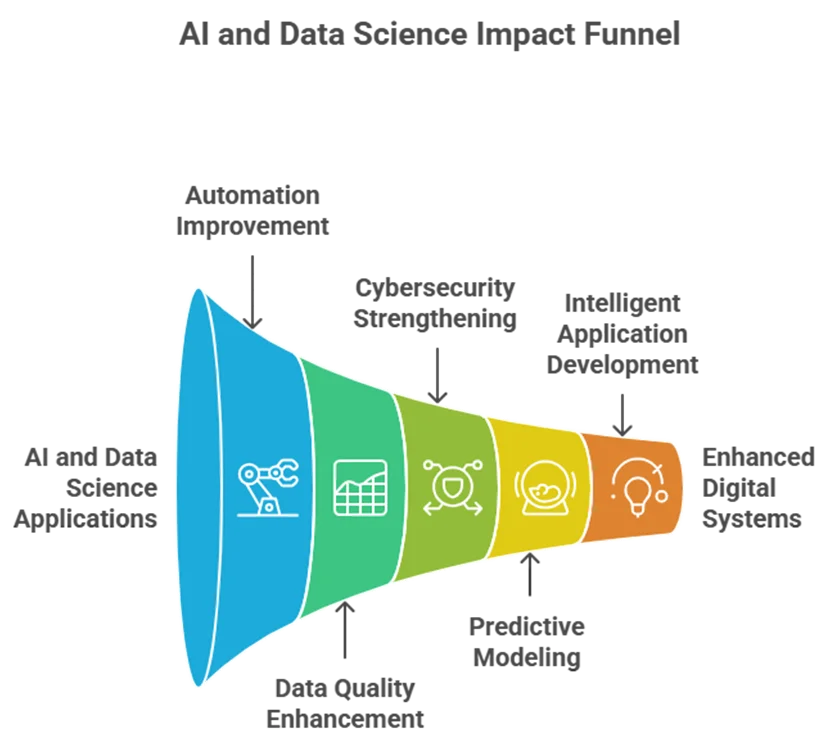
Artificial Intelligence (AI) is changing how businesses collect, analyze and understand data. With the use of AI, machine learning, generative AI and automation data science has become more powerful in 2026. Businesses and organizations across multiple industries are using AI to help make better decisions, improve customer experiences, lower their costs and uncover new opportunities. Data science takes statistical, coding and mathematical knowledge and applies this along with business knowledge to extract insights from data. Data scientist training in Chennai AI can help make this process faster by helping automate tasks, uncover patterns, build predictive models and help better communicate result. This has become an important aspect of digital transformation across many industries such as healthcare, banking, retail, manufacturing and education. Understanding how AI is impacting data science can help students, professionals and businesses prepare for future opportunities.
1. Automate Data Preparation
Data preparation can take a long time to complete. Data scientists will often have to work with data from websites, applications, databases, spreadsheets and business systems. This data can often be messy with lots of missing data, duplicates, inconsistencies and errors.AI tools can help automate this. They can help spot duplicates, propose how to handle missing data, identify outliers and suggest the best way to transform the data. This helps free up your data scientist’s time to spend analysing the data.For example, if an e-commerce company were to get lots of new customer data each day, AI data preparation can help organise this data for analysis.However, there will still need to be some human oversight to ensure nothing important gets lost and any bias isn’t introduced.
2. Analyse Data Faster
Traditionally analysts would have to create queries, reports and analyse large amounts of data. Using AI and machine learning can make this process faster by identifying patterns and relationships.Machine learning algorithms can help identify patterns in customer behaviour, sales, website traffic and performance. It can also help find correlations, outliers and changes.For example, an AI enabled analytics tool could help a retail business uncover which products perform well in certain seasons. This can help them better plan their stock, create relevant promotions and avoid stocking too much.This doesn’t automatically tell you why there are patterns. Data scientists will still need to look into why and make sure assumptions are being tested.
3. Generative AI
Generative AI is a large development within data science in 2026. These can help create text, summarise data, help with coding, explain the results and help users understand data through natural language.Data professionals can use AI assistants to help write SQL queries, explain Python functions, suggest visuals, create documentation and help with debugging. Some can even help turn natural language into queries or analytics reports.For example, a business analyst may ask ‘Which product category had the most revenue last quarter?’. An AI enabled analytics tool could help turn the question into a query and show this in a chart.This can help those without advanced coding skills analyse data. However, the code and explanations may be wrong or incomplete. Professionals will still need to check the queries, calculations and ensure any sensitive data is protected.
4. Machine Learning
Machine learning is a key part of data science. It allows computer systems to learn patterns from historical data to make predictions or classifications.Using AI tools can help teams create features, compare algorithms, tune parameters and monitor model performance. This can help speed up development and allow organisations to experiment with different analytics.Predictive analytics can be used across many industries. For example, banks can use models to predict credit risk and highlight potentially fraudulent transactions. Healthcare organisations can look into patterns in patients risk using appropriate and authorised data. Retailers can predict demand and logistics companies can predict delivery times.The accuracy of predictions will depend on the quality of the training data. If customer behaviour, economic factors or business processes change this can impact how accurate the model becomes. It’s important to regularly test.
5. AutoML
AutoML, or Automated Machine Learning, can help simplify parts of model creation. Depending on the platform it can help with algorithm selection, feature creation, comparing models and tuning parameters.This can be useful for creating baseline models or comparing multiple approaches. It can also be useful for organisations who don’t have much experience with machine learning.For example, a marketing team may want to predict which leads are more likely to become customers. An AutoML platform can help create models to test. They can then use the validated predictions to help prioritise which leads to follow up on.Whilst this can help, data science knowledge will still be needed. Professionals will need to chose appropriate metrics, ensure there is no data leakage and ensure the model is fair.
6. Real Time Analytics
Many businesses will need to gain insights into what is happening. Using AI data tools can help analyzse data coming into the business from applications, IoT devices, websites, payment systems etc. This can help organizations react quickly. Data science course in Coimbatore Financial institutions can highlight any suspicious transactions, delivery companies can highlight any issues with routes and online platforms can adapt recommendations. For example, a digital marketing team can use real time data from their adverts and website. They can look into click through rate, cost per click, cost per lead and conversion rate to identify which campaigns need looking into. Not all businesses will need real time analytics. It will depend on how quickly decisions need to be made, how much it would cost to do this and how reliable the data is.
7. Data Visualization with AI
Data visualization can help people understand data by producing charts, dashboards, tables and reports. AI can help suggest the best visuals to use, create summaries, identify outliers and ask questions about business metrics. Tools like Power BI and Tableau can create analytics and visuals. Depending on the product, version, setup and licensing the AI features will vary. For example, if a company wants to see how their revenue, customer acquisition and product performance is doing each month. An AI enabled dashboard could highlight any issues with revenue in a certain region or more customers cancelling. Analysts can look into what is causing this and explain to decision makers. It’s important to ensure the right metrics are being used, the correct charts chosen and everything is labelled clearly. AI summaries should be checked against the data.
8. Use Cases Across Various Industries
AI enabled data science is providing practical opportunities across multiple industries.
Healthcare
Healthcare organizations can use data analytics to look into patient trends, support medical research, optimize resources and look into potential health risks. Any clinical use needs to be appropriately validated and consider privacy and regulations
Banking & Finance
Financial institutions use analytics models to detect fraud, assess risk, monitor transactions and improve customer service. When models are being used to determine access to financial services it’s important to have human oversight.
Retail & E-Commerce
Retailers can use data analytics to look into purchasing trends, predict demand, personalise recommendations and improve stock management.
Manufacturing
Manufacturing companies can use data analytics to look into sensor data from equipment to identify any outliers. If the models are reliable predictive maintenance can help reduce any unexpected downtime.
Education
Education can use data analytics to look into student engagement, course engagement and learning outcomes. This can be used responsibly to help educators identify where extra support may be needed.
9. Python, SQL & Power BI
Although AI tools are becoming more powerful it’s important to have a solid foundation.
python for data science is a popular tool for data manipulation, automation, visualization and machine learning. There are many libraries available to help with common analytics tasks such as Pandas, NumPy, Scikit-learn and Matplotlib. SQL can help professionals extract, filter, join and summarize data from relational databases. It can be very useful when looking at business transactions, customer data and other business data. Excel can be useful for spreadsheet work, calculations, data cleansing and quick business analytics. It can often be a good starting point for beginners. Power BI can help turn data into interactive dashboards and reports. This can help analysts communicate their findings to managers. Statistics and Machine learning are the foundations of analyzing relationships, testing, building predictive models and understanding uncertainty. Understanding how these technologies work can help students gain practical skills.
10. New Career Opportunities
As AI has grown there are new skills needed for data related careers. Organisations will need professionals who can understand business problems, work with data, assess models and clearly communicate results.
Possible roles include:
- Data Analyst
- Business Intelligence Analyst
- Data Scientist
- Machine Learning Engineer
- AI Engineer
- Data Engineer
- Analytics Consultant
Depending on the organisation the responsibilities and entry requirements will vary. Some roles will focus on reporting and SQL whilst others will require advanced coding, statistics, machine learning or software engineering.A good way to start as a beginner is to start with Excel & SQL, learn Python & Statistics, develop your visualisation skills with Power BI and learn about machine learning. You can then create some projects using real life data sets to show your skills. Using AI tools to help with coding.Having knowledge of AI can be useful but communication, problem solving, critical thinking and understanding of business is still important.
11. Challenges with AI
There are some challenges to using AI.
Data Privacy – Personal and sensitive data needs to be handled appropriately following any relevant laws, organizational policies and access. Bias – If there is historical bias in the training data the model can replicate this. It’s important to test the model against the relevant groups Accuracy – AI can produce incorrect explanations, summaries and code. This needs to be verified. Interpretability – Some models can be quite complex to understand. In high impact situations professionals may need to use other methods to explain why the model is making predictions. Security – AI applications and data will need to be protected. Human Oversight – Recommendations shouldn’t be relied upon. Ensure appropriate judgement is used. Responsible AI – Consider the pros and cons of using the system throughout its development.
12. How to Prepare As A Beginner
Students and those wanting to change careers can prepare for AI driven data science by:
Start with the basics – Get to grips with spreadsheets, statistics and SQL. This will give you an understanding of how data is organized and understood. Learn Python – Learn how to analyze data. Import datasets, clean data, calculate summary statistics and create visuals. Create dashboards – Learn how to use Power BI or similar BI tools. Learn how to select the right metrics. Learn about Machine Learning – Learn about regression, classification, clustering, model evaluation and overfitting. Understand why models perform well/poorly. Explore Generative AI & Auto ML – Use these tools to help with coding and experimenting. Be independent and verify the outputs .Build projects – Create projects to solve real life problems. For example predicting sales, segmenting customers, analyzing marketing campaigns and creating dashboards. Make sure to document the problem, dataset, methods, results, limitations and recommendations for the business. Having a portfolio with clearly explained projects can help show you have practical knowledge.
Conclusion
AI is changing data science in 2026. It can help speed up data preparation, help with predictive analytics, improve visualization, automate parts of machine learning and make tools easier to use. This can help organizations make the most out of increasing amounts of data. Python course in Kochi AI works best when used with reliable data, good statistical knowledge, domain knowledge and human oversight. Accuracy, privacy, fairness and accountability are important when completing successful data science projects. This provides students and professionals with opportunities to develop valuable skills in Python, SQL, Excel, Power BI, Machine Learning and Generative AI. By having a good foundation and building practical projects you can prepare for a changing data driven world. The future of data science isn’t just about using more AI, it’s about using it wisely to solve meaningful problems, make better decisions and provide real value to businesses.
