

Table of Contents
Introduction
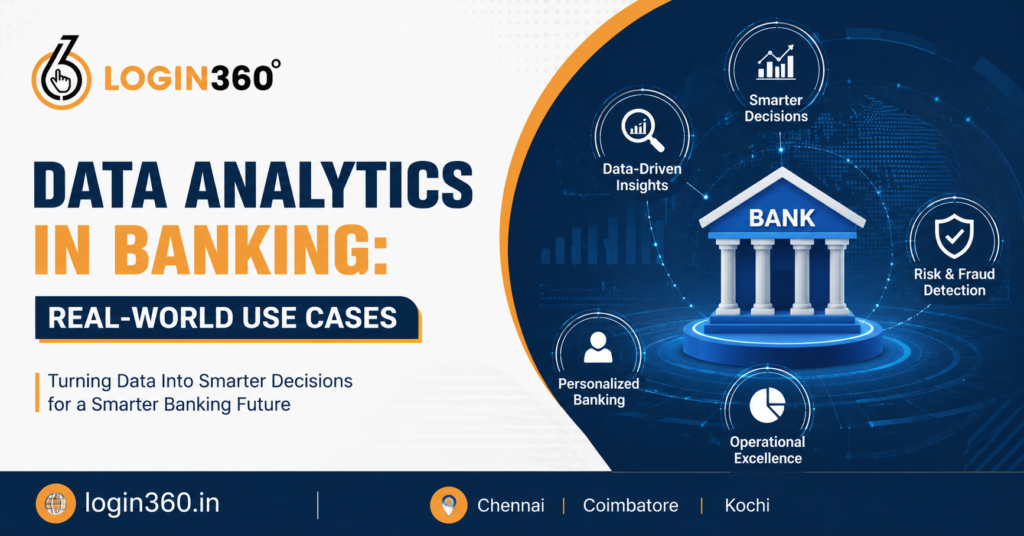
The banking industry has been experiencing impressive digitization. Data has become an invaluable asset for financial companies due to the amount of information generated during each transaction, customer interaction, loan application, and digital payment. Here comes into play data analytics in banking an instrument that allows collecting, processing and analyzing financial data to make informed decisions. By means of using various technologies such as advanced analytics, artificial intelligence, and machine learning, banks can not only make sense out of structured and unstructured financial data but also improve their operations, customer experience, security, and risk management. From real-time suspicious activity detection to financial product personalization, data analytics is a key tool for successful banking companies nowadays. This paper will cover the most important applications of data analytics in banking in terms of providing enhanced security and making informed decisions.
Understanding How Banks Collect and Manage Data
Banks gather information from multiple digital and physical channels throughout the customer journey. Proper data management ensures this information remains accurate, secure, and useful for business decisions. Modern banking systems integrate various sources into centralized platforms that support real-time analysis.
Key Data Sources in Banking
- Customer Information – Personal details, account information, demographics, and financial history help banks understand customer profiles and offer relevant services.
- Transaction Records – Every deposit, withdrawal, transfer, payment, and purchase provides valuable insights into customer spending habits and financial behavior.
- Digital Banking Platforms – Mobile apps, internet banking, chatbots, and online support generate behavioral data that helps improve digital experiences.
- Credit History – Loan repayments, credit scores, and borrowing patterns assist banks in evaluating financial reliability.
- External Financial Data – Economic indicators, market trends, and regulatory information help banks make informed lending and investment decisions.
Fraud Detection and Financial Crime Prevention
Fraud remains one of the biggest challenges for financial institutions as cybercriminals continuously develop new methods to exploit banking systems. Data analytics plays a vital role in preventing financial crimes by analyzing millions of transactions in real time and identifying suspicious activities within seconds. Advanced algorithms can detect unusual spending patterns, unexpected account behavior, or high-value transactions made from unfamiliar locations. For example, if a customer usually makes purchases in one city but suddenly initiates multiple large transactions from another country, the system immediately flags the activity and alerts the customer for verification. In addition, behavioral analytics learns each customer’s normal financial habits and continuously adapts to detect anomalies more accurately. By enabling early fraud detection and reducing financial losses, data analytics not only strengthens banking security but also builds customer trust and loyalty.
Credit Risk Assessment and Loan Approval
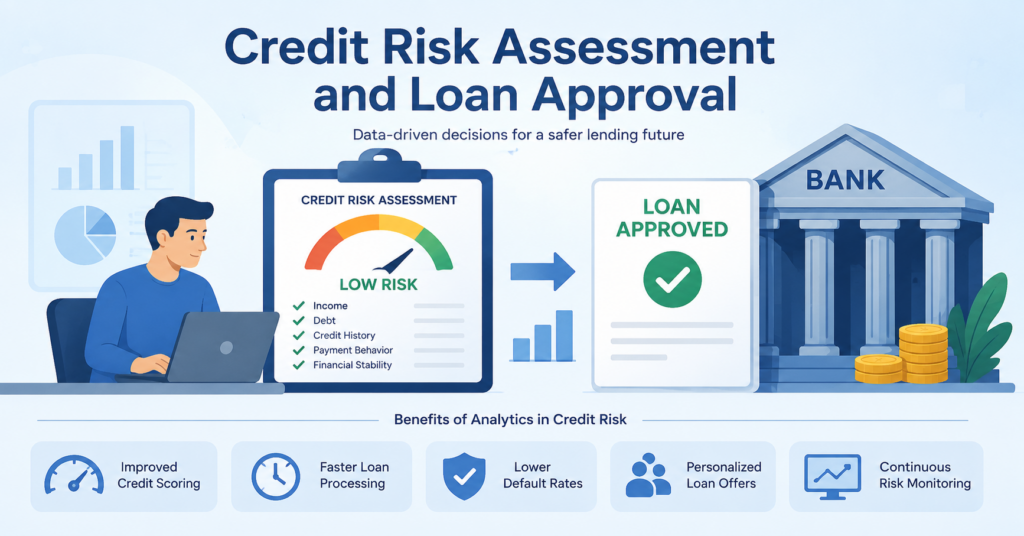
Lending decisions require careful evaluation of financial risk. Data analytics enables banks to make faster and more accurate credit assessments. Traditional loan approval relied heavily on manual reviews and limited financial information. Today, analytics provides a much broader understanding of an applicant’s financial health.
Benefits of Analytics in Credit Risk
- Improved Credit Scoring – Multiple financial indicators create more accurate assessments of borrowing capacity.
- Faster Loan Processing – Automated analysis significantly reduces approval time while maintaining accuracy.
- Lower Default Rates – Predictive models identify high-risk borrowers before loans are approved.
- Personalized Loan Offers – Banks recommend interest rates and repayment plans based on customer profiles.
- Continuous Risk Monitoring – Existing borrowers are monitored throughout the loan lifecycle, allowing banks to identify early warning signs of financial distress.
Personalized Banking and Customer Experience
Customer expectations have shifted significantly with the advent of digital banking. Customers now expect personalized recommendations, quicker responses, and an integrated experience with their finances. With data analytics in banking, institutions can gauge the preferences of customers based on their transaction patterns, savings practices, spending habits, and other financial preferences. Accordingly, the bank recommends suitable products, including credit cards, investment schemes, insurance policies, or savings accounts. The recommendation engine also facilitates the improvement of customer engagement through relevant offers rather than marketing strategies. For instance, a customer who travels overseas on a frequent basis will get recommendations for travel insurance or even premium credit cards with airport lounge access. In addition, the analytics will improve customer support through AI chatbots that can respond to queries and assist customers with banking services 24/7.
Regulatory Compliance and Anti-Money Laundering (AML)
Financial institutions must comply with strict government regulations designed to prevent financial crimes such as money laundering and terrorist financing. Data analytics simplifies compliance by continuously monitoring transactions and identifying suspicious financial behavior.
How Analytics Supports AML
- Real-Time Transaction Monitoring – Unusual transfers, large cash deposits, or rapid movement of funds are detected immediately.
- Customer Risk Profiling – Customers are categorized according to financial risk levels based on multiple indicators.
- Automated Compliance Reporting – Regulatory reports are generated faster while reducing manual effort.
- Pattern Recognition – Analytics identifies hidden relationships between accounts involved in suspicious activities.
- Reduced False Positives – Machine learning improves detection accuracy by distinguishing legitimate transactions from genuinely suspicious ones.
Operational Efficiency Through Banking Analytics
In addition to customer services, analytics also plays a crucial role in improving internal operations within the bank. There is much operational data provided by different departments of banks which can be analyzed in order to improve workflow and cut unnecessary costs. Productivity of employees, time taken for transaction processing, usage of ATMs, performance of branches, waiting times of customers, and usage of online services are analyzed. This allows managers to make better use of resources and detect operational problems. Predictive analytics is also helpful for maintenance of banking infrastructure. Analytics can predict malfunctioning of ATMs and help to perform maintenance of equipment beforehand instead of reacting to the situation. Automation based on analytics makes employees less dependent on routine activities such as document verification and reporting.
Predictive Analytics for Investment and Financial Planning
Predictive analytics helps banks anticipate future financial trends using historical data, statistical models, and machine learning algorithms. Instead of reacting to events after they occur, financial institutions can proactively prepare for market changes and customer needs.
Major Applications
- Investment Forecasting – Market trends help advisors recommend suitable investment opportunities.
- Cash Flow Prediction – Banks forecast liquidity requirements to maintain financial stability.
- Customer Retention – Predictive models identify customers likely to switch banks, enabling proactive engagement.
- Revenue Forecasting – Financial planning becomes more accurate through predictive business analysis.
- Market Risk Management – Economic indicators help institutions prepare for changing financial conditions.
Challenges in Implementing Data Analytics in Banking
Despite the numerous advantages of using data analytics in banking, there are some challenges faced during the implementation process. First, privacy regulations on data compel banks to handle sensitive data from customers carefully by ensuring that the banks can keep the data secured and the users are aware of the usage of their data. International regulations add more complications to this. Furthermore, many banks find it difficult to integrate their legacy systems that do not have features for supporting advanced analytics. Having data in various systems leads to discrepancies, which may make data analytics inaccurate. Lastly, hiring of qualified staff is challenging due to high competition among firms for data scientists, artificial intelligence specialists, cyber experts, and financial analysts.
Future Trends of Data Analytics in Banking
The future of banking will become increasingly driven by artificial intelligence, automation, cloud computing, and advanced analytics.
Emerging Trends
- Artificial Intelligence Integration – AI will automate more complex financial decisions while improving customer interactions.
- Real-Time Analytics – Banks will process massive volumes of transactions instantly for faster decision-making.
- Open Banking – Secure data sharing between financial institutions will create innovative digital services.
- Generative AI – Intelligent assistants will provide personalized financial guidance and automate customer support.
- Hyper-Personalization – Analytics will deliver highly customized financial products based on individual customer behavior.
Conclusion
Data analytics has become one of the key drivers of innovation and competitiveness in the field of banking. Through turning data into valuable insights, financial companies can enhance their security, better evaluate the risks of lending money, create a personalized experience for customers, adhere to the requirements of regulators, and optimize the internal processes. Predictive analytics allows banks to foresee the needs of customers and changes in the market. Despite the existing challenges associated with data protection, legacy systems, and human resources issues, ongoing investments in the latest technologies and data protection practices will help banks deal with those barriers. As technology continues developing, the use of data analytics in banking will become even more important in the future.