

Table of Contents
Introduction
Choosing between MERN Stack and MEAN Stack is one of the first decisions every aspiring full-stack developer faces. Although both stacks share similar backend technologies, they differ in their frontend framework, learning experience, and industry adoption. In this guide, we’ll compare both stacks to help you determine which one best aligns with your career goals.
What is MERN Stack?
MERN Stack is a JavaScript based technology stack used to build full-stack web applications. The name MERN is derived from its four core technologies: MongoDB, Express.js, React, and Node.js. Since every layer of the application uses JavaScript, developers can build both the frontend and backend using a single programming language, making development faster and easier to manage.
Components of MERN Stack
- MongoDB: is a NoSQL database that stores information in flexible, JSON like documents instead of traditional tables. This approach makes it easier to manage dynamic data and scale applications as they grow.
- Express.js: is a lightweight backend framework built on Node.js. It simplifies server side development by handling routing, middleware, and API creation, allowing developers to build web applications more efficiently.
- React: is a JavaScript library developed by Meta for building interactive user interfaces. Its component based architecture enables developers to create reusable UI components, resulting in cleaner code and faster development.
- Node.js: is a JavaScript runtime that allows developers to execute JavaScript outside the browser. It is widely used for building fast and scalable server side applications that can efficiently handle multiple user requests.
Advantages of MERN Stack
- One of the biggest advantages of MERN Stack is that it uses JavaScript throughout the entire application. Developers don’t need to switch between multiple programming languages, which reduces the learning curve and improves productivity.
- React’s component based architecture also speeds up development by allowing developers to reuse code across different parts of an application. This makes projects easier to maintain and update over time.
- Another major advantage is the large developer community. Since MERN is widely adopted, developers have access to thousands of tutorials, open source libraries, and community support, making it easier to solve problems and learn new concepts.
- MERN Stack is also highly flexible. Unlike opinionated frameworks, React gives developers the freedom to structure projects according to their requirements, making it a popular choice for startups and modern web applications.
What is MEAN Stack?
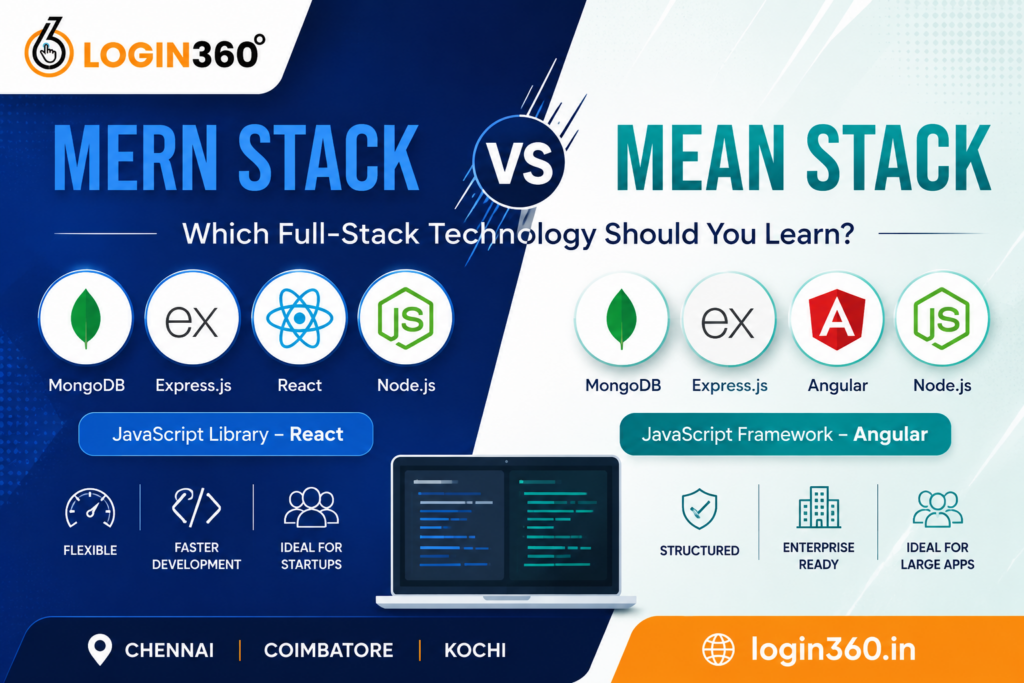
MEAN Stack is a popular JavaScript based technology stack that consists of MongoDB, Express.js, Angular, and Node.js, allowing developers to create complete web applications using JavaScript technologies across both the frontend and backend. The main difference between MERN stack and MEAN stack lies in their frontend technology, as MERN uses React while MEAN uses Angular, a full featured frontend framework developed by Google. With its built in features such as routing, dependency injection, and structured architecture, Angular makes MEAN Stack a preferred choice for developing large scale enterprise applications.
Components of MEAN Stack
- MongoDB: is the database layer of the MEAN Stack. It stores application data in JSON like documents, making it flexible and suitable for applications that handle large amounts of dynamic data.
- Express.js: is the backend framework that runs on Node.js. It simplifies server side development by providing tools for routing, middleware, and REST API development.
- Angular: is a TypeScript based frontend framework developed by Google. Unlike React, Angular is a complete framework that comes with built in features such as routing, dependency injection, form validation, and HTTP services. This reduces the need for additional third party libraries in many projects.
- Node.js: is the runtime environment that executes JavaScript on the server. It enables developers to build scalable backend applications capable of handling multiple client requests efficiently.
Advantages of MEAN Stack
- One of the biggest strengths of the MEAN Stack is its well structured architecture. Angular follows a predefined project structure, making it easier for large development teams to collaborate and maintain consistent coding standards.
- Another advantage is that Angular includes many built in features. Developers don’t have to spend much time choosing and configuring external libraries for routing, forms, or state management, which can simplify enterprise application development.
- Like MERN stack and MEAN Stack also uses JavaScript across the application. Although Angular primarily uses TypeScript, developers still work within the JavaScript ecosystem, making backend and frontend integration straightforward.
- MEAN Stack is also an excellent choice for enterprise level applications because Angular offers long term support, regular updates, and strong documentation backed by Google.
MERN Stack and MEAN Stack: Key Differences
| Feature | MERN Stack | MEAN Stack |
|---|---|---|
| Frontend Technology | React | Angular |
| Frontend Type | Library | Framework |
| Language | JavaScript | TypeScript |
| Learning Curve | Easier | Steeper |
| Flexibility | High | Structured |
| Best For | Startups, SaaS, Freelancers | Enterprise Applications |
| Community Support | Very Large | Large |
| Development Speed | Faster for small to medium projects | Better for large structured projects |
Learning Curve
- For beginners, MERN Stack is generally considered easier to learn. React has a smaller API, fewer concepts to master initially, and allows developers to start building projects quickly. Since it focuses mainly on the user interface, beginners often find it less overwhelming.
- In contrast, MEAN Stack requires learning Angular, which introduces additional concepts such as TypeScript, modules, services, decorators, dependency injection, and RxJS. While these features provide a powerful development environment, they also increase the time required to become proficient.
- However, a steeper learning curve does not mean Angular is a poor choice. Once developers become familiar with Angular’s architecture, they often find it easier to manage large and complex applications because the framework enforces consistent coding practices.
- If your goal is to build projects quickly and strengthen your JavaScript skills, MERN is usually the better starting point. If you plan to work on enterprise software or within large development teams, investing time in learning MEAN can provide long term benefits.
Performance
- Both MERN stack and MEAN stack deliver excellent performance because they rely on Node.js for backend development. The primary performance difference comes from the frontend framework.
- React updates only the necessary parts of the user interface through its Virtual DOM, making rendering fast and efficient. This makes MERN particularly suitable for highly interactive applications where the interface changes frequently.
- Angular, on the other hand, includes more built in features and a larger framework size. Although modern Angular versions have significantly improved performance, it may require additional optimization for very large applications. In return, developers gain a more structured development environment with many built in capabilities.
- For most real world applications, both stacks provide excellent performance. The better choice depends more on project requirements than on raw speed alone.
Scalability
Scalability is an important factor when choosing a full-stack technology, especially if you plan to build applications that may grow over time. Both MERN stack and MEAN stack are capable of supporting scalable applications, but they achieve this in different ways.
- MERN Stack: offers greater flexibility because React allows developers to choose their preferred project structure and supporting libraries. This flexibility makes it easier to build applications that can evolve as business requirements change. Many startups prefer MERN because it enables rapid development while still providing room for future expansion.
- MEAN Stack: on the other hand, focuses on structure and consistency. Angular follows predefined architectural patterns that help development teams maintain large codebases efficiently. As applications become more complex, this structured approach can reduce maintenance challenges and improve collaboration among developers.
Job Opportunities
MERN Stack
has become one of the most popular choices among startups and product based companies. React’s popularity has created a significant demand for developers who can build modern, responsive, and interactive web applications. Companies developing SaaS products, e-commerce platforms, and social media applications frequently look for MERN developers because of React’s flexibility and extensive ecosystem.
MEAN Stack
is commonly preferred by enterprise organizations that require structured and maintainable applications. Industries such as banking, healthcare, government, and large corporate businesses often choose Angular for its standardized architecture and long term support. As a result, developers with Angular experience are in demand for enterprise software development.
Conclusion
Both MERN stack and MEAN Stack are powerful technologies for building modern full-stack applications, and the best choice depends on your career goals and project needs. MERN is ideal for beginners, startups, and developers who prefer flexibility and faster development with React. MEAN is better suited for enterprise applications that require a structured approach using Angular. Ultimately, choosing between MERN stack and MEAN stack depends on the type of projects you want to build and the skills you want to develop.