

Table of Contents
Introduction
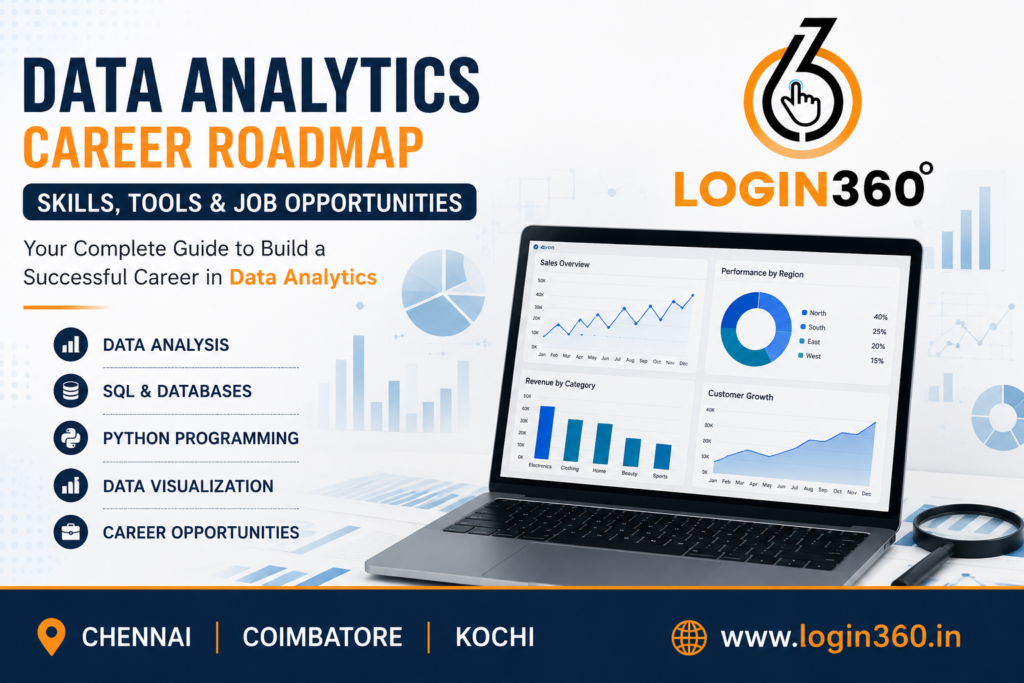
In today’s data driven world, organizations rely on data to make smarter decisions, improve customer experiences, and drive business growth. As a result, data analytics has become one of the most in demand career paths across industries such as healthcare, finance, retail, e-commerce, and technology. If you’re planning to start a career in this field, following a structured Data Analytics Career Roadmap can help you understand the essential skills, tools, certifications, and career opportunities required to succeed. Whether you’re a student, a recent graduate, or a professional looking for a career change, this guide will provide a step by step roadmap to help you build a strong foundation and confidently begin your journey as a data analyst.
What is Data Analytics?
Data analytics is the process of collecting, organizing, cleaning, and analyzing raw data to discover meaningful patterns, trends, and insights that help individuals and organizations make informed decisions. Instead of relying on intuition or guesswork, businesses use data analytics to improve operations, understand customer behavior, optimize marketing strategies, reduce costs, and increase profitability. A data analyst uses tools such as Excel, SQL, Python, Power BI, and Tableau to transform complex datasets into easy to understand reports and interactive dashboards that support business goals. Today, data analytics plays a crucial role in industries like healthcare, finance, retail, e-commerce, education, manufacturing, and technology, making it one of the most valuable and rapidly growing career fields in the digital era.
Why Choose a Career in Data Analytics?
- Choosing a career in data analytics offers excellent growth opportunities and long term stability. Companies increasingly depend on data driven decision making, making skilled data analysts valuable across multiple industries.
- Another advantage is the variety of career paths available. After gaining experience, professionals can move into roles such as Business Analyst, BI Analyst, Data Scientist, Analytics Consultant, or Product Analyst.
- The field also encourages continuous learning. As new technologies and analytical methods emerge, professionals can expand their expertise and remain competitive in the job market. This makes data analytics an exciting career for individuals who enjoy problem solving, technology, and business strategy.
Who Can Become a Data Analyst?
Anyone with an interest in data and problem solving can become a data analyst, regardless of their educational background. A computer science degree is helpful but not mandatory to start a career in data analytics. Students and professionals from fields like commerce, finance, marketing, healthcare, and engineering can transition into this role by learning key analytical skills. Employers mainly look for practical experience, analytical thinking, and proficiency in tools like Excel, SQL, Python, and Power BI.
Essential Skills for Data Analytics
- Analytical Thinking: Analytical thinking helps professionals identify patterns, solve business problems, and interpret complex datasets. Strong analytical skills allow analysts to convert raw information into actionable insights.
- Statistics and Mathematics: Basic statistical concepts such as averages, probability, distributions, hypothesis testing, and correlation help analysts understand data accurately and make informed decisions.
- Problem Solving: Organizations hire analysts to solve real business challenges. Being able to define problems, evaluate solutions, and recommend improvements is a valuable skill.
- Communication Skills: Technical findings need to be presented in simple language. Good communication enables analysts to explain insights through reports, dashboards, and presentations that business stakeholders can understand.
Technical Skills You Need
- Microsoft Excel: Excel remains one of the most widely used tools for analyzing business data. Learning formulas, pivot tables, charts, conditional formatting, lookup functions, and Power Query can significantly improve productivity.
- SQL: SQL (Structured Query Language) is essential for retrieving and managing data stored in databases. Analysts use SQL to filter records, combine tables, summarize data, and generate reports efficiently.
- Python: Python has become one of the most popular programming languages for data analytics because of its simplicity and powerful libraries. Tools like Pandas, NumPy, Matplotlib, and Scikit learn allow analysts to manipulate data, perform analysis, and automate repetitive tasks.
- R (Optional): R is another programming language used primarily for statistical analysis and research. While Python is more commonly requested by employers, learning R can be beneficial for specialized analytics roles.
- Data Visualization: Visualization tools like Power BI and Tableau help analysts create interactive dashboards that communicate insights clearly. Learning how to design meaningful charts and dashboards is an essential skill.
Tools Every Data Analyst Should Learn
- Microsoft Excel for data organization and reporting.
- SQL Databases such as MySQL or PostgreSQL for querying business data.
- Power BI for building interactive dashboards.
- Tableau for advanced data visualization.
- Python with libraries like Pandas, NumPy, and Matplotlib for automation and analysis.
- Google Sheets for collaboration and cloud based reporting.
Step by Step Data Analytics Roadmap
Step 1: Learn Excel
Start with Excel to understand data organization, calculations, sorting, filtering, pivot tables, and visualization.
Step 2: Master SQL
Learn SQL fundamentals including SELECT statements, filtering, joins, grouping, subqueries, and aggregate functions.
Step 3: Learn Statistics
Understand descriptive statistics, probability, distributions, correlation, and hypothesis testing to interpret data correctly.
Step 4: Learn Python
Study Python basics before moving on to libraries like Pandas, NumPy, and Matplotlib. Practice data cleaning, analysis, and visualization.
Step 5: Build Dashboards
Create dashboards using Power BI or Tableau. Learn how to present key performance indicators (KPIs), trends, and business insights effectively.
Step 6: Work on Real Projects
Apply your knowledge by analyzing publicly available datasets. Build projects involving sales analysis, customer segmentation, financial reporting, or marketing analytics.
Step 7: Create a Portfolio
Upload projects to GitHub or create a personal portfolio website. Include project descriptions, dashboards, SQL queries, and business insights to showcase your skills.
Step 8: Apply for Jobs
Prepare your resume, optimize your LinkedIn profile, practice interview questions, and apply for internships or entry level data analyst positions.
Data Analytics Certifications
Data analytics certifications help validate your skills and strengthen your resume, though they are not mandatory for getting a job. Popular certifications include Google Data Analytics, Microsoft Power BI, Tableau, IBM Data Analyst, and SQL or Python certifications. Employers value certifications that include hands on projects and real world case studies. Choosing practical, industry recognized programs can improve your skills, portfolio, and job opportunities.
Job Roles in Data Analytics
- Data Analyst: Collects, cleans, analyzes, and visualizes data to support business decisions.
- Business Analyst: Bridges business requirements with technical solutions by analyzing organizational processes and recommending improvements.
- BI Analyst: Builds dashboards, business reports, and data visualization solutions that help management monitor business performance.
- Reporting Analyst: Creates recurring reports, tracks KPIs, and ensures stakeholders receive accurate business information.
- Product Analyst: Analyzes product usage, customer behavior, and feature performance to improve digital products and user experiences.
- Marketing Analyst: Measures marketing campaigns, customer acquisition, advertising performance, and return on investment using data driven insights.
Industries Hiring Data Analysts
- Information Technology: Analyze user data, system performance, and business metrics to improve software products and services.
- Banking and Financial Services: Use data to detect fraud, assess risks, analyze customer behavior, and support financial decision making.
- Healthcare: Analyze patient records, treatment outcomes, and operational data to improve healthcare services and efficiency.
- E-commerce: Track customer purchasing behavior, sales trends, and website performance to increase revenue and customer satisfaction.
- Retail: Monitor inventory, sales performance, and customer preferences to optimize business operations and marketing strategies.
- Manufacturing: Analyze production data to improve quality, reduce costs, and increase operational efficiency.
- Telecommunications: Evaluate network performance, customer usage patterns, and service quality to enhance customer experience.
- Education: Use student performance and institutional data to improve learning outcomes and administrative planning.
- Logistics and Supply Chain: Analyze shipping, inventory, and delivery data to streamline supply chain operations and reduce delays.
- Digital Marketing: Measure campaign performance, website traffic, and customer engagement to optimize marketing strategies.
- Government Organizations: Analyze public data to support policy decisions, resource allocation, and public service improvements.
- Consulting Firms: Help clients solve business challenges by analyzing data and providing actionable insights for strategic decision making.
How to Build a Strong Portfolio
A strong data analytics portfolio showcases your practical skills and helps you stand out to employers. Include real world projects using tools like Excel, SQL, Python, Power BI, and Tableau, and explain the business problem, dataset, analysis process, and key insights for each project. Publishing your portfolio on GitHub or a personal website can improve your visibility and credibility with recruiters.
- The Business Problem: Clearly define the real world challenge or objective that the data analysis aims to solve.
- The Dataset Used: Mention the source and type of data used for the project, including its size and key variables.
- Data Cleaning Process: Explain how you handled missing values, duplicates, errors, and inconsistent data to prepare it for analysis.
- Analysis Performed: Describe the techniques, queries, or statistical methods used to uncover patterns and insights from the data.
- Dashboard or Visualization Created: Showcase the charts, graphs, or interactive dashboards built to present the analysis effectively.
- Key Insights and Recommendations: Summarize the main findings and provide actionable recommendations based on the data analysis.
Future Trends in Data Analytics
AI Assisted Analytics
Artificial intelligence is making data analysis faster by automating data preparation, anomaly detection, and report generation.
Cloud Analytics
Organizations increasingly store and analyze data on cloud platforms such as AWS, Microsoft Azure, and Google Cloud, making cloud analytics an important skill for future professionals.
Data Storytelling
Beyond technical analysis, businesses want professionals who can communicate insights effectively. Data storytelling combines visualization, narrative, and business context to influence decision making and drive organizational success.
Conclusion
A successful career in data analytics is built on continuous learning, practical experience, and the ability to solve real world business problems using data. By mastering essential skills like Excel, SQL, Python, statistics, and data visualization tools, while working on hands on projects and building a strong portfolio, you can significantly improve your chances of landing a rewarding role in the industry. As businesses continue to embrace data driven decision making, the demand for skilled data analysts will only continue to grow, making now the perfect time to start following this Data Analytics Career Roadmap and invest in a future proof career.



[…] Data Analyst career is one of the most common entry-level positions. These professionals gather, clean, and analyze […]
[…] Data analytics refers to the process of storing, processing, and analyzing data using cloud computing platforms […]