
Table of Contents
Introduction
Python Full Stack Development is one of the most valuable skills for aspiring software professionals. As businesses invest in web applications, cloud platforms, and digital services, the demand for developers who can create both the frontend and backend of an application is steadily increasing. Python, with its simple syntax and strong capabilities, has become a favored programming language for building scalable and secure web applications. Learning Python Python full Stack Development gives you the knowledge to work on every stage of web application development. Instead of focusing on just one area, you learn to design user interfaces, develop server-side logic, manage databases, and deploy complete applications. This versatility makes you an asset in startups, IT companies, product-based organizations, and freelance projects.
What is Python Full Stack Development?
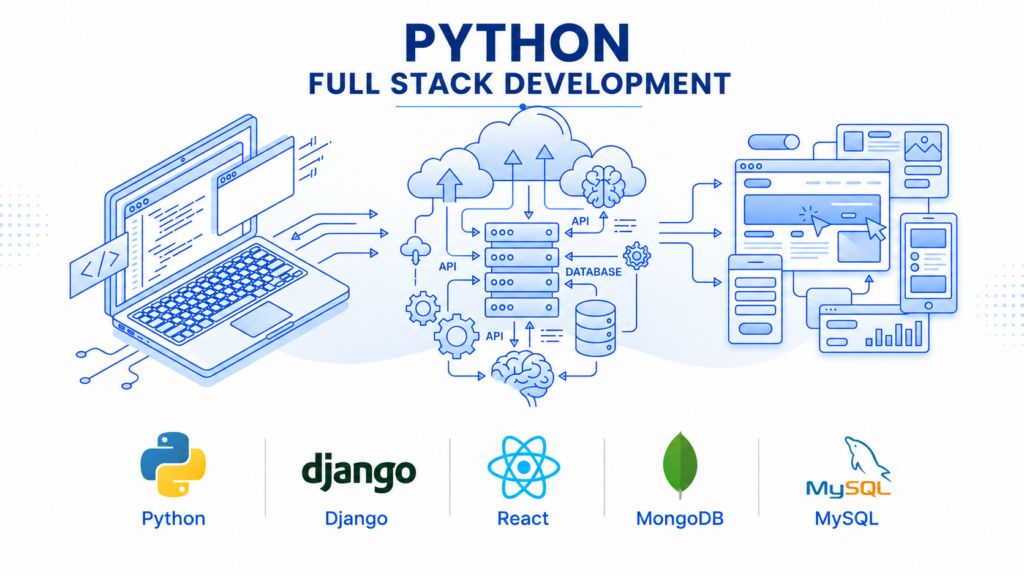
Python Full Stack Development means building complete web applications using Python for backend development along with frontend technologies like HTML, CSS, and JavaScript. A full stack developer can handle both the visual interface that users see and the server-side logic that makes the application run. The frontend focuses on creating responsive and interactive experiences for users. Developers use HTML to structure web pages, CSS to style them, and JavaScript to add dynamic features. Frameworks like Bootstrap and React further enhance design efficiency and user engagement. On the backend, Python frameworks like Django and Flask make application development easier by providing built-in features for authentication, routing, security, and database management.
Why Python is the Preferred Programming Language?
Python has gained a reputation as one of the easiest programming languages to learn while still being powerful enough for enterprise-level software development. Its readable syntax allows beginners to grasp programming concepts quickly without getting lost in complex code. Another reason for Python’s popularity is its broad ecosystem of libraries and frameworks. Developers can use built-in tools to simplify tasks like web development, automation, artificial intelligence, machine learning, and data analysis. This cuts down on development time and boosts productivity. Python is also compatible with various operating systems and integrates well with cloud platforms, APIs, and databases.
Key Skills You Will Learn in Python Full Stack Development
Frontend Development
Frontend development focuses on creating the visual elements of a website that users interact with directly. By learning HTML, CSS, JavaScript, Bootstrap, and React, you can build responsive, interactive, and user-friendly interfaces that provide a seamless experience across desktops, tablets, and mobile devices.
Backend Programming
Backend programming involves developing the server-side logic that powers web applications. Using Python frameworks like Django and Flask, developers can handle user authentication, process requests, connect with databases, manage APIs, and ensure applications run securely and efficiently.
Database Management
Database management is essential for storing and organizing application data. Learning MySQL and PostgreSQL helps developers create, retrieve, update, and delete data while maintaining accuracy, security, and high performance for web applications.
Version Control and Deployment
Version control and deployment skills enable developers to manage source code and publish applications efficiently. Tools like Git and GitHub help track code changes and support team collaboration, while REST APIs, Docker, and cloud platforms simplify application integration, testing, deployment, and scalability.
Benefits of Learning Python Full Stack Development
- Python full Stack Development provides many advantages for individuals looking for a long-term career in software development.
- As organizations prefer developers who understand multiple technologies, learning the full stack greatly enhances job prospects.
- Developers with expertise in both frontend and backend can contribute throughout the software development process. This reduces reliance on various specialists and improves project efficiency.
- Python’s versatility also allows developers to transition into emerging fields like artificial intelligence, data science, cloud computing, and automation.
- The same programming language can be used across several areas, making career growth more flexible.
- Additionally, companies value professionals who can solve problems independently, collaborate across teams, and understand the complete structure of an application. These qualities often lead to faster career advancement and better salary prospects.
Career Opportunities After Learning Python Full Stack Development
- Python Full Stack Developer: Develops complete web applications by handling both frontend and backend development using Python and related technologies.
- Backend Python Developer: Focuses on building server-side logic, managing databases, creating APIs, and ensuring applications run securely and efficiently.
- Software Engineer: Designs, develops, tests, and maintains software solutions that meet business and user requirements across various platforms.
- Web Application Developer: Creates interactive, responsive, and functional web applications that provide seamless user experiences across devices.
- Full Stack Software Engineer: Manages the entire software development process, from designing user interfaces to developing backend systems and deploying applications.
- API Developer: Builds and maintains Application Programming Interfaces (APIs) that enable different software systems and applications to communicate securely.
- Django Developer: Specializes in developing scalable and secure web applications using the Django framework and Python programming language.
- Flask Developer: Develops lightweight, flexible, and customized web applications using the Flask framework for Python.
- Technical Consultant: Provides technical guidance, recommends suitable software solutions, and helps organizations implement technology effectively.
- Freelance Web Developer: Works independently by designing, developing, and maintaining websites and web applications for clients across different industries.
Industries Hiring Python Full Stack Developers
- Python Full Stack Developers are needed across many industries because web applications have become vital for business operations.
- Companies seek professionals who can build secure, scalable, and high performing software solutions.
- The IT and software services industry is one of the largest employers of Python developers. However, demand has significantly expanded into sectors such as healthcare, where applications handle patient records and telemedicine platforms.
- Financial institutions use Python-based systems for secure transactions, analytics, and customer management.
- E-commerce businesses rely on Python developers to create online shopping platforms, payment systems, and inventory management applications.
- Educational technology companies also use Python to develop learning management systems, virtual classrooms, and online assessments.
- As industries embrace digital transformation, Python Full Stack Developers find opportunities in various business areas.
Essential Tools and Technologies for Python Full Stack Developers
A successful Python Full Stack Developer uses various tools that enhance productivity and simplify application development.
- Code Editors – Visual Studio Code and PyCharm offer intelligent coding features and debugging support.
- Frameworks – Django and Flask speed up backend development with built-in security and routing options.
- Databases – MySQL and PostgreSQL assist in managing structured application data efficiently.
- Version Control – Git and GitHub enable developers to collaborate, track code changes, and maintain project history.
- Deployment Tools – Docker, cloud platforms, and CI/CD pipelines help developers deploy applications reliably and scale them effectively.
Tips to Become a Successful Python Full Stack Developer
- Building a successful career requires more than just learning programming concepts. Practical experience and continuous improvement are equally important.
- Practice coding every day to enhance logical thinking and problem solving skills.
Build realnworld projects like e-commerce websites, blogging platforms, dashboards, and portfolio applications. - Upload projects to GitHub to showcase technical skills during interviews. Stay updated with new Python frameworks, frontend technologies, and cloud services.
- Participate in coding challenges, hackathons, and developer communities to improve practical knowledge and networking.
- Sticking to these habits consistently helps developers stay competitive in the fast-changing software industry.
Conclusion
Python Full Stack Development combines versatility, career growth, and practical application. By learning both frontend and backend technologies, developers can create complete web applications that meet modern business needs. Python’s simplicity, wide ecosystem, and strong industry use make it one of the best programming languages for aspiring software professionals. Whether your goal is to land your first IT job, switch to software development, or expand your technical skills, investing time in Python Full Stack Development can be a rewarding choice. Continuous learning, hands-on project experience, and familiarity with modern development tools will help you build confidence and stay competitive in the tech industry. As businesses keep embracing digital innovation, skilled Python Full Stack Developers will be in high demand, making this a strong career path for long-term professional success.