

Data is a crucial component in decision making, understanding customers’ behavior, streamlining operations, and identifying growth areas in today’s data-driven environment. Nonetheless, the utility of any raw data is almost negligible without access and proper organization and analysis. This is where SQL for data analytics comes into play. If your goal is to become a Data Analyst, a Business Analyst, a Data Scientist, a Marketing Analyst, a Business Intelligence specialist, and more, learning SQL would greatly enhance your ability to analyze data. The importance of SQL as the key to unlocking the power of databases and deriving insights from there cannot be overstated. That makes SQL one of the highly demanded technical skills out there. Let’s look closer at why learning SQL for analytics is so important and why.
What Is SQL?
SQL (Structured Query Language) is a programming language designed specifically for managing and querying relational databases. It enables users to retrieve, organize, filter, update, and analyze large volumes of data stored in database systems.
Organizations store vast amounts of information such as:
- Customer records
- Sales transactions
- Marketing performance data
- Website analytics
- Product inventory
- Financial reports
- Employee information
SQL allows analysts to access this data efficiently and convert it into actionable business insights.
Unlike complex programming languages, SQL is relatively easy to learn because it uses straightforward commands and a logical structure. This makes it an ideal starting point for anyone entering the field of data analytics.
Why Is SQL Important for Data Analytics?
The core of data analytics lies in the generation of useful insights from data. Prior to visualizing or modeling the data, there is a need to first collect, clean, filter, and organize it. Here comes the importance of SQL.
Organizations tend to hold data within their relational databases, for instance, MySQL, PostgreSQL, Microsoft SQL Server, Oracle, and others. Using SQL, one interacts directly with the data and extracts precisely what is needed for analysis.
In the absence of SQL, one would have to rely on database administrators or developers in order to access the necessary data, hence making the decision process lengthy and inefficient.
Mastering SQL for data analytics helps professionals to be self-sufficient when dealing with data analysis.
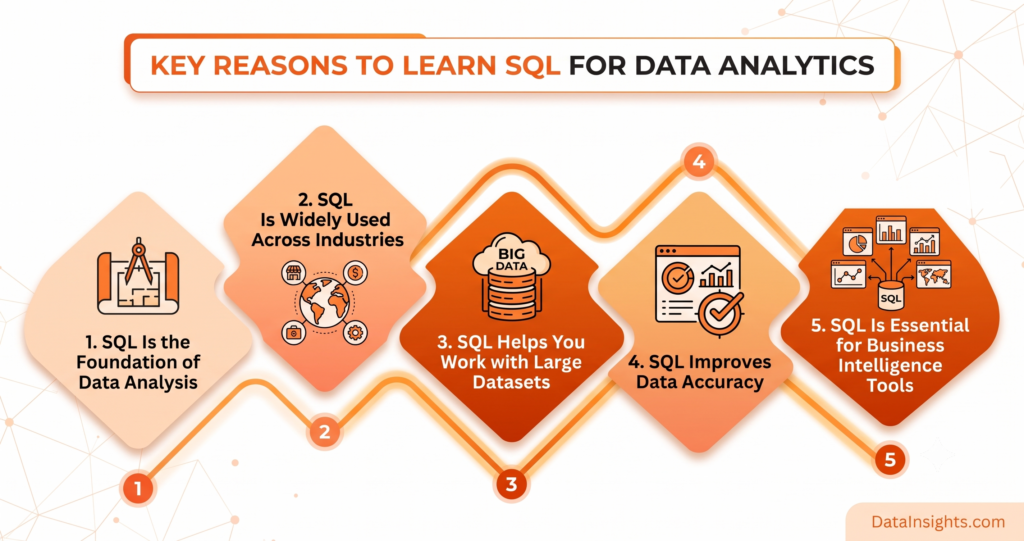
Key Reasons to Learn SQL for Data Analytics
1. SQL Is the Foundation of Data Analysis
Before creating dashboards or generating reports, analysts need access to accurate data. SQL provides the tools needed to retrieve and manipulate information from databases.
Common SQL operations include:
- Selecting relevant records
- Filtering data based on conditions
- Sorting information
- Grouping and aggregating data
- Combining multiple datasets
- Identifying trends and patterns
These tasks form the foundation of nearly every analytics project.
2. SQL Is Widely Used Across Industries
One of the biggest advantages of learning SQL is its universal adoption.
Industries that heavily rely on SQL include:
- Healthcare
- Banking and Finance
- E-commerce
- Retail
- Manufacturing
- Telecommunications
- Education
- Digital Marketing
- Logistics
Regardless of the industry, organizations need professionals who can access and analyze business data efficiently.
This broad applicability makes SQL a highly transferable and valuable skill.
3. SQL Helps You Work with Large Datasets
Spreadsheets are useful for small datasets, but they become inefficient when handling millions of records.
Modern businesses generate enormous amounts of data every day. SQL enables analysts to process large datasets quickly and accurately without affecting performance.
For example, an e-commerce company may store millions of customer transactions. Using SQL, analysts can retrieve specific information within seconds, such as:
- Top-selling products
- Monthly revenue trends
- Customer retention rates
- Regional sales performance
This capability is essential for effective data analysis.
4. SQL Improves Data Accuracy
Manual data handling often increases the risk of errors. SQL allows analysts to automate data retrieval and ensure consistency across reports.
By using structured queries, professionals can:
- Eliminate duplicate records
- Validate data quality
- Standardize calculations
- Create repeatable reporting processes
Accurate data leads to more reliable business decisions and better analytical outcomes.
5. SQL Is Essential for Business Intelligence Tools
Many popular business intelligence and data visualization platforms rely on SQL behind the scenes.
Examples include:
- Power BI
- Tableau
- Looker
- Google Data Studio
- Qlik Sense
Although these tools provide visual interfaces, SQL knowledge helps users:
- Connect to databases
- Create custom queries
- Build efficient reports
- Troubleshoot data issues
- Optimize dashboard performance
Professionals who understand SQL often gain greater control over their analytics workflows.
Real-World Applications of SQL in Data Analytics
SQL is used daily by data professionals to answer important business questions.
Sales Analysis
Organizations use SQL to analyze:
- Monthly sales growth
- Revenue by product category
- Top-performing sales regions
- Customer purchasing patterns
These insights help businesses improve profitability and sales strategies.
Customer Analytics
Customer data is one of the most valuable assets for modern organizations.
Using SQL, analysts can identify:
- High-value customers
- Customer churn trends
- Purchase frequency
- Customer lifetime value
These insights support better customer retention and engagement strategies.
Marketing Performance Analysis
Marketing teams frequently use SQL for data analytics to measure campaign effectiveness.
Common analyses include:
- Website traffic performance
- Conversion rates
- Lead generation metrics
- Advertising ROI
- Customer acquisition costs
This information helps marketers optimize campaigns and improve results.
Financial Reporting
Finance teams use SQL to:
- Monitor expenses
- Track revenue streams
- Generate financial reports
- Analyze profit margins
- Forecast future performance
Accurate financial analysis supports strategic planning and budgeting.
SQL Skills Every Data Analyst Should Learn
To become proficient in analytics, it’s important to master core SQL concepts.
SELECT Statements
The SELECT command retrieves information from a database and serves as the starting point for most SQL queries.
Filtering with WHERE
The WHERE clause helps analysts extract specific records based on conditions.
Sorting with ORDER BY
Sorting allows users to arrange data in ascending or descending order.
Aggregation Functions
Functions such as:
- COUNT()
- SUM()
- AVG()
- MAX()
- MIN()
help summarize large datasets and uncover trends.
GROUP BY
Grouping enables analysts to categorize data and perform calculations for each category.
JOIN Operations
JOIN statements combine information from multiple tables, allowing analysts to work with complex datasets.
Subqueries
Subqueries enable more advanced analysis by embedding one query inside another.
Window Functions
Window functions help calculate rankings, running totals, moving averages, and other advanced metrics.
Mastering these concepts significantly enhances analytical capabilities.
Why Employers Value SQL Skills
SQL consistently ranks among the most requested skills in data-related job postings.
Employers prefer candidates who can:
- Access data independently
- Generate accurate reports
- Support business decisions
- Work with large datasets
- Collaborate with technical teams
SQL serves as a common language between analysts, developers, data engineers, and business stakeholders.
As organizations continue investing in data-driven strategies, demand for SQL professionals remains strong.
SQL and Career Opportunities
Learning SQL for data analytics can open doors to various career paths.
Popular roles include:
Data Analyst
Data Analysts use SQL to collect, clean, analyze, and interpret business data.
Business Analyst
Business Analysts leverage SQL to identify operational improvements and support strategic decision-making.
Marketing Analyst
Marketing Analysts use SQL to evaluate campaign performance and customer behavior.
Financial Analyst
Financial Analysts rely on SQL to generate reports and perform financial analysis.
Data Scientist
Although Data Scientists often use Python and machine learning tools, SQL remains essential for accessing and preparing data.
Business Intelligence Analyst
BI Analysts use SQL extensively to build dashboards and generate business reports.
Because SQL is applicable across multiple roles, learning it increases career flexibility and job opportunities.
SQL Complements Other Data Analytics Skills
SQL is often combined with other analytics tools and technologies.
Popular combinations include:
SQL and Excel
Excel is useful for reporting and quick analysis, while SQL handles large datasets efficiently.
SQL and Power BI
SQL retrieves and prepares data, while Power BI visualizes insights through interactive dashboards.
SQL and Tableau
Many organizations use SQL with Tableau to create data-driven visualizations and business reports.
SQL and Python
Python enables advanced analytics and automation, while SQL provides efficient access to database information.
Together, these skills create a powerful analytics toolkit.
Is SQL Difficult to Learn?
One of the biggest misconceptions about SQL is that it is difficult to master.
In reality, SQL is considered one of the most beginner-friendly technical skills in data analytics.
Reasons include:
- Simple syntax
- Easy-to-understand commands
- Immediate practical application
- Strong community support
- Extensive learning resources
Most learners can grasp the basics within a few weeks of consistent practice.
The key to success is working with real datasets and practicing query writing regularly.
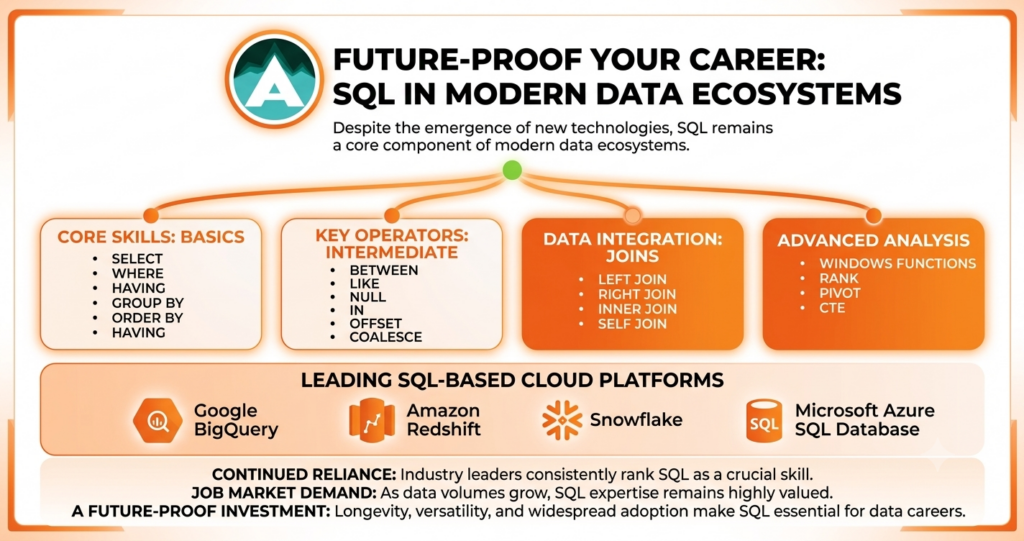
Future Demand for SQL in Data Analytics
Despite the emergence of new technologies, SQL remains a core component of modern data ecosystems.
Cloud platforms such as:
- Google BigQuery
- Amazon Redshift
- Snowflake
- Microsoft Azure SQL Database
continue to rely heavily on SQL for data management and analysis.
As organizations generate increasing volumes of data, professionals who understand SQL will remain valuable in the job market.
Industry experts consistently rank SQL among the most important skills for aspiring data analysts.
Its longevity, versatility, and widespread adoption make it a future-proof investment for anyone interested in data careers.
Conclusion
Studying SQL in terms of data analysis is probably one of the most intelligent things to do if you are going to build a career in data. SQL allows you to use the data efficiently through accessing, organizing, analyzing and interpreting the information, which makes SQL an essential skill for any analyst.
Sales and customer reports, marketing analytics, financial forecasts – everything is based on the results of working with SQL databases. It allows analysts to manage huge amounts of data, increase its accuracy and get valuable conclusions from this process.
SQL is an excellent basis for both beginners who are just beginning their journey in the world of data analysis and experienced professionals who want to upgrade their knowledge about data. The growing need in data-based decision making will only increase your chances of having a successful career.