
Table of Contents
Introduction
The technology industry is continuously growing, creating exciting career opportunities for students, fresh graduates, and working professionals. Businesses increasingly depend on digital products, web applications, and software solutions to improve their operations and customer experiences. As a result, the demand for skilled professionals who can develop, manage, and maintain complete software products is increasing. One career path gaining attention in the technology industry is full stack product engineering career.
Full stack product engineering combines frontend development, backend development, database management, software testing, and product development practices. It helps professionals understand how an application works from the user interface to the server and database. Unlike traditional development roles that focus on a single area, full stack product engineers work across different stages of the product development lifecycle. Choosing this career path can provide opportunities to work on real-world projects, develop technical expertise, and build a strong professional future in the software industry.
Growing Demand for Full Stack Product Engineers
One of the main reasons to choose a full stack product engineering career is the increasing demand for professionals with diverse technical skills. Companies need developers who can understand different parts of an application and contribute to complete product development.
Businesses across industries such as healthcare, finance, education, e-commerce, and information technology depend on software products. These organizations require professionals who can develop responsive websites, scalable applications, and efficient backend systems.
Full stack product engineers can contribute to multiple development activities, making them valuable members of software development teams. Their ability to understand both frontend and backend technologies helps organizations manage projects more efficiently.
Opportunity to Learn Multiple Technologies
A major advantage of full stack product engineering is the opportunity to work with different technologies and tools. Instead of concentrating on only one programming language or development area, professionals gain knowledge across several technical domains.Some important technologies include:
- HTML and CSS: Used to structure and style web pages.
- JavaScript: Helps create interactive and dynamic web applications.
- React: A popular JavaScript library for building user interfaces.
- Node.js: Used for developing server-side applications.
- Python: Supports backend development and application logic.
- SQL and MongoDB: Used for database management and data storage.
- Git and GitHub: Help developers manage and collaborate on code.
- APIs: Enable communication between different software applications.
Better Career Opportunities Across Industries
- Information Technology: Software companies hire developers to build websites, enterprise applications, and software products.
- E-commerce: Online shopping platforms need professionals to develop payment systems, product pages, shopping carts, and order management applications.
- Healthcare: Hospitals and healthcare organizations use digital platforms for appointment booking, patient management, and medical records.
- Banking and Finance: Financial institutions require secure applications for online banking, transactions, and customer management.
- Education: Educational institutions use learning management systems, online examination platforms, and digital classrooms.
Ability to Build Complete Software Products
One of the most exciting aspects of this career is the ability to develop complete software applications.A full stack product engineer understands how different application components work together. They can create the frontend interface, develop backend functionality, connect databases, and integrate APIs.For example, when developing an online shopping application, a full stack engineer may work on:
- Designing the website interface.
- Creating user registration and login functionality.
- Developing product listing pages.
- Integrating shopping cart features.
- Connecting payment gateways.
- Managing product and customer databases.
- Testing application performance.
Attractive Salary and Career Growth
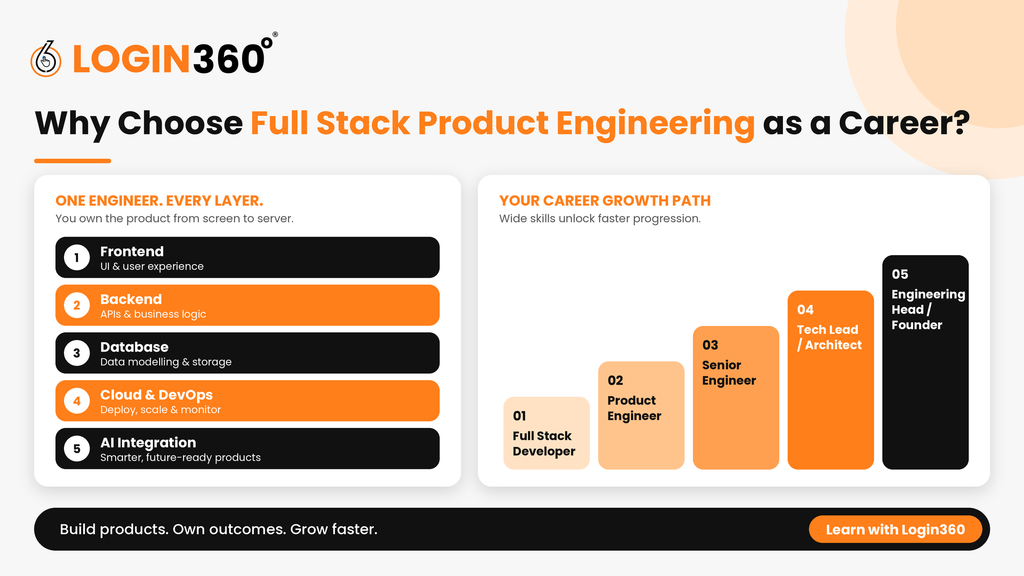
Salary potential is another reason why many students and professionals consider a full stack product engineering career.Compensation depends on factors such as technical knowledge, practical experience, project portfolio, company requirements, and location. Professionals with strong programming skills and experience in modern development technologies may find opportunities for career advancement.With experience, full stack engineers can move into advanced technical and leadership positions, including:
- Junior Full Stack Developer
- Full Stack Developer
- Senior Software Engineer
- Full Stack Product Engineer
- Technical Lead
- Software Architect
- Engineering Manager
Develop Problem-Solving and Practical Skills
Software development involves identifying problems and creating effective solutions. Full stack product engineering encourages professionals to develop logical thinking, analytical abilities, and problem-solving skills.Developers regularly work with different challenges, such as fixing coding errors, improving application performance, managing databases, and resolving technical issues.
Working on real-world projects also improves practical knowledge. Instead of learning programming concepts only through theory, students get opportunities to apply their knowledge to actual development tasks.These experiences help build confidence and prepare candidates for professional software development environments.
Opportunities for Freelancing and Entrepreneurship
A full stack product engineering career also provides opportunities beyond traditional employment.Professionals with full stack development knowledge can work as freelancers and provide services to businesses, startups, and individual clients.They can develop websites, business applications, e-commerce platforms, and customized software solutions.This technical knowledge can also support entrepreneurship. Individuals who understand the complete development process can build their own digital products, launch startups, or create software solutions to solve real-world problems.Therefore, full stack product engineering offers flexibility in choosing different career paths.
What Skills Are Required to Become a Full Stack Product Engineer?
- Programming Knowledge: Programming knowledge is the foundation of a successful full stack product engineering career. Developers should understand programming concepts such as variables, functions, loops, conditional statements, and object-oriented programming. Languages like JavaScript and Python are widely used in software development for creating interactive applications and managing backend operations.
- Frontend Development: Frontend development focuses on creating the visual and interactive parts of a website or application that users interact with directly. A full stack product engineer should have a good understanding of HTML, CSS, JavaScript, and React. HTML provides the structure of web pages, while CSS controls their appearance, layout, and design.
- Backend Development:Backend development involves managing the server-side functionality of an application. It handles business logic, user authentication, data processing, and communication between the frontend and database. Technologies such as Node.js, Python, and Java are commonly used for backend development. Full stack product engineers should understand how servers work, how applications process user requests, and how information is transferred between different components.
- Database Management: Database management is another essential skill for professionals pursuing a full stack product engineering career. Databases are used to store, organize, retrieve, and manage application information. Developers should understand both SQL and NoSQL databases based on project requirements. SQL databases such as MySQL and PostgreSQL organize information using structured tables, whereas NoSQL databases such as MongoDB support flexible data storage formats
- API Integration: API integration allows different software applications and services to communicate with each other. APIs (Application Programming Interfaces) help developers connect frontend applications with backend systems and external platforms.
- Version Control:Version control is an important part of modern software development because it helps developers track changes made to source code. Tools such as Git and GitHub allow development teams to manage code, collaborate on projects, and maintain different versions of applications.
- Testing and Debugging: Testing and debugging are essential for maintaining software quality and application performance. Testing helps developers identify whether different features work as expected, while debugging involves finding and correcting errors in the code. Full stack product engineers should understand different testing approaches, including unit testing, integration testing, and functional testing.
- Communication Skills: Technical knowledge alone is not enough to build a successful full stack product engineering career. Communication skills are equally important because software development often involves working with designers, developers, project managers, clients, and other team members.
- Problem-Solving: Problem-solving is one of the most valuable skills required for full stack product engineers. During software development, professionals may face challenges related to coding errors, database performance, application security, and system functionality. Developers should be able to analyze problems, identify their root causes, and implement suitable solutions.
How Can Freshers Start a Career in Full Stack Product Engineering?
- Step 1: Learn Programming Fundamentals: Start by understanding programming concepts, variables, functions, loops, and object-oriented programming.
- Step 2: Understand Frontend Development: Learn HTML, CSS, JavaScript, and a frontend framework such as React to create responsive user interfaces.
- Step 3: Learn Backend Development: Understand server-side programming, application logic, authentication, and API development.
- Step 4: Practice Database Management: Learn how to store, retrieve, and manage application data using SQL or NoSQL databases.
- Step 5: Build Real-World Projects: Create practical projects such as portfolio websites, online shopping applications, task management systems, and student management platforms.
- Step 6: Develop a Strong Portfolio: Upload projects to GitHub and create a professional portfolio to demonstrate your technical abilities to potential employers.
Conclusion
Choosing a full stack product engineering career can be a valuable decision for students, fresh graduates, and working professionals interested in the technology industry. It provides opportunities to learn multiple technologies, develop complete software products, work across different industries, and explore various career paths.
With knowledge of frontend development, backend programming, databases, APIs, and software development practices, professionals can build a strong foundation in the software industry. Practical experience, continuous learning, and real-world project development are essential for long-term career growth.
If you are interested in building innovative software applications and developing technical expertise, full stack product engineering can be a promising career choice.Want to build a successful career in Full Stack Product Engineering? Join Login360 and gain industry-relevant knowledge through practical training and real-world projects. Visit Login360 today to explore our courses and take the next step towards your technology career!
Frequently Asked Questions (FAQs)
1. What is a full stack product engineering career?
A full stack product engineering career involves developing and maintaining complete software products by working with frontend technologies, backend programming, databases, APIs, and software development tools.
2. Is full stack product engineering a good career choice?
Yes. It offers opportunities to work across different industries, develop multiple technical skills, build software products, and explore various career advancement options.
3. Can freshers learn full stack product engineering?
Yes. Freshers can start by learning programming fundamentals, frontend development, backend technologies, and database management. Practical projects help them develop the skills required for entry-level roles.
4. What programming languages are required for full stack product engineering?
JavaScript and Python are commonly used. Developers may also work with Java, PHP, and other programming languages depending on the project requirements.
5. What are the job opportunities after learning full stack product engineering?
Candidates can explore roles such as Full Stack Developer, Software Engineer, Backend Developer, Frontend Developer, and Full Stack Product Engineer.
6. How long does it take to learn full stack product engineering?
The learning duration depends on the individual’s background, learning schedule, and practice. With consistent learning and hands-on project development, beginners can gradually build the skills needed for entry-level opportunities.
7. Do I need a computer science degree to become a full stack product engineer?
A computer science degree can be helpful, but it is not always mandatory. Candidates from different educational backgrounds can enter this field by developing programming knowledge, practical skills, and a strong project portfolio.