

Table of Contents
Introduction
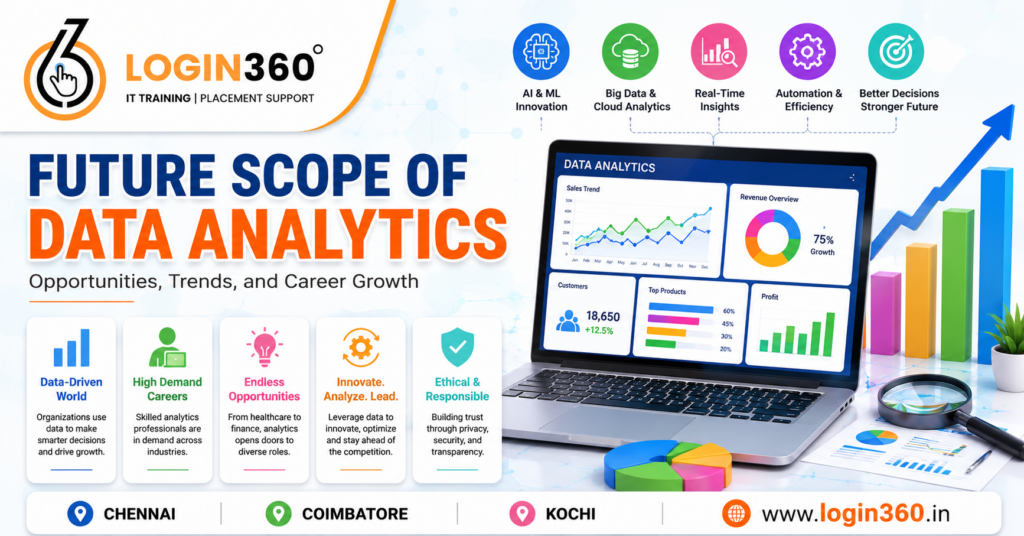
Data analytics has become a crucial part of today’s digital world, helping organizations transform vast amounts of data into meaningful insights. Every online activity, business transaction, and customer interaction generates data that can be analyzed to improve decision-making, enhance operational efficiency, and better understand customer behavior. As businesses continue to adopt digital technologies, the demand for data analytics is growing rapidly across industries. Its ability to uncover trends, predict outcomes, and support strategic planning makes it an essential tool for modern organizations. With increasing reliance on data-driven decision-making, the future scope of data analytics is expanding significantly, creating exciting opportunities for businesses, students, and professionals. As technology evolves, data analytics will continue to play a key role in driving innovation, competitiveness, and long-term growth.
The Evolution of Data Analytics
Data analytics has evolved significantly over the last few decades. In the past, businesses primarily relied on basic reports and spreadsheets to evaluate performance. Data analysis was often time-consuming, and insights were limited to historical information. With advancements in technology, organizations gained access to larger volumes of data and more powerful analytical tools. The introduction of databases, business intelligence platforms, cloud computing, and big data technologies transformed how companies collect and analyze information. Today, data analytics extends far beyond simple reporting. Modern analytics platforms can process massive datasets in real time, identify hidden patterns, and even predict future outcomes. Businesses now use descriptive, diagnostic, predictive, and prescriptive analytics to make smarter decisions. The continuous evolution of data analytics demonstrates its growing importance and highlights the tremendous opportunities that lie ahead.
Current Trends Shaping Data Analytics
Data analytics is evolving rapidly as organizations rely more on data-driven strategies to improve decision-making and business performance. Emerging technologies and advanced tools are making analytics faster, smarter, and more accessible than ever before. Businesses are increasingly using data to understand customers, optimize operations, and identify growth opportunities. As a result, several key trends are shaping the future of data analytics across industries. These developments are helping organizations gain deeper insights and maintain a competitive advantage.
- Big Data: Organizations generate massive volumes of data daily from websites, apps, and connected devices. Advanced technologies are required to store, process, and analyze this information efficiently.
- Real-Time Analytics: Businesses can access instant insights and respond quickly to market changes. This enables faster decision-making and improved operational performance.
- Cloud Analytics: Cloud platforms provide scalable and cost-effective analytics solutions. Companies can access powerful tools without investing heavily in infrastructure.
- Self-Service Analytics: User-friendly analytics tools allow non-technical employees to explore and visualize data. This encourages wider adoption of data-driven decision-making.
The Role of Artificial Intelligence and Machine Learning
Artificial Intelligence (AI) and Machine Learning (ML) are revolutionizing data analytics by enabling systems to analyze large volumes of data, identify patterns, and generate accurate predictions with minimal human intervention. AI-powered analytics tools can automate data processing, detect anomalies, and provide valuable recommendations, allowing analysts to focus on strategic decision-making rather than routine tasks. Machine learning algorithms play a key role in predictive analytics, helping businesses forecast sales, predict customer behavior, detect fraud, and optimize operations more effectively. In addition, AI enhances data visualization and reporting by transforming complex datasets into easy-to-understand dashboards, charts, and insights that support faster decision-making. As AI and ML technologies continue to advance, their ability to deliver deeper insights and improve analytical accuracy will grow, making them essential drivers of innovation and a major contributor to the future scope of data analytics across industries.
Future Technologies Transforming Data Analytics
Emerging technologies are rapidly transforming the field of data analytics and creating new opportunities for businesses. These innovations help organizations process data faster, gain deeper insights, and make smarter decisions. From AI-powered tools to connected devices, technology is making analytics more efficient and accessible. Companies are increasingly adopting advanced solutions to stay competitive in a data-driven environment. As these technologies continue to evolve, they will significantly shape the future of data analytics.
- Generative AI: Generates reports, summarizes data, and provides insights automatically. It helps analysts interpret complex datasets more efficiently.
- Edge Analytics: Processes data closer to its source instead of centralized servers. This improves speed and supports real-time decision-making.
- Internet of Things (IoT): Connected devices continuously generate valuable data. Analytics helps organizations extract meaningful insights from this information.
- Automation: Automates data preparation, cleansing, and reporting tasks. This increases efficiency, accuracy, and scalability in analytics workflows.
Industry-Wise Future Scope of Data Analytics
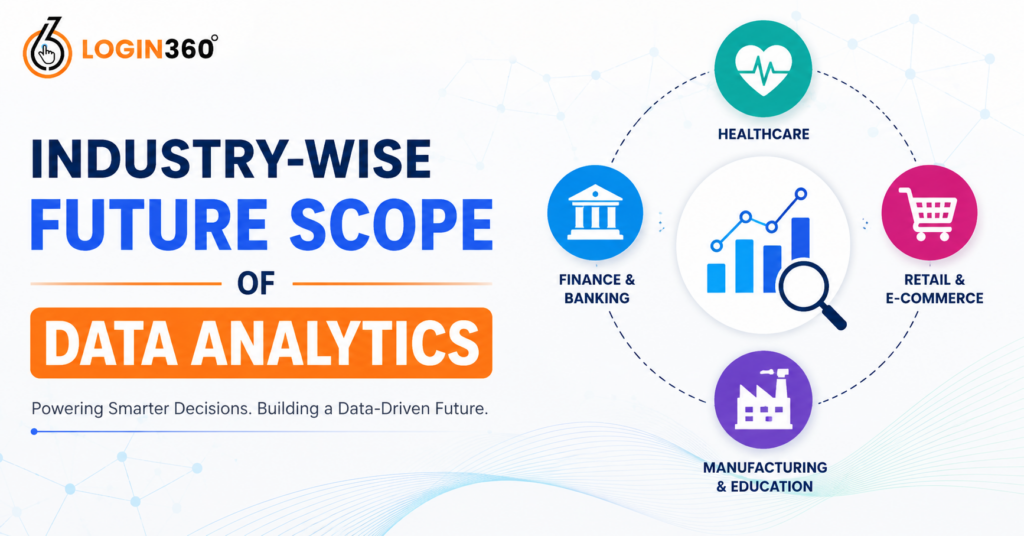
The future scope of data analytics is expanding across almost every industry as organizations increasingly rely on data-driven decision-making. Analytics helps businesses improve efficiency, reduce costs, and enhance customer experiences. From healthcare to education, data is transforming how services are delivered and managed. Organizations use analytics to identify trends, predict outcomes, and optimize operations. As digital transformation continues, the demand for advanced analytics solutions will grow significantly.
- Healthcare: Analytics improves patient care and supports medical research. Predictive models help identify health risks and enable preventive treatment.
- Finance and Banking: Data analytics helps detect fraud and assess financial risks. It also supports smarter investment and customer management decisions.
- Retail and E-commerce: Businesses use analytics to understand customer behavior and personalize shopping experiences. This helps increase sales and customer satisfaction.
- Manufacturing and Education: Analytics improves production efficiency and predicts maintenance needs. In education, it helps track student performance and personalize learning.
Career Opportunities in Data Analytics
The growing adoption of data analytics has created numerous career opportunities across industries, with organizations seeking professionals who can transform data into valuable business insights. As the future scope of data analytics expands, demand for skilled experts continues to rise, offering strong career growth and competitive salaries.
- Data Analyst: Analyzes datasets, identifies trends, and creates reports to support business decisions.
- Business Analyst: Connects business goals with data insights to improve strategies and operations.
- Data Scientist: Uses statistics, machine learning, and programming to solve complex business challenges.
- Data Engineer: Builds and maintains systems for collecting, storing, and processing data efficiently.
- Emerging Roles: Analytics Consultants, AI Specialists, Data Governance Managers, and Machine Learning Engineers are becoming increasingly important in modern organizations.
Benefits of Data Analytics for Businesses
Data analytics provides significant benefits that help businesses improve performance and achieve long-term success. By using data-driven insights instead of assumptions, organizations can make more informed and accurate decisions. Analytics helps businesses better understand customer preferences, behaviors, and purchasing patterns, enabling them to deliver personalized experiences and strengthen customer relationships. It also improves operational efficiency by identifying bottlenecks, optimizing workflows, and reducing costs. In addition, data analytics supports innovation by uncovering market trends and new business opportunities, allowing companies to develop products and services that meet changing customer needs. Furthermore, analytics enhances risk management by detecting unusual patterns, predicting potential challenges, and enabling proactive decision-making. These advantages make data analytics a valuable tool for organizations seeking growth, efficiency, and a competitive edge in today’s data-driven business environment.
Challenges and Ethical Considerations
While data analytics offers numerous benefits, it also presents challenges that organizations must address to ensure responsible and effective use of data. Data privacy is a major concern, as businesses collect and store large amounts of sensitive information that must be protected and handled according to regulations. Cybersecurity threats, including data breaches and cyberattacks, can lead to financial losses and reputational damage. Another important issue is bias in data and algorithms, which can result in unfair or inaccurate outcomes if not properly monitored. Maintaining high data quality is equally essential, as incomplete or incorrect data can lead to poor business decisions. As data analytics continues to evolve, organizations must prioritize transparency, fairness, accountability, and security to build trust and ensure ethical decision-making.
Future Scope of Data Analytics: Opportunities and Predictions
The future of data analytics is bright, with organizations increasingly investing in data-driven technologies to improve decision-making, innovation, and business growth.
- Growing Demand for Analytics Professionals: Businesses will need more skilled experts to analyze data and generate valuable insights.
- AI-Powered Analytics: Artificial intelligence will automate routine tasks and enable faster, more accurate decision-making.
- Increased Data Literacy: Understanding and using data will become an essential skill across all business functions.
- Predictive Analytics Growth: Organizations will use data to forecast trends, customer behavior, and future business outcomes.
- Prescriptive Analytics Adoption: Advanced analytics will recommend the best actions to achieve specific business goals.
- Data-Driven Business Strategies: Companies will increasingly rely on analytics to guide innovation, efficiency, and competitiveness.
- Technology-Driven Expansion: Emerging technologies will continue to enhance the capabilities and applications of data analytics.
How Students and Professionals Can Prepare for the Future
Students and professionals who want to build a successful career in data analytics should focus on developing both technical and analytical skills. Learning industry-standard tools such as Excel, SQL, Python, R, Power BI, and Tableau provides a strong foundation for analyzing and interpreting data effectively. Gaining practical experience through real-world projects is equally important, as it helps individuals apply theoretical knowledge, solve business challenges, and showcase their abilities to employers. Earning certifications from recognized platforms can further strengthen credibility and demonstrate expertise in analytics-related fields. Since technologies and methodologies continue to evolve, continuous learning is essential for staying competitive. In addition to technical knowledge, professionals should develop strong communication and problem-solving skills to present insights clearly and support informed decision-making. By combining education, hands-on experience, and ongoing skill development, individuals can position themselves for long-term success in the rapidly growing field of data analytics.
Conclusion
The future scope of data analytics is highly promising as organizations increasingly rely on data-driven decision-making to drive growth and innovation. Emerging technologies such as AI, machine learning, IoT, and automation are expanding the capabilities of analytics across industries. As demand for skilled professionals continues to grow, data analytics offers excellent career opportunities for students and professionals. Despite challenges related to privacy, security, and ethics, businesses that effectively leverage data will gain a significant competitive advantage, making data analytics a crucial component of future success.